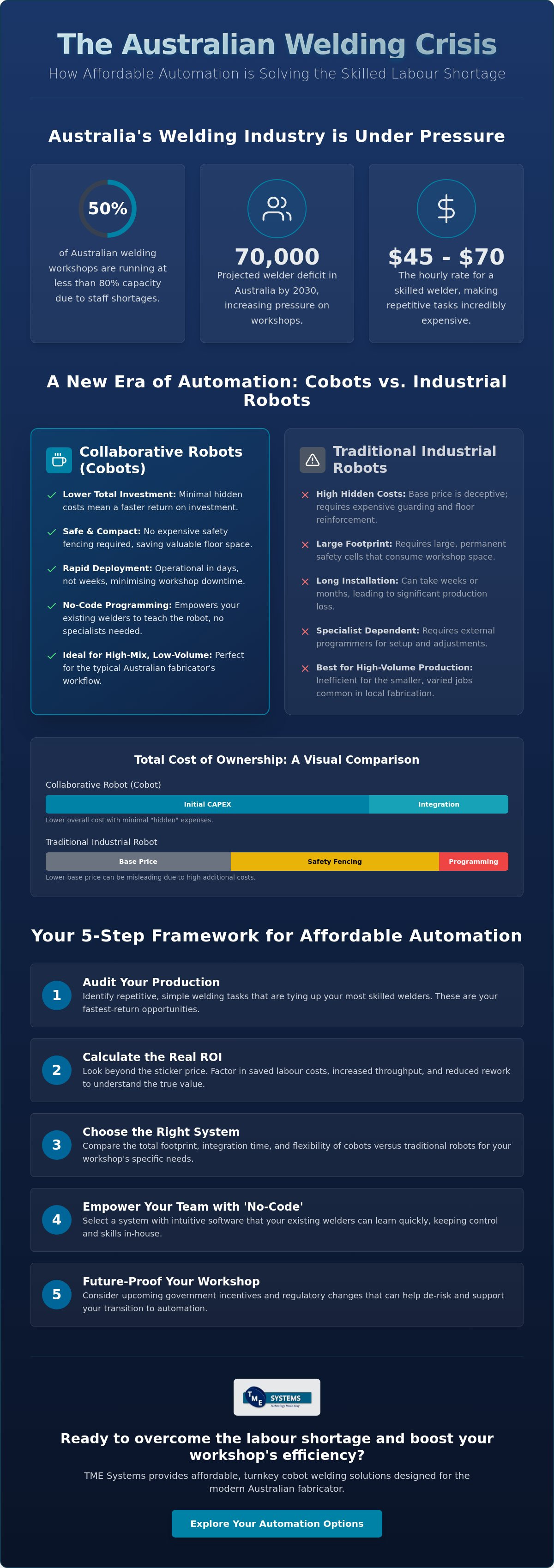

Did you know that half of Australia's welding workshops are currently running at less than 80% capacity simply because they can't find the staff? With a projected deficit of 70,000 welders by 2030, the pressure on your workshop floor isn't just a phase; it's a structural shift in how our industry operates. It's frustrating to watch potential profits slip away while you're battling rising labour costs and the constant hunt for reliable, ticketed welders.
You might feel that robotics are only for the big players with massive budgets, but affordable welding automation has finally become a reality for the local fabricator. This guide is designed to help you lower the barriers to entry for robotic welding without sacrificing quality or breaking the workshop budget. We'll show you how "no-code" simplicity is changing the game by letting your existing team take control, while also exploring how upcoming regulatory changes and government incentives can help you de-risk the transition to a more efficient workshop.
Key Takeaways
- Learn why affordable welding automation in 2026 is no longer just for high-volume production but is now a viable tool for smaller, high-mix Australian workshops.
- Compare the capital expenditure and floor space requirements of collaborative robots versus traditional industrial systems to find the best fit for your workshop floor.
- Master the art of calculating real ROI by looking beyond the initial sticker price and factoring in local labour rates and long-term operational savings.
- Discover a practical five-step framework for auditing your current production and identifying which parts will deliver the fastest returns on investment.
- Understand how no-code teaching software empowers your existing team to manage robotics without the need for specialist programming experts.
Redefining Affordable Welding Automation for the Australian Workshop
In the past, "affordable" was often a polite way of saying "cheap and limited." For an Australian fabricator in 2026, the definition has changed completely. True affordable welding automation isn't about finding the lowest sticker price on a piece of hardware. It's about finding a system that pays for itself by solving your biggest bottleneck: the chronic shortage of skilled hands. With local labour rates now ranging from $45 to $70 per hour, the cost of having a ticketed welder perform basic, repetitive joins is a luxury most workshops can no longer justify.
The old rule of thumb was that you only automated if you had thousands of identical parts. That logic is dead. Modern systems are designed for the "high-mix, low-volume" reality of the typical Aussie workshop. If you can automate a batch of twenty gate frames or a dozen base plates and then switch to a new job in minutes, the machine becomes a versatile tool rather than a static asset. This shift moves the focus away from "cheap" hardware toward high-value integrated systems that actually get used every day instead of gathering dust in the corner of the shed.
The Shift from Industrial Robots to Collaborative Cells
Traditional industrial robots are impressive, but they often come with hidden costs like safety fencing, specialised floor reinforcements, and complex integration. Robot welding has evolved into the era of the collaborative robot, or "cobot." These units act as a workshop tool rather than a standalone machine. Because they are designed to work safely alongside your team, you save on the "footprint cost" of your shop floor. Turnkey collaborative cells have lowered the entry price point for local manufacturers by eliminating the need for bespoke engineering and long setup times.
Why 'No-Code' is the Secret to Real Affordability
Programming used to be the hidden killer of ROI. If you have to pay an external specialist $150 an hour to tweak a weld path every time a part design changes, your "affordable" robot becomes a money pit. This is where no-code robot welding software changes the math. It allows your existing welders to "teach" the robot by simply moving the arm to the start and end points. This reduces the "cost of curiosity," making it easy and profitable to try the robot on new, smaller jobs without risking downtime or expensive programming errors. Your team stays in control, and the machine simply amplifies their existing trade skills.
Cobots vs. Industrial Robots: A Value Comparison for Fabricators
Choosing between a traditional industrial robot and a collaborative robot (cobot) isn't just about the robot arm itself. It's about the total investment required to get that first arc struck. Traditional industrial robots are built for raw speed and heavy-duty cycles, making them ideal for high-speed automotive lines. However, for the majority of Australian workshops, the real path to affordable welding automation lies in the cobot. While an industrial robot might have a lower base price in some instances, the "hidden" costs of guarding, light curtains, and specialised floor reinforcements quickly add up.
Cobots are designed with force-sensing technology that allows them to work safely alongside your team. This eliminates the need for expensive, permanent safety cells that eat up valuable floor space. In a local shop where every square metre of the shed counts, the "footprint cost" of a massive fenced-in robot can be a deal-breaker. By choosing a system that doesn't require a fortress around it, you maintain a flexible workshop layout and keep your initial capital expenditure (CAPEX) focused on the welding technology rather than the fencing.
Installation and Integration Timelines
A traditional industrial setup can take weeks or even months of site preparation and specialist programming before it produces a single part. Cobots are often up and running in just a few days. This reduction in downtime is critical because every day your shop floor is disrupted is a day of lost production. To make this transition even smoother, working with welding system integration specialists can ensure the cell fits your specific workflow from day one, avoiding the "opportunity cost" of a botched DIY setup.
Long-term Maintenance and Skill Requirements
Industrial robots typically require high-paid, specialised technicians for even minor adjustments or troubleshooting. This adds a layer of ongoing cost that many small fabricators aren't prepared for. Cobots empower your current staff to handle the machine. Because the software is intuitive, your ticketed welders can manage the system themselves. This is a vital advantage given the current welding skills shortage, as it allows you to maximise the "arc-on" time of your existing team without hiring extra IT support. If you want to see how these systems handle your specific parts, you might consider booking a mobile demo system visit to your own workshop to test the flexibility firsthand.
Calculating the Real ROI: Beyond the Sticker Price
The biggest mistake a workshop owner can make is looking at the initial invoice as the final cost of a system. Calculating the true return on investment for affordable welding automation requires a shift in perspective toward Total Cost of Ownership (TCO). You have to look at what that machine saves you over five years, not just what it costs today. In Australia, where labour rates for a skilled welder sit between $45 and $70 per hour, every minute spent on a repetitive fillet weld is a high-cost activity. If a cobot can handle those standard runs, your ticketed welders are free to focus on the complex, high-value projects that actually grow your margins.
The rework factor is another silent profit killer in many local sheds. Manual welding, especially toward the end of a long shift, is subject to human fatigue. A missed weld or a bit of slag that requires heavy grinding doesn't just waste time; it consumes consumables and electricity. Automation delivers "right-first-time" quality that virtually eliminates the need for the "grinder and paint" approach to fabrication. When you factor in the value of consistent, high-quality output, the payback period for a welding cell often drops significantly faster than most owners expect.
The 'Invisible' Savings of Automation
Precision is where the hidden money is found. A robot uses the exact amount of gas and filler metal required for the joint, no more and no less. Over a year of production, these small savings on consumables add up to thousands of dollars. There is also the human element to consider. By automating the dull and dirty jobs, you reduce the physical strain on your best workers. This leads to lower staff turnover and fewer injury claims, which is a massive win in a market where finding a replacement welder is nearly impossible.
Financing and Government Incentives in Australia
The National Robotics Strategy highlights how automation is becoming central to our sovereign manufacturing capability. This focus has opened doors for various funding pools, such as the Industry Growth Program and the NSW Advanced Manufacturing Fund, which offer grants ranging from $50,000 to $5 million for innovative SMEs. Financing your cell through a lease can also help manage cash flow, allowing the machine to effectively pay for its own monthly instalment through the labour savings it generates. If you're still on the fence, a mobile demo system is a great way to de-risk the decision by seeing exactly how the tech performs on your floor before committing to a purchase.
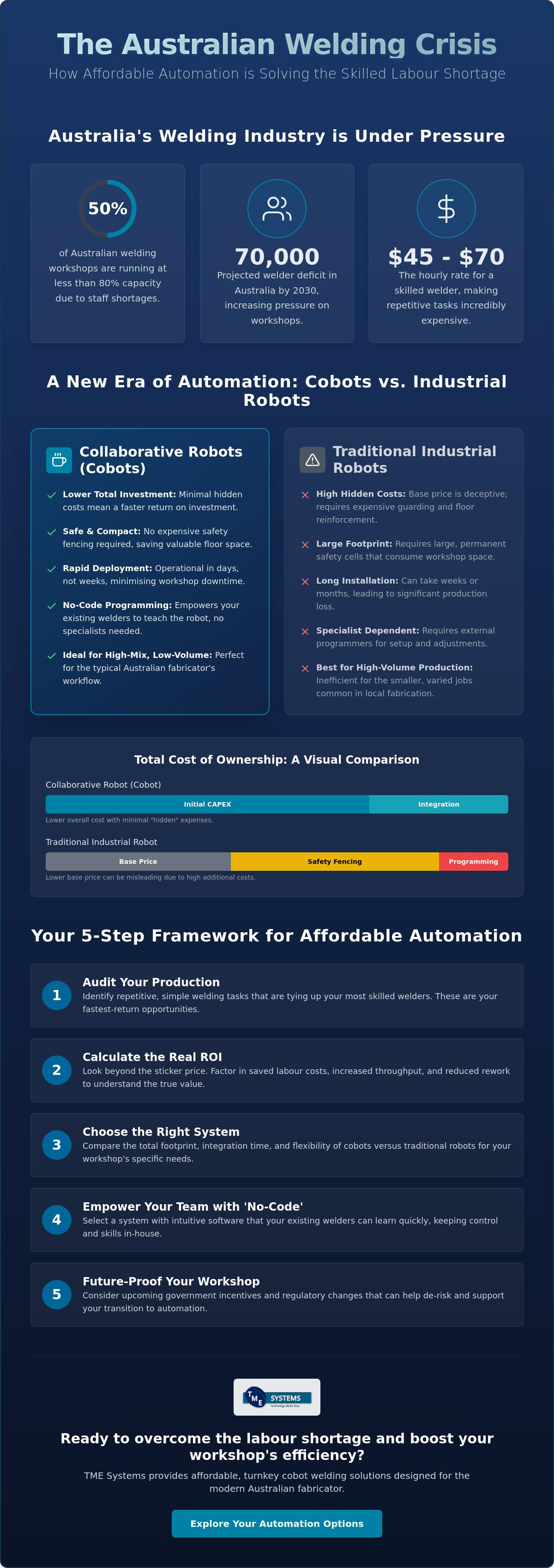
A 5-Step Framework for Choosing an Affordable Welding Cell
Moving from manual processes to robotics can feel like a massive leap for a local fabrication business. However, the process becomes much more manageable when you break it down into logical steps. Success in affordable welding automation isn't about buying the most expensive arm on the market; it's about choosing a system that fits your specific workflow and team. This framework helps you filter out the noise and focus on the practicalities of the workshop floor.
Selecting Your First Automated Part
The biggest mistake is trying to automate your most complex job first. Instead, you should look for the "low-hanging fruit" that will give you an immediate win and build your crew's confidence. Low-hanging fruit for automation are parts with high repeatability and low geometric complexity. Think about those simple base plates, standard brackets, or repetitive sub-assemblies that currently tie up your best welders for hours. To measure the success of the transition, record your manual "arc-on" time and total assembly time for a specific batch before the robot arrives. Once the system is integrated, compare these figures to see the direct impact on your throughput.
Once you've identified the right parts, you need to evaluate the software interface. Is it truly no-code, or is it just "low-code" masquerading as simple? A truly affordable system allows a welder to teach a new path in minutes without touching a single line of script. If your team has to call a programmer every time a jig moves slightly, the hidden costs will quickly erode your savings. You want a system that stays in the hands of the people who know the metal best.
The Importance of Local Australian Support
There is a real danger in buying "cheap" imported robots that arrive in a crate with no local backup. What happens when you have a technical question on a Tuesday morning and your production line has ground to a halt? Real affordability includes the peace of mind that comes with local expertise. Look for an Australian partner who provides operator training and onboarding in plain English, right there on your workshop floor. This ensures your team isn't just watching a video, but actually getting hands-on experience with the equipment they'll be using daily.
Finally, assess the integration and the human factor. A high-value cell should work seamlessly with your existing MIG or TIG power sources rather than forcing you to buy all-new gear. When it comes to onboarding, involve your senior welders early in the process. Show them that the robot is a tool designed to take over the dull, back-breaking work, leaving them free to apply their high-level skills to the specialised projects that require a human touch. This collaborative approach ensures the new technology is welcomed as a partner rather than a threat.
Future-Proofing Your Workshop with TME Systems Pty Ltd
Investing in new technology is a significant decision for any workshop owner. At TME Systems Pty Ltd, we understand that "affordable" doesn't mean finding the lowest price tag; it means finding the highest value for every dollar spent. Our approach to affordable welding automation centres on high-value integration that fits into your existing workflow without requiring a complete overhaul of your shop floor. We focus on providing tools that solve the immediate labour crisis while building a foundation for long-term growth.
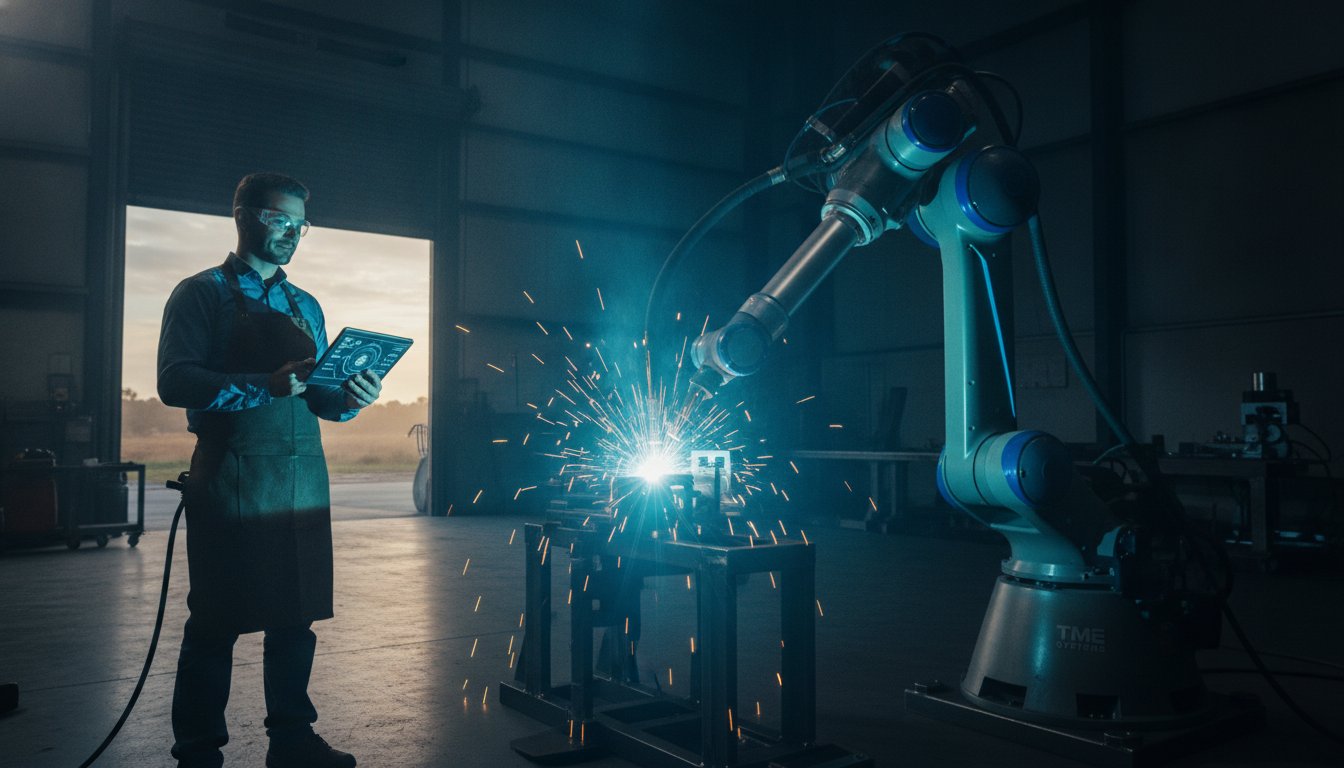
Our collaborative robot welding cells are designed specifically for the Australian fabrication environment. We know that local sheds often deal with limited space and a high variety of short-run jobs. By using systems that don't require massive safety cages or permanent floor fixings, we help you maintain the flexibility your business needs to stay competitive. This isn't about replacing your skilled tradespeople. It's about giving them a precision tool that handles the repetitive work, allowing them to apply their ticketed expertise where it matters most.
Our Pragmatic Approach to Automation
We don't just ship a crate to your door and wish you luck. TME Systems Pty Ltd integrates solutions that are ready to work from day one. Our team takes a hands-on role in ensuring the technology adapts to your operators, not the other way around. Through comprehensive operator training and onboarding, we make sure your senior welders feel empowered and confident using the no-code teaching software. This local, supportive approach ensures that your investment meets Australian manufacturing standards and delivers the results you expect without the headaches of unsupported imports.
The power of our no-code teaching software lies in its simplicity. It removes the technical barriers that often make automation feel intimidating. Your team can refine weld paths, adjust parameters, and switch between different parts in minutes. This ease of use is what makes the system truly affordable over the long run, as it eliminates the need for expensive external programming support every time a new job comes through the door.
Book Your On-Site Demonstration
The best way to understand how this technology fits your workshop is to see it in person. We offer a mobile demo system that brings the robot directly to your floor. This allows you to see the system working on your actual parts and provides a clear, real-world estimate of your potential ROI based on your specific production data. It is the most effective way to de-risk the transition and ensure the system is the right fit for your crew. Book a mobile welding robot demonstration today and take the first step toward a more productive, future-proof workshop.
Equipping Your Workshop for the Road Ahead
Transitioning to robotics isn't a luxury for the big players anymore; it's a practical necessity for any Aussie workshop looking to stay competitive. By focusing on high-value integration and "no-code" simplicity, you can reclaim your workshop's capacity and support your existing crew without breaking the bank. We've shown that affordable welding automation is truly found in systems that your team can master in days, not months. It's about choosing tools that work as hard as you do.
As an Australian-owned and operated partner, we're here to help you navigate this shift with expert no-code software integration and specialised operator onboarding programs. We're committed to making sure the technology fits your floor and your people perfectly. If you're ready to see how these systems handle your specific parts, Book a Mobile Demo to see affordable automation in your workshop. There's no better way to de-risk your investment than seeing it strike an arc in your own shed. You've built a great business; let's give it the tools to go even further.
Frequently Asked Questions
Is robotic welding automation really affordable for a small job shop?
Yes, it's highly affordable for small shops because modern systems are built for high-mix, low-volume work rather than just massive production lines. By filling the gap left by the projected 70,000-welder deficit in Australia, affordable welding automation allows you to take on more work without increasing your headcount. It turns a one-person job into a high-output station, making the most of your existing workshop floor.
Do I need a specialised programmer to run a welding cobot?
No, you don't need a computer expert or a programmer to manage a modern collaborative cell. These systems use intuitive interfaces that allow your ticketed welders to "teach" the robot by manually moving the arm to the required weld points. This keeps technical control in the hands of your tradespeople and eliminates the need for expensive external consultants every time a job changes.
How long does it typically take to see a return on investment (ROI)?
Most Australian fabricators see a full return on their investment within 12 to 24 months. This timeline is driven by the high local labour rates of $45 to $70 per hour and the significant reduction in grinding and rework. When the machine strikes a perfect arc every time, the savings on consumables and labour costs quickly stack up to cover the initial purchase price.
Can a welding cobot handle both MIG and TIG processes?
Yes, collaborative robot cells are versatile enough to handle both MIG and TIG welding applications. While MIG is the go-to for many structural and batch jobs, TIG automation is perfect for stainless steel or aluminium projects that require high-quality aesthetics. The system integrates with your chosen process to deliver consistent travel speeds and torch angles that are difficult to maintain manually over long shifts.
What kind of safety guarding is required for an affordable cobot cell?
Cobots generally require much less guarding than industrial robots because they feature built-in force-sensing technology to stop upon contact. While you still need to protect workers from the welding arc and fumes, you often don't need the massive, permanent safety cages required for traditional robots. This significantly lowers your setup costs and allows the cell to fit into tighter spaces on your workshop floor.
How does no-code software differ from traditional robot programming?
No-code software replaces complex text-based scripting with a visual, "lead-through" teaching method. Traditional programming requires specialised training and hours of typing code to set a single path. In contrast, no-code software makes affordable welding automation possible by letting a welder set a new path in minutes. It simplifies the interface between the human operator and the machine, making the technology feel like just another tool.
Can I use my existing welding power source with a new robotic cell?
Yes, many collaborative cells are designed to be "agnostic," meaning they can integrate with the MIG or TIG power sources you already own. This is a pragmatic way to lower the barrier to entry because you don't have to buy an entirely new welding plant. It allows you to upgrade your workshop's capability while continuing to use the gear your team is already comfortable with.
What happens if the robot breaks down—is there local support in Australia?
Local support is a critical part of the package when you partner with an Australian-owned specialist. You get access to on-site operator training and technical troubleshooting delivered in plain English. This ensures that if you have a question on a Tuesday morning, you aren't waiting for a response from an overseas time zone. Reliable local backup is what keeps your production moving and your investment protected.