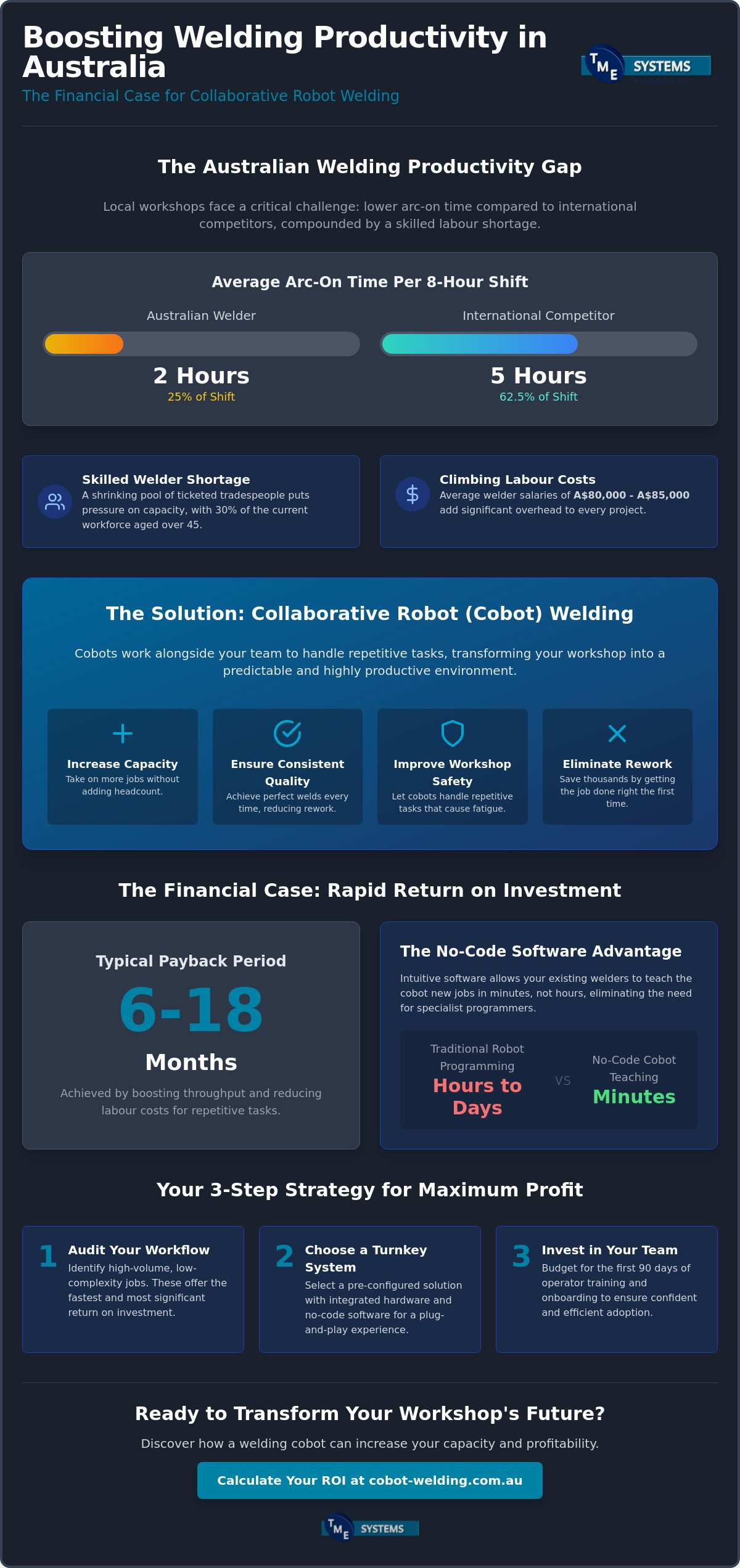

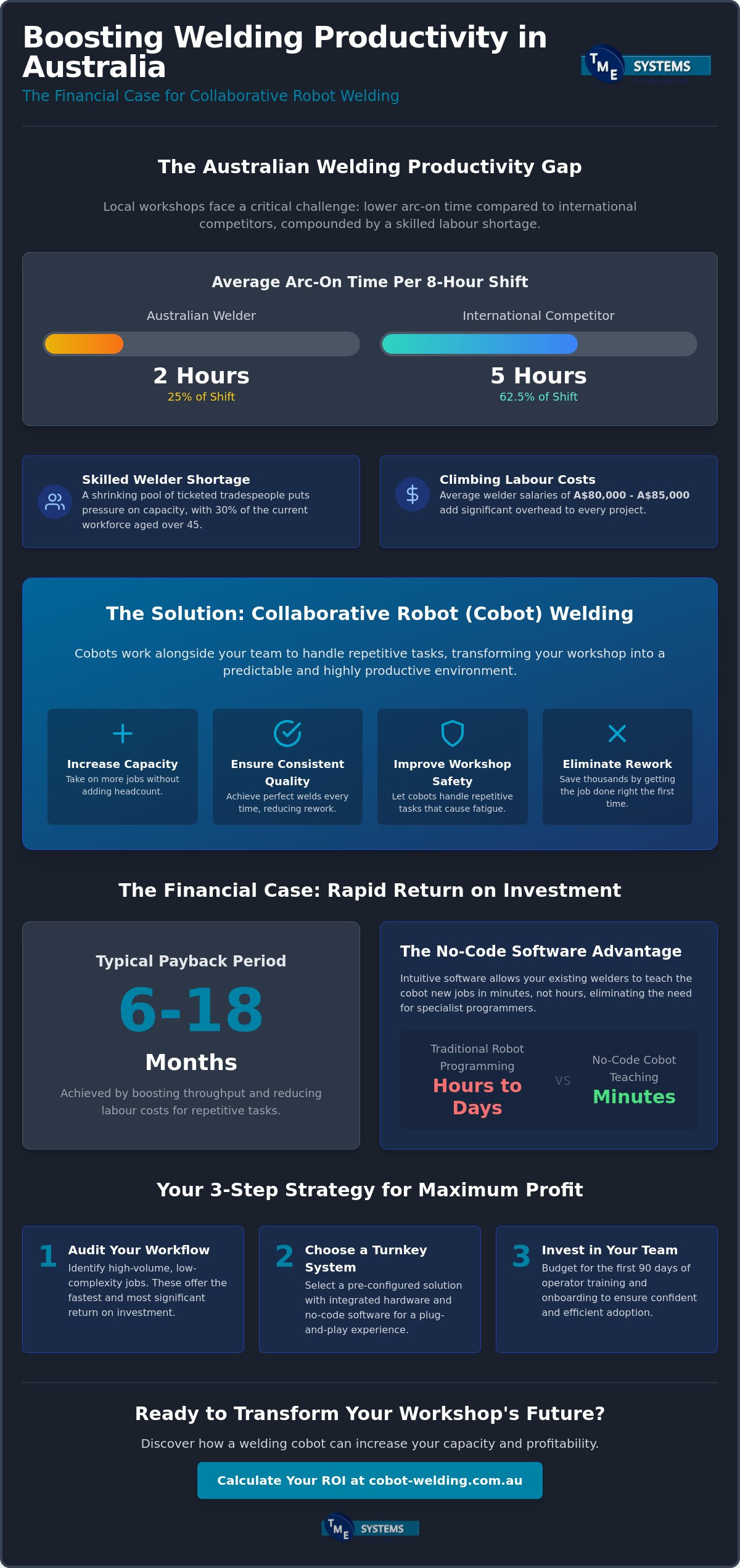
Did you know that the average arc-on time for a welder in Australia is just two hours per shift? While international competitors often reach five hours, many local workshops are struggling to keep the torch lit amidst a chronic shortage of ticketed tradespeople and labour costs that continue to climb. It's a frustrating reality for fabricators who want to grow but feel restricted by their current output and a lack of clear cobot welding productivity metrics to guide their next move. If you're tired of seeing expensive rework eat into your margins or turning down quotes because the team is stretched too thin, you aren't alone.
The good news is that automation doesn't have to be a complex or intimidating leap. By focusing on the right data, you can build a clear financial case for bringing a collaborative partner onto your workshop floor. This guide will show you exactly how to calculate the payback period for a welding cobot and why no-code software is the secret to achieving a faster return on investment in Australian workshops. We'll explore how to increase your capacity and speed up your quoting process without the need for a single extra headcount.
Key Takeaways
- Learn how to calculate a realistic payback period for your workshop by looking beyond the initial sticker price to include long-term labour savings and increased throughput.
- Discover how no-code teaching software eliminates the "programming tax," allowing your existing team to set up new jobs in minutes rather than hours.
- Identify the essential cobot welding productivity metrics that matter most for Australian fabricators, including arc-on time improvements and rework reduction.
- Understand how automation addresses the chronic skilled welder shortage while improving workshop safety and ensuring consistent weld quality.
- Get a step-by-step approach to auditing your current workflow to find the high-volume, low-complexity jobs that offer the fastest path to profitability.
Understanding Cobot Welder ROI in the Australian Manufacturing Landscape
In Australia, the conversation around automation has shifted from "maybe one day" to "we need it now." By 2026, the convergence of rising labour rates and a shrinking pool of ticketed tradespeople has created a tipping point. For many local workshops, calculating Return on Investment (ROI) is no longer a simple matter of comparing a machine's price tag against a year's wages. It's about survival and growth. While traditional Robot welding systems were once the domain of massive automotive plants, collaborative systems (cobots) have brought this technology to the family-run fabrication shop. These systems don't require safety cages or complex coding; they work alongside your team to handle the heavy lifting of repetitive production runs.
The True Cost of the Skilled Welder Shortage
With average welder salaries in Australia now ranging between A$80,000 and A$85,000, the cost of human labour is a significant factor in every quote you send. However, the real drain on your bank account isn't just the weekly payroll. It's the contracts you're forced to turn away because you don't have the staff to man the bays. This opportunity cost is a silent killer of profitability. With roughly 30% of the existing welding workforce aged over 45, the pressure to find reliable talent is only increasing. A cobot doesn't replace these skilled workers. It supports them by taking over the repetitive runs that lead to physical fatigue. This stability reduces staff turnover and ensures your workshop remains a productive environment even when the local labour market is tight.
Why Payback Period is Only Half the Story
Most owners focus on the "payback period," which often lands between 6 and 18 months for a well-utilised cell. While that's a strong financial justification, it's only half the story. You need to look at cobot welding productivity metrics that track capacity rather than just cost. Are you getting more quotes out the door because you know exactly how long a run will take? Are you saving thousands each month by eliminating the rework associated with inconsistent manual seams? Moving from a cost-centre mindset to a capacity-builder perspective changes how you view your floor. It turns your workshop from a place that's always "flat out" into an organised production line with predictable timelines. This reliability strengthens your client relationships and allows you to bid on larger, more lucrative projects with confidence. As you scale up to handle these larger contracts, you can check out ML Traffic Engineers Australia to ensure your facility's transport and traffic planning is ready for the increased volume.
Essential Productivity Metrics: Measuring More Than Just Arc-On Time
When you start looking at automation, it's easy to get fixated on the price of the robot arm itself. However, the arm is just one part of a larger system. To get an accurate picture of your cobot welding productivity metrics, you need to account for the entire setup. This includes the power source, the torch, safety sensors, and the table it sits on. If you try to piece these together yourself, you'll often find that the time spent on troubleshooting and integration far outweighs any initial savings. A pragmatic approach involves looking at the "all-in" cost to ensure there are no surprises once the equipment hits your floor.
Hardware, Software, and Integration: What is in the Box?
A turnkey collaborative robot welding cell simplifies the transition by providing a pre-configured solution. Instead of worrying about whether your power source communicates correctly with the robot, you get a system that's ready to work from day one. High-quality no-code software is a critical part of this package. It's the difference between needing a specialist programmer and having your existing team set up a new job in ten minutes. Budgeting for the first 90 days is also vital. This period should cover operator training and onboarding to ensure your team feels confident and supported as they adjust to the new workflow. Investing in a mobile demo system can help your team visualise this integration before the permanent cell is installed.
Ongoing Costs: Maintenance and Power Consumption
Operating a cobot is surprisingly cost-effective. Unlike heavy industrial robots that require massive amounts of power and specialised three-phase setups, most cobots are highly energy-efficient. For industrial facilities looking to align these workshop efficiencies with a broader sustainability strategy, Super Smart Energy offers specialised consultancy in energy optimisation and decarbonisation. Your consumable usage, including wire, gas, and tips, will actually become more predictable. Because the robot follows a precise path every time, you'll see significantly less waste than you would with manual welding. Regular maintenance is straightforward but essential. A simple annual schedule ensures 99% uptime, keeping your production lines moving without unexpected stoppages or expensive emergency repairs.
To further enhance your facility's resilience and manage long-term power requirements, you can learn more about Foton Energy (Foton Pty Ltd) and their energy storage infrastructure solutions designed for Australian industry.
Beyond energy storage, the broader trend of facility automation includes smart environmental controls; if you are looking for inspiration on how to modernise your building's interface, you can learn more about Rocatech and their range of intelligent automation solutions.
Choosing between a DIY approach and a professional integration comes down to how you value your time. While a DIY project might look cheaper on paper, the hidden hours spent on floor reorganisation and technical hurdles often lead to a much slower return. A professional system integration ensures that the cell is optimised for your specific workshop layout from the start. This allows you to bypass the "tinkering" phase and move straight into production, which is where the real financial gains are made. By focusing on these broader metrics, you can ensure your investment delivers the capacity boost your workshop needs.
The No-Code Advantage: Reducing Setup Time and Time-to-First-Weld
Traditional automation often carries a hidden burden known as the "Programming Tax." In many industrial setups, if you want to change a part, you need a specialist to rewrite lines of code. For an Australian fabrication shop running small batches, this tax kills the business case for robotics before the first arc is struck. If it takes four hours to program a job that only takes two hours to weld, you'll naturally stick to manual methods. This is why no-code robot welding software is such a vital tool for local workshops. It replaces complex syntax with intuitive touch-points, allowing your team to "teach" the robot by simply moving the arm to the start and end points.
Reducing Setup Time for Small Batch Runs
When evaluating your cobot welding productivity metrics, the "Time-to-First-Weld" is arguably the most important figure on the sheet. This metric measures the gap between deciding to run a new part and the moment the torch starts moving. In a high-mix production environment, rapid job switching is the only way to maintain a high utilisation rate. Imagine the difference in your weekly output if setup time drops from one hour down to just five minutes. That efficiency allows a single cobot cell to handle 5 to 10 different part types in a single shift. It transforms the robot from a single-purpose tool into a versatile workshop assistant that can keep up with a fast-moving quote schedule.
Empowering Existing Staff Without Programming Degrees
One of the biggest fears in any workshop is that new technology will be too complicated for the current team. No-code systems solve this by keeping the focus on welding expertise rather than computer science. Your best manual welders already know about travel speeds, angles, and heat input. They are the perfect candidates to become Robot Supervisors. Instead of spending weeks in a classroom, most operators can master the basics in a single afternoon of training. It's a supportive way to bring your team into the future of manufacturing without making them feel obsolete.
This transition does more than just boost output; it improves morale. By removing the physical drudgery of long, repetitive seams, you're helping to retain your best tradespeople. They get to use their skills on the challenging, high-value jobs while the cobot maintains a consistent pace on the standard production runs. It's a pragmatic way to scale your capacity without needing to hunt for external robotics consultants or software engineers. You're simply giving your existing staff better tools to do what they already do best.
Quantifying the Intangibles: Quality, Safety, and Capacity Metrics
While direct labour savings are easy to track, some of the most significant financial gains come from areas that fabricators often label as "intangibles." In reality, these factors are highly measurable. Consider your arc-on time. In a typical Australian workshop, a manual welder might only be striking an arc for about two hours of an eight-hour shift due to fit-up, cleaning, and fatigue. When you integrate automation, that efficiency can jump from 20% to as high as 80%. This massive leap in cobot welding productivity metrics doesn't just mean more parts; it means your fixed overheads are spread across a much larger volume of finished work.
Workplace Health and Safety (WHS) is another area where the benefits are concrete. By moving the operator away from the immediate weld plume and intense UV exposure, you're actively reducing the long-term health risks associated with the trade. This isn't just about being a supportive employer. It's about smart risk management. Reducing your workshop's exposure to injury claims and potentially improving your standing with insurers like WorkCover can have a direct impact on your bottom line. A safer floor is almost always a more profitable floor.
Eliminating Rework and Material Waste
The cost of a single rejected weld on a high-pressure job is staggering. You aren't just losing the wire and gas; you're losing the labour time to grind it out and the opportunity cost of the booth being tied up. Cobots provide a level of consistency that manual welding simply can't match over a full shift. This precision allows for tighter tolerances and significantly reduces the time your team spends on post-weld cleaning and grinding. When your parts come off the table ready for dispatch, your turnaround times shrink and your profit per part grows. You'll also see material savings through precise control of gas flow and wire feed, ensuring you only use exactly what the job requires.
Achieving this level of precision in fabrication is not unlike the discipline required in high-stakes financial environments. If you are interested in applying similar analytical rigor to the financial markets, you can visit Traders4Traders to learn about their elite trader development programs.
Expanding Your Bidding Power for Larger Contracts
Capacity is the engine of growth. Many local shops stay small because they can't find the staff to take on bigger projects. With a cobot cell, you can scale your production up for major contracts without the traditional hiring headache. Tier 1 clients and government projects increasingly look for "Modern Manufacturing" capabilities when vetting suppliers. Showing that you've invested in collaborative robot welding cells demonstrates that your workshop is reliable, technologically advanced, and capable of meeting strict delivery schedules. It allows you to lower your bid price to stay competitive while actually maintaining healthier margins than your manual-only rivals.
To complement your increased workshop capacity, ensuring your business is discoverable by new clients is vital. Partnering with Tools N Tactics | Local SEO & Digital Marketing Solutions can help your firm secure a prime spot in search results, making it easier to attract the large-scale contracts that drive long-term growth.
Implementing Your Cobot Strategy for Maximum Workshop Profit
Success with automation isn't just about the hardware you buy; it's about how you integrate it into your daily operations. To see a real return, you need a clear plan that starts with a thorough audit of your current workflow. Don't try to automate your most complex, one-off custom job first. Instead, look for the repetitive tasks that currently tie up your most skilled workers. By establishing a baseline of your manual welding time versus the expected automated time, you can create a realistic set of cobot welding productivity metrics to track your progress. Starting with a pilot project allows your team to build confidence and refine their processes before you scale up to more complex tasks.
Identifying the High-Impact Jobs in Your Workshop
Most workshops find that the 80/20 rule applies to their production; roughly 20% of your parts likely consume 80% of your team's welding time. These high-volume, repetitive components are your "low hanging fruit." When selecting your first automated jobs, focus on parts with simple geometries and long, straight seams. These are the best candidates because they offer the fastest setup times and the most predictable results. By moving these "boring" welds to a cobot, you free up your tradespeople to focus on the intricate, custom work that requires their years of experience and problem-solving skills.
Partnering with TME Systems Pty Ltd for a Seamless Transition
Transitioning to automation is a journey, and you don't have to walk it alone. Partnering with an Australian specialist who understands the local manufacturing environment ensures that your integration plan is tailored to your specific workshop layout and safety requirements. One of the best ways to de-risk the investment is through a mobile welding robot demonstration. Seeing the system operate on your own floor, with your own parts, provides the steady confidence needed to make an informed decision.
A customised integration plan goes beyond just dropping a machine on your floor. It includes operator training and onboarding to ensure your staff are ready to take the reins from day one. Ongoing support is equally critical; having a local partner means you have access to technical advice and maintenance that keeps your cobot welding productivity metrics trending in the right direction. This end-to-end relationship ensures that your investment remains a profitable, capacity-building asset for the long term; for instance, as your workshop adopts more digital tools, you can explore Cyber security with Aspire Computing to safeguard your operational data.
Take the Next Step Toward Smarter Fabrication
Securing the future of your workshop in a competitive Australian market requires a shift from reactive problem-solving to proactive capacity building. By tracking the right cobot welding productivity metrics, you can transform your floor into a predictable production environment where quality is consistent and rework is virtually eliminated. We've explored how no-code software removes the traditional "programming tax," allowing your current team to manage automation without needing external specialists.
TME Systems is an Australian-owned and operated specialist dedicated to making this transition seamless. We provide the no-code software expertise, end-to-end integration, and operator training necessary to ensure your investment pays off quickly. It's about giving your skilled tradespeople the tools they need to stay ahead of the curve. Calculate your workshop’s potential with a TME Systems Mobile Demo and see the difference on your own floor. The path to a more profitable, scalable workshop is ready when you are.
Frequently Asked Questions
What is the typical payback period for a cobot welder in Australia?
Most Australian fabricators see a full return on investment within 6 to 18 months. This rapid payback is driven by high local labour rates and the ability to significantly increase arc-on time per shift. When you factor in the reduction of rework and the ability to take on more contracts without adding headcount, the financial justification becomes quite clear for most small to medium enterprises.
Can a cobot welder really handle small batches profitably?
Small batches are actually where cobots shine when paired with no-code software. Because you can teach a new part in minutes rather than hours, the programming tax that usually kills automation for short runs is eliminated. This flexibility allows your workshop to remain profitable even when handling high-mix, low-volume production schedules that would be too expensive for traditional industrial robots.
How much does a collaborative robot welding cell cost initially?
The initial investment for a collaborative robot welding cell depends on the specific hardware, software, and level of integration your workshop requires. A complete package typically includes the robot arm, a dedicated welding power source, safety peripherals, and intuitive teaching software. While costs vary based on your needs, the focus should be on the total cost of ownership and how quickly the system adds capacity to your floor.
Do I need a robotic engineer to programme the cobot?
You don't need a specialised robotics engineer to operate or programme these systems. Modern no-code teaching software is designed for your existing ticketed welders to use. Most operators can learn to set up new jobs in a single afternoon, turning your best tradespeople into robot supervisors without requiring them to learn complex computer languages or write a single line of code.
What are the main safety requirements for cobot welding in an Aussie workshop?
Safety in Australian workshops is governed by AS/NZS 4024.1:2019 and the updated ISO 10218-2:2025 standards. Even though cobots are designed to work alongside humans, a comprehensive risk assessment is a legal requirement under WHS law. This assessment must consider the welding arc, fumes, and the specific layout of your workshop to ensure a compliant and safe environment for all staff.
How does a cobot welder impact my insurance or WHS obligations?
Implementing automation can positively impact your WHS profile by reducing worker exposure to hazardous fumes and intense UV radiation. By moving the operator further from the arc, you're mitigating long-term health risks and physical strain. Documenting these improvements and adhering to Australian safety standards can help demonstrate a lower risk profile to your insurance providers and WorkCover, potentially lowering your premiums.
Can I use my existing welding power source with a new cobot arm?
It's often possible to integrate an existing power source, but a turnkey cell usually offers better performance through seamless communication between the arm and the welder. Using a matched system ensures that your cobot welding productivity metrics remain high by providing precise control over every weld parameter. A professional integration specialist can help determine if your current gear is suitable for a reliable automation setup.
What happens if my production needs change in six months?
Cobots are incredibly flexible and can be redeployed to different parts of your workshop as your production needs evolve. Unlike traditional fixed automation, a cobot can be reprogrammed for a new job in minutes or moved to a different bay if you're using a mobile base. This adaptability ensures your investment remains useful and profitable even if your product mix or project volume changes completely over time.