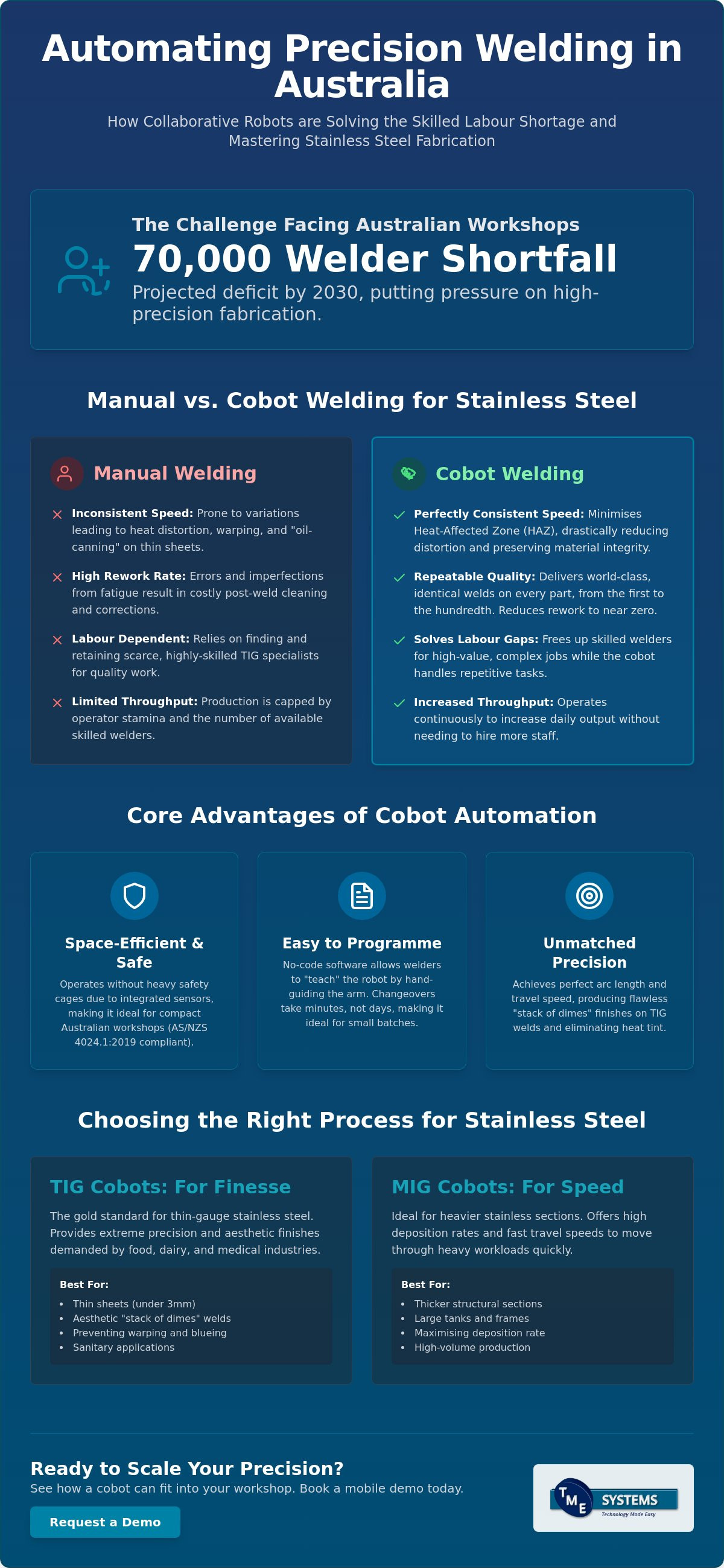

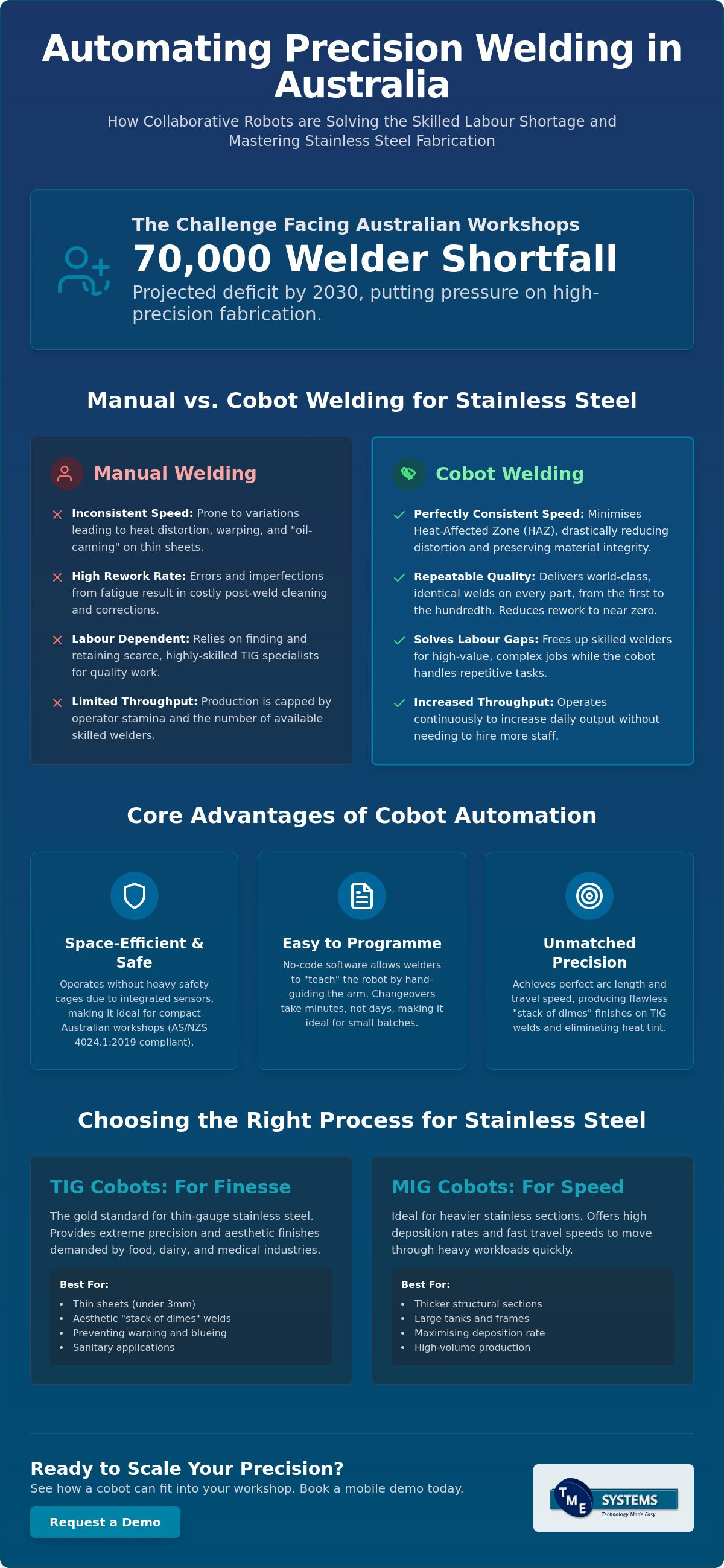
Australia is projected to face a deficit of 70,000 welders by 2030; a reality that hits hardest in high-precision shops where TIG specialists are becoming harder to find. If you're managing a workshop, you likely feel the pressure of maintaining quality while your most skilled staff are stretched thin. Implementing cobot welding stainless steel into your production line isn't just about modernising; it's a practical way to manage the high rate of rework caused by distortion on thin sheets and the difficulty of finding reliable labour for repetitive tasks.
We understand that for an Australian fabricator, every millimetre and every minute counts. This guide explains how collaborative robots can help you capture the finesse of a master welder and replicate it across every batch, even for small-to-medium runs. You'll learn how to achieve consistent, world-class finishes that reduce post-weld cleaning time and increase your daily throughput without needing to hire more staff. We'll cover everything from meeting local safety standards like AS/NZS 4024.1:2019 to choosing mobile systems that fit into your current workshop floor without a complete overhaul.
Key Takeaways
- Understand how collaborative robots operate safely without heavy safety cages, making them a space-efficient solution for compact Australian workshops.
- Learn the technical methods for managing heat and reducing distortion on thin stainless steel sheets through consistent robotic travel speeds.
- See how cobot welding stainless steel can solve labour shortages by freeing up your skilled tradespeople for high-value, complex fabrication work.
- Discover the practical requirements for a repeatable setup, from auditing your production bottlenecks to investing in the right modular jigging.
- Explore why a supportive integration and training partner is essential for moving from manual processes to seamless, high-precision automation.
What is Cobot Welding for Stainless Steel?
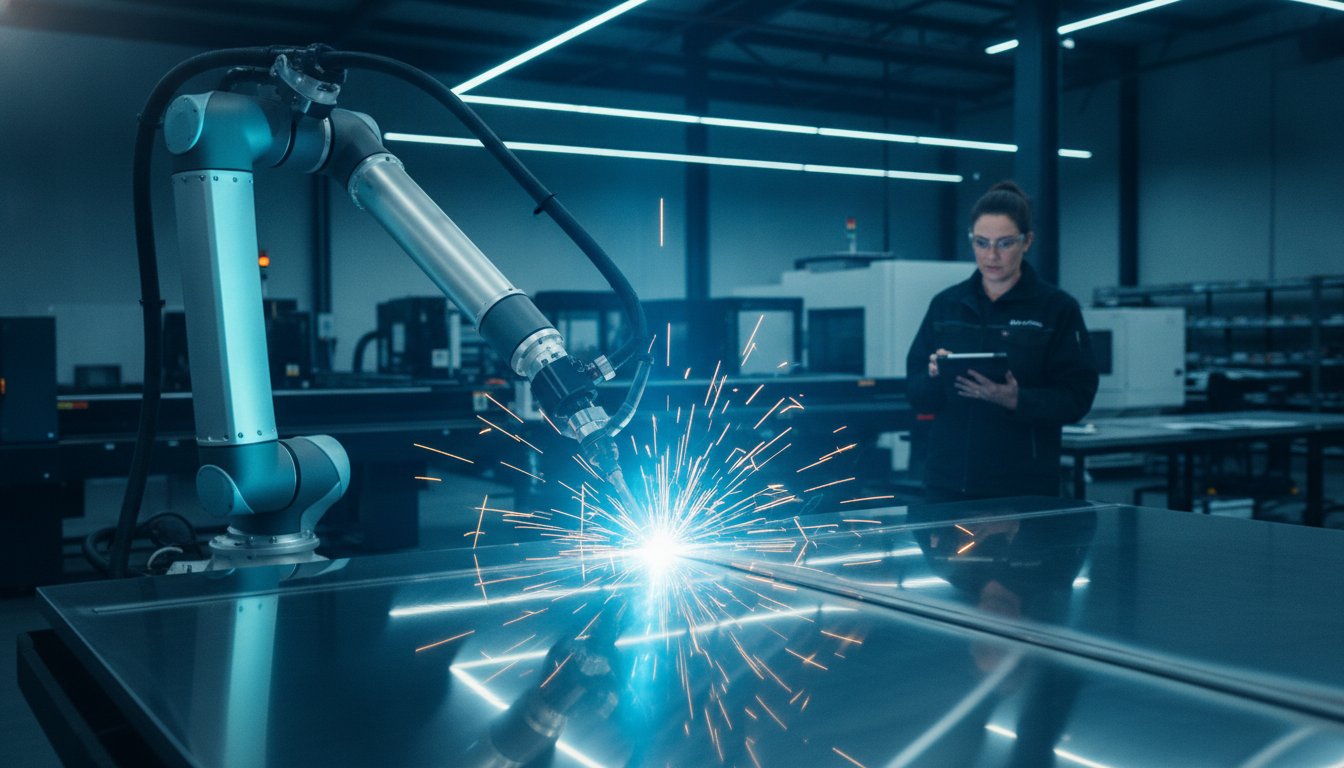
For many Australian workshops, the term "automation" used to bring to mind massive, expensive systems reserved for car manufacturers. Cobot welding stainless steel has changed that reality. At its core, this technology involves using collaborative robots (cobots) to perform precise TIG or MIG welding tasks alongside your existing team. It is a partnership where the machine handles the repetitive, high-precision passes, while the human operator provides the oversight and setup expertise. Unlike traditional robotic welding, these systems are designed to be flexible, approachable, and easy to move around a busy shop floor.
The timing for this shift is critical. Recent advances in no-code robot welding software have removed the technical barriers that once kept small-to-medium enterprises (SMEs) away from automation. You no longer need a dedicated programmer on staff to get a system up and running. If your team can weld, they can teach the robot to weld. This accessibility is a game-changer for Aussie fabricators who need to increase throughput but can't find enough skilled TIG welders to fill their shifts.
Collaborative vs. Traditional Industrial Robots
The most immediate difference you'll notice is the lack of heavy safety cages. Industrial robots are fast and powerful, but they require a significant footprint because they must be fenced off to protect workers. Cobots are built with integrated sensors that allow them to stop instantly if they contact a person or an object. This "no-cage" design is vital for compact Australian workshops where floor space is at a premium. It allows the robot to sit right next to a manual welding station without disrupting the flow of the shop.
Teaching a cobot is also a hands-on process. Instead of typing lines of code, an operator can simply "hand-guide" the robot arm along the desired weld path. You're essentially recording the movements of a master welder and then hitting "play" for the rest of the batch. This significantly lowers the total cost of ownership (TCO) because the time spent on changeovers is measured in minutes, not days. It makes automation viable even for small batches of twenty or thirty parts.
TIG vs. MIG for Stainless Automation
Choosing the right process depends entirely on your specific applications and the Australian industry standards you need to meet. For thin-gauge stainless steel used in the food, dairy, or medical sectors, TIG cobots are the gold standard. They provide the extreme precision and aesthetic "stack of dimes" finish that these industries demand. The cobot maintains a perfect arc length and travel speed, which is the best way to manage heat input and prevent the warping or "blueing" often seen with manual welding on thin sheets.
If you're working on heavier stainless sections, such as structural brackets or large tanks, a MIG cobot might be the better fit. These systems offer much higher deposition rates and faster travel speeds, allowing you to move through heavy workloads quickly. Regardless of the process, the goal is to match the automation to your workflow, ensuring that every weld meets the high-quality benchmarks your customers expect.
Mastering the Challenges of Stainless: Heat, Distortion, and Finish
Stainless steel is a temperamental material that demands respect. Unlike mild steel, its high thermal expansion and low thermal conductivity mean that heat stays trapped near the weld. For a manual welder, this often leads to warping, "oil-canning" on thin sheets, and the dreaded purple-to-black oxidation known as heat tint. Using cobot welding stainless steel allows you to move past these issues by maintaining a precise, constant travel speed that a human hand simply cannot replicate over a long shift. By keeping the torch moving at an exact pace, the cobot minimises the Heat-Affected Zone (HAZ), preserving the material's structural integrity and appearance.
Distortion is another common headache that leads to expensive rework. A cobot doesn't get bored or lose its place; it can be programmed to execute complex, staggered weld sequences. Instead of welding a long seam in one pass and watching the metal pull, the robot can jump between different sections of the workpiece to distribute heat evenly. This level of robotic precision ensures that the 100th stainless tank you produce looks and fits exactly like the first one. If you want to see how this works in a real workshop environment, you might consider booking a mobile demo system to test your specific parts.
Managing the Chromium Oxide Layer
The reason your customers choose stainless steel is its corrosion resistance, which relies on a thin, protective chromium oxide layer. If you "burn out" the alloying elements with excessive heat or poor gas coverage, that layer is compromised, and the weld will eventually rust. Recent advancements in cobot welding have focused heavily on integrating gas shielding controls that ensure the weld pool is protected at all times. Because the cobot maintains a perfect torch angle and arc length, the gas envelope remains stable, significantly reducing oxidation and the need for aggressive chemical cleaning or pickling after the job is done.
Pulse Welding and Aesthetic Control
For industries like food processing or architectural fabrication, the "stack of dimes" look is a non-negotiable standard. Achieving this finish manually with TIG welding is slow and requires a high level of skill. Cobots can be paired with high-end power sources to master pulse TIG welding, where the current fluctuates to create that uniform, rippled appearance. When combined with a controlled cold wire feed, the robot delivers a consistent volume of filler metal every time. This doesn't just look better; it drastically reduces the time your team spends on post-weld grinding and polishing. In an Australian market where labour costs are high, cutting two hours of polishing off a job can be the difference between a profitable contract and a loss.
Manual vs. Cobot Stainless Welding: Finding the ROI
The decision to automate usually comes down to a simple question: will it pay for itself? In a market where a manual welder costs between A$45 and A$60 per hour in full employment costs, the financial case for cobot welding stainless steel is becoming harder to ignore. With an all-in operating cost of just A$8 to A$15 per arc-on hour for the machine, many Australian shops report a full return on investment within 12 to 18 months. This isn't just about saving on wages. It's about eliminating the "Friday afternoon" human error that leads to expensive scrap on high-value stainless workpieces.
Consistency is where the cobot shines. A human welder might struggle to maintain focus during a long shift of repetitive seams, but a robot executes the 50th weld with the same precision as the first. This reliability allows you to optimise your team's skills. Instead of asking your best TIG specialist to spend all day on boring, straight runs, you can let the cobot handle the "grunt work." Your skilled staff can then focus on complex custom projects or troubleshooting, which adds far more value to your business. A recent case study on cobot ROI shows that some fabricators have boosted their welding production by 200% by shifting their workflow this way.
Throughput also sees a massive lift. Because cobots are designed to work safely alongside people, one operator can often supervise two separate welding cells simultaneously. This setup can effectively triple your production without adding to your headcount. Beyond the numbers, there is a significant health and safety benefit. Moving the operator further away from the immediate weld zone reduces their exposure to hexavalent chromium fumes and UV radiation, creating a cleaner and safer workshop environment.
When to Stick with Manual Welding
Automation isn't a silver bullet for every job. If your shop focuses on one-off repairs or highly irregular custom geometries that change every day, manual welding remains the most practical choice. In these scenarios, the time required for setup and jigging often outweighs the actual time spent welding. Manual welding is also essential for on-site maintenance work or installations where bringing a mobile robot cell isn't feasible. Human adaptability is still your greatest asset for "out-of-the-box" problems.
When to Deploy a Cobot
Cobots are the ideal choice for repeatable batch runs, typically ranging from 5 to 500 units. They are particularly effective for long, straight, or circular welds on items like stainless tanks or pressure vessels where perfect uniformity is required for pressure testing. If you're working with high-value materials where a single mistake can cost thousands of dollars, the robotic precision of a cobot acts as an insurance policy. It ensures that every part meets the required Australian standards without the risk of heat-induced distortion or structural failure.
Setting Up Your Stainless Cobot Cell for Success
Setting up your workshop for automation is a methodical process that doesn't require a complete factory overhaul. It begins with a practical audit of your current production line to identify the "bottleneck" stainless parts. These are usually the components that pile up while your TIG welders are tied down with tedious, repetitive seams. By targeting these specific parts first, you ensure the fastest path to a clear return on investment and immediate relief for your staff.
Once you've identified the right parts, the focus must shift to part repeatability. Success with cobot welding stainless steel depends heavily on the quality of your fixtures. If a part moves by even a millimetre between batches, the robot's programmed path won't match the joint. Investing in high-quality jigging and modular welding tables is the foundation of a successful cell. It ensures that the machine can perform its task without constant human intervention to correct alignment issues.
The Importance of Fit-Up and Jigging
When working with stainless steel, "near enough" is never good enough. Because the material is prone to warping, you need modular fixtures that keep thin sheets flat and properly aligned throughout the entire weld cycle. Good jigging removes the guesswork by ensuring every workpiece is in the exact same position every time. This consistency reduces the need for expensive and complex "seam tracking" sensors; the robot can simply follow its pre-set path with total confidence. This setup phase is where your team's fabrication expertise is most valuable, as they understand the physical constraints of the metal better than any software ever could.
Upskilling Your Current Workforce
The most successful installations are led by a "Cobot Champion." This is typically a senior welder who understands the nuances of stainless steel and can translate that knowledge into the robot's programming. By putting your best tradespeople in charge of the technology, you reframe the robot as a powerful tool rather than a job replacement. It becomes an extension of their skill, allowing them to produce more without the physical strain of manual TIG welding.
The "No-Code" revolution is the key to this transition. Modern interfaces allow your staff to become "automation supervisors" without needing to learn complex programming languages. They use their existing knowledge of arc length and puddle control to refine the robot's movements through simple, tablet-based controls. This approach builds a culture of innovation on the workshop floor, where technology supports traditional craftsmanship. To ensure your team is ready for this shift, it's vital to choose a partner who provides comprehensive operator training and onboarding.
If you're ready to see how these systems integrate into your specific workflow, you can book a mobile demo system to see the technology in action on your own shop floor.
Scaling Precision with TME Systems Pty Ltd
Scaling your workshop with automation is a long-term commitment that requires a partner who understands the local landscape. At TME Systems Pty Ltd, we don't just supply hardware; we focus on a complete integration into your specific workflow. This ensures that the transition to cobot welding stainless steel is managed by people who understand the reality of a production line. Our role is to act as a pragmatic mentor, supporting your team as they move from manual processes to supervised automation.
Professional credibility is built on the workshop floor, not in a boardroom. Our team speaks your language and understands regional hurdles, from local supply chain constraints to the high cost of skilled tradespeople. By providing national coverage for training, maintenance, and technical troubleshooting, TME Systems Pty Ltd ensures your cell stays productive for its entire ten-year operational lifespan. This ongoing support is what allows local fabricators to lower their cost-per-part and compete effectively with larger global manufacturers.
The Mobile Demo: Seeing is Believing
Investment in automation is a significant step, and we want you to be confident in the results before you commit. This is why we offer a mobile demo system that brings the technology directly to your facility. We don't just show you generic samples; we test the system on your actual stainless steel parts to prove the precision and cycle times in your own environment. This hands-on approach allows you to verify the ROI and see exactly how the robot handles your most challenging geometries. You can book your mobile welding robot demonstration to start this journey and see the difference for yourself.
Future-Proofing Your Workshop
The Australian manufacturing sector is shifting toward high-value, small-batch production, and staying ahead of this curve is essential for long-term survival. Implementing cobot welding stainless steel gives you the flexibility to pivot between different projects without expensive re-tooling. This automated workforce allows you to bid on larger, more consistent contracts that you previously couldn't staff due to the welder shortage. By building a flexible, tech-enabled workshop, you aren't just solving a temporary labour problem; you're creating a scalable business model that is ready for whatever the market throws at it next.
Take the Lead in Stainless Fabrication
Transitioning to automation is a strategic move to protect your shop's future. You've seen how cobot welding stainless steel handles the technical demands of heat control and distortion, ensuring every part meets a world-class standard. By letting the robot manage the repetitive seams, your skilled team can focus on the high-value custom work that defines your craftsmanship. This shift doesn't just increase your throughput; it creates a safer, more efficient environment that scales with your business goals.
As an Australian-owned and operated partner, we provide the no-code software and nationwide support needed to make this transition simple for real tradespeople. We're here to help you refine your process and compete on a global stage without losing the local touch. Our integration services ensure that your new technology adapts to your workshop, not the other way around.
Ready to see the results on your own workshop floor? Book a Mobile Welding Robot Demonstration today and discover how practical automation can transform your production. It's time to empower your workforce and deliver consistent excellence to your clients.
Frequently Asked Questions
Is stainless steel harder to weld with a cobot than mild steel?
Stainless steel isn't necessarily harder to weld with a cobot; it simply requires more precision. While mild steel is more forgiving, the cobot's ability to maintain a perfectly consistent arc length makes it the ideal tool for the tighter tolerances of stainless alloys. The machine doesn't suffer from the fatigue that often leads to inconsistencies in manual stainless TIG welding.
Can a cobot handle very thin stainless steel under 1.5mm without burn-through?
Thin-gauge stainless under 1.5mm is well within the capabilities of a collaborative system. By utilising pulse settings and high travel speeds, the system prevents excessive heat build-up. This precision avoids the burn-through and warping that often plague manual operators working on thin sheets, ensuring a clean finish every time.
Do I need a computer programmer to change the weld path for a new batch?
You don't need a programmer or an IT degree to update your weld paths. Modern no-code software allows your senior welders to teach the cobot by simply moving the arm to the desired points. This keeps the control on the workshop floor where the fabrication expertise lives, allowing for quick changeovers between different jobs.
How does the cobot manage heat tint on the back of the weld?
Managing heat tint requires perfect gas coverage and steady movement. The cobot ensures the torch stays at the optimal angle to keep the shielding gas focused on the weld pool at all times. While your usual purging techniques still apply for the back of the weld, the robot's consistent speed reduces the overall oxidation risk compared to manual passes.
Can I use my existing TIG power source with a collaborative robot?
Many existing digital TIG power sources can be integrated into a cobot cell. We check the communication protocols of your current gear to see if it can interface with the robot controller. This often allows you to leverage your existing equipment investment while upgrading your workshop to cobot welding stainless steel.
What is the typical ROI for a stainless welding cobot in an Australian job shop?
Most Australian job shops achieve a full return on investment within 12 to 18 months. This is driven by a 50% to 150% increase in throughput and a significant reduction in post-weld polishing time. By cutting down on rework and scrap, the system pays for itself quickly even in shops with smaller batch sizes.
How does the cobot handle non-consumable tungsten electrode maintenance?
Tungsten maintenance remains a manual task, but the cobot helps extend the life of each point. Because the robot never accidentally "dips" the tungsten into the puddle, you'll find yourself regrinding far less often. Your operator simply swaps the electrode during routine part changeovers to keep the arc stable.
Is special safety guarding required for TIG cobots in Australia?
You don't need traditional safety cages, but you must still follow Australian standards. Every installation requires a risk assessment against AS/NZS 4024.1:2019 to ensure operator safety. While the robot is collaborative, the welding arc and fumes still require standard protection like light curtains, flash screens, and proper extraction systems.