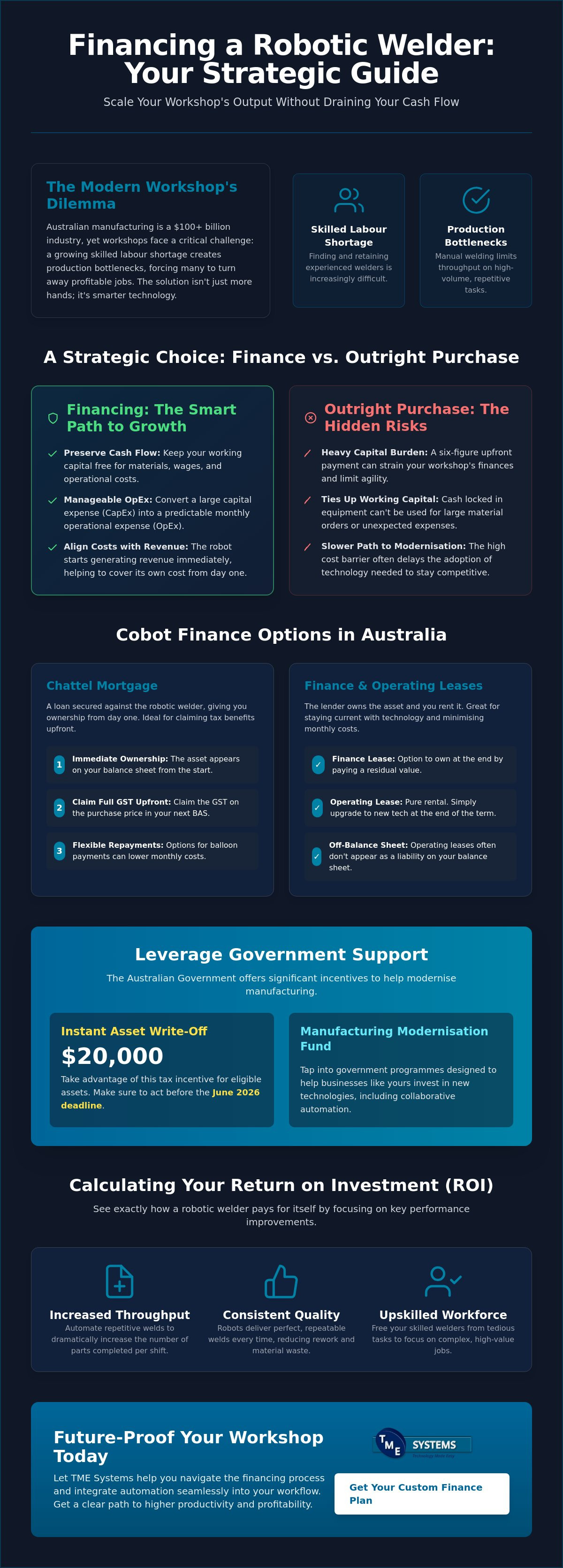

The biggest barrier to growing your workshop isn't a lack of work; it's the belief that you can't afford the technology needed to finish it. You've likely seen the production bottlenecks pile up while the search for skilled welders becomes increasingly difficult. It's frustrating to turn away profitable jobs just because you don't have enough hands on deck to get the beads laid. While the initial cost of automation can look intimidating at first glance, financing a robotic welder is often the most practical way to scale your business without putting your cash flow under unnecessary pressure.
We understand that every dollar counts in a local fabrication business. This guide is designed to help you navigate the transition from manual welding to collaborative automation with confidence. You'll learn how to identify the right local finance options, make the most of the $20,000 instant asset write-off before the June 2026 deadline, and tap into government programmes like the Manufacturing Modernisation Fund. We'll also provide a clear framework for calculating your return on investment so you can see exactly when your new robot starts paying for itself through improved workshop throughput.
Key Takeaways
- Understand why financing a robotic welder is a smarter move than buying outright in the current labour market, as it keeps your cash free for materials and daily workshop costs.
- Learn the practical differences between a chattel mortgage and an operating lease to decide which structure best suits your balance sheet and tax goals.
- Discover how to calculate a realistic return on investment by focusing on increased throughput and consistent quality rather than just the initial equipment cost.
- Find out exactly what local lenders need to see in your business case and financial statements to get your automation project approved quickly.
- Get a clear view of the total implementation costs, including operator training and system integration, to ensure your workshop's transition is seamless.
Why Financing a Robotic Welder is the Strategic Choice for 2026
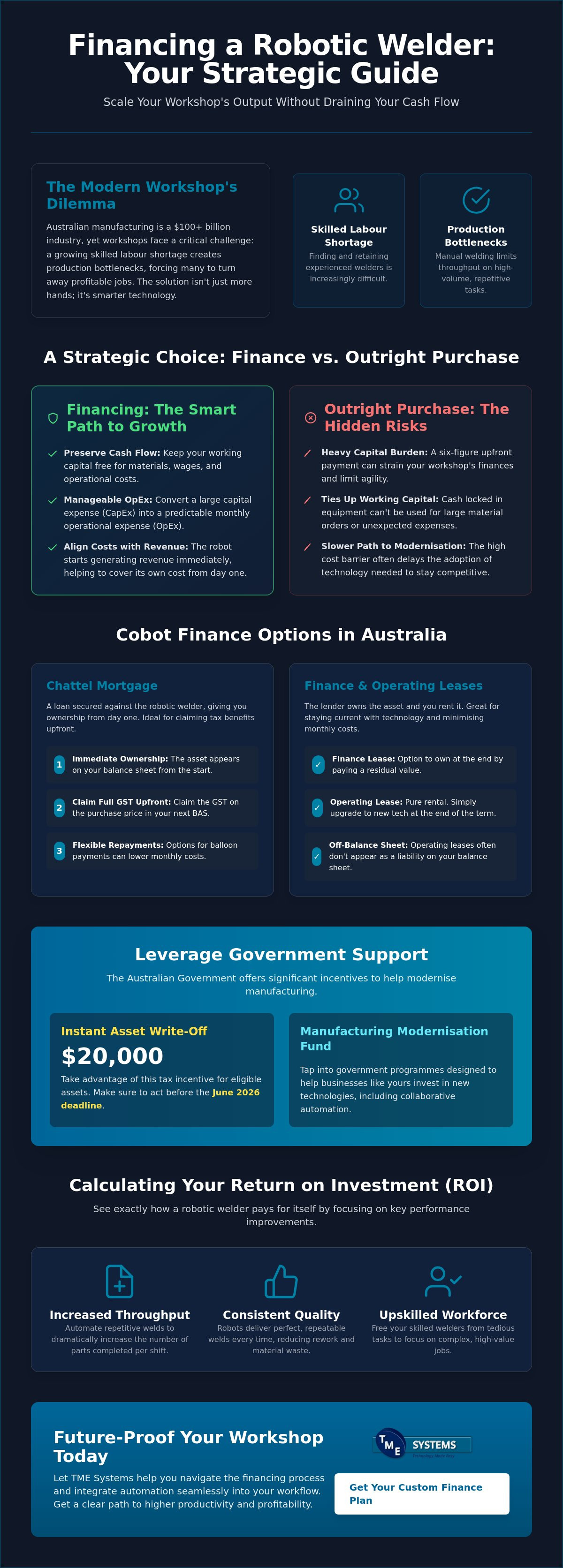
The Australian manufacturing sector is currently facing a unique set of challenges. While the industry generates over $100 billion in economic output annually, finding enough skilled hands to keep up with the workload is becoming a real struggle for many workshops. This labour shortage isn't just a temporary dip; it's a structural shift that requires a different approach to production. This is where financing a robotic welder becomes a strategic move rather than just an expense. By spreading the cost of automation over several years, you can modernise your shop floor without the massive capital hurdle that often stops growth in its tracks.
Modern Robot welding technology has moved beyond the massive, fenced-off industrial cells of the past. Collaborative robots, or cobots, offer a much lower total cost of ownership because they don't require the same expensive safety guarding or specialised programming staff. When you finance this technology, you shift the investment from a heavy "CapEx" burden to a manageable monthly "OpEx" payment. This transition allows you to align your equipment costs directly with the revenue the robot generates each month, making the investment feel much more like a tool and less like a debt.
Addressing the Skilled Labour Shortage
Automation isn't about replacing the experienced tradespeople you already have; it's about making them more effective. A financed cobot acts as a force multiplier for your best fabricators. It takes over the repetitive, high-volume welds that often lead to fatigue and inconsistency, allowing your skilled staff to focus on complex setups and bespoke projects. This approach reduces the constant pressure of finding and retaining specialised welding staff in a highly competitive market. It makes your workshop a more attractive place to work by removing the "grunt work" and letting your team focus on the craft they actually enjoy.
Cash Flow Management for Workshops
For most small to medium Australian workshops, paying six figures upfront for new technology is a fair dinkum risk. It ties up the working capital you need for materials, unexpected repairs, or daily operations. By financing a robotic welder, you keep your cash reserves intact and maintain a healthy balance sheet. This liquidity is vital if you want to be ready for future workshop expansions or large-scale contracts that require significant material outlays. It's a pragmatic way to ensure your business stays agile while still adopting the advanced tools needed to stay competitive in 2026.
Types of Cobot Finance Available in Australia
Choosing the right way to fund your equipment is just as important as choosing the robot itself. In Australia, the financial landscape is geared towards supporting business growth, especially through the Australian Government's Modern Manufacturing Strategy. When you're looking at financing a robotic welder, you'll find several distinct products, each with its own tax and cash flow advantages. Understanding these differences helps you pick the one that fits your workshop's long-term goals and current financial position.
Chattel Mortgages for Fabricators
A chattel mortgage is a popular choice for many fabricators because it gives you ownership from day one. The lender secures the loan against the equipment, but the asset sits on your balance sheet. One of the biggest perks here is the GST treatment. You can usually claim the full GST amount on the purchase price in your next Business Activity Statement (BAS), which provides a welcome cash injection early on. Many lenders also offer flexible repayment structures, such as balloon payments at the end of the term, to keep your monthly outgoings lower while the robot ramps up production.
Finance Leases vs. Operating Leases
If you prefer to keep your monthly costs as low as possible, a finance lease might be the way to go. The lender buys the equipment and leases it back to you. At the end of the term, you can pay a residual value to take ownership. In contrast, an operating lease works more like a rental. This is ideal for high-growth shops that want to stay on the cutting edge. Because you don't own the asset, it often stays off the balance sheet, and you can simply upgrade to the latest tech every few years. It's a great way to ensure your workshop never falls behind the curve.
Don't forget the tax benefits available for the 2025-2026 income year. While the $20,000 instant asset write-off threshold is a great boost for smaller tools, larger investments like financing a robotic welder still benefit from significant depreciation deductions. You might also consider a Commercial Hire Purchase (CHP) if you want the certainty of eventual ownership with fixed monthly costs. If you're unsure which path to take, it's worth seeing how collaborative robot welding cells could fit into your production line before committing to a specific finance structure. With interest rates for business equipment currently starting around 7.49% for prime borrowers, now is a pragmatic time to run the numbers for your workshop.
Calculating Robotic Welder ROI for Australian Manufacturers
When you're looking at the bottom line, the sticker price of a new cell is only half the story. To get a true sense of the value, you need to look at the return on investment (ROI) over the life of the machine. Financing a robotic welder allows you to spread the cost, but the real magic happens when you measure the increase in throughput. If your workshop can push out more product with the same headcount, the finance payments suddenly look very small compared to the extra revenue hitting your bank account. You also need to factor in the reduction in rework. Every piece of scrap metal or hour spent grinding out a bad weld is money down the drain. A robot delivers a consistent bead every single time, which slashes your material waste and keeps your margins healthy.
A pragmatic ROI model must also account for "soft costs" that are often overlooked. These include the time spent setting up the machine and the speed at which your team can adapt to the new technology. If a system sits idle because it's too hard to use, it isn't earning its keep. By financing a robotic welder as a complete package, you can include the software and training needed to ensure the machine is productive from day one. This approach turns a technical upgrade into a reliable profit centre for your business.
The Impact of No-Code Software on ROI
The biggest drain on automation efficiency is often the time lost during job changeovers. Traditional robots require complex coding that can take hours or even days to adjust for a new part. However, using no-code robot welding software slashes these costs by allowing your existing team to make adjustments on the fly. You don't need to hire expensive external programmers every time a new job comes through the door. Intuitive teaching software accelerates the "time-to-first-weld" by allowing operators to program parts in minutes rather than hours.
Bundling Integration and Training
When you're organising finance, it's a smart move to cover the "whole box and dice"—including the initial integration and operator onboarding. Many fabricators make the mistake of buying the hardware and then struggling to get it running smoothly on their own. This leads to costly downtime that can delay your ROI by months. Professional integration usually pays for itself in weeks because it ensures the system is perfectly tuned to your specific workshop floor. Allocating a portion of your budget for operator training is equally vital; it empowers your staff to take ownership of the technology and ensures the long-term success of your investment.
The Finance Approval Checklist: What Lenders Look For
Lenders in the Australian market are increasingly comfortable with automation, but they still need to see a solid paper trail before they sign off on a loan. Before you sit down with a broker or a bank manager, you'll need to organise your financial statements, including your Profit and Loss (P&L) reports, current balance sheets, and your most recent Business Activity Statements (BAS). These documents provide a window into your workshop's financial health and your ability to manage debt. Lenders also look for "character," which is really just a way of assessing your trading history and the stability of your client base. Having a formal quote from a specialist integrator is a vital part of this process. It shows the lender that you aren't just buying a box of parts, but a complete, integrated solution designed for immediate production.
Preparing Your Business Case
A strong business case is what bridges the gap between a technical wish list and a financial reality. You need to explain to the lender exactly how financing a robotic welder will increase your contract capacity. If you can show that the robot allows you to take on more work without increasing your floor space or headcount, the loan becomes much more attractive to a bank. Lenders also view collaborative welding cells as high-quality collateral. Unlike bespoke, fixed automation, these systems are mobile and adaptable, which gives them a higher resale value and reduces the lender's risk. Use your current production data to prove that the extra throughput will easily cover the monthly repayments.
Documentation and Compliance
Compliance is a major factor that can stall an application if not handled correctly. Lenders need to be sure the equipment meets Australian safety standards before they'll release funds. For larger, multi-stage integration projects, you might need to look at "Progress Draws." This allows the lender to pay the integrator in stages as the system is built, tested, and finally installed on your floor. Handling the GST correctly is another way to boost your cash flow. If you're using a chattel mortgage, you can often claim the full GST on the purchase price in your next BAS, providing a significant cash injection right when you need it most. To get started on your own business case, you can explore our collaborative robot welding cells to see which configuration fits your production needs.
Future-Proof Your Shop with TME Systems Financing Support
At TME Systems, we take a pragmatic approach to helping Australian fabricators adopt automation. We know that the transition from manual welding to robotics can feel like a massive leap for a small to medium business. That's why we focus on making the process as transparent and supportive as possible. When you're considering financing a robotic welder, you need a partner who understands the specific pressures of a local fabrication shop. We work closely with finance partners who are specialised in the manufacturing sector. These lenders understand the long-term value of the equipment, which often leads to smoother approvals and more flexible terms for our clients.
Our turnkey collaborative robot welding cells are built for rapid deployment. We don't just deliver the hardware; we provide the full welding system integration and operator training needed to get your team up to speed. This end-to-end relationship doesn't end once the machine is running. We provide ongoing technical support to ensure your investment continues to deliver a high ROI for years to come. By treating technology as a tool to empower your workers, we help you build a more resilient and competitive business that's ready for whatever the market throws at it next.
From Mobile Demo to Workshop Floor
Seeing is believing on a busy workshop floor. Our Mobile Demo System allows you to "try before you buy," proving the concept with your own parts before you commit to any finance agreement. This hands-on experience is vital for demystifying the technology for your team. We help you customise the integration to fit your existing workshop centre and workflow, ensuring the new tech supports your human operators rather than complicating their daily tasks. From that very first weld through to full-scale production, we're here as a trusted local partner to help you refine your processes and maximise your output.
Next Steps: Get Your Automation Roadmap
The path to a more productive workshop starts with a clear automation roadmap. Booking a consultation allows us to sit down and discuss your specific welding needs, common batch sizes, and production goals. We'll then provide a comprehensive quote that includes the "soft costs" like training and software, making it straightforward to secure financing a robotic welder. It's about moving away from a transactional purchase toward a collaborative partnership that prioritises your long-term success. Enquire about our collaborative welding solutions today to see how we can support your workshop's growth.
Take the Next Step Toward Smarter Fabrication
Transitioning to automation doesn't have to be a financial burden that stalls your operations. By choosing the right path for financing a robotic welder, you can preserve your working capital while significantly increasing your workshop's throughput. Whether you opt for a chattel mortgage to claim GST upfront or a lease to keep your technology fresh, the goal is always the same: making your skilled team more productive and your business more competitive.
As specialists in Australian manufacturing automation, TME Systems provides more than just hardware. Our no-code software allows for rapid job changeovers, and our comprehensive operator training ensures your team is ready to succeed from the first weld. We're committed to helping you navigate the complexities of integration and finance with steady, practical support. Contact TME Systems to discuss your robotic welder financing options today. We're ready to help you build a roadmap that secures the long-term success of your workshop.
Frequently Asked Questions
Is it better to lease or buy a robotic welder in Australia?
The choice between leasing and buying depends on your workshop's long-term strategy and cash flow needs. Buying through a chattel mortgage is a popular choice for fabricators who want immediate ownership and the ability to claim GST on their next BAS. On the other hand, an operating lease is often better if you want to keep payments off the balance sheet and have the flexibility to upgrade to the latest technology every few years.
Can I include the cost of welding software and training in my finance package?
You can definitely bundle the costs of no-code teaching software and operator training into your total finance amount. Most Australian lenders actually prefer a "whole box and dice" quote because it shows the equipment will be productive from day one. Including these soft costs ensures you aren't hit with unexpected out-of-pocket expenses while your team is getting up to speed with the new system.
What is the typical ROI period for a collaborative robot welder?
Most local fabricators see a full return on investment within 12 to 24 months of installation. This period is driven by the significant increase in workshop throughput and a reduction in rework and material waste. When you're financing a robotic welder, you can often align your monthly repayments with the extra revenue generated by this increased capacity, making the system self-funding relatively quickly.
Do I need a large deposit to finance a welding cobot?
A large upfront deposit isn't always necessary for established businesses with a solid trading history. Many specialised lenders offer 100% finance options that allow you to keep your cash reserves for materials and daily operations. If you've been trading for more than two years and have a clean credit profile, you'll likely find several no-deposit paths to getting an automated cell onto your floor.
How does the instant asset write-off work for robotic equipment in 2026?
The instant asset write-off threshold is $20,000 for the 2025-2026 income year for small businesses with a turnover under $10 million. While a complete collaborative welding cell usually sits above this price point, you can still claim immediate deductions for eligible components under $20,000. For the larger investment, you'll use standard depreciation schedules to reduce your taxable income over the life of the machine.
What happens if my workshop’s electrical capacity needs upgrading during installation?
Electrical upgrades and other site preparation costs can often be included in your integration quote and financed as part of the project. It's a pragmatic move to identify these requirements early during the site assessment phase. Bundling these infrastructure costs into your financing a robotic welder package prevents cash flow shocks and ensures your workshop is fully prepared for the new equipment's power demands.
Are there specific grants for Australian manufacturers to help with financing?
There are several federal and state-level grants designed to help manufacturers adopt advanced technology like robotics. Programmes such as the Manufacturing Modernisation Fund and the Industry Growth Program provide matched funding or advisory services for automation projects. While these grants often require a co-contribution, they can significantly lower the total amount you need to finance through traditional lenders.
Can I finance a used robotic welding cell?
You can finance used equipment, though lenders usually have stricter criteria regarding the age and condition of the machine. Most banks will require an independent valuation and a clear service history before they'll sign off on the loan. It's also worth considering that older industrial robots often have higher integration and maintenance costs compared to modern, collaborative systems that are designed for ease of use.