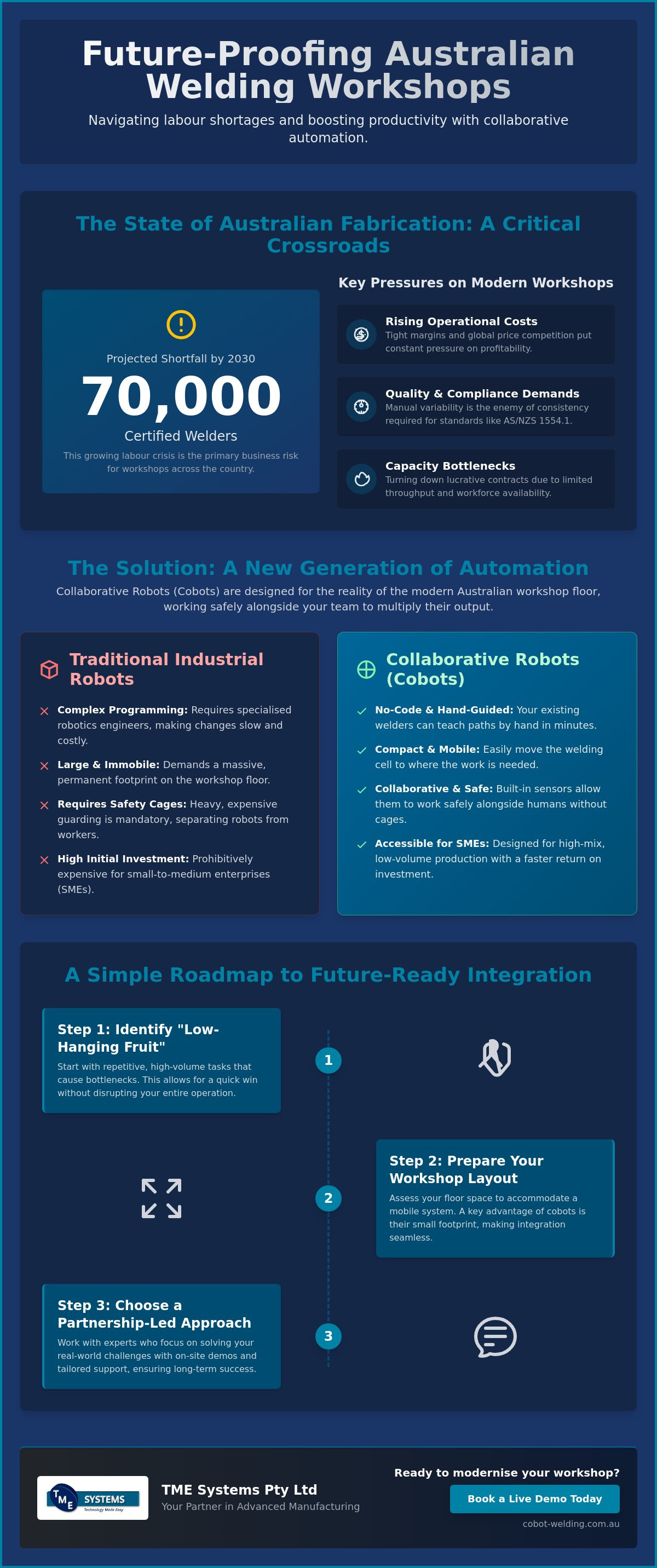

With a projected shortfall of 70,000 certified welders across the country by 2030, the real challenge isn't just finding more staff; it's figuring out how much longer your current team can carry the load alone. You've likely felt the pressure of rising operational costs and the frustration of turning down lucrative contracts because your floor capacity has hit its limit. It's a tough spot to be in, especially when quality consistency remains a constant worry. Future proofing welding workshops in this environment requires a shift in how we think about the relationship between the tradesperson and the machine.
We understand that the goal isn't to replace the skill of a seasoned welder, but to support it. This guide explores how you can navigate these labour shortages and rising expenses by integrating accessible automation and no-code technology into your existing workflow. You'll discover how to increase your daily throughput and maintain weld quality that consistently meets AS/NZS 1554.1 standards. We'll also look at how modernising your workshop can help you attract younger talent who are looking for tech-forward careers in Australian manufacturing.
Key Takeaways
- Learn how collaborative robot welding cells maintain consistent quality while working safely alongside your experienced fabricators.
- Discover how no-code teaching software allows your team to set paths by hand, removing the need for specialised robotics programming skills.
- Identify the 'low-hanging fruit' in your production line to begin future proofing welding workshops without disrupting your entire operation.
- Find out how to prepare your workshop layout to accommodate mobile demo systems and ensure a seamless integration of new technology.
- Understand the importance of a partnership-led approach that focuses on solving real-world fabrication challenges on your actual workshop floor.
The Evolving Landscape of Australian Fabrication in 2026
The Australian fabrication sector is at a crossroads. While industry output expanded by 1.2% over the last year, the reality on the workshop floor is often one of tight margins and constant pressure. Local workshops are no longer just competing with the shop down the road; they're up against global price points and increasingly complex supply chains. Relying solely on manual processes is becoming a significant bottleneck. It prevents businesses from scaling up even when the demand is there. In May 2026, the Ai Group Industry Index for manufacturing sat at -22.4 points, showing that while the sector is resilient, it's still navigating a period of contraction.
The Reality of the Labour Crisis
Finding a qualified, ticketed welder is no longer just a recruitment headache. It's a primary business risk. With Weld Australia projecting a shortfall of 70,000 welders by 2030, the pool of available talent is shrinking fast. An ageing workforce means decades of experience are retiring out of the industry, and not enough apprentices are coming through to fill the void. This shortage directly impacts your lead times. When your best operators are stretched thin, you're forced to turn away profitable contracts simply because you don't have the hands to do the work. Future proofing welding workshops starts with acknowledging that the old way of hiring your way out of a capacity problem is no longer a viable strategy.
Meeting Modern Standards and Compliance
Beyond the labour issue, the demand for precision is higher than ever. Whether it's structural steel or specialised components, projects now require rigorous traceability and adherence to standards like AS/NZS 1554.1. Manual variability is the enemy of compliance. A single bad day on the tools can lead to quality inconsistency, resulting in costly rework or non-compliance issues that damage your reputation. This is where collaborative robots (cobots) and other smart technologies begin to bridge the gap.
By automating the repetitive, high-volume tasks, you allow your skilled welders to focus on complex joins that require human intuition. This shift is essential for high-mix, low-volume production environments. It ensures your shop can handle high-spec projects with total confidence while maintaining the flexibility that Australian manufacturing is known for. Transitioning to a tech-enabled workflow isn't about removing the human element. It's about giving your team the tools they need to meet modern output requirements without burning out.
Why Collaborative Automation is the Key to Workshop Resilience
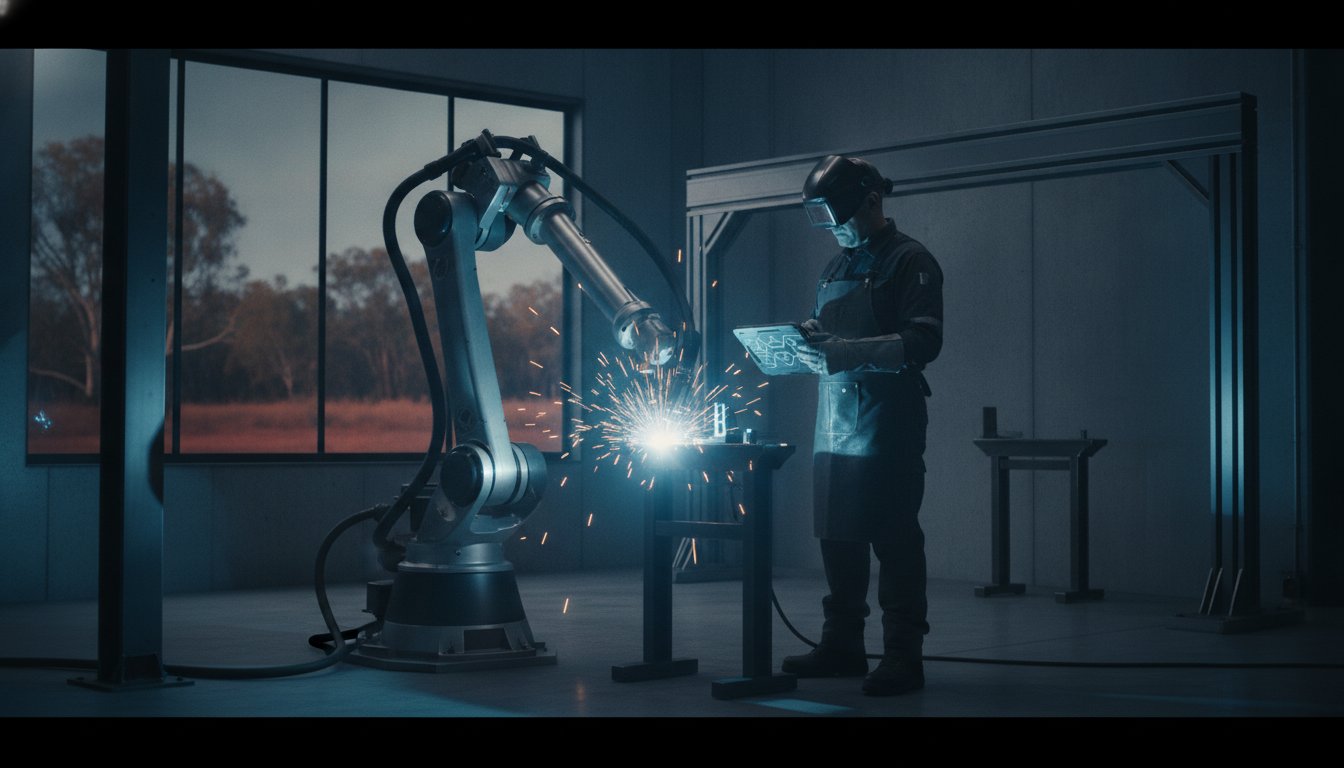
Resilience in a modern fabrication shop doesn't come from asking your team to work harder. It comes from providing them with tools that multiply their output. A collaborative robot, or "cobot", is essentially a high-precision power tool designed to work alongside your staff rather than behind a safety fence. While traditional automation was built for massive automotive lines, cobots are built for the reality of the Australian workshop floor. They excel at the repetitive MIG and TIG tasks that often lead to fatigue or quality drift over a long shift. By integrating these systems, you're effectively future proofing welding workshops against the unpredictable nature of the labour market.
Safety is a significant factor in why these units are becoming the standard for local fabricators. Because they're designed with built-in sensors to stop immediately upon contact, they don't require the heavy, expensive guarding or dedicated "no-go" zones of older industrial robots. This means you can roll a unit into a tight workspace without reconfiguring your entire floor plan. It's a pragmatic approach that aligns with Australia's advanced manufacturing strategy, which encourages shops to adopt tech that enhances human capability rather than replacing it.
The Difference Between Cobots and Industrial Robots
Traditional industrial robots often failed small workshops because they were too expensive and too complex to program. If you needed a computer science degree just to change a weld path, the machine ended up gathering dust. Modern collaborative robot welding cells solve this through a "plug-and-play" philosophy. They are compact, mobile, and can be set up in a fraction of the time. For a workshop where floor space is at a premium, the ability to move the automation to the work, rather than the other way around, is a game changer.
Augmenting Human Skill
We often talk about the "dirty, dull, and dangerous" jobs. These are the long, straight runs or the hundreds of identical small brackets that drain a senior welder's morale. When you hand these tasks to a cobot, you aren't just increasing speed; you're improving your workshop culture. Your senior tradespeople are freed up to focus on high-value custom fabrication and complex assemblies that require their years of expertise. This shift reduces the physical strain on your team and allows one operator to oversee multiple units, significantly boosting your individual productivity levels without adding to the headcount.
Breaking the Barrier: No-Code Software for Small-Batch Practicality
One of the biggest misconceptions in Australian fabrication is that robotics are only for massive production runs of identical parts. For many local owners, the idea of "programming" sounds like a task for an IT specialist, not a welder. This perceived complexity is often what stops businesses from investing in future proofing welding workshops. However, the arrival of no-code robot welding software has completely changed the equation. It removes the technical hurdles and puts the control back into the hands of the tradesperson.
Instead of typing lines of code, your welders can now teach the machine a path by hand. This approach is practical and grounded in the reality of a busy shop floor. If you can weld the part, you can teach the robot to weld it. This lowers the barrier to entry significantly. It means that even a small batch of ten pieces becomes profitable to automate because the setup time is often under ten minutes. You can even make real-time adjustments to parameters like wire speed or voltage on the fly. This ensures the arc is perfect without stopping the production run, allowing for immediate refinement of the weld quality.
Intuitive Path Teaching
The "lead-through" method is the heart of this technology. An operator simply holds the robot arm and moves it to define the start and end points of a weld. The visual interface on the control tablet looks more like a modern smartphone app than a technical terminal. By using familiar terminology like "travel speed" and "torch angle" instead of coordinate geometry, we reduce the fear factor for older tradespeople. It turns the robot into a helpful apprentice that follows instructions perfectly every time, prioritising the skill of the operator over the complexity of the machine.
Flexibility for the Job Shop
Most Australian workshops are job shops that handle a high variety of work. No-code technology is designed for this flexibility. You can quickly switch between different jigs and parts in a single shift without needing a dedicated technician. Once a job is finished, you can store the programme and recall it instantly for recurring customer orders months later. This reduces the "cost of curiosity" for new projects. It allows you to experiment with automating different parts of your workflow without risking hours of downtime. It's about making innovation feel attainable and supporting your team's progress one part at a time.
A Roadmap to Integrating Future-Ready Technology
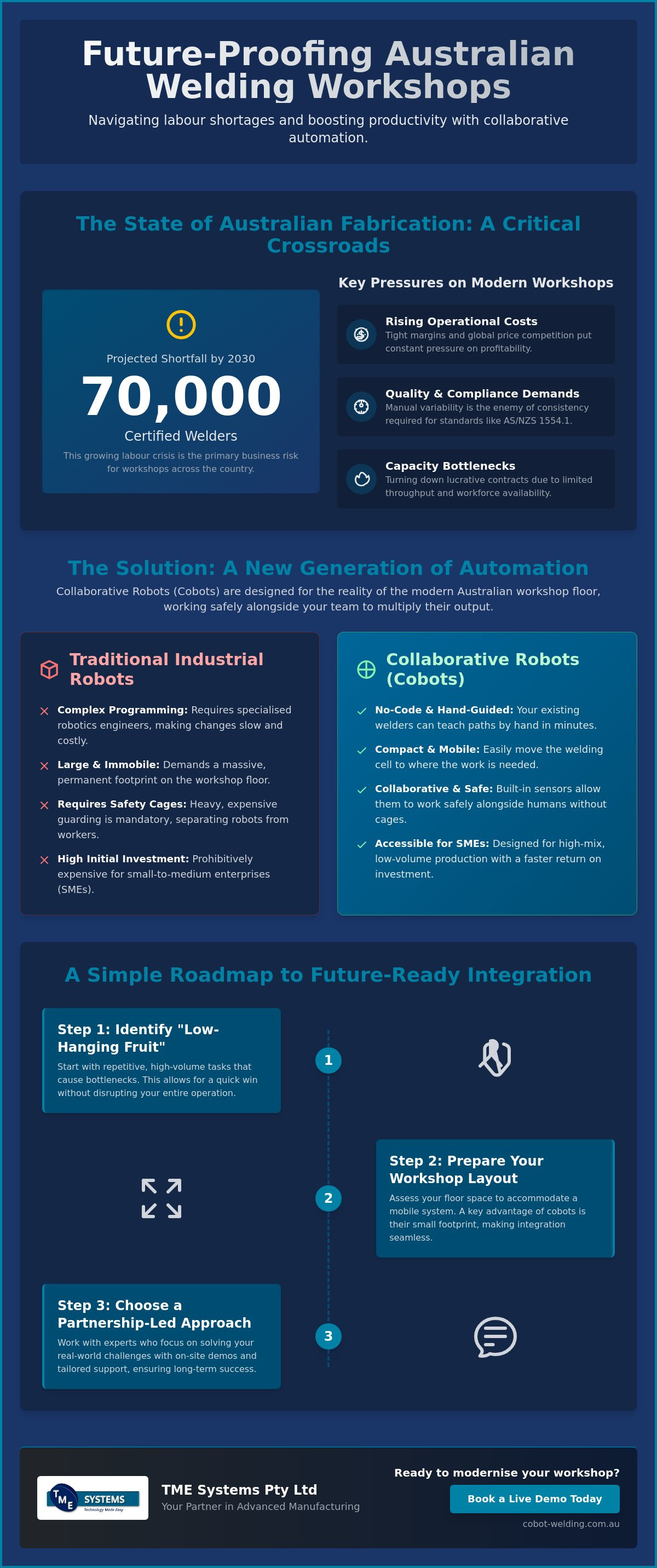
Implementing automation doesn't have to be an all-or-nothing overhaul that disrupts your entire production line. In fact, the most successful transitions happen when you start small and scale based on proven results. Taking a methodical approach to future proofing welding workshops ensures that the technology serves your business goals rather than complicating them. It begins with a clear-eyed look at your current floor and identifying where the bottlenecks are costing you the most in time and wasted material.
Phase 1: The Operational Audit
The first step is a 'Low-Hanging Fruit' audit. Look for the most repetitive, high-volume jobs in your shop. If a senior welder spends half their shift on simple fillet welds for standard base plates, that is a manual bottleneck. You can calculate the true cost of these tasks by looking at the hourly rate of your skilled staff versus the actual arc-on time achieved. Selecting the right welding system integration specialists to evaluate your workflow can help you recognise which parts are 'cobot-ready' and which still require the nuanced hand of a master tradesperson. This phase is about finding the right balance between human intuition and robotic precision.
You should also organise your workshop layout to accommodate a mobile demonstration system. Because modern cobots have a small footprint and don't require fixed safety cages, they can often be integrated into existing bays with minimal changes. This flexibility allows you to test the technology in the actual environment where it will be used, ensuring it fits your specific workflow requirements.
Phase 2: Cultural Integration
Technology only works if your team is on board. Frame the introduction of a cobot as a 'new power tool' for the trade, similar to how the industry moved from manual stick welding to advanced MIG systems. Involve your best welders in the selection and teaching process. When they see that the machine handles the tedious work while they focus on high-value custom fabrication, buy-in happens naturally. Long-term success relies on operator onboarding and hands-on training that happens locally, not in a distant classroom. Ensuring your team feels capable and supported is just as vital as the hardware itself.
Measuring success should go beyond simple speed. Look at rework reduction and the consistency of your arc-on time. If you can maintain quality that meets AS/NZS 1554.1 standards without having to grind out and redo welds, your profitability will climb. If you want to see how this technology handles your specific parts on your own floor, you can book a mobile demo system to experience the results first-hand.
Partnering for Long-Term Success: The TME Systems Approach
TME Systems Pty Ltd understands that Australian fabrication isn't a one-size-fits-all industry. Local workshops face specific hurdles, from high energy costs to the need for rapid turnaround on small, varied batches. We don't just supply equipment; we act as a practical partner to help you navigate the transition to automation. By focusing on the daily challenges you face on the floor, we ensure that future proofing welding workshops is a structured, low-risk process that delivers immediate value. Our goal is to make innovation feel attainable rather than intimidating.
Turnkey Solutions for Local Manufacturers
A collaborative robot welding cell from TME Systems Pty Ltd is a complete, ready-to-work package. It typically includes the cobot arm, the integrated welding power source, and our intuitive no-code teaching software. Because we provide Australian-based support, you have direct access to experts who understand our local welding standards and compliance requirements. We help you refine your workflow from the very first cell, providing a solid foundation to scale your operations as your business grows. This end-to-end relationship means you aren't left to figure out the technical integration on your own.
Our approach includes:
- Welding System Integration: Customising the setup to match your existing workshop power and space requirements.
- Operator Training and Onboarding: Practical, hands-on sessions that ensure your team is proficient and confident from day one.
- Ongoing Technical Support: Local help is always available to assist with new part setups or software updates.
Taking the First Step
The best way to understand how this technology fits your workshop is to see it in action. Our mobile demo system brings the technology directly to your floor. This allows you to see the cobot weld your actual parts, using your specific jigs and materials. It removes the guesswork and allows your team to interact with the system before you make a final commitment. Seeing the arc-on time and quality consistency on your own parts often provides the clarity needed to move forward with confidence.
Reducing the risk of adoption is our priority. Through expert-led integration and a focus on human-centric technology, we help you turn automation into a competitive advantage. Future proofing welding workshops is a journey, not a single purchase. It's about building a more resilient, productive, and attractive workplace for the next generation of Australian tradespeople. By partnering with a local integrator who values craftsmanship as much as technical innovation, you can reclaim your workshop's capacity and secure its long-term success.
Secure Your Competitive Edge on the Workshop Floor
The shift towards advanced manufacturing in Australia is no longer a distant prospect; it's happening right now in shops across the country. By moving away from purely manual workflows and adopting collaborative technology, you can overcome the persistent skills shortage and protect your business from rising operational costs. We've explored how no-code software makes this transition accessible, allowing your best tradespeople to lead the way without needing to learn complex programming.
Ultimately, future proofing welding workshops is about building a more resilient, productive environment that values human skill. As Australian-owned and operated integration specialists, we focus on providing no-code teaching software that empowers your team. Our systems have a proven track record of reducing workshop rework and increasing arc-on time, helping you maintain a competitive advantage in a global market.
Ready to see how these systems handle your actual parts? Book a mobile welding robot demonstration today to see future-proofing in action. Let's work together to keep your production line moving forward with confidence.
Frequently Asked Questions
Is my workshop too small for a welding cobot?
Most collaborative units are designed with a compact footprint specifically for shops where floor space is at a premium. Unlike traditional industrial robots, these cells are often mobile and can be rolled into a standard welding bay. This makes them an ideal solution for future proofing welding workshops that don't have the luxury of dedicated automation zones.
Do my welders need to learn how to code to use these systems?
Your team doesn't need any coding or computer science background to operate these units. We use no-code teaching software that allows a welder to move the robot arm by hand to set the path. If your staff can weld a part manually, they can teach the cobot to do it in a matter of minutes.
How long does it take to see a return on investment for a welding cell?
While the exact timeframe varies, most workshops see a return through increased throughput and a significant reduction in rework. By automating repetitive tasks, you free up your senior staff for high-value work and ensure consistent quality that meets Australian standards from the first part to the last.
Can a cobot handle both MIG and TIG welding processes?
Yes, collaborative robots are highly versatile and can be integrated with both MIG and TIG power sources. This flexibility allows you to automate a wide range of fabrication tasks, from heavy structural steel joins to precise thin-gauge stainless steel work, all within the same workshop environment.
What happens if we have a wide variety of small jobs instead of one big run?
No-code technology is specifically built for high-mix, low-volume production. Because the setup time for a new part is often under ten minutes, it's practical to automate runs as small as ten pieces. You can save and recall programmes instantly, making recurring small orders much more profitable.
Are collaborative robots safe to use without a cage in a busy workshop?
Cobots are designed with advanced force-sensing technology that allows them to work safely alongside humans. If the arm makes contact with an object or person, it stops immediately. This eliminates the need for expensive safety cages and allows for a more integrated, open workshop layout.
What kind of maintenance do these automated welding units require?
Maintenance requirements are straightforward and similar to your existing welding equipment. Aside from standard torch and liner care, the robotic arm requires minimal periodic checks. These systems are built for the grit and dust of a real fabrication floor, ensuring long-term reliability with very little downtime.
Does TME Systems provide training for my existing staff?
We provide comprehensive operator training and onboarding as part of our integration service. Our goal is to ensure your team is confident and proficient with the system from day one. We focus on practical, hands-on learning that respects the trade expertise your welders already possess.