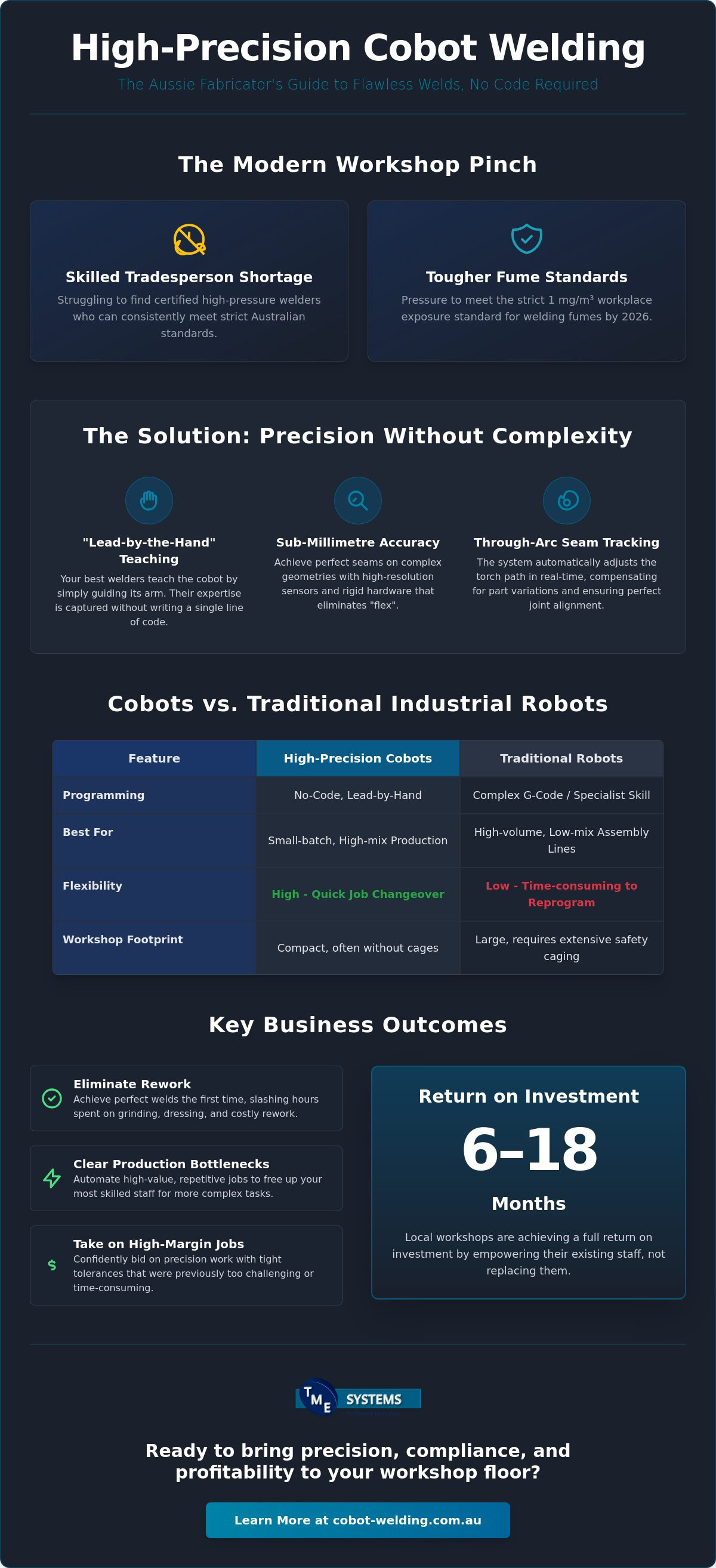

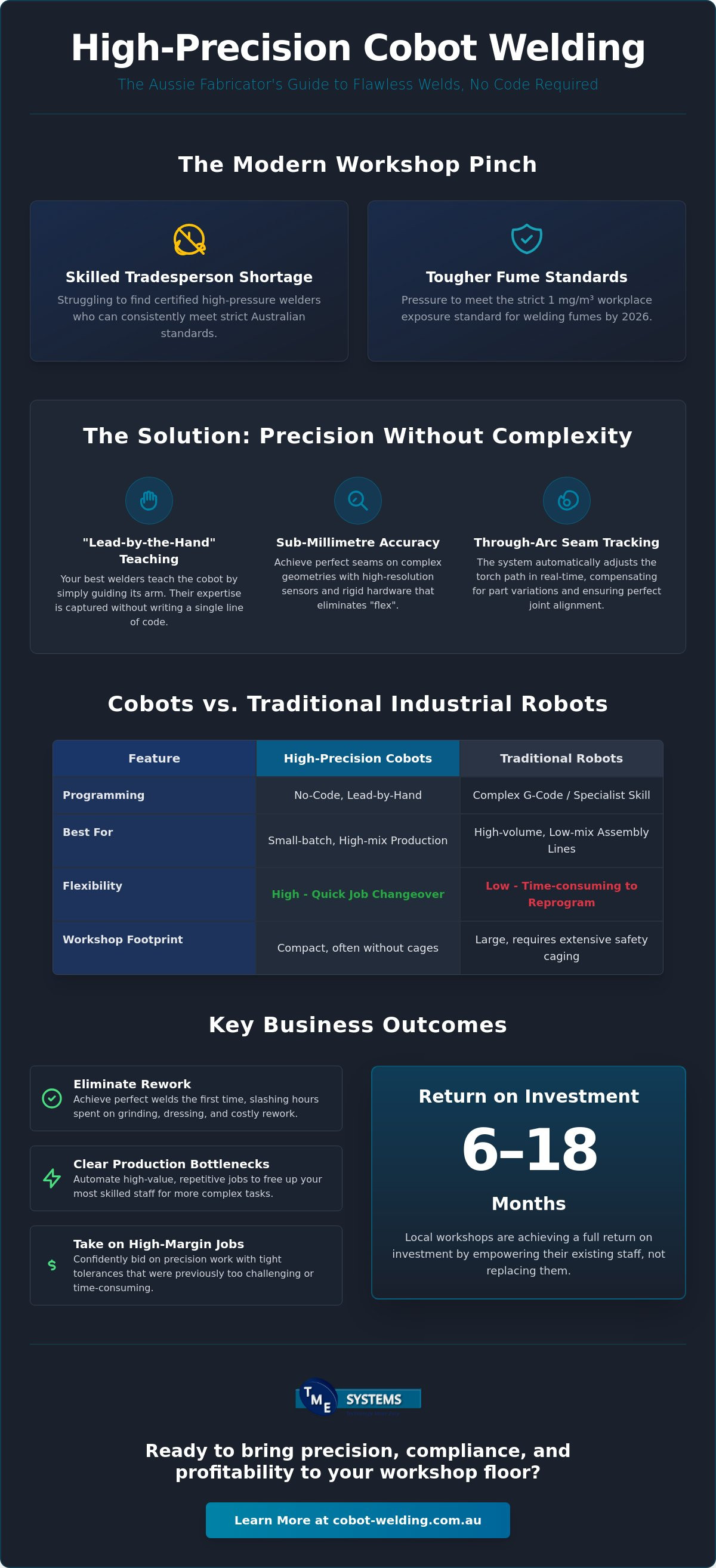
What if your most experienced welder could "teach" a machine to deliver a flawless seam without writing a single line of code? Most Aussie fabricators are feeling the pinch right now. Between the chronic shortage of skilled tradespeople and the pressure to meet the strict 1 mg/m³ workplace exposure standards for welding fumes, the workshop floor has never felt more demanding. You want to take on those high-margin, precision jobs, but the thought of complex robot programming for a small run of parts usually isn't worth the headache. It's frustrating to watch production bottlenecks grow while your best staff spend their time on repetitive tasks that could be automated.
We understand that automation only works if it's practical for the people actually doing the work. This guide shows you how high precision cobot welding is changing that equation, allowing your existing team to produce perfect results using intuitive no-code software. You'll discover how these collaborative systems help you maintain compliance with the 2026 shift toward Workplace Exposure Limits (WELs) while significantly reducing rework. We'll walk through the latest integration standards and how local workshops are achieving a full return on investment within 6 to 18 months by empowering their staff rather than replacing them.
Key Takeaways
- Discover how sub-millimetre accuracy is achieved by combining collaborative robots with intuitive no-code software and advanced sensors.
- Learn why high precision cobot welding is the most flexible solution for small-batch production and complex geometries in modern Aussie workshops.
- Understand the "lead-by-the-hand" teaching method that allows your best welders to transfer their skills to a machine without writing any code.
- Identify the specific high-value, repetitive jobs in your workshop that are perfect candidates for initial automation to clear production bottlenecks.
- Get a practical plan for auditing your current power sources and infrastructure to ensure a seamless integration of robotic welding cells.
What is High Precision Cobot Welding?
For many Australian fabricators, the term "automation" used to bring to mind massive, caged industrial arms that only made sense for high-volume automotive lines. That changed with the arrival of the collaborative robot (cobot), but even then, early models often lacked the rigidity needed for the finest work. Today, high precision cobot welding represents a significant leap forward. It isn't just a robot arm; it's a specialised integration of high-resolution sensors, rigid mounting, and no-code software designed to achieve sub-millimetre accuracy. This setup allows the machine to follow complex paths with the same steady hand as your most senior welder, ensuring that every bead is placed exactly where it needs to be.
As we move through 2026, the margin for error in Aussie workshops is shrinking. Clients are demanding tighter tolerances on precision components, and the cost of materials means you can't afford to scrap expensive alloys. By moving away from traditional, rigid automation toward these flexible, high-spec cells, you're not just buying a tool; you're refining your entire production process. The real impact is felt on the bottom line. When you achieve a perfect weld the first time, you eliminate the hours spent on grinding, dressing, and rework. It's about getting the job out the door faster without adding more names to the payroll.
The Difference Between Standard and High Precision Welding
It's vital to understand the gap between repeatability and accuracy. A standard cobot might be repeatable, meaning it can return to the same point over and over. However, high precision cobot welding requires accuracy across a multi-axis path. Standard systems often struggle when moving through complex geometries because they lack the high-resolution encoders needed to track minute deviations. High-precision cells use specialised hardware and rigid foundations to prevent the "flex" that causes wonky seams. This ensures the torch stays perfectly centred in the joint, even on intricate, curved weldments.
Why Australian Workshops Are Making the Switch
The push toward high-precision automation is largely driven by the national shortage of certified high-pressure welders. It's becoming nearly impossible to find staff who can consistently meet strict Australian standards for structural steel or pressure-vessel work. Local shops are also finding that they need "low-mix, high-volume" flexibility. You might have a large contract for one part this week, but a completely different set of precision components the next. High-precision cobots allow you to switch between these jobs quickly, maintaining the high standards required by local regulations while keeping your production lines moving steady.
The Mechanics of Precision: Hardware Meets No-Code Software
Precision in the workshop isn't just about having a steady hand; it's about the tools that support that hand. While standard automation relies on complex lines of code, high precision cobot welding uses a no-code interface that essentially acts as a bridge between human skill and robotic consistency. This software allows a welder to physically guide the robot arm along the desired path, a process often called "lead by the hand" teaching. As the operator moves the arm, the software creates a digital twin of the motion, capturing every subtle angle and speed change. The next generation of cobots takes this further by allowing the system to refine these paths, smoothing out human jitter while keeping the expert's intent intact.
Even the best jig can't account for every minor variation in a part. That's where through-arc seam tracking comes in. By monitoring the electrical characteristics of the arc in real-time, the system can adjust the torch position to follow the actual joint, even if the part is slightly warped or out of position. This integration with high-end power sources ensures the weld stays exactly where it should, maintaining the integrity of the component without constant human intervention. It's a pragmatic solution for workshops that deal with real-world materials rather than laboratory-perfect samples.
No-Code Teaching: Empowering the Tradesperson
We've seen too many shops where the robot sits idle because the one person who knows G-code is away. No-code software removes this "black box" entirely. Your best welders can now adjust voltage, wire speed, and travel speed mid-path using a simple tablet interface. This shifts the focus from "programming" back to "welding." It's common to see set-up times for new components drop from several hours of manual coding to just a few minutes of hand-teaching. If you're ready to see how this works on your own floor, you can explore our collaborative robot welding cells designed for local conditions.
Achieving Sub-Millimetre Repeatability
In a high-precision environment, repeatability is the baseline for quality; modern systems often achieve a repeatability of 0.03mm, ensuring every part in a run is identical. This level of consistency is only possible when you account for the realities of the Australian climate. Thermal compensation software adjusts for the expansion and contraction of the robot arm as the workshop heats up during a shift. To maintain this standard, high-precision torches and specialised wire feeders are non-negotiable, as they prevent the bird-nesting and arc instability that ruin a clean finish.
Cobots vs. Traditional Industrial Robots for High-Spec Jobs
Traditional industrial robots are the gold standard for high-volume manufacturing, but for the average Australian fabricator, they often represent a rigid and expensive commitment. These machines require significant floor space for safety cages and specialised staff to manage complex G-code. In contrast, high precision cobot welding offers a smaller footprint and a level of agility that better suits our local market. While industrial robots excel at repetitive, high-speed tasks, cobots thrive in environments where the job mix changes weekly. You aren't just buying a machine; you're adding a flexible workstation that can be moved and redeployed as your production needs shift.
There's a common myth that cobots are too slow for high-spec production. While it's true that industrial robots have higher top speeds, speed on paper doesn't always translate to productivity. In a workshop doing small to medium runs, the "speed" of an industrial robot is often negated by the days or weeks of downtime required to reprogram it for a new part. A cobot maintains a steady, high-quality pace without the need for constant supervision or lengthy setup delays. When you look at the Total Cost of Ownership (TCO), the cobot often wins because it avoids the hidden costs of safety infrastructure and external programming consultants.
Setup Time and Programming Latency
The real bottleneck in traditional automation is programming latency. Coding a complex path for an industrial robot can take days of professional engineering time. With no-code software, that same path can be "taught" by a welder in about 15 minutes. This makes it profitable to automate even "one-off" precision jobs or small batches of 20 to 50 units. Rapid job changeovers mean your workshop throughput stays high, even when your order book is diverse. You're no longer waiting for a programmer to become available; your existing team keeps the torch moving.
Safety and Collaborative Environments
Reclaiming floor space is a priority for most Aussie shops. Because cobots use advanced force-sensing technology, they can often operate without bulky safety fences, provided a proper risk assessment is conducted. This aligns with Australian safety standards like AS/NZS 4024 and ISO 15066, which are non-negotiable legal requirements. Beyond the physical space, there's a psychological benefit. When a robot is locked in a cage, it feels like a replacement for a worker. When a cobot sits on the bench next to a welder, it's seen as a pragmatic tool that handles the repetitive, high-heat tasks while the tradesperson focuses on the final fit-up and quality control.
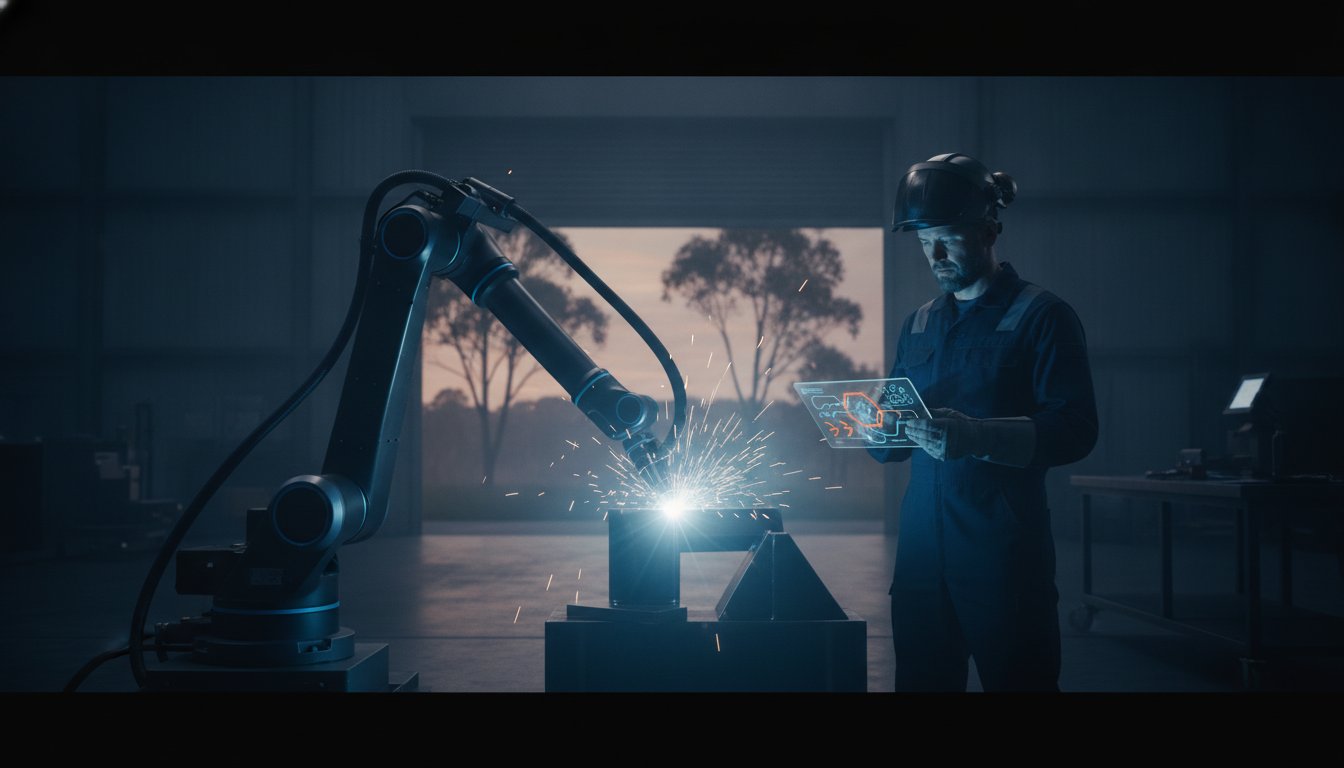
Implementing High Precision Welding in Your Workshop
Moving from manual fabrication to automation can feel like a massive leap, but success usually comes down to a methodical approach. You don't need to overcomplicate the process. Instead, focus on a clear transition plan that respects your existing workshop flow. High precision cobot welding works best when it's integrated into a floor that already has solid manual processes in place. The goal is to let the machine handle the "boring" precision, freeing your skilled team for the complex fit-ups that require a human eye.
To get started, we recommend a five-step integration plan:
- Step 1: Identify high-value, repetitive precision jobs. Look for parts with long weld seams or tight tolerances that currently cause high rework rates. These are your best candidates for initial automation.
- Step 2: Audit your infrastructure. Check your existing power sources, gas supply, and floor space. Most collaborative cells are designed to plug into standard workshop power, but you'll want to ensure your current MIG or TIG equipment is compatible with robotic control.
- Step 3: Prioritise operator training. Onboarding is the secret to a fast ROI. When your team feels confident with the no-code interface, they'll find new ways to use the cell that you hadn't even considered.
- Step 4: Continuous optimisation. Use software updates to refine weld paths and adjust for material variations. The digital twin of your process allows you to tweak settings without stopping production for hours.
- Step 5: Scale your production. Once the first cell is delivering consistent results, you can look at scaling to a fully integrated line or adding a second mobile unit.
Preparing Your Staff for Automation
It's natural for staff to feel a bit of "robot anxiety" when a new machine arrives on the floor. We find the best way to overcome this is through hands-on demonstrations where the welders themselves get to move the arm. Identify a "Cobot Champion" in your team, someone who is respected for their welding skill and open to learning new tools. This person will lead the transition, moving from spending all day behind a mask to managing the overall welding process. This shift empowers your best people rather than making them feel replaced.
Technical Integration and Support
You shouldn't have to replace all your gear just to start with automation. A pragmatic integration ensures the cobot works with your current MIG or TIG power sources. To prove the concept before you commit, we often recommend using a Mobile Demo System to see the results on your own shop floor. Having local Australian technical support is also vital. If you have a question about a specific weld path or a software update, you need an expert who understands the local manufacturing environment and can help you minimise any potential downtime.
The TME Systems Advantage: Precision Without Complexity
At TME Systems Pty Ltd, we believe that automation should adapt to your workshop, not the other way around. Our approach to high precision cobot welding is built on the reality of the Australian manufacturing floor, where versatility and reliability are non-negotiable. We don't just provide a robot arm; we offer a complete system integration that puts the power of advanced automation directly into the hands of your tradespeople. By removing the technical barriers that usually accompany robotic systems, we help you focus on what really matters: delivering perfect welds and keeping your production schedule on track.
The core of our solution is the no-code teaching software. We've seen how much knowledge your senior welders hold, and our system is designed to capture that expertise. Instead of hiring external programmers, your existing team can lead the robot through a path, adjusting parameters like travel speed and arc voltage in real-time. This pragmatic approach ensures that the "tribal knowledge" of your best staff is translated into robotic consistency, allowing you to achieve sub-millimetre accuracy without a single line of G-code. It's about empowering your workforce to do more with the skills they already possess.
Our commitment to your success doesn't end when the equipment is delivered. We provide end-to-end support that covers everything from the initial proof-of-concept to ongoing operator training and onboarding. We're here to ensure that your collaborative cell becomes a productive member of your team as quickly as possible. This steady, supportive relationship is why Aussie fabricators choose us as their partner in innovation. We understand the local industry hurdles and provide the technical assistance needed to keep your workshop moving forward.
Mobile Demonstrations: Seeing is Believing
We know that every workshop has its own unique challenges, which is why a one-size-fits-all approach rarely works. To help you make an informed decision, we bring the technology to your door. We'll set up a cell on your floor and use it to weld your actual parts, validating the precision and speed in your specific environment. This hands-on experience removes the guesswork and proves the value of the system before you commit. If you're ready to see the results for yourself, you can book your mobile welding robot demonstration today.
Long-Term Partnership and Integration
Our goal is to keep Australian manufacturing competitive on a global stage by providing tools that refine your process and reduce labour-intensive rework. As technology evolves, we provide ongoing software updates and technical support to ensure your system stays at the cutting edge. We're invested in your long-term growth, moving beyond a simple transaction to a collaborative partnership. If you're ready to level up your production and eliminate bottlenecks, contact TME Systems Pty Ltd for a consult.
Future-Proof Your Workshop Floor
The pressure on Australian fabricators isn't going away, but the tools to handle it have arrived. By adopting high precision cobot welding, you're giving your best tradespeople the ability to scale their expertise without the complexity of traditional programming. We've explored how no-code software removes technical barriers and why these flexible cells are more practical than caged industrial robots for the varied job runs common in local shops.
At TME Systems, we provide more than just hardware. Our turnkey cells are designed specifically for Australian standards, supported by local experts who understand your day-to-day challenges. This isn't about replacing the skill on your floor; it's about refining it. If you're ready to see how this technology handles your specific parts, we'll bring the solution to you.
Book a Mobile Demonstration to see this technology in your workshop and discover how simple automation can be. We're here to help you stay competitive and grow your production with confidence.
Frequently Asked Questions
Is high precision cobot welding suitable for TIG welding applications?
Yes, high precision cobot welding is exceptionally well-suited for TIG applications. Because TIG requires a steady arc length and extremely consistent travel speeds, the robotic arm's precision often exceeds what is possible manually. These systems can manage the delicate torch manipulation and wire feeding required for high-spec stainless steel or aluminium work, ensuring clean, aesthetic seams with minimal distortion on thin-gauge materials.
How long does it take for a welder to learn the no-code software?
Most experienced welders become proficient with the no-code interface in just a few hours. Since the software uses a "lead-by-the-hand" teaching method, there is no need to learn complex programming languages or G-code. A typical operator can go from a basic introduction in the morning to teaching a new weld path and running production by the end of the same afternoon.
Can a cobot handle heavy-duty structural steel welding?
Yes, cobots are more than capable of structural steel work when integrated with a sufficiently powerful MIG source. While they are often associated with smaller precision parts, their ability to perform long, multi-pass welds makes them ideal for structural beams and plates. The consistency of the robot ensures that deep penetration is maintained throughout the joint, meeting the rigorous demands of Australian structural standards.
Do I need a special power source to achieve high precision?
You don't necessarily need a brand-new machine, but a modern digital power source is recommended for the best results. High precision cobot welding relies on the robot and the welder communicating in real-time. This allows the system to adjust arc characteristics instantly as the torch moves, which is essential for maintaining a stable weld pool on complex geometries or thin materials.
What are the safety requirements for operating a cobot without a fence in Australia?
Operating without a safety fence requires a formal risk assessment according to AS/NZS 4024 and ISO 15066 standards. This process evaluates the speed of the robot, the welding process itself, and the proximity of workers. Because the robot has built-in force-sensing technology, it can stop if it detects contact, but the entire workstation must be assessed to ensure a safe collaborative environment.
How does the cobot handle variations in part fit-up?
The system uses advanced features like touch sensing and through-arc seam tracking to account for minor fit-up variations. Before starting the arc, the robot can "touch" the part to find its exact location. During the weld, it monitors electrical feedback to adjust the torch path in real-time, ensuring the bead stays centred even if the part is slightly warped or misaligned in the jig.
What is the typical ROI period for a collaborative welding cell in a small shop?
Many Australian workshops see a full return on investment within 6 to 18 months. This rapid ROI is driven by a combination of increased throughput and the near-total elimination of grinding and rework. By freeing up your senior welders to focus on complex fit-ups while the cobot handles repetitive seams, you can increase your overall output without adding to your headcount.
Does TME Systems provide on-site training for our staff?
Yes, we provide comprehensive operator training and onboarding as part of our integration service. We believe that the success of automation depends on the confidence of your team. Our specialists work directly with your welders on your own shop floor, ensuring they understand how to teach paths, adjust parameters, and maintain the system for long-term production success in your specific environment.