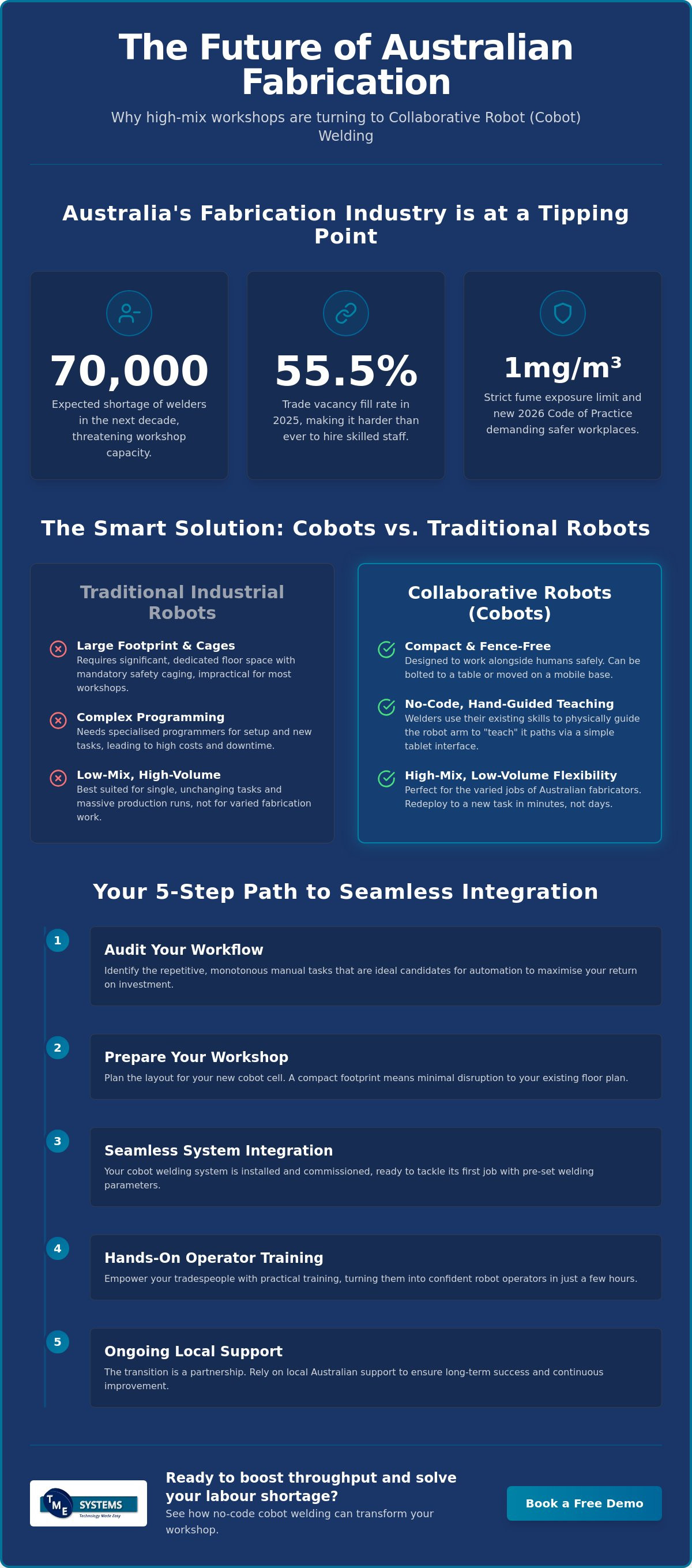

Did you know that Australia is expected to face a shortage of 70,000 welders over the next decade? For fabricators looking into cobot welding Sydney wide, this statistic isn't just a headline; it's a daily reality that makes it harder to get jobs out the door. You've likely found that traditional automation is often too expensive for your shop or far too complex for the small, varied batches you actually handle. It's a common frustration to feel stuck between a lack of skilled staff and technology that feels like it requires a university degree to operate.
We believe that technology should support the tradesperson, not replace them. This guide will show you how to transition to automated welding using no-code technology to boost your throughput without needing complex programming skills. You'll learn how to empower your existing staff to produce consistent, high-quality results while easily meeting the strict 1mg/m³ fume exposure standards. We will walk through the practical steps of system integration, operator training, and staying compliant with the 2026 Code of Practice.
Key Takeaways
- Discover how no-code teaching software allows your existing team to "teach" robot paths by hand, completely removing the need for complex programming skills.
- Understand why workshops looking into cobot welding sydney wide are using collaborative cells to solve the skilled welder shortage while maintaining high quality standards.
- Learn to calculate your return on investment by focusing on increased arc-on time and the long-term labour savings found in high-mix production.
- Follow a practical five-step implementation plan to audit your current manual tasks and prepare your workshop floor for a seamless robotic integration.
- See how hands-on operator training and ongoing local support turn a technical transition into a supportive partnership that empowers your tradespeople.
The Shift Toward Collaborative Automation in Australian Fabrication
The Australian fabrication industry is currently facing a perfect storm. With the 'Code of Practice: Welding Processes' becoming legally binding on July 1, 2026, and the strict 1 mg/m³ exposure limit for welding fumes already in effect, workshop owners are under more pressure than ever to modernise. For those exploring cobot welding sydney businesses are leading the way by moving away from the idea that automation is a threat to the trade. Instead, they are viewing the collaborative robot (cobot) as a high-tech tool that sits right alongside the welder. This partnership allows the machine to handle the monotonous, repetitive runs while the tradesperson applies their expertise to the complex joints that require a human touch.
We are at a tipping point where accessible industrial automation is no longer a luxury for Tier 1 contractors. The technology has matured to a point where it's rugged, reliable, and designed for the dust and heat of a local workshop. By integrating these systems, you aren't just buying a machine; you're building a more resilient business model that can withstand the unpredictable nature of the modern labour market. For those looking to scale this digital transformation further, PLM-Sme FZC offers specialised consultancy in industrial digitalisation and Product Lifecycle Management to ensure your technology investments are fully optimised.
Solving the Labour Shortage with Smart Tech
Weld Australia has highlighted a looming gap of 70,000 welders over the next decade. When you combine this with a trade vacancy fill rate that sat at just 55.5% in 2025, it's clear that simply trying to hire more people isn't a viable long-term strategy for growth. Smart technology allows you to keep your shop competitive by maximising the 'arc-on' time of your existing staff. By automating the straight-line fillets and repetitive circular welds, your best welders can focus on high-value tasks, such as complex assemblies and custom fabrication. This shift also reduces the physical strain on your team, helping to retain older, more experienced staff who might otherwise struggle with the ergonomic demands of high-volume manual welding.
Cobots vs. Industrial Robots: The Practical Difference
Traditional industrial robots are massive, expensive, and require significant floor space for safety cages and light curtains. In a typical Sydney workshop where every square metre of floor space counts, these systems are often impractical. Cobots offer a different path for several reasons:
- Fence-free operation: Inbuilt power and force-limiting sensors allow cobots to work safely in shared workspaces without physical fencing.
- Compact footprint: Most units can be bolted to a standard welding table or moved around the shop on a mobile base.
- High-mix flexibility: Unlike traditional robots that are hard-wired for one task, cobots can be redeployed to different jobs in minutes.
This flexibility makes them the ideal choice for the high-mix, low-volume production that characterises most Australian fabrication businesses. You don't need a thousand identical parts to justify the setup; you just need a few hours of repetitive work that could be better handled by a machine.
Simplifying the Process: How No-Code Software Empowers Your Team
The biggest barrier to entry for many local shops is the fear of complex code. If you're looking at cobot welding sydney solutions, you might worry that you'll need to hire an expensive consultant every time you want to weld a new part. That simply isn't the case anymore. Modern collaborative systems use intuitive interfaces that feel more like using a smartphone than an industrial computer. By removing the need for a dedicated programmer, you put the power back into the hands of your welders. They are the ones who understand penetration, travel angles, and heat input. This user-centric approach aligns with research from the University of Technology Sydney, which has helped shape how workers safely and effectively interact with these smart machines on the workshop floor.
The transition from manual work to automation is no longer about learning a new language. It's about using your existing trade skills in a more efficient way. When your team sees that they can control the robot's every move through a touchscreen, the "fear of the machine" disappears. They stop seeing the cobot as a threat and start seeing it as a way to get through the boring jobs faster. If you want to see this simplicity for yourself, you can book a mobile demo system to visit your shop floor.
Teaching Robot Paths Without a Single Line of Code
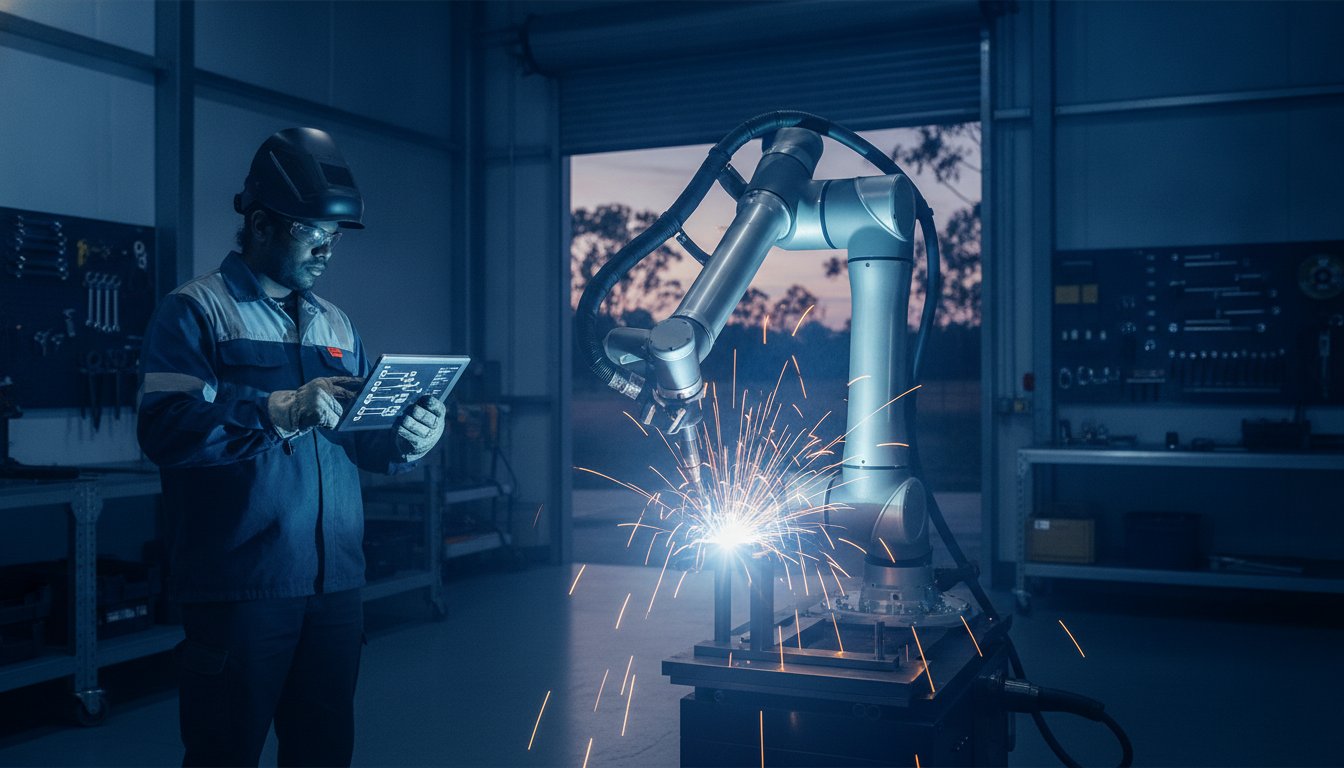
The "lead-through" method is the heart of modern cobot operation. Instead of typing coordinates, your welder simply presses a button on the robot arm and physically moves it to the start and end points of the weld. No-code robot welding software acts as the essential interface for modern fabricators, turning these physical movements into precise digital instructions instantly. While moving the arm, the operator can adjust parameters like voltage, wire feed speed, and travel speed on the fly. It's a tactile, hands-on process that feels natural to anyone who has spent years with a torch in their hand.
Rapid Job Changeovers for Small Batch Success
Australian workshops rarely deal with thousands of identical parts. Most of the work is high-mix, meaning you might need to switch from a MIG task on a trailer frame to a different jig for a batch of brackets in the same afternoon. No-code software makes this possible by allowing you to save and recall weld paths in seconds. Once a job is "taught" once, it's stored in the library. This reduces downtime between production runs and ensures that even a small batch of ten items can be automated profitably. Your tradespeople can manage the entire library themselves, ensuring the workshop stays productive without waiting for external tech support.
Assessing ROI: Why Cobots Suit High-Mix Australian Workshops
When you're looking at the bottom line for cobot welding sydney workshops, the conversation usually starts with the purchase price. However, the real return on investment comes from looking at the "arc-on time" and the reduction of hidden costs. In a typical manual setup, even your best welder might only have the arc struck for 20% to 30% of their shift. The rest of the time is spent on part positioning, cleaning, and the inevitable fatigue that comes with a high-heat environment. A collaborative cell changes this dynamic by keeping the torch moving while the operator prepares the next jig. This doesn't just speed up the process; it makes your production schedule predictable.
The financial impact of high precision cobot welding goes beyond just speed. It's about the total cost of the finished part. When a machine delivers the same perfect bead on the hundredth part as it did on the first, you're effectively removing the "Friday afternoon" human error factor. This level of repeatability allows you to quote on jobs with much tighter margins, knowing exactly how much gas, wire, and time each component will consume.
Calculating the Real Cost of Manual Rework
Grinding isn't just a loud and dirty job; it's a massive drain on your workshop's profitability. Every hour a staff member spends fixing a sub-par weld or grinding back excessive spatter is an hour they aren't finishing a new project. By implementing a cobot, you significantly reduce the hidden expenses of abrasives and scrapped materials. This consistency acts as a tool for accurate project quoting. You can confidently promise lead times to your clients because you've standardised the most variable part of the fabrication process. It's a way to improve your workshop throughput without the constant struggle of trying to increase your headcount in a tight labour market.
Future-Proofing for 2027 and Beyond
Investing in automation is a long-term play for the health of your business. As we head toward 2027, the ability to scale your operations will depend on how well you've integrated these systems. Collaborative cells are modular, meaning you can start with one station and add more as your contract volume grows. This approach also helps with staff retention. Younger apprentices and tradespeople are increasingly looking for shops that use modern tools. They want to be "robot supervisors" rather than just manual labourers. By providing this tech, you make your workshop a more attractive place to work, ensuring you have the talent needed to keep the doors open for years to come.
The 5-Step Implementation Plan for Your First Welding Cell
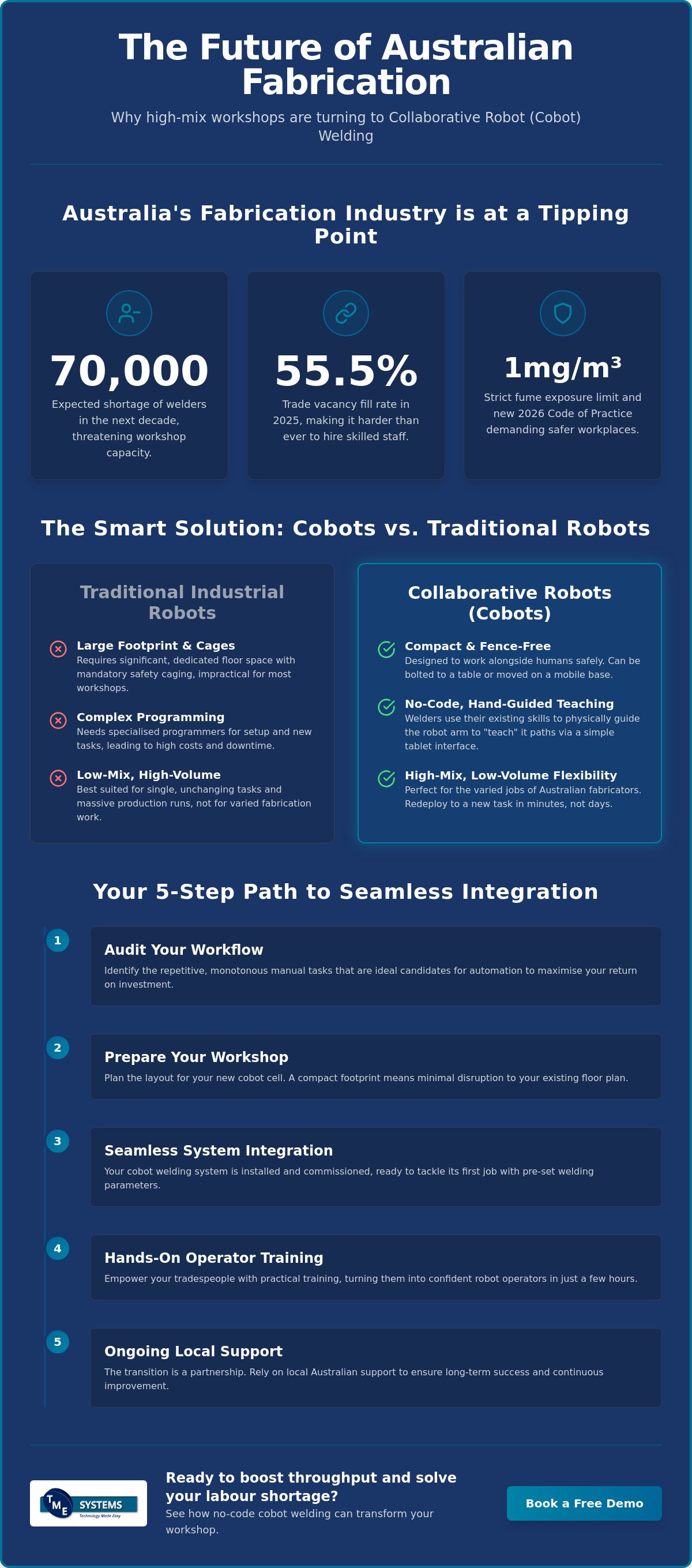
Transitioning to automation shouldn't feel like a leap of faith. It's a methodical process that respects your existing workflow while introducing new efficiencies. For many fabricators looking into cobot welding sydney, the goal is to start small, prove the value, and then scale. Following a structured plan ensures you don't waste time on technical hurdles that could have been avoided with a bit of foresight. By following these five steps, you can move from a purely manual shop to a tech-enabled powerhouse in a matter of weeks.
- Step 1: Audit your tasks. Don't try to automate your most complex custom job first. Look for the "low-hanging fruit"—the repetitive brackets or long straight seams that eat up your skilled staff's time.
- Step 2: Evaluate your workshop. While cobots have a small footprint, they still require stable 3-phase power and a level floor. Ensure your chosen area has enough room for the operator to move safely around the cell.
- Step 3: Select your system. Decide between a pre-configured turnkey cell or a custom integration. This choice depends on your specific jigs and the variety of parts you plan to run.
- Step 4: Onboard the team. This is the most critical phase. Conduct staff inductions that focus on the "no-code" interface, showing your welders how the machine makes their job easier, not harder.
- Step 5: Run a pilot project. Pick one high-volume part and spend time refining the weld parameters and timing. Use this project to set a benchmark for quality and throughput.
Conducting a Workshop Audit
The success of your first cell depends on identifying the right work for the machine to handle. Measure your current cycle times for a baseline so you can accurately track your improvement. It's essential to involve your lead welders in this selection process. They know which jobs are the most tedious and which ones are prone to human error after several hours on the torch. By letting them choose the first pilot project, you gain their buy-in and ensure the technology is solving a real problem on the floor.
Integration and Setup Best Practices
Working with specialists ensures that your new cell talks to your existing equipment without a hitch. Whether you are using a modern digital power source or a reliable older MIG unit, compatibility is key to a smooth rollout. Remember that the robot is only as good as the parts it's given. High-quality jigs and fixtures are the unsung heroes of cobot welding sydney setups. If your parts aren't held in the same position every time, the robot's precision is wasted. If you're ready to see how this fits into your specific workshop layout, our team provides comprehensive welding system integration to get you started.
Securing Success Through Operator Training and Local Support
The transition to automation is only half complete once the cell is bolted to the floor. The real success of cobot welding sydney operations depends on how well your team adapts to their new digital colleague. While the software is intuitive, a structured training programme ensures that your welders don't just use the machine but master it. This master-level understanding allows them to troubleshoot minor fit-up issues or adjust for heat sink variations without needing to call for external help. It turns a piece of equipment into a reliable workshop asset that grows in value as your team's skills evolve.
A local partnership provides the safety net needed for long-term production stability. When you have a question about a specific material grade or a complex jig setup, you need an answer from someone who speaks the language of the Australian workshop floor. We focus on being a practical mentor rather than just a vendor, providing the steady confidence your staff needs to push the limits of what their new tools can achieve. This collaborative relationship ensures that your investment continues to deliver high-quality results long after the initial installation is finished.
Comprehensive Operator Onboarding
Effective onboarding is about more than just showing which buttons to press. It's about building a culture of safety and precision around human-robot collaboration. Your team will learn the specific protocols for working in shared spaces, ensuring that every operator feels secure while the arm is in motion. We also dive into advanced techniques for refining weld quality over time, such as adjusting weave patterns for wider gaps or fine-tuning the start and end parameters to eliminate craters. This hands-on approach ensures your staff remains empowered and in control of the fabrication process.
The TME Systems Pty Ltd Partnership
We provide end-to-end integration and training services that are designed to minimise disruption to your daily workflow. By choosing TME Systems Pty Ltd, you gain a partner invested in your workshop's specific output goals. One of the best ways to start this journey is by seeing the technology in action through our mobile demo system. We can bring the cell to your floor, allowing you to test your actual parts and jigs before making a final decision. It's a transparent way to verify the ROI and see the "no-code" simplicity firsthand. If you're ready to see how we can support your business, Book a consultation to see how we support Australian fabricators.
Future-Proofing Your Workshop with Accessible Automation
Transitioning to a collaborative cell is no longer a complex engineering project; it's a practical step toward securing your workshop's future. By utilising no-code software for instant operation and turnkey cells designed specifically for local workshops, you can bypass the traditional hurdles of industrial programming. This technology allows your existing team to work alongside smart systems, ensuring you meet the strict 2026 safety standards while maintaining high throughput. You don't need to be a programmer to lead your shop into the next era of manufacturing.
Choosing the right partner for cobot welding sydney means accessing Australian-based integration and support that understands your daily challenges. We are here to help you refine your processes and support your growth every step of the way. If you're ready to see how this tech handles your specific parts, Book a Mobile Demo to See Cobot Welding in Your Workshop. Taking the first step toward automation is a move that will pay dividends for your team's morale and your shop's bottom line. We look forward to helping you build a more resilient, productive workshop.
Frequently Asked Questions
How much does a cobot welding system cost in Australia?
The investment for a collaborative system depends on the complexity of your jigs and the specific welding process you require. While there are various tiers of systems available in the Australian market, from basic entry-level units to high-end custom cells, it's important to consider the total integrated cost. This includes the robot arm, the welding power source, and the necessary fume extraction to meet the 1 mg/m³ exposure standards.
Do I need a robotic programmer to operate a cobot welder?
No, you don't need a specialist programmer to run these systems on your floor. Modern no-code software allows your existing tradespeople to "teach" the robot by physically moving the arm to the required points. This makes the technology accessible to anyone who already understands the fundamentals of a good weld, keeping the control in the hands of your skilled staff.
Can a cobot welder perform both MIG and TIG welding?
Yes, cobots are highly versatile and can be integrated with both MIG and TIG power sources. While MIG is the most common choice for high-volume repetitive tasks, TIG integration is an excellent option for high-precision work on stainless steel or aluminium. The system is designed to adapt to the specific needs of your workshop's production mix.
Is cobot welding safe to use without a safety cage?
Collaborative robots are designed with inbuilt power and force-limiting sensors that allow them to work safely alongside humans. If the arm makes contact with an object or person, it stops instantly to prevent injury. However, you must still conduct a thorough risk assessment of the welding arc itself and ensure your workshop meets the 2026 legal standards for fume and fire safety.
How long does it take to install and start welding with a cobot?
Most workshops looking at cobot welding sydney can have a cell integrated and operational within a matter of days. Once the hardware is physically in place, the intuitive software allows your team to begin teaching paths for their first parts in just a few hours. This rapid deployment ensures your production schedule isn't disrupted by a long and complex installation process.
What is the typical ROI period for a collaborative welding robot?
The typical payback period for a collaborative welding robot is often between 12 and 24 months. Workshops that run multiple shifts or have high-volume repetitive tasks frequently see a return on their investment even sooner. This is achieved by increasing "arc-on" time and significantly reducing the hidden costs associated with material scrap and manual grinding.
Can cobots weld aluminium and stainless steel effectively?
Absolutely. Cobots excel at welding aluminium and stainless steel because they maintain a perfectly consistent travel speed and torch angle. This precision is vital for managing the heat input required for these sensitive materials. The result is a cleaner bead with significantly less warping, which is often difficult to achieve consistently with manual welding over long shifts.
What maintenance is required for a robotic welding cell?
Maintenance is very similar to your existing manual equipment and focuses mostly on the torch consumables. You will need to regularly check and replace contact tips, shrouds, and liners to ensure weld quality remains high. The robot arm itself is built for the industrial environment and typically only requires periodic software updates and basic mechanical inspections to ensure it continues to operate reliably.