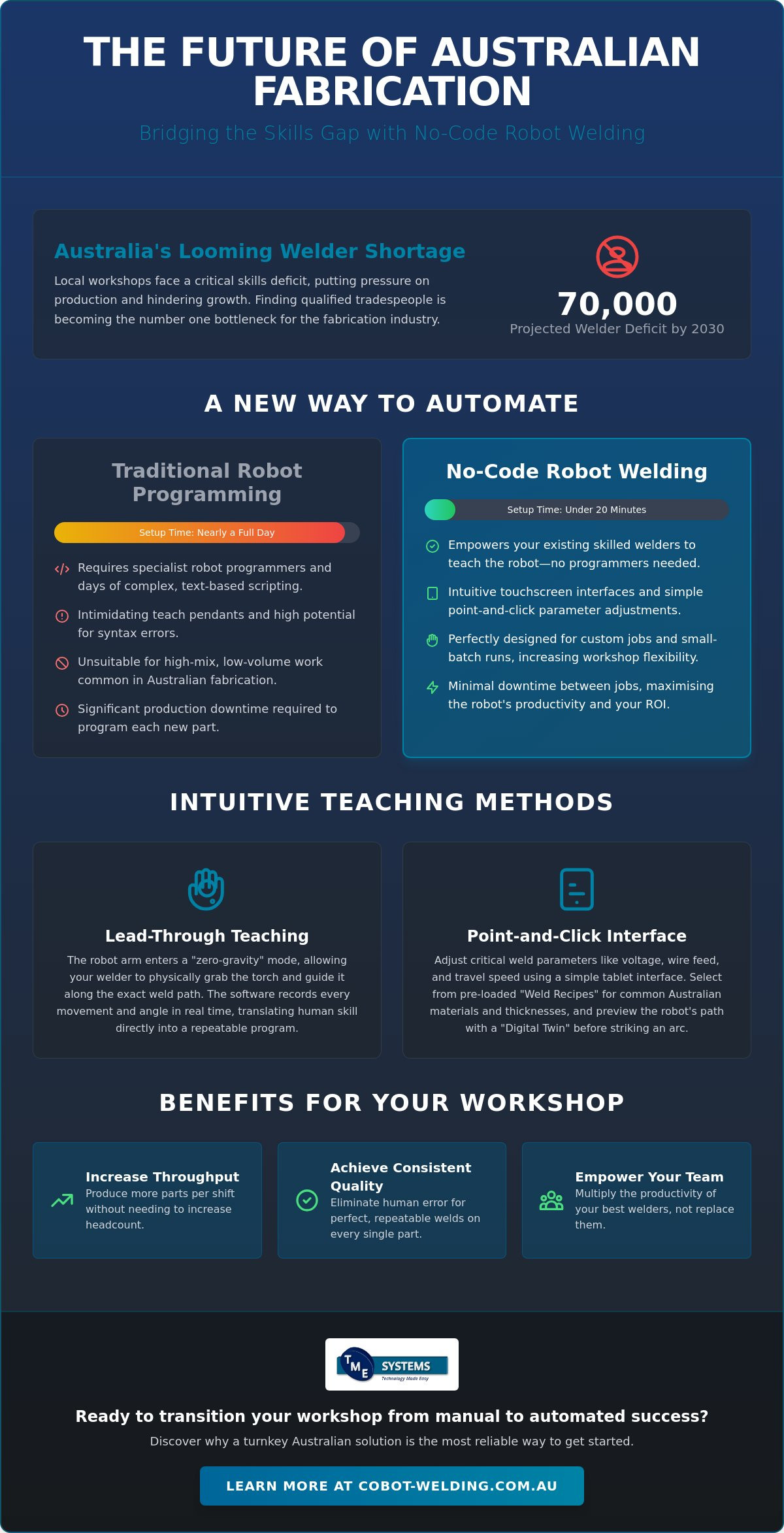

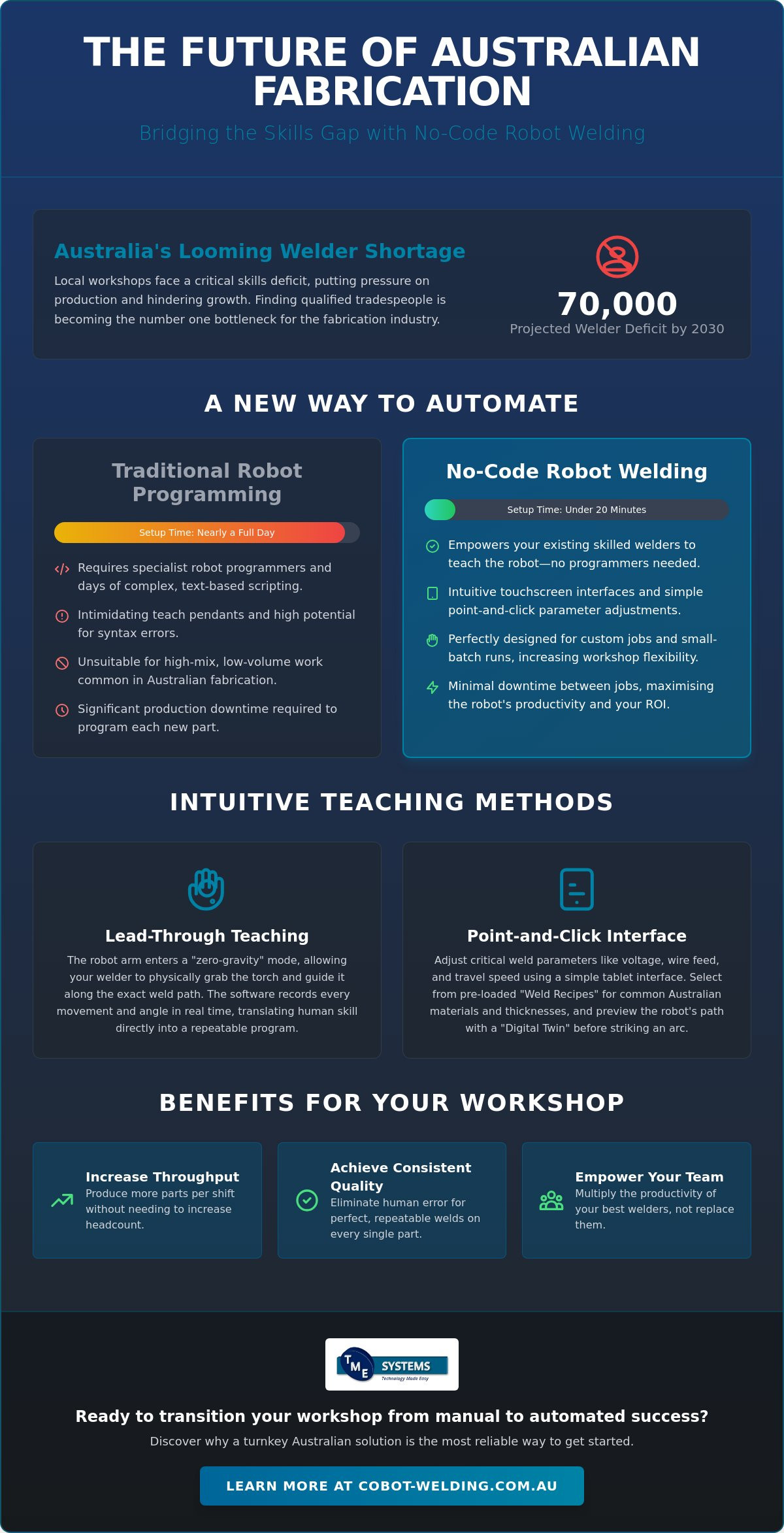
Australia faces a projected deficit of 70,000 skilled welders by 2030, a figure that highlights the growing pressure on local workshops. You've likely felt the pinch of this shortage while trying to balance tight deadlines with a team that's already stretched to its limit. It's frustrating to watch potential growth stall because you can't find the right hands for the job, or because traditional automation feels too complex for custom, small-batch runs. This is where no-code robot welding software steps in to bridge the gap.
We understand that your most valuable resource is the expertise of the tradespeople already on your floor. This guide shows you how to empower your existing team to teach welding robots in minutes, completely removing the need for expensive programming specialists. You'll discover how to increase your workshop's throughput and achieve consistent weld quality without needing to increase your headcount. We'll explore how simple, lead-through programming can turn your workshop into a more productive, predictable, and competitive operation.
Key Takeaways
- Learn how no-code robot welding software empowers your experienced welders to teach new paths using physical guidance instead of complex programming scripts.
- Compare the efficiency of modern automation, where setup times for new parts can be reduced from nearly a full day to less than twenty minutes.
- Master the "Lead-Through" and "Point-and-Click" techniques that allow your team to handle high-mix, low-volume work with total confidence.
- Discover how to select the right software-hardware combination that integrates seamlessly with your existing welding power sources.
- Find out why an Australian turnkey solution is the most reliable way to transition from manual processes to automated success.
What is No-Code Robot Welding Software and Why Does it Matter?
For decades, automation was a luxury reserved for the massive production lines of car manufacturers. If you wanted a robot to weld a part, you needed a specialist programmer to spend days writing complex scripts. That doesn't work for the average Australian fabrication shop. Most local businesses deal with "high-mix, low-volume" work, meaning they change parts frequently and need to move fast. No-code robot welding software changes this dynamic by allowing operators to teach weld paths through visual interfaces or by simply moving the robot arm by hand. It shifts the focus from "syntax and scripts" to "points and parameters," making automation accessible to anyone who understands a weld pool.
The Evolution from Traditional Coding to Intuitive Teaching
The old way of setting up Robot welding involved a "teach pendant" covered in buttons and lines of code that looked like a foreign language. It was slow, intimidating, and prone to errors. Modern no-code systems replace those pendants with touchscreens and lead-through programming. Think of the software as a sophisticated translator; the welder shows the robot the intent, and the software handles the underlying geometry. This evolution has reduced the "time-to-first-weld" from several hours of painstaking coding to under twenty minutes. You no longer need to take the robot out of production for a whole shift just to introduce a new part.
Why Australian Fabricators are Making the Switch
Australian workshops are currently facing a significant challenge: a chronic shortage of qualified manual welders combined with rising operational costs. With a projected deficit of 70,000 welders by 2030, your growth can easily hit a ceiling if you can't find enough MIG or TIG specialists to keep up with orders. Implementing no-code robot welding software provides a practical way to increase throughput without needing to hire additional staff. Unlike traditional "offline programming" which often requires perfect CAD files and a desk-bound engineer, on-the-fly teaching happens right on the workshop floor. It allows your best welders to set up a job, hit start, and then move on to more complex tasks that require a human touch. No-code software is a tool that empowers tradespeople to multiply their productivity rather than replacing their hard-earned skills with a machine.
How No-Code Technology Simplifies Complex Welding Paths
The real power of no-code robot welding software lies in its ability to strip away the technical barriers that usually stop a fabrication shop from automating. Instead of writing lines of logic, your team interacts with the robot in ways that feel familiar to a manual welder. This isn't just about making the process "easier"; it's about making it fast enough to be profitable on a single custom frame or a small run of brackets. When you don't have to spend half a day debugging code, the robot becomes a tool you can use for almost any job that comes through the door.
Lead-Through Teaching: The Most Intuitive Path
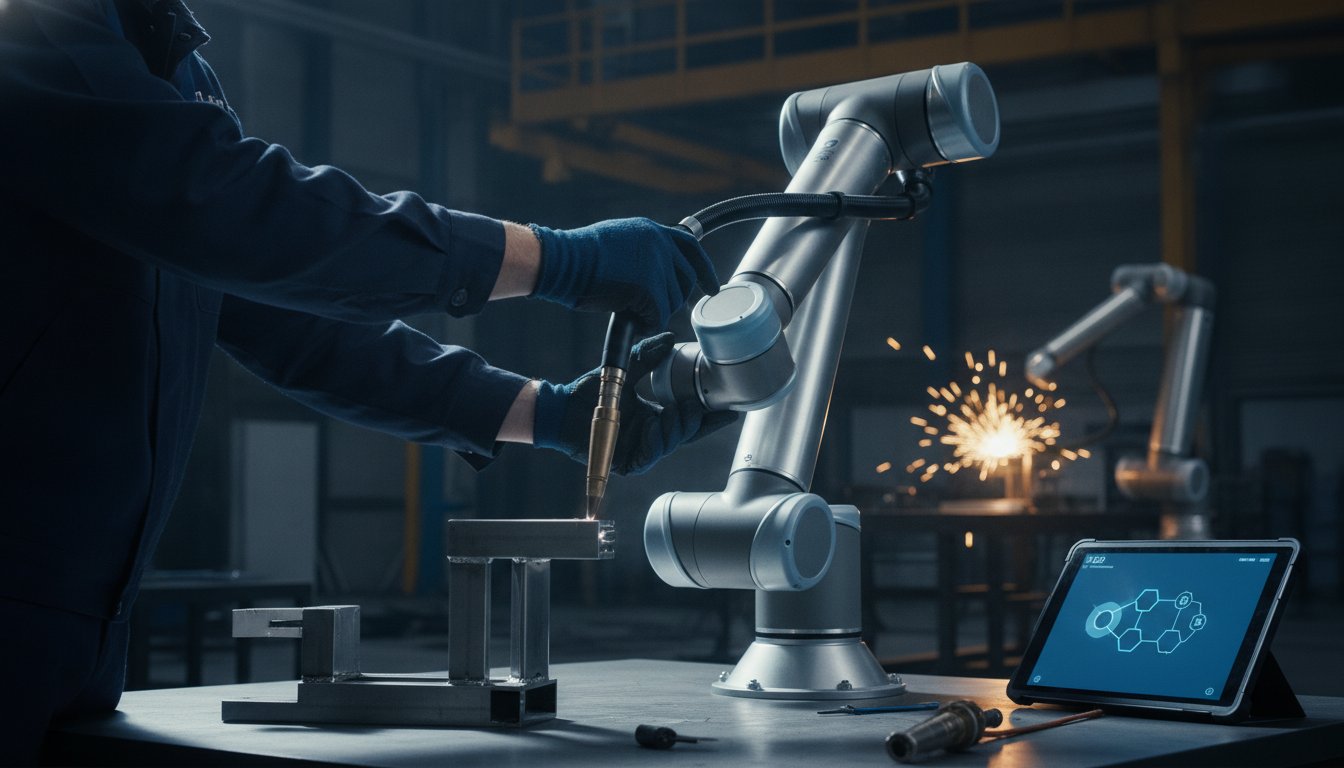
Lead-through teaching is perhaps the most significant leap forward for workshop floor automation. In this mode, the robot arm enters a "zero-gravity" state, allowing an operator to physically take hold of the torch and guide it along the desired weld path. It feels like a natural extension of the welder's own arm. As you move the torch, the software records the coordinates and orientation in real time. This method is particularly effective for complex, non-linear joins where no programming required means a welder can set a path based on their professional instinct rather than a coordinate grid. For safety, these paths are always taught at a reduced speed, allowing the operator to verify clearances before the system runs at production pace.
Visual Programming and Parameter Management
Once the path is set, managing the technical details happens through a "Point-and-Click" tablet interface. Instead of typing text, operators use icons and sliders to adjust critical variables like voltage, wire feed speed, and travel speed. Most systems come with pre-saved "Weld Recipes" for common Australian material thicknesses and wire types. If the robot is working on 6mm mild steel, the operator simply selects the corresponding recipe and the software handles the rest. You can even see a "Digital Twin" preview on the screen, which shows exactly how the robot will move before it strikes an arc.
One of the biggest frustrations with older systems was the inability to make small changes without a full restart. With modern no-code robot welding software, if a part is slightly out of alignment, the operator can tweak a single point on the path or adjust the weave pattern on the fly. This level of control ensures that the final weld meets the quality standards required by AS/NZS 1554 without requiring a software degree. If you want to see how this works on your own parts, our mobile demo system can show your team exactly how simple the interface is in a real-world setting.
Traditional Programming vs. No-Code Software: A Practical Comparison
When you look at the bottom line, the difference between old-school automation and modern no-code robot welding software comes down to one thing: agility. Traditional systems were designed for factories making thousands of identical parts. In that environment, spending a full day programming a single robot move makes sense. For most Australian job shops, however, that level of downtime is a deal-breaker. If you can't get a robot up and running in the time it takes to have a smoko, the machine usually ends up sitting in the corner gathering dust. No-code software changes the ROI calculation by making even a five-part run profitable.
- Skill Requirements: Traditional systems require a software engineer or a technician trained in specific coding languages. No-code systems are designed for the experienced welders already on your team.
- Setup Time: Preparing a new part traditionally takes between 4 and 8 hours of coding and testing. With no-code teaching, that same part is ready to weld in 10 to 20 minutes.
- Cost of Changes: If a part design changes slightly, traditional programming often requires calling back a specialist. No-code allows for instant, floor-level tweaks by the operator.
Skill Barriers and Personnel Costs
Finding "Robot Programmers" in regional Australia is an uphill battle. Most graduates with those skills are snapped up by the mining or aerospace sectors, leaving local fabricators in the lurch. The complexity of traditional robot programming is reflected in the intensive training required to master it. No-code software removes this barrier by letting you promote your best manual welders to the role of "Robot Leads". Instead of sending a staff member away for weeks of coding school, you can achieve full proficiency with just a few days of on-site onboarding. This keeps your expertise exactly where it belongs: on the workshop floor.
Batch Size and Flexibility
Traditional robots were once the exclusive domain of automotive-scale production because they lacked the flexibility to handle "dirty" or inconsistent parts. In a real-world Australian workshop, material isn't always perfect, and jigs can have slight variations. No-code robot welding software excels in this "Job Shop" environment. It allows an operator to switch from a heavy trailer chassis to a small mounting bracket in minutes. If a batch of parts arrives with a slightly different offset, the operator can simply shift the weld path on the tablet rather than rewriting an entire programme. This adaptability ensures the robot stays busy, regardless of how varied your daily production schedule looks.
Transitioning Your Workshop: From Manual Welding to Automated Success
Moving from a purely manual operation to one supported by automation doesn't have to happen overnight. The most successful Australian fabricators take a staged approach, starting with "high-value, low-complexity" parts. These are the repetitive jobs that consume hours of skilled labour but don't require intricate, bespoke handiwork. By offloading these runs to no-code robot welding software, you immediately free up your best welders for the complex, high-margin projects that actually need their expertise. This initial phase allows your team to get comfortable with the system before you move on to more difficult geometries.
Once you've identified your target parts, the next step is ensuring your hardware and software work in harmony with your existing setup. You don't need to scrap your current gear. Modern no-code solutions are designed to integrate with the MIG and TIG power sources you already use on your floor. As you build momentum, you'll start developing a "Weld Library". This is a digital catalogue of your repeat jobs; next time a regular customer calls with an order for fifty brackets, you simply pull up the saved path and start welding in minutes.
Getting Staff Buy-In for New Technology
The biggest hurdle in any workshop isn't the technology; it's the "human element." It’s natural for experienced staff to feel anxious that robots might replace them. Address this early by framing the robot as a tool that handles the "dull, dirty, and dangerous" work. Identify "Automation Champions" within your team, those who are naturally curious about new tools, and let them lead the charge. When the rest of the crew sees their peers easily managing a robot, the intimidation factor disappears. TME Systems Pty Ltd provides a supportive, hands-on training environment that is essential to turning scepticism into genuine enthusiasm.
Preparing Your Infrastructure
Preparing your floor for a collaborative cell is simpler than you might think. Unlike traditional industrial robots, these systems have a compact footprint and often don't require extensive safety caging after a proper risk assessment. You'll need to consider three main factors:
- Floor Space: A level surface with enough room for the cell and the operator to move safely.
- Power and Air: Standard industrial power and a clean, dry air supply for the pneumatic components.
- Jigs and Fixtures: Simple, repeatable jigs are vital. Since the robot follows a set path, your parts must be in the same spot every time.
If you're ready to see how this fits into your specific workflow, the Collaborative Robot Welding Cells provided by TME Systems Pty Ltd are designed for rapid deployment in Australian workshops. We focus on getting your system integrated and your team productive without the usual headaches of complex automation projects.
Why TME Systems Pty Ltd is the Partner for Australian No-Code Automation
At TME Systems Pty Ltd, we don't believe in just selling a box and walking away. We know that for an Australian fabricator, the real value of no-code robot welding software is only realised when it's actually laying down clean beads on the workshop floor. Our approach is grounded in the reality of local manufacturing. We act as a practical mentor, helping you move from manual processes to automated efficiency without the usual technical headaches. Our turnkey philosophy means TME Systems Pty Ltd provides the software, the collaborative robot, and the training as a single, cohesive package. You don't have to worry about compatibility issues or hidden integration costs; we've already done the hard work of ensuring everything works together from day one.
National Integration and Technical Support
Choosing a partner who is physically present in Australia is critical for long-term ROI. You shouldn't have to rely on overseas technicians or wait through different time zones to get an answer to a simple question. TME Systems Pty Ltd provides national integration and technical support, ensuring that help is always nearby. We understand the specific standards that govern our industry, such as AS/NZS 1554 for structural welding and AS 4024.3301 for robotic safety. Our relationship with our clients is an end-to-end partnership. TME Systems Pty Ltd starts with a thorough feasibility study to ensure automation is right for your parts, and we stay involved through operator onboarding and regular 12-month check-ins to refine your processes.
Seeing is Believing: The Mobile Demonstration
The most common question we hear from workshop owners is: "Can my team actually do this?" We believe the best way to answer that is to show you. Our Mobile Demo System is a unique service where TME Systems Pty Ltd brings the technology directly to your floor. There is a distinct "Aha!" moment when a manual welder uses no-code robot welding software to teach a path in under five minutes. It demystifies the technology and proves that automation is a tool for the tradesperson, not just the engineer.
Beyond the initial setup, TME Systems Pty Ltd focuses heavily on operator training and onboarding to ensure your team feels ownership of the new equipment. We don't just show them which buttons to press; we teach them how to refine the system for different jobs. This hands-on support is what turns a machine into a productive member of your team. If you want to see how this looks on your own parts, Book your mobile welding robot demonstration with TME Systems Pty Ltd today and see the difference that accessible automation can make to your throughput.
Take Control of Your Workshop's Productivity
Modern automation isn't about replacing the skills your team has spent years perfecting. It's about removing the bottlenecks that slow you down. By adopting no-code robot welding software, you allow your experienced welders to focus on high-value tasks while the robot handles the repetitive runs. You've seen how this technology slashes setup times from hours to minutes, making even the smallest batches profitable.
TME Systems Pty Ltd is an Australian-owned and operated integration specialist dedicated to making this transition seamless. We provide specialised training for your existing manual welders and offer ongoing local support to ensure your long-term success. If you're ready to see the results for yourself, our mobile demo units can come directly to your workshop to show you the system in action on your own parts.
Book a Mobile Demo to See No-Code Welding in Action
It's time to stop worrying about the welder shortage and start building a more resilient, efficient future for your business. We're here to support you every step of the way.
Frequently Asked Questions
Do I need to know how to code to use no-code welding software?
No, you don't need any programming knowledge or experience with scripts to operate the system. The interface is designed specifically for the tradespeople already on your workshop floor. Instead of typing lines of code, your team uses a tablet or physically guides the robot arm to set weld paths. This approach makes no-code robot welding software accessible to anyone who understands how to lay a quality bead.
Can no-code software handle complex TIG welding paths?
Yes, the software is fully capable of managing the precision required for TIG applications. It allows for fine adjustments to travel speed and torch angle, which are critical for high-quality joins on thinner materials. You can set specific parameters for arc starts and craters just as you would during a manual process. This flexibility ensures that aesthetic welds meet your workshop's quality standards without complex programming.
How long does it take to train a manual welder to use the software?
Most manual welders become proficient with the system after just a few days of on-site training. Because the interface uses familiar welding terminology and visual icons, the learning curve is exceptionally shallow. TME Systems Pty Ltd focuses on a hands-on onboarding process that gets your team comfortable teaching the robot their first parts immediately, ensuring they feel confident in their new role as robot leads.
Is no-code software compatible with my existing MIG welder?
Yes, the software is designed to integrate with most modern MIG and TIG power sources from major global brands. TME Systems Pty Ltd handles the system integration to ensure the robot communicates perfectly with your existing equipment. This allows you to leverage your current gear while adding the benefits of automation. We verify your equipment's compatibility during the initial feasibility stage to ensure a seamless match.
What happens if the part isn’t perfectly aligned with the CAD model?
You don't actually need a CAD model to set your weld paths with this technology. If a part is slightly out of alignment or the fit-up varies, the operator can simply adjust the points on the tablet or move the robot arm to the correct position. This on-the-fly teaching is a major advantage of no-code robot welding software over traditional automation, which often struggles with real-world part inconsistencies.
Can I use no-code software for small batches of only 5 or 10 parts?
Yes, small batches are exactly where this technology provides the most value. Traditional automation was once only profitable for thousands of identical parts, but no-code teaching makes a run of five or ten items viable. Since it takes less than twenty minutes to set up a new part, the robot spends more time welding and less time in setup mode, keeping your workshop competitive on custom orders.
Is the software difficult to update as new features are released?
Updating the software is a straightforward process that doesn't require a specialist to visit your site every time. Most updates are handled through simple digital downloads that introduce new features and refinements to the interface. As your local partner, TME Systems Pty Ltd provides ongoing support to help you navigate any major updates, ensuring your system stays current and continues to deliver a strong ROI.
Does no-code software work for aluminium and stainless steel?
Yes, the system works exceptionally well for both aluminium and stainless steel. You can create and save specific "Weld Recipes" that account for the different thermal properties and wire speeds required for these materials. This ensures consistent penetration and bead appearance across every project. Whether you are fabricating heavy steel frames or light aluminium brackets, the software adapts to the specific technical needs of the material.