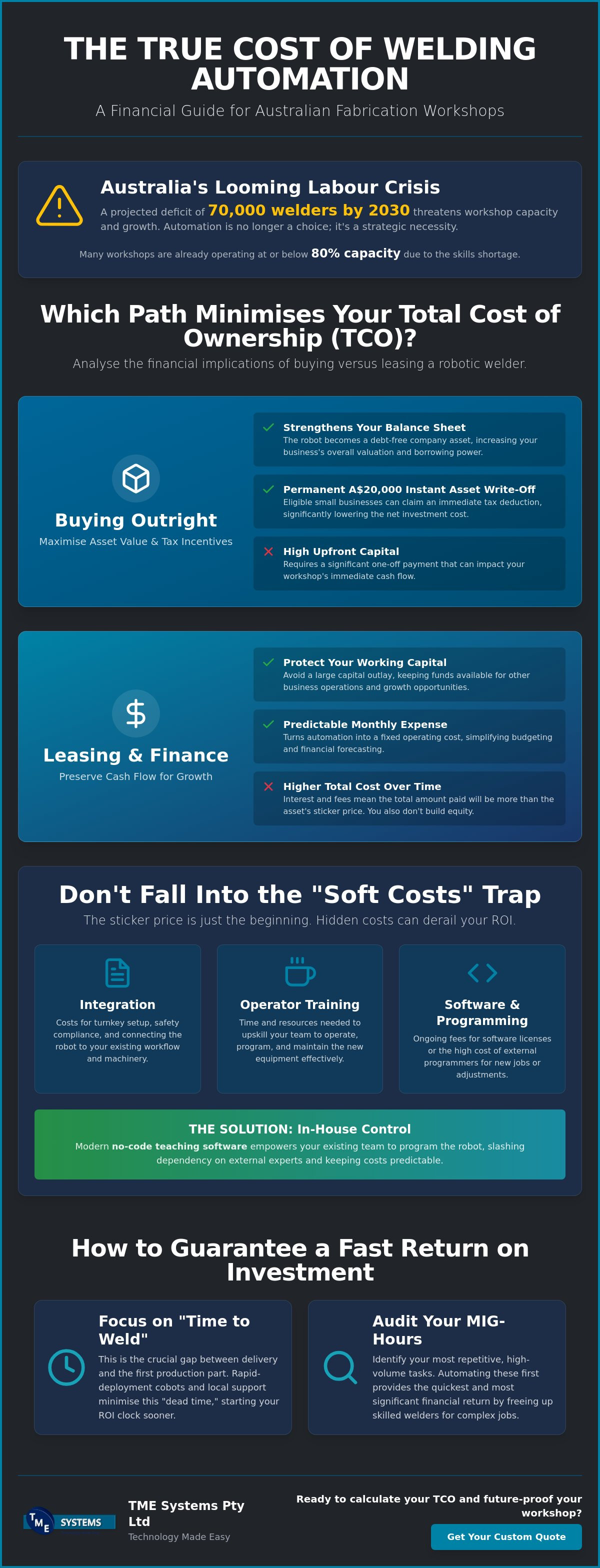

With Australia facing a projected deficit of 70,000 welders by 2030, the question for your workshop isn't whether you should automate, but how much that transition will actually cost your bottom line. You probably recognise that the sticker price on a new machine is only the start of the journey. Between the current 4.35% RBA cash rate and the constant pressure to protect your cash flow, calculating the true robotic welder total cost of ownership can feel like trying to hit a moving target while managing hidden programming and maintenance fees.
We're here to help you master the financial side of automation by comparing leasing versus buying to find the best TCO for your Australian fabrication workshop. By the end of this guide, you'll understand how to leverage the permanent $20,000 instant asset write-off and use no-code software to slash soft costs. We will show you how to turn automation into a predictable monthly operating expense that delivers a faster strike-to-arc time and keeps your production lines moving.
Key Takeaways
- Understand why the deepening Australian skills shortage makes automation a vital tool for protecting your workshop's long-term capacity.
- Calculate the true robotic welder total cost of ownership by factoring in turnkey integration, operator training, and essential safety compliance.
- Evaluate the financial benefits of outright ownership, including the permanent A$20,000 instant asset write-off, versus leasing options that preserve your cash flow.
- Discover how no-code teaching software can help you avoid the "soft cost" trap by keeping programming and adjustments in-house.
- Learn how to audit your workshop’s MIG-hours to identify the specific tasks where automation will deliver the fastest return on investment.
The 2026 Labour Crisis and the Robotic Welder Total Cost of Ownership
The 2026 labour crisis isn't just a headline; it's a daily reality on the workshop floor. With a projected deficit of 70,000 welders across Australia by 2030, finding and keeping skilled staff has become the single biggest bottleneck for growth. This shortage makes understanding your robotic welder total cost of ownership more than a financial exercise; it's a survival strategy for local manufacturers. If you can't find the people to weld, you can't deliver the projects.
Defining TCO requires looking past the invoice price of the robot arm. It's the total investment needed to get a finished part out the door, including hardware, software, integration, and the training your team needs to succeed. The Australian market is shifting away from massive, fenced-off industrial robots. Instead, collaborative cells (cobots) are becoming the standard for job shops. These systems are designed to work with your people, fitting into existing workflows without requiring a total factory overhaul.
The Opportunity Cost of Manual Welding
The most significant hidden expense in a manual workshop is the work you can't take on. When half of Australian welding workshops are operating at or below 80% capacity due to skills shortages, every contract you turn away represents lost revenue. Manual welding also carries the risk of inconsistent quality and high rework rates. Robotic welding technology provides a level of repeatability that human hands can't match over a long shift, protecting your reputation and your margins. Additionally, keeping your experienced welders on repetitive tasks often leads to burnout and staff turnover. By automating the simple runs, you allow your best people to focus on high-value, complex work that keeps them engaged.
The "Time to Weld" Metric
The faster you strike the first arc, the sooner your robotic welder total cost of ownership begins to equalise. We look at "Time to Weld" as the gap between the machine arriving at your door and the first production part being finished. Modern cobots reduce this "dead time" significantly because they are designed for rapid deployment and easy setup. Local support plays a vital role here; having experts nearby to assist with integration and operator onboarding ensures you aren't left with an expensive paperweight. Reducing downtime through reliable support and intuitive software keeps your ownership costs predictable and your production schedule on track.
Choosing to "wait and see" is often the most expensive decision a business owner can make. With rising labour costs and the A$20,000 instant asset write-off now a permanent fixture for small businesses, the financial case for automation is clear. Starting the transition today ensures your workshop remains competitive and capable of meeting the demands of Australia's growing infrastructure and defence sectors.
Buying Outright: Maximising Asset Value and Tax Incentives
Buying a robotic cell outright is a significant decision. It’s a one-off capital hit that immediately strengthens your workshop balance sheet. For many Australian fabrication businesses, owning the equipment provides a sense of security that leasing can't match. When you own the hardware, it's a debt-free asset that contributes to your business's overall valuation from day one. This approach is particularly effective for established shops with healthy cash reserves who want to avoid ongoing interest costs.
Australian Tax Incentives for 2026
The tax landscape in 2026 offers clear advantages for those purchasing equipment. From 1 July 2026, the A$20,000 instant asset write-off becomes a permanent fixture for small businesses with an annual turnover of up to A$10 million. This allows you to claim an immediate deduction for the full cost of eligible assets, reducing your taxable income in the year of purchase. It's part of a broader trend of government support for advanced manufacturing designed to keep local shops competitive. When calculating your robotic welder total cost of ownership, these upfront tax savings can significantly lower the net investment required.
Asset Ownership and Borrowing Power
Owning your automation technology outright does more than just simplify your taxes. It improves your borrowing power for future expansions. Banks and lenders look favourably on workshops that hold high-value, versatile assets like collaborative robot cells. There is also a distinct "peace of mind" factor. During seasonal lulls or quiet periods in the workshop, you don't have a fixed monthly lease repayment putting pressure on your cash flow. You have the flexibility to scale your production up or down without financial penalty.
A high-quality cobot cell is generally considered a 10-year asset. While you face a higher initial cost, you eliminate the long-term interest charges associated with financing. Ownership also grants you total customisation freedom. You can modify the cell layout, integrate bespoke jigs, or adjust the safety guarding to suit specific jobs without needing approval from a third-party finance provider. This flexibility is often why Tier 1 and Tier 2 suppliers prefer ownership; it demonstrates long-term contract stability and operational independence.
While you are responsible for maintenance, budgeting between A$1,000 and A$3,000 annually for servicing ensures your robotic welder total cost of ownership remains predictable over the machine's decade-long lifespan. If you're ready to see how this technology integrates with your current workflow, you might consider booking a mobile demo system visit to see the hardware in action on your own workshop floor.
Leasing and Finance: Preserving Cash Flow for Growth
While buying outright has its benefits for the balance sheet, many Australian workshops find that financing is a more strategic path for growth. Choosing to lease rather than buy isn't just about managing a lack of capital; it's about keeping your working capital liquid. In a market where raw material prices can be volatile, having cash on hand allows you to buy in bulk or navigate project delays without stress. Financing turns a major capital investment into a predictable monthly operating expense.
The "Pay-as-you-Earn" model is a particularly effective way to manage your robotic welder total cost of ownership. By aligning your finance repayments with the monthly revenue the robot generates, the machine effectively pays for itself as it works. This approach protects your cash flow and ensures that the technology is a self-sustaining part of your production line from the first month. Leasing also acts as a technology hedge. As automation evolves, a 3 or 5-year lease term makes it simpler to upgrade to the latest models without the burden of trying to sell an older, owned asset.
Robotic Welder Finance Structures in Australia
Lenders in Australia are now much more comfortable using collaborative robots as collateral for SMEs. A chattel mortgage is a popular choice because it allows you to own the asset from day one while claiming the full GST on the purchase price in your next Business Activity Statement (BAS). This provides an immediate cash flow injection that other structures might not offer. Commercial Hire Purchase is another option, though the GST treatment differs. Most workshops opt for terms between 36 and 60 months, often with a residual "balloon" payment at the end to keep the monthly repayments as low as possible.
Scaling Without the Capital Burden
When you compare a monthly lease repayment to the cost of a casual labour hire, the financial case for automation becomes even stronger. A lease on a collaborative cell often costs significantly less per month than the fully burdened rate of a single welder. This cost difference allows you to add a second or third cell to your workshop without needing a massive capital raise.
By preserving your cash through financing, you can invest in other areas that drive productivity. Many owners use their saved capital to implement no-code robot welding software. This ensures that your current staff can teach the robot new tasks in minutes, further reducing your reliance on hard-to-find specialist programmers. This combination of smart finance and accessible software is how modern job shops are scaling their capacity while keeping their financial risk low.
The "Soft Costs" Trap: Integration, Training, and Software
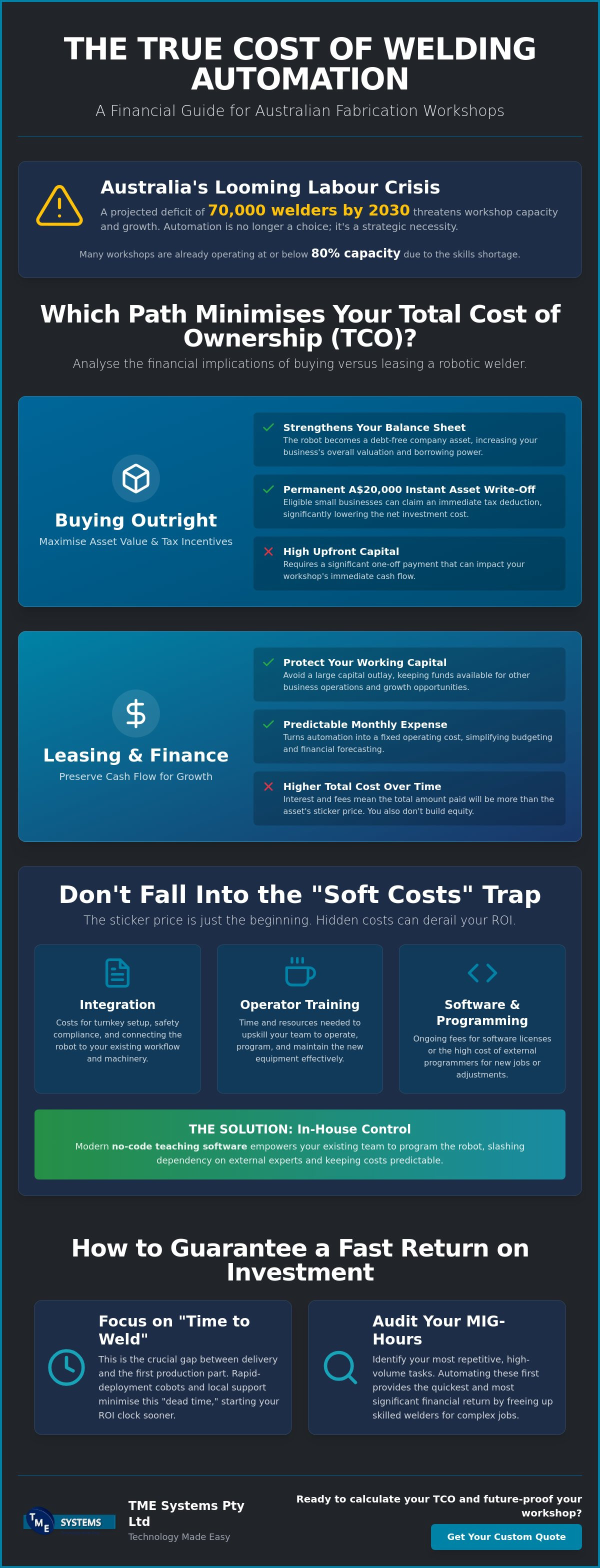
Many workshop owners get caught out by the sticker price of a standalone robot arm. It looks like a bargain until you realise it doesn't include the power source, the torch, the safety guarding, or the freight to get it to your site. These "soft costs" can easily account for 30% to 50% of the project total. A truly accurate robotic welder total cost of ownership must factor in a complete turnkey integration to avoid nasty surprises halfway through the setup.
The good news is that most of these initial costs are financeable. You can bundle the installation, freight, and operator training into your monthly lease or purchase agreement. This ensures you have a predictable figure from day one. We focus on delivering complete collaborative cells that are ready to work, rather than just a box of parts. This eliminates the risk of "DIY fatigue" where a project stalls because the workshop team doesn't have the time to build the safety enclosures themselves or figure out the electrical requirements.
The No-Code Software Advantage
Traditional robot programming is a significant drain on resources. It often requires a specialist or a long learning curve for your staff. This "intellectual capital" cost can blow out your robotic welder total cost of ownership if every new part requires hours of complex coding. No-code teaching software changes this dynamic. It allows your best welder to teach the robot by simply moving the arm and clicking a button. This keeps your expertise on the workshop floor and slashes changeover times for small-batch jobs. When the operator leads the machine, the machine becomes a tool rather than a burden.
Ongoing Maintenance and Consumables
Don't forget the daily consumables. High-duty cycle environments mean you'll go through liners, tips, and shrouds faster than you would with manual welding. Budgeting for these ensures your production doesn't stop for want of a A$10 part. Having local Australian technical support is equally vital. If a machine goes down, you need a partner who can provide parts or advice immediately. This prevents the machine from becoming an expensive paperweight and ensures your investment continues to deliver value year after year.
Investing in operator training and onboarding is your most important productivity multiplier. A team that feels confident with the technology will find new ways to use it, driving down the cost per part. If you want to see how a fully integrated cell fits into your production line, you can book a welding system integration consultation to map out your specific requirements.
Decision Framework: Which Path Minimises Your TCO?
Choosing between buying and leasing requires a clear-eyed look at your workshop's current output and future goals. To find the lowest robotic welder total cost of ownership, you need a framework that moves beyond guesswork and into hard data. We recommend a four-step audit to determine which path protects your margins while solving your labour constraints.
- Step 1: Audit your MIG-hours. Identify the most repetitive 20% of your current workload. These simple, high-volume tasks are where a robot delivers the fastest ROI.
- Step 2: Run the numbers. Compare a monthly lease repayment against your current fully burdened labour rate. If the machine costs less per month than a casual hire, the financial case is made.
- Step 3: Assess your team. Evaluate your internal capacity for programming. If you don't have a dedicated programmer, no-code software is essential to keep your TCO low.
- Step 4: Review your tax position. Determine if the permanent A$20,000 instant asset write-off at EOFY is more valuable to your business than preserving cash through a lease.
Volume vs Variety: The Job Shop Equation
The nature of your work often dictates the best financial structure. Buying outright usually suits manufacturers with high-volume, static product lines that won't change for years. In these cases, the long-term asset value outweighs the initial capital hit. Conversely, leasing provides a vital safety net for job shops where work types shift every quarter. It allows you to adapt your technology to the market without being locked into a single configuration forever. If you're unsure how a robot handles your specific parts, a mobile welding robot demonstration is an excellent way to prove the concept on your own floor before you commit to a contract.
The TME Systems Partnership
We understand that every Australian fabrication shop has different pressures. Our team helps you navigate the finance landscape with transparent, turnkey quotes that include every "soft cost" we discussed earlier. By focusing on accessible, no-code automation, we ensure your robotic welder total cost of ownership remains as low as possible throughout the life of the machine. Our relationship doesn't end when the first arc is struck; we provide the ongoing technical support and operator training needed to keep your workshop productive for the long haul. Whether you choose to lease or buy, we're here to ensure automation becomes a reliable partner in your business's growth.
Securing Your Workshop’s Future through Smarter Automation
Navigating the 2026 labour crisis requires a shift in how we think about production capacity. By now, you should have a clearer picture of how to balance upfront tax incentives against the cash flow benefits of leasing. Most importantly, you know how to avoid the hidden traps of DIY setups by focusing on turnkey cells and no-code software that keeps your best welders in control. Master the financial side of your investment by accurately calculating the robotic welder total cost of ownership before you sign on the dotted line.
Our team is here to simplify this transition with expert integration that meets Australian manufacturing standards. We provide no-code software that eliminates expensive programming costs and offer ongoing, Australian owned and operated support. If you're ready to see the technology in action on your own floor, you can Book a Mobile Demo to see how a cobot fits your workshop. Automation is a practical tool designed to empower your staff and keep your business competitive. We look forward to supporting your next step toward a more predictable and productive workshop.
Frequently Asked Questions
Is it better to lease or buy a welding robot for a small Australian workshop?
The choice depends on your current cash flow and tax requirements. Buying is often better for workshops with high-volume, static products that want to maximise upfront tax deductions like the instant asset write-off. Leasing is a strategic choice for job shops that need to keep their working capital liquid for raw material purchases or want the flexibility to upgrade as technology evolves.
What tax incentives are available for robotic welders in Australia for 2026?
From 1 July 2026, small businesses with an annual turnover under A$10 million can access a permanent A$20,000 instant asset write-off. This allows for an immediate deduction of the asset's cost in the year of purchase. Larger firms may also benefit from loss carry-back provisions or R&D tax incentives if the robotic welder total cost of ownership includes developing custom integration solutions.
Can I include the cost of operator training in a robot finance package?
Yes, you can typically bundle soft costs like operator training, onboarding, and system integration into your finance agreement. Lenders for Australian SMEs often allow these essential services to be financed alongside the hardware. This approach ensures your total investment is covered by a single, predictable monthly repayment rather than requiring a large secondary cash outlay for staff development.
What is the typical lifespan of a collaborative welding robot in a job shop?
A high-quality collaborative robot generally has an operational lifespan of approximately 10 years. To reach this milestone, you should budget for annual servicing, which typically costs between A$1,000 and A$3,000 in the Australian market. Regular maintenance protects your investment and ensures the arm maintains the precision required for high-quality fabrication over its decade of service.
How long does it take to see a return on investment (ROI) for a cobot welder?
Many Australian fabrication shops report a full return on investment within 12 to 18 months. The exact timing depends on your production volume and how quickly you integrate the machine into your workflow. Using no-code software to reduce the "time to weld" is the most effective way to shorten this period and begin offsetting the costs of the current skills shortage.
Does a welding robot lease count as a tax-deductible operating expense?
If you choose an operating lease, your monthly payments are generally fully tax-deductible as a business expense. This is different from a chattel mortgage, where you instead claim the interest on the loan and the depreciation of the asset. Because every workshop's financial situation is unique, it's vital to speak with your accountant to determine which structure best manages your robotic welder total cost of ownership.
What happens to the equipment at the end of a robotic welder lease?
Your options at the end of the term depend on the specific finance structure you've chosen. With a chattel mortgage or finance lease, you usually pay a pre-agreed residual "balloon" amount to take full ownership of the equipment. If you've opted for an operating lease, you may have the choice to return the machine, extend the lease, or upgrade to the latest model to keep your workshop at the cutting edge.
How much deposit is usually required for a robotic welder chattel mortgage?
Many Australian lenders offer A$0 deposit finance for established businesses with a solid credit history. While you can often finance 100% of the purchase price, including the GST, providing a 10% or 20% deposit can be a smart move. A larger deposit reduces your monthly repayments and the total interest you'll pay over the life of the loan, which lowers your long-term ownership costs.