
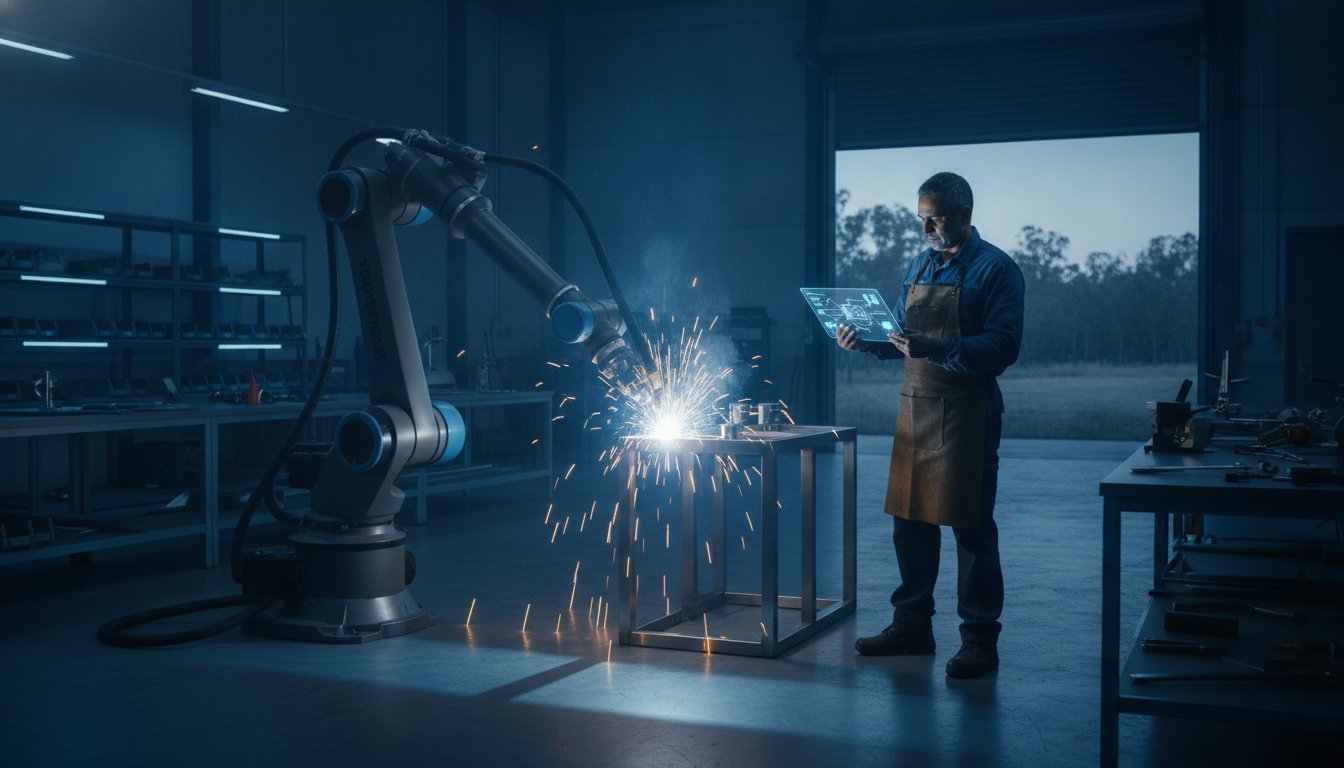
What if the most expensive part of your new automation isn't the machine itself, but the months it sits idle because no one knows how to program it? For many Australian fabricators, the fear of buying a "white elephant" is just as real as the pressure of a 70,000-welder shortage projected by 2030. You've likely felt the squeeze of rising labour costs and the frustration of manual weld quality dipping on those long, repetitive production runs that your best tradespeople find tedious.
We understand that you need more than just a shiny piece of hardware; you need a tool that actually works for your team from day one. This guide breaks down the current robotic welding system price landscape for 2026, moving past the initial quote to reveal the true, "all-in" investment. You'll learn how to calculate a predictable payback period and discover how no-code teaching software is making it possible for your existing staff to take control of the torch without needing a degree in robotics. We're here to help you move from uncertainty to a clear, pragmatic plan for your workshop's growth.
Key Takeaways
- Move beyond the "sticker price" to understand the true, all-in robotic welding system price, including why the robot arm itself is often only 30% of your total investment.
- Identify the essential components of a collaborative welding cell, from high-quality modular fixturing to the specialised power sources that ensure consistent weld quality.
- Learn how no-code teaching software eliminates the need for expensive external programmers, allowing your existing workshop team to take ownership of the technology.
- Use a simple two-step method to calculate your ROI by comparing your current fully-burdened labour rates against the significant gains in arc-on time.
- Discover why local technical support and operator onboarding are the most critical factors in preventing downtime and ensuring your system stays productive.
Understanding the Robotic Welding System Price Range in 2026
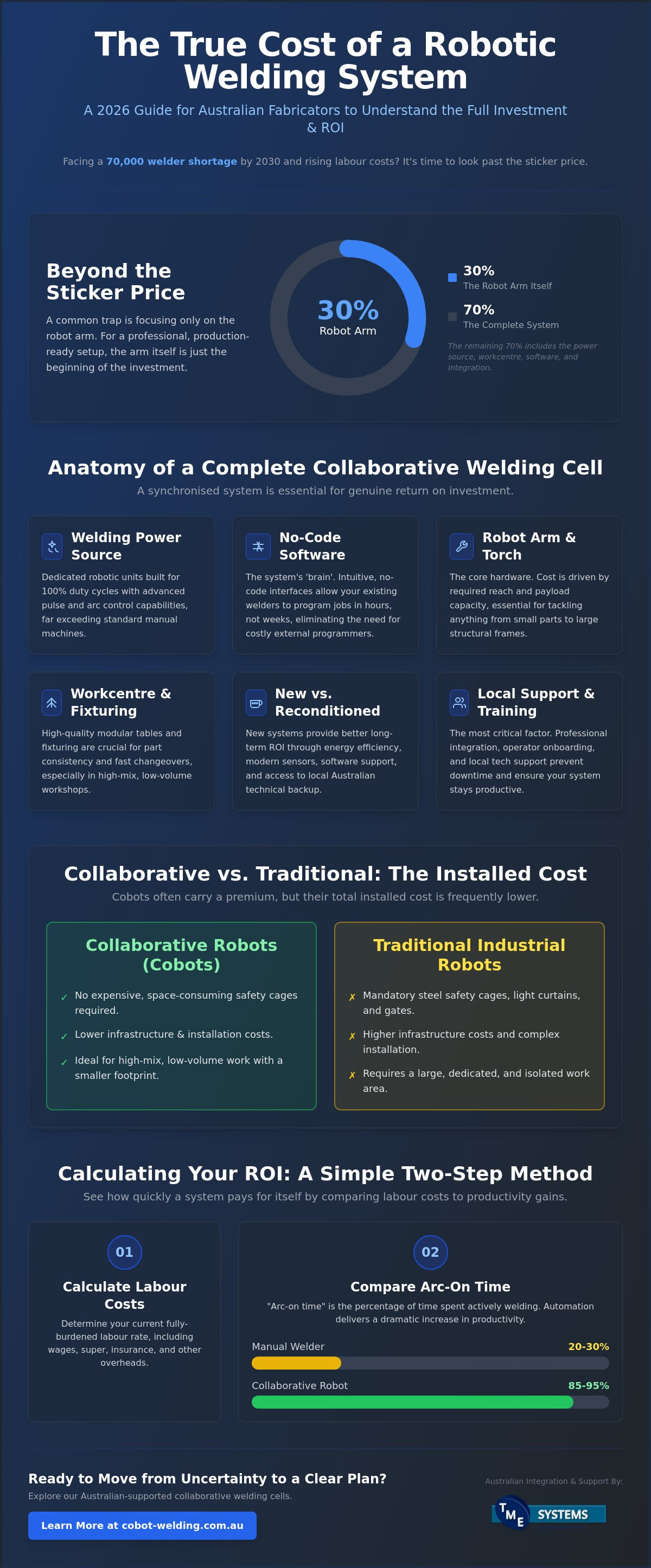
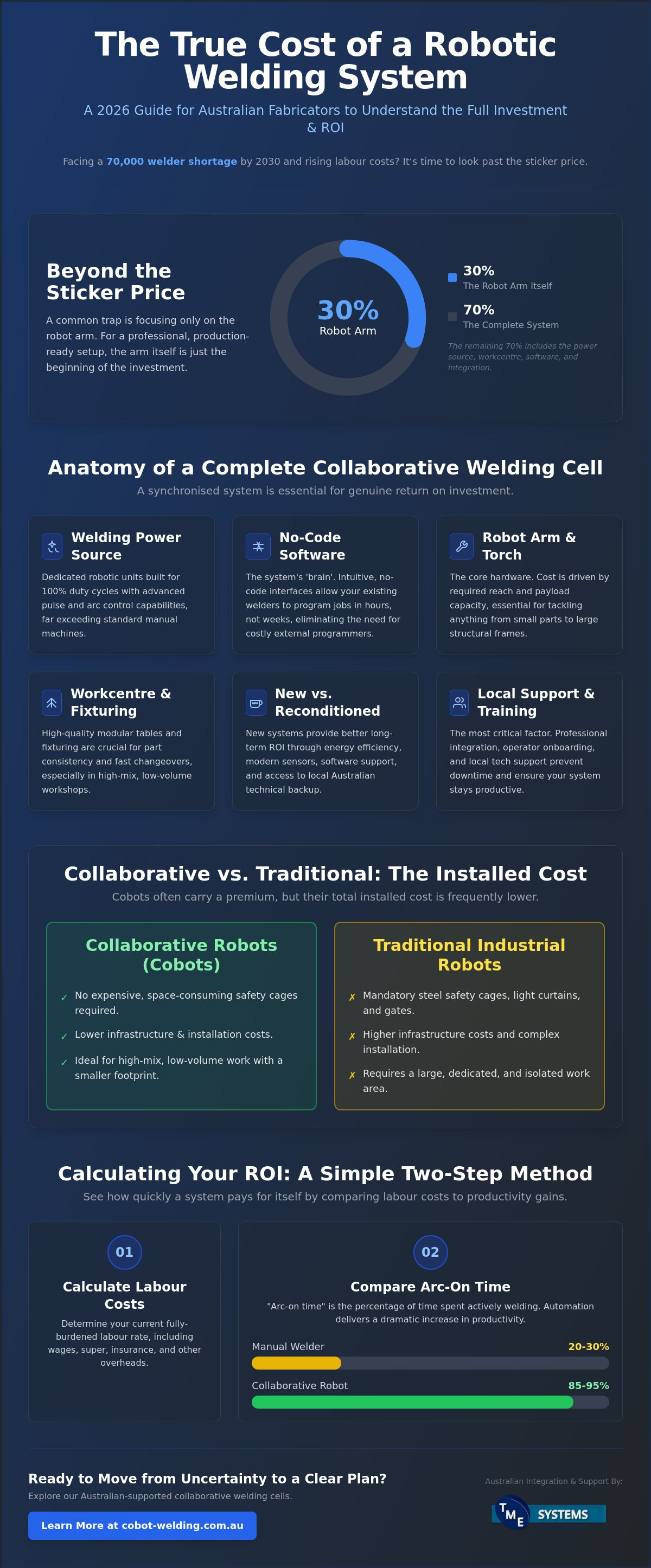
Every workshop owner starts with the same fundamental question: what is the total robotic welding system price once the unit is actually on the shop floor and producing parts? In the Australian market, the answer depends heavily on the gap between a standalone component and a complete, integrated solution. It's a common trap to focus solely on the robot arm, but for a professional setup, the "sticker price" of the arm itself usually only accounts for about 30% of the total investment. The remaining 70% is tied up in the welding power source, the torch assembly, the workcentre, and the software that brings it all to life.
The primary drivers of your investment are reach, payload, and the sophistication of the welding power source. If you're tackling large structural frames, you'll require a longer arm and a higher payload capacity, which naturally increases the cost. High-end power sources designed specifically for robotic welding are built for 100% duty cycles and offer advanced pulse capabilities that far exceed standard manual machines. When comparing options, you'll find a clear distinction between entry-level kits, which often require significant DIY integration, and industrial-grade collaborative cells that arrive ready to work.
Collaborative vs. Traditional Industrial Robots
One of the biggest shifts for Australian fabricators is the move toward collaborative robots, or cobots. While the robot itself might carry a premium due to its sensitive safety sensors, the "installed cost" is often much lower than traditional industrial robots. This is because cobots generally don't require the expensive steel safety cages, light curtains, or interlocked gates that take up valuable floor space. For high-mix, low-volume shops, the ability to work alongside the machine without a massive footprint makes the robotic welding system price easier to justify through reduced infrastructure costs.
New vs. Reconditioned Systems
It's often tempting to look at reconditioned or second-hand hardware to save on the initial outlay. However, this path is fraught with hidden risks, particularly regarding software compatibility. Modern 2026 technology offers significantly better ROI through energy-efficient motors and advanced seam-tracking sensors that older models simply don't have. More importantly, older systems rarely support the intuitive, no-code interfaces that allow your existing staff to program the robot. Investing in a new system ensures you have access to local Australian technical support and a predictable path for future upgrades, which is essential for long-term workshop stability.
The Anatomy of a Collaborative Welding Cell Investment
Thinking of a robotic welding system as just a mechanical arm is like buying a truck engine without the chassis. To get a genuine return on your investment, you need a complete, synchronised cell. The total robotic welding system price covers several distinct layers that must work in harmony. This includes the hardware, the workcentre, and the software that acts as the system's brain. Finally, professional integration and onboarding ensure your team isn't left staring at a complex machine they don't know how to use. For a workshop to remain competitive, these components must be selected for reliability and ease of use.
Software is often the most overlooked part of the package. It determines how fast you can switch between different jobs, which is vital for Australian shops handling high-mix, low-volume work. A system with a steep learning curve can lead to weeks of downtime. Conversely, intuitive software allows a skilled welder to become a proficient operator in a matter of hours. If you want to see how these components fit into a real-world setup, you can explore our collaborative robot welding cells for more detail.
The Welding Power Source Factor
Your choice between MIG and TIG capabilities significantly influences the robotic welding system price. While many shops consider integrating an existing power source to save money, a dedicated robotic source is often the smarter play. These units are built for the high duty cycles required by automation. Following current welding industry trends, advanced arc control and pulse welding features are becoming standard. These technologies reduce spatter and heat input, which means less time spent on post-weld cleaning and grinding. For most fabricators, the slight extra spend on a pulse-capable machine pays for itself through improved finish quality and reduced consumable wear.
Fixturing and Tooling Costs
A robot is only as good as the parts it's presented with. High-quality modular welding tables and flexible clamping systems are essential for repeatable results. While custom-built jigs might work for a single, massive contract, modular fixturing allows you to reconfigure your workspace for different projects in minutes. When budgeting, consider the following:
- Table Size: The "centre point" reach of your robot dictates how much of the table it can actually access.
- Clamping Kits: Modular systems allow for rapid adjustments without the need to weld up new jigs for every job.
- Repeatability: Precision fixturing ensures that the robot finds the weld seam in the exact same spot every time, preventing costly rework.
Investing in the right workcentre infrastructure from the start prevents your automation from becoming a bottleneck. By choosing flexible tooling, you ensure that your robotic welding system price reflects a long-term asset capable of adapting to whatever jobs come through the door next.
Why No-Code Software is the Real Cost-Saver for AU Workshops
When calculating the total robotic welding system price, most business owners focus on the hardware. However, the real cost of traditional automation often lies in the "programming tax." In Australia, a specialised robotic engineer can easily command a salary of over $120,000 per year. For a small to medium-sized workshop, adding that kind of overhead makes automation feel out of reach. No-code software changes this equation by shifting the power back to your existing tradespeople.
Traditional industrial robots require thousands of lines of complex code for even simple tasks. This creates a bottleneck where the machine sits idle while waiting for a specialist to arrive. The Welding Institute's analysis of robotic welding costs highlights that while initial investment is high, the long-term success of a system depends on operational efficiency. By eliminating the need for a dedicated coder, you remove the single biggest barrier to a profitable robotic welding system price over the life of the machine.
Empowering Your Existing Workforce
Your best welders already understand torch angles, travel speeds, and wire feed rates. They are the best people to oversee your automation, provided the interface is accessible. No-code robot welding software is a tool that translates hand-guided movements into precise machine code. This approach removes the "fear factor" often associated with new technology. When a welder can simply move the robot arm to the start and end points of a seam, the machine becomes a helpful partner rather than a confusing obstacle. It allows your skilled staff to focus on quality control instead of fighting with a computer screen.
High-Mix, Low-Volume Profitability
Australian fabrication is often built on small batches and custom jobs. In the past, traditional automation failed these shops because the time required to program a new part exceeded the time saved during the weld. No-code interfaces allow for rapid job changeovers, often taking only minutes to teach a new path. This makes it profitable to automate even a run of ten or twenty parts. To understand how this works in practice, you can refer to our No-Code Robot Welding Software Guide for a deeper look at accessible automation. By reducing the cost-per-part through faster setups, your workshop can take on more work without the need to hire hard-to-find specialised staff.
Calculating ROI: When Does the System Pay for Itself?
Understanding the robotic welding system price is only half the battle. To make a sound business decision, you need to calculate exactly how quickly that investment returns to your pocket. In the Australian market, where the average welder earns approximately $43 per hour, the financial case for automation is often stronger than many realise. By following a structured ROI calculation, you can move from guessing to knowing your payback period.
To find your true return, follow these five steps:
- Step 1: Determine your fully-burdened hourly labour rate. This includes superannuation, insurance, and overheads, usually bringing a $43 base rate up to $65 or $75 per hour.
- Step 2: Estimate your arc-on time increase. Robots typically move from a 25% manual average to over 70%.
- Step 3: Factor in the reduction in rework. Consistency means less grinding, less scrap, and fewer wasted consumables.
- Step 4: Account for Australian grants. Programs like the Industry Growth Program (IGP) offer matched funding between $50,000 and $250,000 for eligible businesses.
- Step 5: Calculate the payback period. Most Aussie workshops find that with a single shift, the system pays for itself in 12 to 18 months.
The 'Arc-on Time' Advantage
In a typical manual welding shift, a skilled tradesperson spends a huge portion of their day on part positioning and cleaning. A collaborative robot changes this dynamic through parallel processing. While the robot is busy laying down consistent beads on one side of the table, your operator is prepping the next part on the other. This effectively doubles or even triples your daily throughput without adding to your headcount. The consistency of a machine also ensures that high-spec fabrication jobs meet strict standards every single time, eliminating the human error that often leads to costly rework.
Beyond the Spreadsheet: Intangible Value
Not every benefit shows up in a weekly ledger. With Australia facing a projected deficit of 70,000 welders by 2030, automation is a vital strategy for business survival. It removes your best staff from the most repetitive, fume-heavy tasks, reducing the risk of long-term health issues and workplace injuries. This keeps your experienced team focused on complex, high-value projects that require human intuition and craftsmanship. If you're ready to see how these numbers apply to your specific workshop, you can book a mobile demo system to see the results on your own shop floor.
Choosing the Right Automation Partner in Australia
Selecting a partner is about more than just comparing quotes. A "box mover" might offer a lower initial robotic welding system price, but they often leave you to handle the complex integration and safety compliance on your own. In contrast, a specialised integration partner works with you to ensure the cell fits your specific workflow. They provide the necessary operator training and onboarding that turns a piece of machinery into a productive member of your team. Without this local support, a minor technical glitch could lead to days of expensive downtime while you wait for a response from overseas.
A critical part of the evaluation process is seeing the technology in action. A mobile demo system allows you to test the robot on your own part geometries before committing to a purchase. This proof of concept removes the guesswork. It confirms that your existing staff can actually use the no-code interface and that the machine can handle your specific weld joints. It's a pragmatic way to ensure the system delivers the ROI you've calculated without risking a "white elephant" on the shop floor.
Turnkey vs. DIY Integration
It's tempting to think you can save money by handling the installation yourself. However, the true cost of DIY integration often includes weeks of lost production and the risk of failing a mandatory safety risk assessment. Australian standards like AS/NZS 4024 for machinery safety and ISO 15066 for collaborative robots are legal requirements that must be met. A professional commissioning service ensures your cell is compliant and profitable from day one. Look for an Australian expert who understands local manufacturing realities and offers end-to-end support rather than just a transactional sale.
Next Steps for Your Workshop
Before your new cell arrives, you'll need to prepare your floor space and ensure your power supply meets the system's requirements. Most collaborative cells have a compact footprint, but they still need a stable, level surface to maintain precision. Booking a site visit is the best way to assess your specific workshop layout and part flow. This allows an expert to spot potential bottlenecks before they happen. When you're ready to move forward, you can Request a tailored quote for your robotic welding system to get a clear picture of the investment required for your specific needs. Taking this methodical approach ensures that your transition to automation is smooth, supported, and successful for the long term.
Future-Proofing Your Workshop with Confidence
Investing in automation is a strategic necessity for any Australian shop looking to navigate the projected shortage of 70,000 welders by 2030. As we've explored, the true robotic welding system price is about more than just the robot arm; it's an investment in a complete, integrated cell that works as hard as your best staff. By prioritising no-code software and modular fixturing, you ensure that your workshop remains agile enough to handle high-mix jobs without the expensive "programming tax" of external engineers. This approach keeps your existing team at the centre of the production process.
We're Australian-owned and operated integration specialists who understand the unique pressures of local manufacturing. Our collaborative cells come with no-code software designed specifically for tradespeople, and we include full operator onboarding and technical support to ensure your system is profitable from day one. You don't have to navigate this transition alone; we're here to act as a pragmatic partner in your workshop's growth. To see exactly how these cells perform with your specific parts, Book a Mobile Demonstration to See the ROI for Yourself. Taking this first step is the best way to move your business toward a more predictable and productive future.
Frequently Asked Questions
How much does a basic robotic welding system cost in Australia?
Entry-level robotic welding systems for basic MIG applications typically range between $40,000 and $70,000 for the hardware and controller. Mid-range systems with more advanced automation features generally fall between $70,000 and $120,000. These figures represent the base robotic welding system price before adding specialised fixturing or professional integration services.
Is a cobot welder cheaper than a traditional industrial welding robot?
While the initial package price for a cobot welder might start from $187,500 +GST, the total "installed cost" is often lower than traditional robots. Cobots don't require the expensive safety cages or light curtains that traditional industrial robots need to meet Australian safety standards. This reduced footprint and simpler setup make them a more cost-effective choice for many local workshops.
What are the hidden costs of welding automation?
The most common hidden costs include modular fixturing, safety risk assessments, and operator training. You should also account for the "programming tax" associated with traditional systems that require external specialists. Choosing a system with no-code software helps mitigate these ongoing expenses by allowing your existing team to handle job changeovers in-house.
How long does it take for a welding robot to pay for itself?
Most Australian fabricators achieve a full return on investment within 12 to 18 months of operation. This payback period is driven by the significant increase in arc-on time, which typically jumps from 25% with manual welding to over 70% with automation. When you factor in the current average welder salary of $89,075, the labour savings alone quickly offset the initial robotic welding system price.
Do I need to hire a programmer to run a robotic welding system?
No, you don't need to hire a dedicated programmer if you select a system equipped with no-code teaching software. These modern interfaces are designed for tradespeople rather than engineers; they allow your best welders to program new paths using simple hand-guided movements. This eliminates the need to pay for a high-salary robotic specialist to keep your production line moving.
Can I use my existing MIG or TIG welder with a new robot arm?
It is technically possible to integrate some existing power sources, but it isn't always the most pragmatic choice. Dedicated robotic power sources are built for 100% duty cycles and offer the high-speed communication required for the robot to control the arc precisely. A dedicated source ensures better weld quality and reduces the risk of communication errors between the arm and the welder.
What kind of maintenance costs should I budget for annually?
You should budget between $5,000 and $15,000 per year for maintenance and welding consumables. This covers routine items like torch tips, liners, and nozzles, as well as scheduled mechanical inspections and software updates. Regular maintenance is essential for preventing unplanned downtime and extending the service life of your investment.
Is there government funding or tax incentives for welding automation in 2026?
Several funding options exist, including the Industry Growth Program which offers matched grants between $50,000 and $250,000 for commercialisation projects. The Manufacturing Modernisation Fund also provides co-funding grants for small and medium enterprises. Additionally, businesses should check their eligibility for the Instant Asset Write-Off to accelerate the tax benefits of their new equipment.