
What if the most advanced tool in your workshop became a silent, expensive paperweight just because a single line of code went sideways? It is a valid fear for many Australian fabricators considering the leap into automation. You want the 30% to 50% boost in throughput that robotics can provide, but you don't want to be "locked out" of your own equipment. For workshops in regional areas, the worry is even sharper. Will you be left waiting days for a technician to travel to your site while production sits at a standstill?
We understand that technology should empower your tradespeople, not replace them or make them feel redundant. This guide explains how expert robotic welding technical support ensures your cobot welding system stays productive, regardless of your team's previous programming experience. You'll discover how the shift toward no-code software and local, responsive partnerships can bridge the skills gap. We will look at the practical steps to keep your cell running and why your experienced welders are actually the best people to handle most day to day adjustments themselves.
Key Takeaways
- Learn why modern cobot support focuses on empowering your fabricators rather than locking them out with complex industrial coding.
- Understand how no-code teaching software allows your team to troubleshoot and refine welding processes without needing a software engineer on-site.
- Discover how remote diagnostics now provide rapid robotic welding technical support for regional Australian workshops, significantly reducing potential downtime.
- Use our 5-point checklist to find a local partner who prioritises thorough operator onboarding over a simple 'drop-and-run' delivery.
- Gain the confidence to bridge the skills gap by ensuring your technology adapts to your welders, not the other way around.
Demystifying Robotic Welding Technical Support for Australian Fabricators
For many Australian workshops, the term "technical support" often conjures up images of IT consultants in high-vis vests or expensive flights for specialist engineers from overseas. In the context of Robotic Welding using collaborative robots (cobots), the reality is much more practical. Unlike traditional industrial robots that require high-level programming and rigorous guarding, cobot support is about keeping the system flexible and the operator in control. It's the difference between needing a software engineer to change a part and having a welder who can adjust the path on the fly.
Traditional industrial robot maintenance often focuses on mechanical cycles and complex PLC logic. In contrast, support for collaborative systems is geared toward the human-machine interface. Because cobots are designed to work alongside your team, the support must focus on safety and consistency. If the sensors aren't calibrated or the safety settings aren't correctly tuned to your specific floor layout, the system won't perform. Reliable robotic welding technical support bridges this gap, ensuring that your workshop remains a safe environment while your weld quality stays uniform across every shift.
Proactive support is what prevents a high-tech investment from becoming an expensive paperweight in the corner of the shed. If your team feels "locked out" or intimidated by the interface, they'll revert to manual welding the moment a minor glitch occurs. This usually happens when the "why" behind a system adjustment isn't clear. Effective support builds the confidence required to keep the arc on, maintaining the 30% to 50% throughput gains that these systems are designed to deliver.
What Does 'Support' Actually Cover?
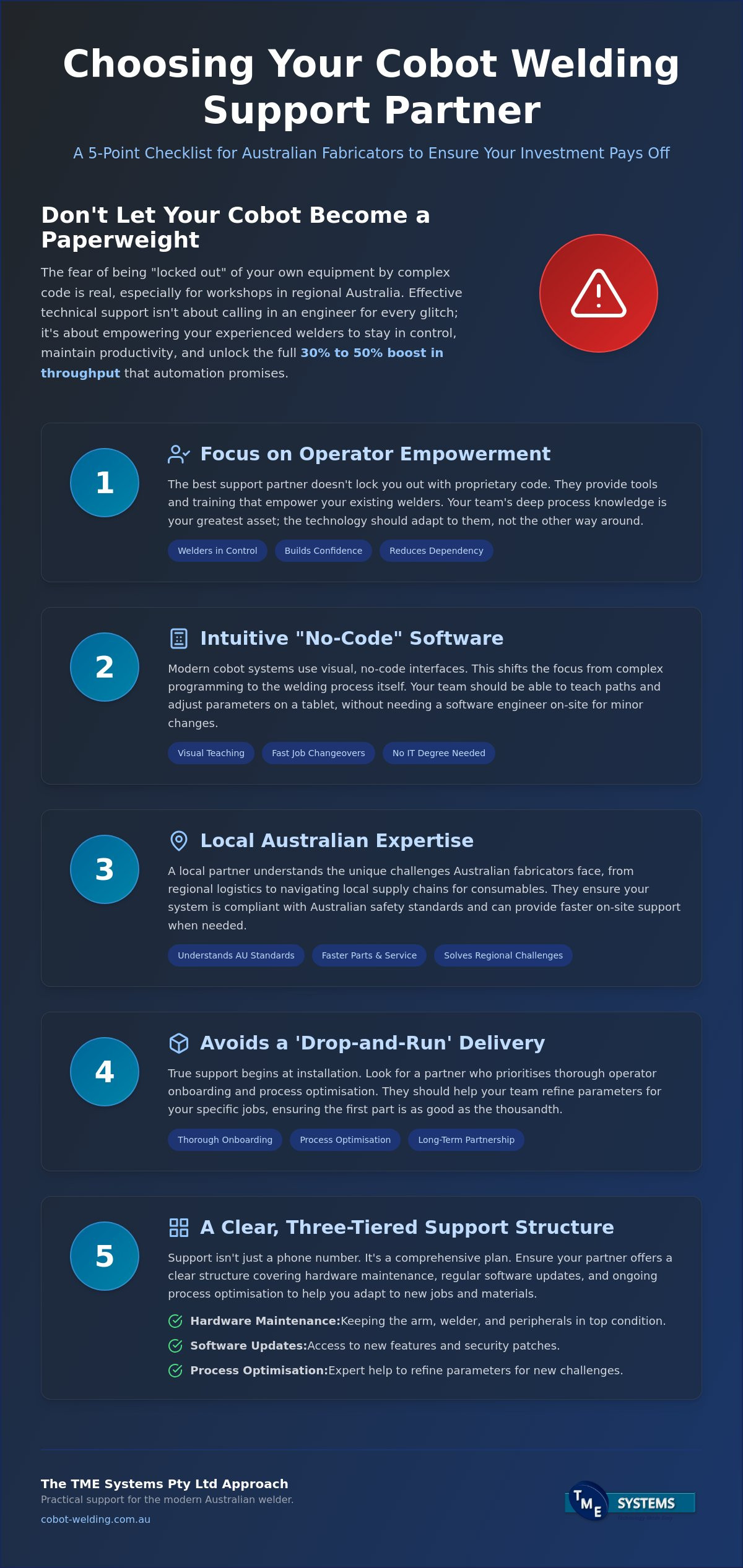
Support isn't just a phone number for when things break; it's a three-tiered approach to workshop health. It generally covers:
- Hardware maintenance: Keeping the robotic arm and the power source in top nick, ensuring that wire feed and gas flow remain consistent.
- Software updates: Ensuring the no-code interface stays current and secure, often adding new features that make complex welds easier to teach.
- Process optimisation: Helping your team refine their parameters to strike the perfect arc on a new job, ensuring that the first part is as good as the thousandth.
The Value of Local Australian Expertise
Australian fabricators face a specific set of hurdles, from regional isolation to a projected deficit of 70,000 welders by 2030. Local expertise means having a partner who understands that a two-day wait for a spare part isn't just an inconvenience; it's a disaster for your delivery schedule. A local robotic welding technical support partner helps you navigate Australian supply chains for consumables and ensures your setup aligns with Welding Cobot Safety in Australia standards. This local context is what turns a piece of machinery into a reliable member of your workshop team.
The Shift from Programming to Process: How No-Code Support Works
The traditional model of automation support often felt like a barrier between the workshop and the work. If a path needed adjusting or a new part was introduced, production stopped until an external software engineer could arrive to rewrite lines of complex code. This created a bottleneck that many Australian fabricators simply couldn't afford. Modern robotic welding technical support has shifted away from this IT-heavy approach. By using no-code interfaces, the focus returns to the welding process itself. Support is no longer about fixing a "bug" in the system; it is about helping your staff refine a weld path using intuitive, visual tools.
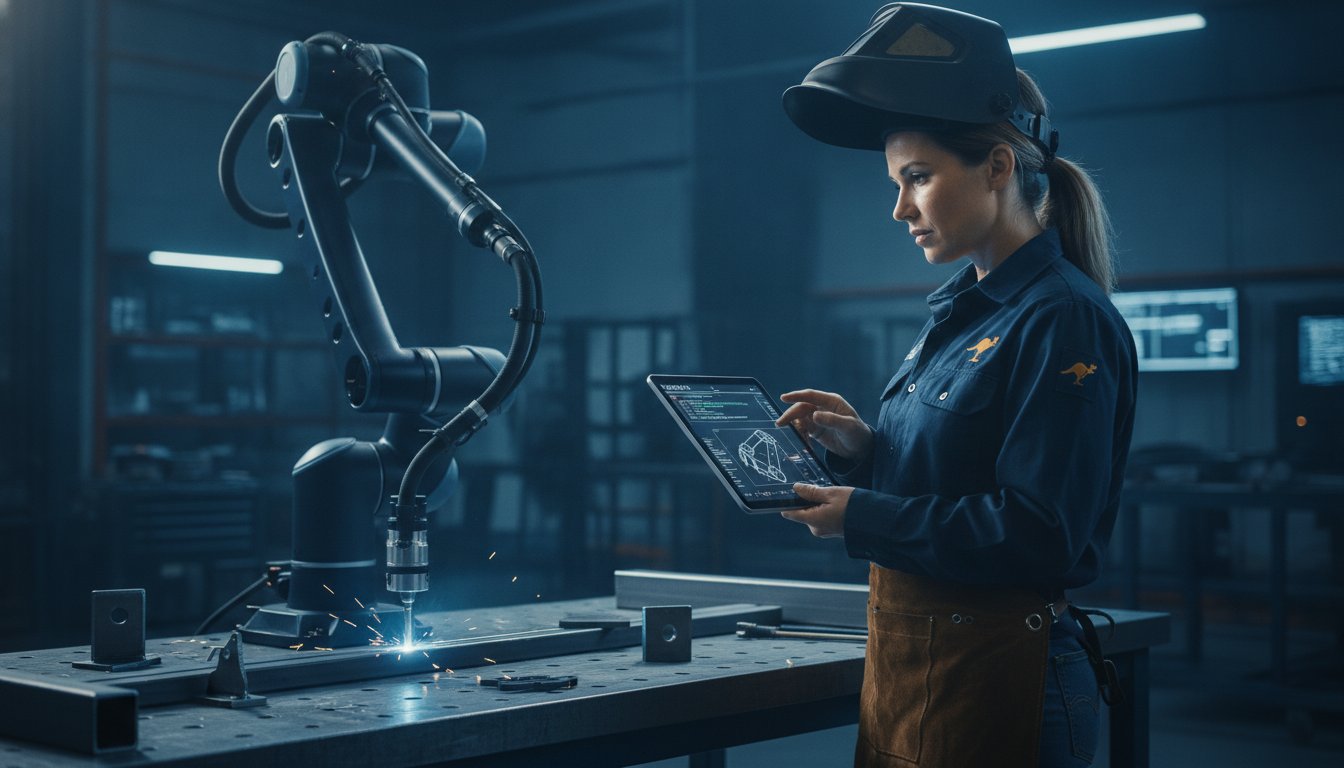
This "Practical Mentor" approach empowers your experienced tradespeople to take ownership of the technology. When a welder encounters an issue, they don't need to understand C++ or Python. They use the user interface to troubleshoot the problem. This shift allows workshops to organise their own production schedules with far more flexibility. If a rush job comes in on a Tuesday afternoon, your team can teach the robot the new path and start production immediately, rather than waiting for a support ticket to be cleared by an outside specialist.
No-Code Software vs. Traditional Coding Support
In a traditional setup, support is reactive and technical. In a no-code environment, support is proactive and educational. When you utilise no-code robot welding software, the number of support tickets related to "system errors" drops significantly. Most adjustments become a matter of "point and click" or "drag and teach." Your team spends less time worrying about the robot's logic and more time ensuring the torch angle and travel speed are perfect for the job at hand.
Troubleshooting the Weld, Not the Robot
One of the greatest anxieties for workshop owners is the "skills gap." They worry that their best welders won't be able to handle high-tech equipment. However, because the support landscape has changed, your tradespeople are actually the best-qualified people to manage the system. They already possess the skills necessary to properly program and operate welding robots when the interface speaks their language. Troubleshooting now focuses on weld parameters like wire speed, voltage, and gas flow. If a weld isn't looking right, your robotic welding technical support partner helps your team adjust the arc, not the code. This bridges the gap between traditional craftsmanship and modern automation, keeping the human operator at the centre of the production line. If you want to see how this looks on your workshop floor, you might consider exploring our range of integrated welding solutions.
Remote vs On-Site: Finding the Right Support Mix for Your Workshop
Australia's vast geography presents a unique challenge for manufacturing. For a workshop in regional Queensland or Western Australia, waiting for a technician to drive eight hours can mean thousands of dollars in lost productivity. This "tyranny of distance" used to be a major barrier to automation. However, by 2026, the landscape of robotic welding technical support has shifted toward a hybrid model that prioritises speed without sacrificing the "hands-on" reliability fabricators expect.
The rise of cloud-connected systems means that many issues can now be resolved before the kettle has even finished boiling. This is particularly vital as more shops adopt advanced welding technology to combat the national welder shortage. Finding the right mix between remote troubleshooting and on-site visits is the key to maintaining a high-performance production line while keeping overheads under control.
The Power of Remote Diagnostics
Remote support is no longer just a phone call with a vague description of a problem. Modern cobot interfaces allow for real-time screen sharing and path review through the cloud. A support specialist in a metropolitan centre can look at exactly what your operator sees on the teach pendant. This allows them to:
- Identify hardware faults or sensor misalignments before a technician even leaves the office.
- Review and adjust weld paths remotely to fix simple software hitches or logic errors.
- Reduce downtime from several days of waiting to just a few minutes of digital adjustment.
When On-Site Support is Essential
While digital tools are powerful, they don't replace the need for physical presence in specific scenarios. On-site robotic welding technical support remains the gold standard for high-stakes moments in a workshop's journey. You'll generally need a technician on the floor for complex system integration, especially when connecting new cobot cells with existing factory workflows or conveyors. Major hardware repairs, such as replacing internal motors or performing safety system recalibrations after a floor layout change, also require a physical visit to ensure everything meets Australian standards.
Perhaps most importantly, the initial operator onboarding phase benefits immensely from on-site guidance. Having a practical mentor standing next to your welders as they strike their first automated arc builds a level of confidence that a video call simply cannot match. It ensures that your team doesn't just learn how to use the machine, but how to master it within the specific context of your workshop's daily grind.
Choosing a Support Partner: A 5-Point Checklist for Local Manufacturers
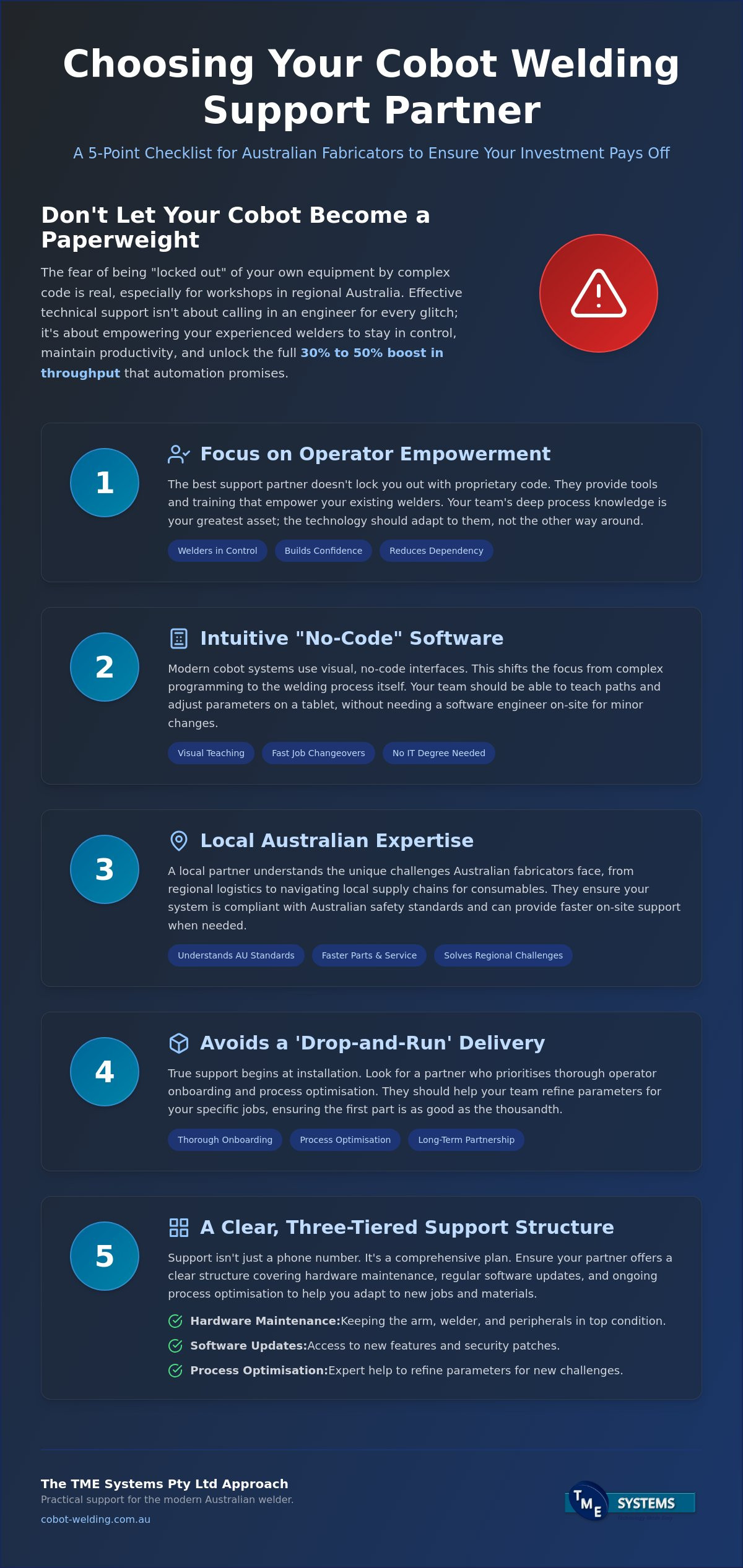
Choosing a partner for robotic welding technical support isn't just about comparing response times on a spreadsheet. It's about finding a team that understands the grit and reality of an Australian fabrication shop. You need a partner who sees themselves as a long-term collaborator, not just a hardware vendor. Before signing any service agreement, use this checklist to ensure your investment stays productive for years, not just the first week.
- Alignment with Australian Standards: Ensure they can advise on the latest safety regulations, including the transition to new Workplace Exposure Limits (WEL) coming in late 2026.
- Local Parts Inventory: Check if they stock consumables and critical spares in Australia. Waiting for an international shipment is a production killer for a busy job shop.
- Transparent SLAs: Your service level agreement should define exactly what "support" means, including guaranteed response windows for remote diagnostics and on-site visits.
- Weld Literacy: The support team must be able to troubleshoot a bird-nested wire or a gas coverage issue as easily as a software glitch.
- Training Depth: Look for a partner who offers more than a single afternoon of instruction. Successful automation requires a structured path to operator independence.
The 'Weld-First' Support Philosophy
You don't want a support technician who only understands coding logic when your weld pool is sagging or your penetration is inconsistent. The most effective robotic welding technical support comes from people who have spent time under a hood. They should understand MIG and TIG parameters as well as they understand robotic joint limits. During a demo, ask them to troubleshoot a porosity issue or adjust a weave pattern. If they can't speak the language of a tradesperson, they won't be able to help your team refine the "craft" of automated welding. You need a partner who understands that the robot is just a tool to carry the torch, not the other way around.
Onboarding and Continuous Training
The "drop-and-run" delivery is the fastest way to ensure your cobot ends up gathering dust in a corner. The first 30 days are critical; this is when your team either builds confidence or develops a fear of the machine. Look for partners who offer a dedicated onboarding phase that includes hands-on training on your own specific parts. A good partner also provides refresher courses for new hires or advanced sessions as your production needs grow. Our operator training and onboarding programs are designed to ensure your staff feel like masters of the technology from day one. Mobile demo systems are also a great way to test this capability before you commit, allowing you to see the support philosophy in action on your own workshop floor.
The TME Systems Pty Ltd Approach: Practical Support for the Modern Welder
At TME Systems Pty Ltd, we understand that the most advanced technology is only as good as the work it produces on your floor. If a system sits idle because an operator is unsure of a setting, that represents a failure of support, not the machine. We've built our robotic welding technical support around the human operator. We don't just provide a manual and a phone number; we provide a clear path to mastery. By centring the welder in every interaction, we ensure that the transition to automation feels like a natural step up in their trade, not a confusing departure from it.
Our commitment to no-code empowerment means we've removed the coding bottlenecks that traditionally slowed down Australian workshops. We focus on workshop-ready solutions that allow your team to be productive within hours. This end-to-end partnership begins long before the system is installed. It starts with a mobile demo and continues through welding system integration, operator training, and ongoing preventive maintenance. This holistic approach is why fabricators across the country trust TME Systems Pty Ltd to keep their production lines moving, even in the most demanding environments.
Grounded in the Realities of the Workshop Floor
We offer pragmatic advice that respects the traditional craftsmanship your business was built on. Our robotic welding technical support staff speak the language of the trade, not the IT department. If you're dealing with a difficult weld angle or a specific material challenge, we provide solutions that work in the real world. We measure our success by your uptime. If the arc isn't struck, the job isn't done. This focus on practical results ensures that your investment continues to deliver the throughput gains you expect without the stress of technical "black boxes."
Ready to Automate with Confidence?
Seeing is believing, especially when it comes to new technology. We invite you to see our cobot systems in action on your own floor to understand how they adapt to your specific jobs. Our integration specialists work closely with your team to ensure the cell fits perfectly into your existing workflow, managing everything from initial setup to safety compliance. You can Book a Mobile Welding Robot Demonstration today to see our support and technology in action. It's the most practical way to prove that automation is within reach for your team and your workshop's future.
Future-Proofing Your Workshop with Confidence
The transition to automation doesn't end when the crates are unpacked; it truly begins with the first arc struck by your team. We've seen how the right mix of no-code software and local expertise transforms a complex machine into a reliable workshop tool that your staff can actually own. By prioritising weld-literacy and responsive robotic welding technical support, you ensure that your shop remains competitive and compliant as Australian manufacturing standards evolve toward 2026 and beyond.
TME Systems Pty Ltd is committed to this human-first approach, providing the specialised training and integration needed to keep your floor productive. Our specialised no-code teaching software and comprehensive operator onboarding programs are designed to bridge the skills gap, turning your experienced welders into confident robot operators. If you're ready to see the difference that practical, local expertise makes to your bottom line, you can Book a Mobile Welding Robot Demonstration to see our support in action. Taking the next step toward a more efficient workshop is a straightforward process when you have a trusted partner to guide the way.
Frequently Asked Questions
What happens if my welding robot stops mid-job?
The system usually provides a specific error code on the teach pendant to identify the cause immediately. Most mid-job stops are triggered by safety sensors or wire feed issues that your operator can clear on the floor. If the stoppage is caused by a logic fault, remote support can often reset the path without losing your progress on the work piece.
Do I need to hire a programmer to manage the technical support for a cobot?
No, you don't need a dedicated programmer or software engineer on your payroll. Modern no-code interfaces are designed for tradespeople to manage using intuitive visual tools. Your existing team handles the day to day teaching and troubleshooting, while your robotic welding technical support partner manages high-level system updates and complex integration needs.
Is remote technical support secure for my workshop's data?
Yes, remote diagnostics use encrypted, industrial-grade connections to protect your workshop's intellectual property. Most systems only share the robot's performance data and the visual interface of the teach pendant. This allows technicians to see exactly what the operator sees without accessing your internal factory network or sensitive business files.
How long does it typically take to get a response for robotic welding support in Australia?
Response times vary by provider, but cloud-connected systems often allow for near-instant diagnostics. For regional Australian workshops, remote assistance can resolve software hitches in minutes rather than days. If a physical visit is required, your Service Level Agreement (SLA) will define the travel window, which is why choosing a local partner is critical for minimising downtime.
Can my existing welders be trained to handle basic technical support tasks?
Absolutely, and they are usually the best people for the job because they understand the craft of welding. They can quickly learn to adjust torch angles, wire speeds, and gas flow through the user interface. Professional onboarding programs focus on making your tradespeople self-sufficient so they can maintain the cell's productivity without external help for minor issues.
Does technical support cover the welding power source as well as the robot arm?
Yes, comprehensive robotic welding technical support covers the entire integrated cell as a single system. This includes the robotic arm, the no-code software interface, and the welding power source. Ensuring these components communicate correctly is vital for maintaining consistent arc quality and preventing communication errors that can stall production.
What are the ongoing costs associated with robotic welding technical support?
Ongoing costs generally involve an annual service agreement that covers software updates, security patches, and priority assistance. Some workshops prefer a "pay-as-you-go" model for on-site repairs, while others choose a fixed-fee plan for predictable budgeting. You should check your specific agreement for details on what is included versus what might incur additional travel or call-out fees.
How do I know if my issue is a software bug or a hardware failure?
The system's built-in diagnostic tools usually distinguish between the two and display a clear notification. Hardware failures often present as physical grinding, erratic movement, or sudden power loss, whereas software issues typically result in error messages or frozen screens. A quick remote check by a specialist can confirm the root cause before you begin any physical repairs.