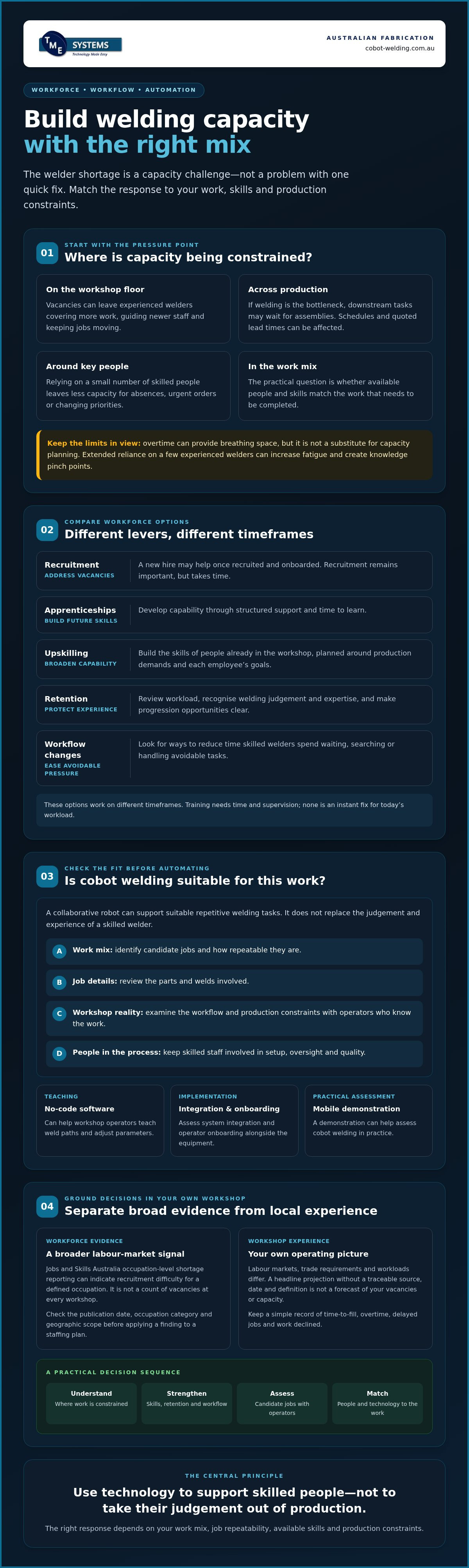

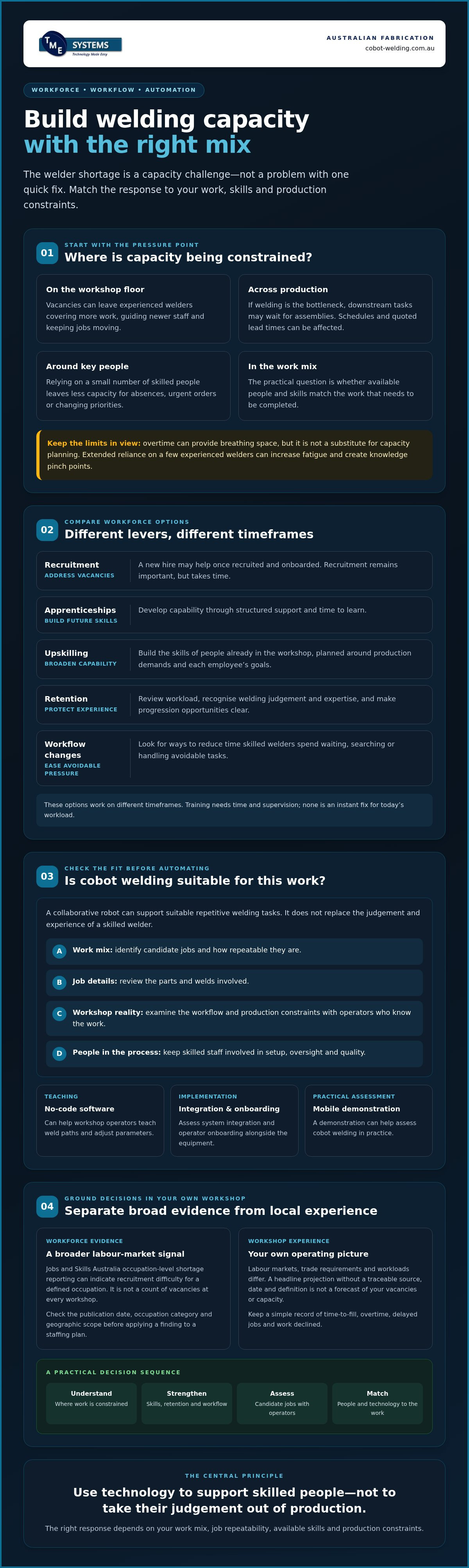
Solving the welder shortage in Australia won’t come down to finding one quick fix. When roles stay unfilled and experienced welders are already under pressure, keeping production moving means making the best use of people, processes and equipment.
Recruitment and training remain important, but they take time. In the meantime, job planning and welding automation may help protect capacity. The right response depends on your work mix, how repeatable the jobs are, the skills available and the constraints in your production process. A collaborative robot can support suitable repetitive welding tasks, but it doesn’t replace the judgement and experience of a skilled welder.
This article compares workforce, workflow and automation options for fabricators. You’ll learn where recruitment and training can help, when cobot welding may suit the work, and what to assess before investing in equipment, integration or operator onboarding. We’ll also cover how no-code teaching can help workshop operators teach weld paths and adjust parameters, keeping skilled people at the centre of production.
Key Takeaways
- Approach solving the welder shortage in Australia as a capacity challenge, and distinguish workforce evidence from workshop-level experience.
- Compare recruitment, apprenticeships, upskilling, retention and workflow changes against your production needs and timeframes.
- Before considering automation, identify candidate jobs and review their parts, welds and workflow with operators who know the work.
- Assess whether collaborative robot welding suits repetitive tasks, while keeping people involved in setup, oversight and quality.
- Consider how no-code teaching software, system integration, operator onboarding and a mobile demonstration can help you assess cobot welding in practice.
Solving the Welder Shortage in Australia: What Fabricators Are Up Against
When welding roles stay vacant, pressure often falls on the people already on the floor. Experienced welders may be asked to cover more work, guide newer staff and keep jobs moving at the same time. That can help in the short term, but relying on a small number of key people leaves less capacity to manage absences, urgent orders or changing production priorities.
For a fabricator, solving the welder shortage in Australia is best understood as a workforce-capacity challenge: does the available mix of skills and people match the work that needs to be completed? Reports of hard-to-fill roles can signal wider recruitment pressure, while a workshop’s experience may reflect its labour market, trade requirements or workload. Neither gives the full picture on its own.
How does a shortage affect Australian fabrication workshops?
Vacancies can constrain throughput even when machines, materials and orders are ready. If welding is the bottleneck, downstream tasks may wait for assemblies to be completed, affecting schedules and quoted lead times. Managers may also defer new work if they can’t confidently allocate the skilled hours needed to deliver it.
Overtime can provide breathing space, but it isn’t a substitute for capacity planning. Extended reliance on a few experienced welders can increase fatigue and create a knowledge pinch point if only certain people can complete or check particular jobs. The impact varies between workshops because trade mix, workload and labour-market conditions differ.
What does the available workforce evidence actually tell us?
Jobs and Skills Australia’s occupation-level shortage reporting is a broader labour-market signal, not a count of vacant roles at every fabrication workshop. It can indicate recruitment difficulty for a defined occupation, but it can’t establish how severe the problem is for a particular employer or location. Check the publication date, occupation category and geographic scope before applying a finding to your staffing plan.
That distinction matters when weighing reports against workshop experience. A headline projection without a traceable source, date and definition shouldn’t be treated as a forecast of your own vacancies or production capacity. Keep a simple record of time-to-fill, overtime, delayed jobs and work declined. These measures can help show where your own constraints are building.
The work itself also helps explain why headcount alone isn’t the answer. Welding joins materials through processes that require suitable preparation, technique and quality checks. A shortage of people able to perform the work consistently can therefore affect more than the number of welds completed. The practical question is where capacity is constrained and which response best supports the skilled people your production depends on.
Beyond Recruitment: Workforce Options That Can Strengthen Welding Capacity
Recruitment matters, but it’s only one part of a workforce response. Apprenticeships build future skills, while upskilling can broaden the capability of people already in the workshop. Retention protects experience that takes time to develop. Workflow changes may also ease pressure by reducing the time skilled welders spend waiting, searching or handling avoidable tasks.
These options work on different timeframes. A new hire may help address a vacancy once recruited and onboarded; an apprentice needs structured support and time to develop; and upskilling must be planned around production demands and the employee’s goals. None is an instant fix for today’s workload. For a wider industry perspective, fabricators can follow the advocacy work of Weld Australia alongside their own workforce and production data.
How can employers retain and develop welding skills?
Start with a consistent onboarding plan. Explain work practices, show how jobs move through the workshop and give new starters access to experienced guidance. Mentoring can help apprentices and existing staff develop technique without leaving training to chance. Map skills across the team, then offer relevant development opportunities rather than relying on one or two people for every specialised task.
Retention is shaped by the day-to-day experience of the work. Review whether workloads are manageable, recognise the judgement and expertise welding requires, and make progression opportunities clear. Training strengthens long-term capability, but it needs time, supervision and realistic production planning. For practical ideas about supporting operators as equipment changes, see this guide to on-site cobot welder training.
Where can workflow changes free up skilled welding time?
Before adding technology, follow a job from preparation to dispatch. Check whether material is ready when the welder needs it, whether parts are presented consistently, whether suitable fixtures are available and whether job sequencing causes avoidable changeovers or waiting. These observations can reveal practical improvements without changing who performs the weld.
Separate support tasks from work that relies on a welder’s skill. Better preparation, material handling and sequencing can reduce interruptions. Decisions about fit-up, weld quality or an unusual repair still need appropriate human judgement. A simple review of where welding time is spent can identify tasks to reorganise and help protect skilled attention for work that needs it.
Solving the welder shortage in Australia calls for a mix of measures, not a choice between people and process. If collaborative robot welding is on your assessment list, explore cobot welding options for fabricators alongside workforce development and workflow improvements.
Can Cobot Welding Help Solve Australia’s Welder Shortage? Compare the Options
There isn’t one response that suits every workshop. Hiring can add experienced capacity, but finding and onboarding the right person takes time. Training develops capability within the team, though it won’t fill an immediate production gap. Workflow redesign may ease pressure sooner by reducing delays and unnecessary handling. Cobot welding is another option when jobs are suitable and the system can be integrated with the way work already moves through the workshop.
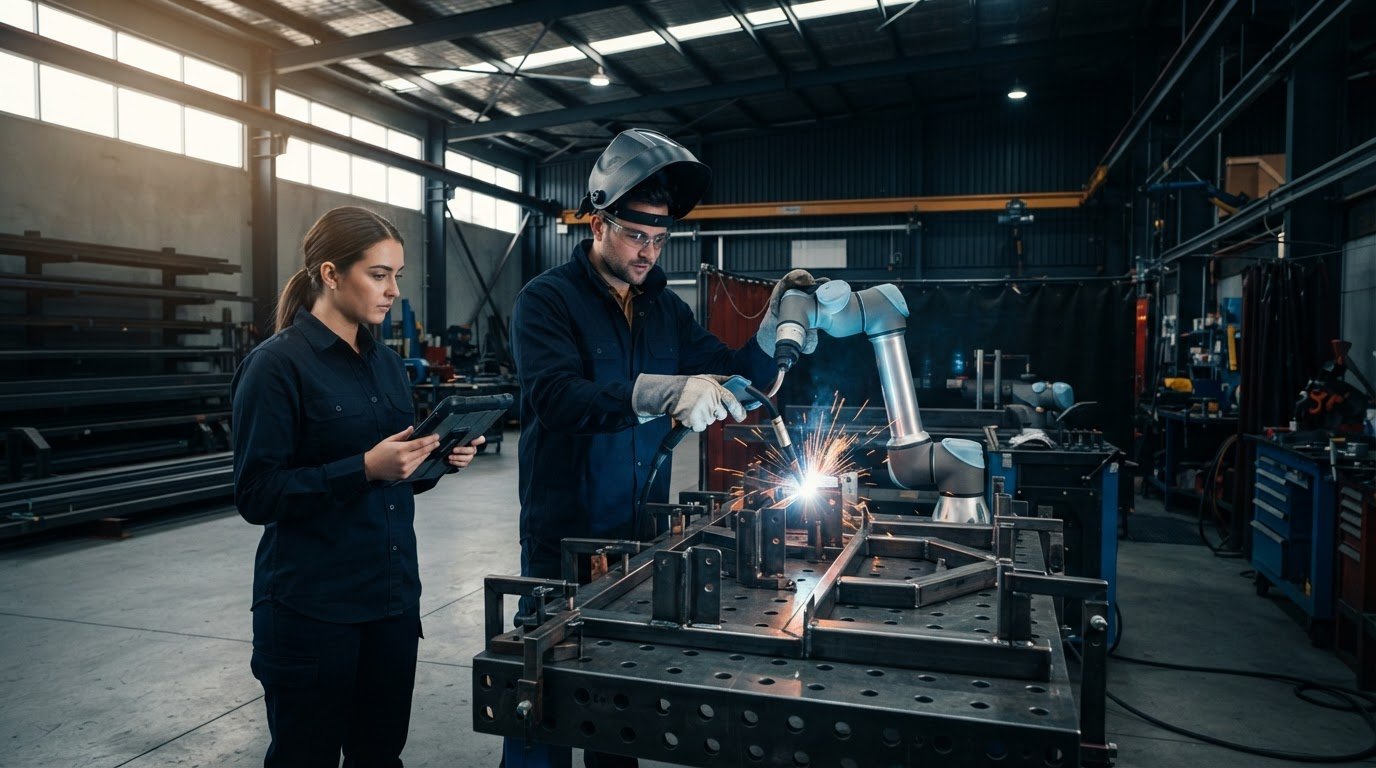
Collaborative robots can support repeatable welding tasks, but they don’t remove the need for welding expertise. People still bring judgement to job setup, process decisions, oversight and quality checks. In practice, cobots can help extend capacity around skilled workers rather than replace their knowledge.
The case for automating aspects of the welding process depends on the work, not just the pressure to fill a vacancy. A job title alone can’t show whether automation is suitable. Variation in parts, weld paths, fit-up and process requirements can all affect how repeatable a task is in practice.
Which welding tasks may suit collaborative automation?
Look for jobs with consistent parts, accessible weld paths and stable process requirements. Repeated assemblies may be worth assessing, while frequent variations or difficult part presentation could add setup demands. Review the actual components and workflow with operators before deciding whether a trial is worthwhile. For cell-related considerations, see this collaborative robot welding cells guide.
What should businesses weigh before choosing a response?
Compare the availability of suitable workers, how often jobs change, task repeatability, operator capability and the integration work required. No-code teaching may make it easier for operators to teach weld paths and adjust parameters without traditional robot programming, but it won’t suit every process or remove the need for training and oversight. Read more in this no-code robot welding software guide.
Solving the welder shortage in Australia means matching the response to the production constraint. If repeatable work is a possible fit, explore collaborative welding options alongside recruitment, skills development and workflow improvements.
How to Assess Readiness Before Introducing Welding Automation
A useful readiness check starts with the work, not the robot. Choose a job to assess, examine its parts and welds, map the workflow, then test whether automation is technically and operationally feasible. Involve welders and operators from the outset. They know where parts vary, which adjustments are routine and what can disrupt a job. Their practical knowledge can help shape a system that fits the workshop and earns the team’s confidence.
What should a workshop check before a cobot trial?
Review part consistency, fit-up, fixtures, access to the weld path, weld requirements and how often the job changes. A task that looks repetitive on a schedule may still involve frequent component or setup variations. Record those differences before deciding whether a trial is worthwhile.
Next, map how the job moves through the workshop. Note existing equipment, material presentation, operator movements and any points where a welding cell would need to connect with the current process. An integration specialist can help assess these interfaces. Agree on trial objectives and acceptance criteria with operators and decision-makers before testing. Set a baseline using measures relevant to the job, such as setup time, changeovers, rework or cycle time. You can then assess the trial against the current process without assuming it will deliver a particular productivity or quality gain.
How do safety and operator onboarding fit into the plan?
Consider safety in the context of the actual cell, its equipment and how people will work around it. Have the risk assessment, guarding and safe system design reviewed by appropriately qualified people, and confirm which Australian safety requirements and standards apply to the specific installation. Don’t rely on a generic checklist or assume that a collaborative robot removes the need for a careful assessment.
Plan operator onboarding as part of implementation, not as an afterthought. Include instruction, supervised practice and a clear understanding of who can teach weld paths, adjust parameters and respond to issues. No-code teaching may make job adjustments more accessible to workshop operators, but people still need to learn the process and its limits. Operator feedback during trials can also expose practical concerns before the system becomes part of routine production.
Readiness is strongest when the job, workflow, safety considerations and people are assessed together. To discuss whether a collaborative robot welding cell could suit your work, explore cobot welding options and consider how integration and operator onboarding would fit your assessment.
Build Welding Capacity with the Right Mix of People and Technology
Solving the welder shortage in Australia isn’t about choosing between skilled people and automation. Fabricators can keep developing and retaining their workforce while assessing whether repetitive welding tasks are suitable for collaborative robot support. The goal is to match the response to the work: people bring trade knowledge and judgement, while technology may support consistent tasks that are appropriate for automation.
How can a cobot support experienced welders?
A cobot welding cell can support experienced staff by taking on a suitable repeatable task, while welders remain involved in setup, process oversight and quality. With no-code teaching software, operators can teach weld paths and adjust parameters without traditional robot programming. This may make job changes more accessible, but the work still needs skilled input and appropriate operator onboarding.
For practical ideas on reviewing tasks and workflow, read this guide to improving welding productivity with cobots. It’s a useful next step when considering where automation might fit alongside the skills already in your workshop.
What is a practical next step for an Australian fabricator?
Choose a representative job and document its parts, welds, changeovers and process constraints. Include the operators who know the work, then discuss the application and integration needs before deciding whether a cobot is suitable. A mobile demonstration system can provide a practical way to explore how a cobot handles an application, but it can’t guarantee a particular production or quality outcome.
TME Systems supplies collaborative robot welding cells and no-code teaching software, and provides welding system integration and operator training and onboarding. Consider these elements together as you assess the job, how operators will work with the system and what support is needed to introduce it.
Start with the task, not a predetermined solution. A clear discussion of your workshop’s parts, workflow and constraints can help establish whether a demonstration or further assessment is the right next step. To talk through your application, discuss cobot welding options with TME Systems.
Take the Next Step Towards Stronger Welding Capacity
Solving the welder shortage in Australia calls for a practical mix of workforce development, thoughtful workflow improvements and automation where the work is a good fit. Recruitment, training and retention help build skills over time, while assessing repeatable tasks can show whether a cobot may support your team without replacing the experience and judgement skilled welders bring.
Start with a representative job and the people who know it best. Consider the parts, weld requirements, workflow and operator needs before choosing equipment. TME Systems supplies collaborative robot welding cells and no-code teaching software, which lets operators teach weld paths and adjust parameters without traditional robot programming. Welding system integration, operator onboarding and a mobile demonstration system are also available to help you explore an application and assess its fit without assuming a particular outcome.
If you’re ready to talk through your workshop’s requirements, discuss cobot welding options with TME Systems. A considered first step can help you build capacity while keeping skilled people at the centre of production.
Frequently Asked Questions
Is Australia experiencing a shortage of welders?
Yes, Australian manufacturers have reported difficulty recruiting welding skills, although the pressure isn’t the same for every employer, occupation or location. A national headline doesn’t show how a particular workshop is affected. For a clearer picture, check current Jobs and Skills Australia occupation data and Weld Australia industry updates, paying attention to publication date, occupation definitions and geographic scope. Your own vacancy, overtime and scheduling records can show where capacity is constrained.
Can cobot welding help with a welder shortage?
Yes, cobot welding may help extend capacity when a workshop has repeatable tasks that suit automation. A cobot can support consistent weld work while skilled people remain involved in setup, process oversight and quality checks. It isn’t a universal fix: part variation, fixtures, workflow and changeovers all affect suitability. Solving the welder shortage in Australia still depends on developing and retaining people, with automation considered as one option for appropriate work.
Will welding robots replace qualified welders?
Welding robots don’t remove the need for skilled welding knowledge. People still need to assess the job, prepare and present parts, set up the process, monitor the work and check quality. Automation may take on a suitable repetitive task, but experienced welders’ judgement remains important, especially when parts or requirements vary. A useful assessment asks how a robot could support the team, not how to eliminate the people responsible for welding quality.
How can a small fabrication business respond to a shortage of welders?
Start by identifying where work is held up. Review recruitment alongside apprentice development, upskilling, staff retention and job preparation. Check whether material handling, fixtures or sequencing are taking skilled welders away from welding tasks. If a job is repetitive, assess whether automation could support it, including the integration and operator training required. A measured approach is to assess a representative job first rather than assume a system will suit every task.
What welding jobs are suitable for cobot automation?
Jobs may be suitable when parts are consistent, weld paths are accessible and process requirements are stable across repeat runs. A job that appears repetitive may still involve frequent variations, difficult fit-up or regular changeovers, so assess the actual parts and workflow. Consider fixtures, operator access and how components are presented. A site assessment or practical demonstration can help test feasibility, but a job title alone can’t confirm that automation is appropriate.
Do operators need programming experience to use a welding cobot?
Not necessarily. No-code teaching software can let operators teach weld paths and adjust parameters without writing traditional robot code. That can make job adjustments more accessible, but it doesn’t remove the need for training or a sound understanding of the welding task. Operators need to learn how the system works, when adjustments are appropriate and how to follow the agreed process. Onboarding should be planned as part of introducing the equipment.
What should a workshop assess before introducing welding automation?
Assess a representative job from part preparation through to inspection. Review part consistency, fixtures, weld access, process requirements, changeovers and how a cell would fit with existing equipment and workflow. Involve operators early, set trial objectives and record baseline measures before testing. Also have site-specific integration, risk assessment, guarding and safe system design reviewed by appropriately qualified people, confirming which Australian requirements apply. Plan operator instruction and supervised practice as part of implementation.