
The hardest part of running a modern Australian workshop isn't finding the work; it's finding the skilled hands to do it while meeting the strict 1mg/m³ welding fume standards. You've likely felt the frustration of watching repetitive, high-volume jobs pile up because your best welders are stretched thin or tied down by rework. It's a common hurdle that many local fabricators face, but it doesn't have to be the thing that limits your daily throughput.
We understand that the shift to automation often brings up concerns about complex programming and expensive downtime. This guide will show you how turnkey robotic welding units can transform your output with minimal setup and no complex coding. We'll walk through the practicalities of integrating these systems, from achieving a fast ROI to ensuring consistent quality across every shift. You'll discover how no-code teaching software empowers your existing team to lead the charge, making innovation feel like a natural part of your workshop floor rather than a technical burden.
Key Takeaways
- Understand why collaborative "cobot" cells are replacing traditional industrial robots to provide a safer, more flexible solution for smaller Australian fabrication shops.
- Explore the "no-code" advantage that allows your team to lead the robot through a weld path manually, eliminating the need for complex pendant programming.
- Identify the essential components of turnkey robotic welding units, including how to match the right power source and reach to your specific production requirements.
- Learn the practical steps for a successful rollout, covering everything from floor space and gas requirements to final operator onboarding.
- Discover how a partnership-led approach to automation ensures your workshop achieves consistent quality and a faster return on investment.
What are Turnkey Robotic Welding Units?
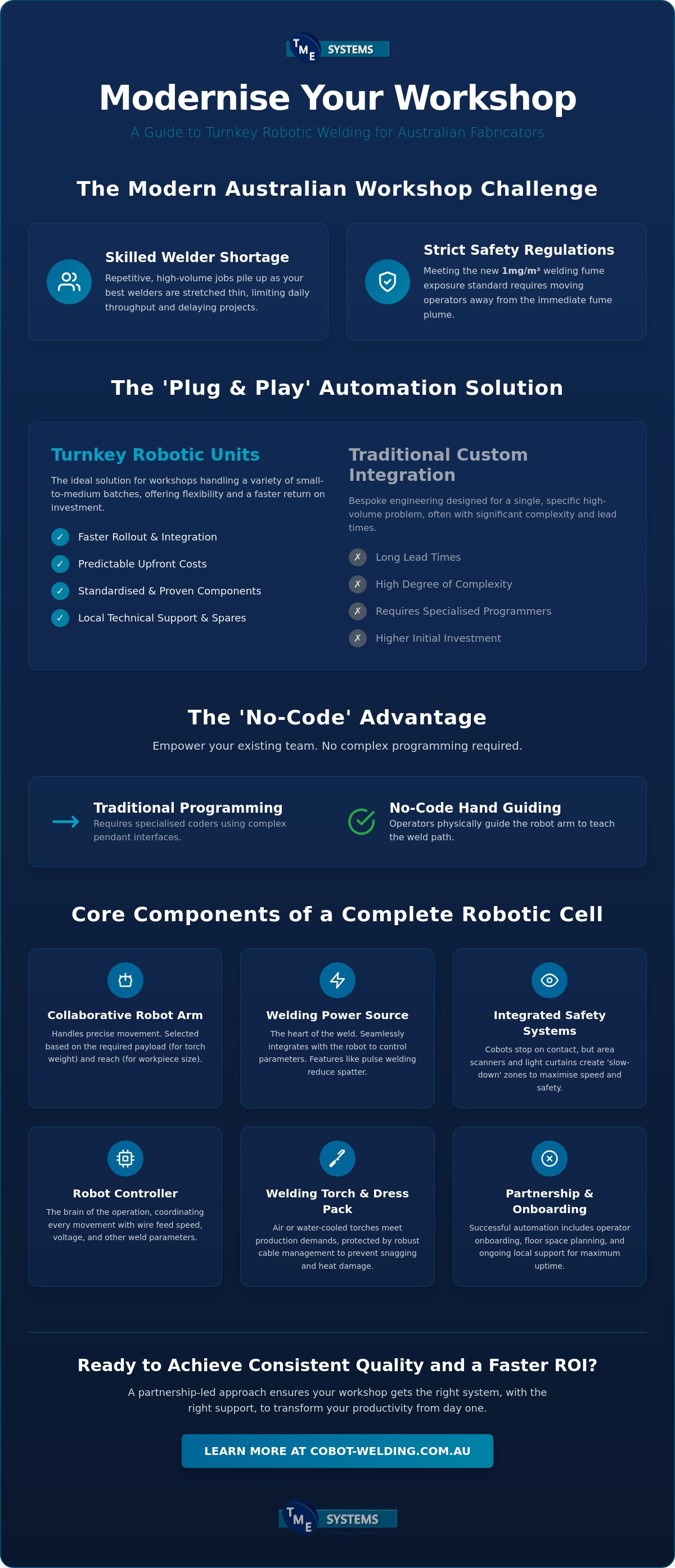
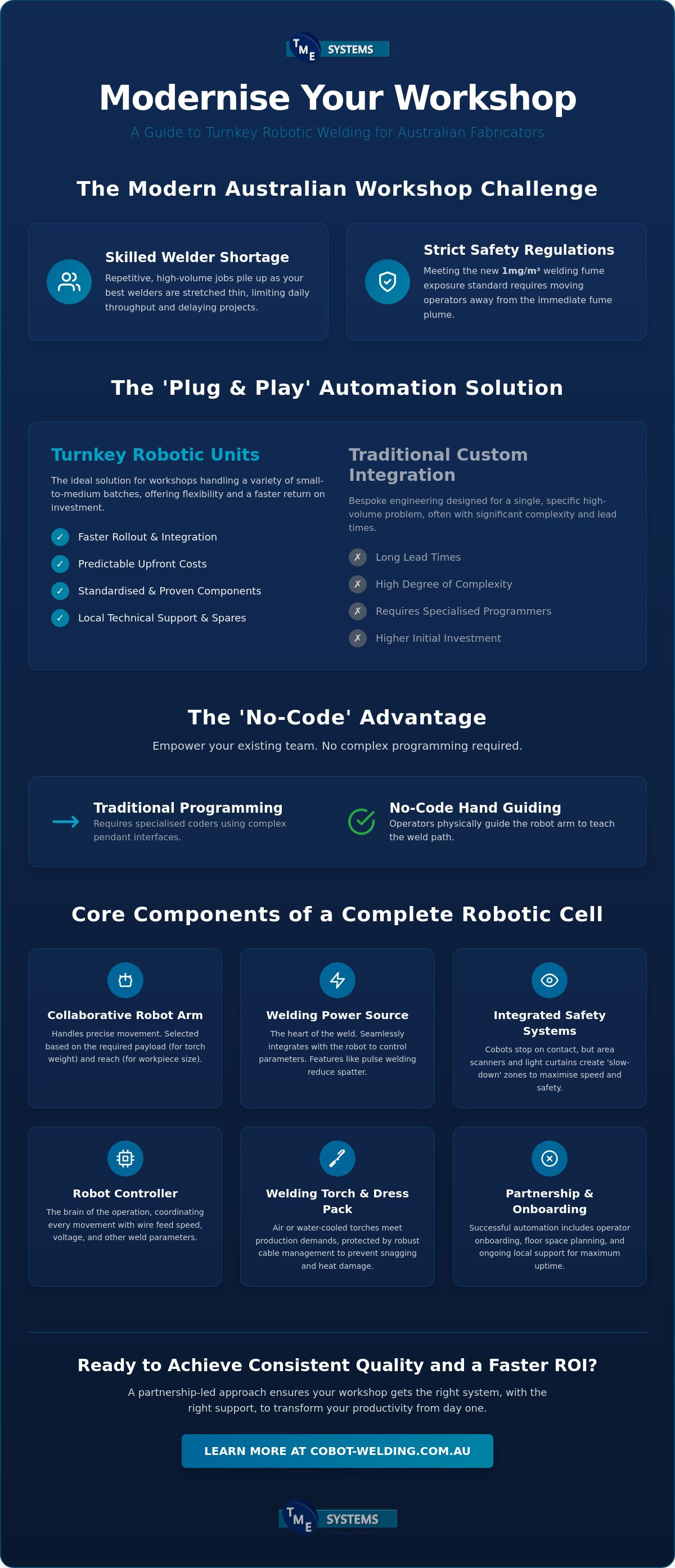
In the simplest terms, a turnkey unit is a pre-integrated, ready-to-weld system that arrives at your workshop as a complete package. Unlike traditional automation projects where you might buy a robot from one supplier and a power source from another, turnkey robotic welding units are designed to work together from the moment they're powered up. They include the robot arm, the welding torch, the power source, and the safety guarding, all managed through a unified control interface. This "plug and play" approach is designed to remove the technical guesswork that often stalls automation projects before they even start.
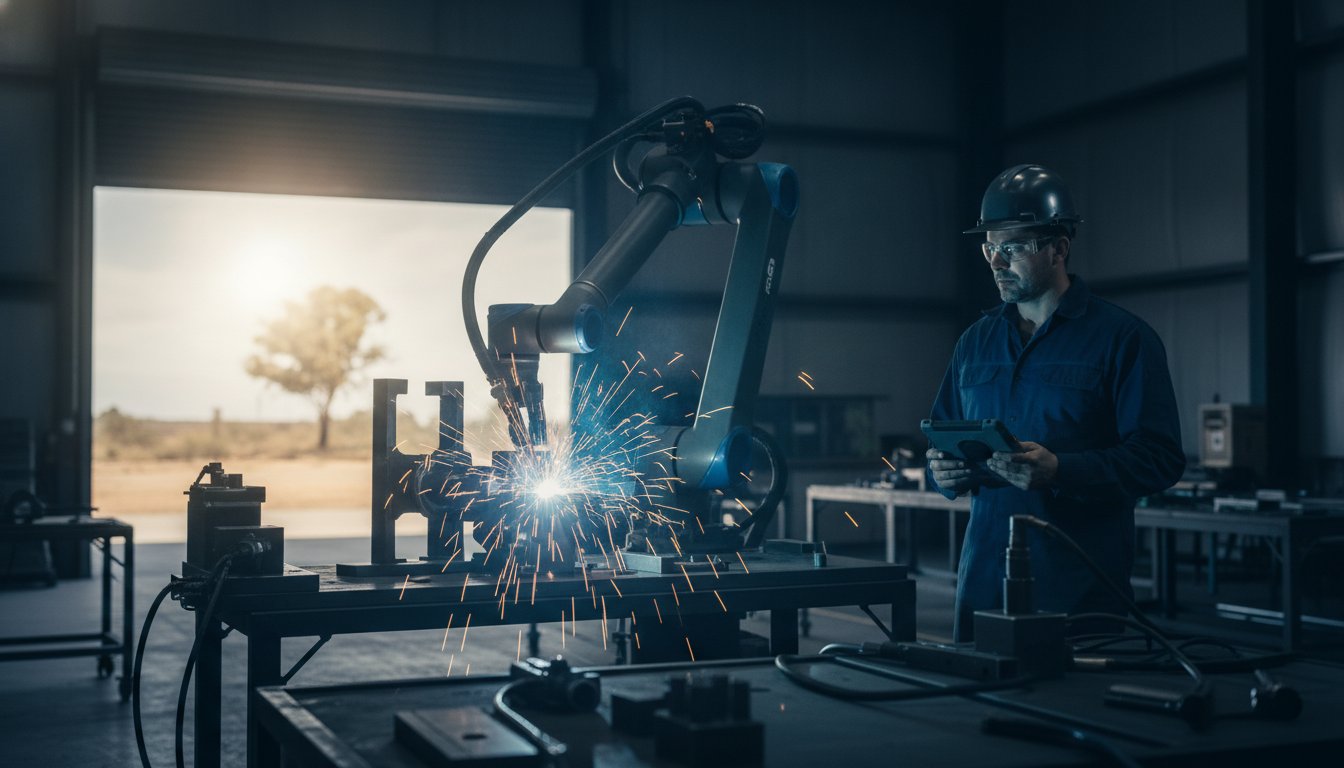
While Robot welding has been a staple in high-volume automotive plants for decades, the technology has historically been out of reach for the average Australian fabricator. Traditional industrial robots required extensive floor space, heavy safety cages, and specialised programmers. The shift toward collaborative "cobot" cells has changed this dynamic. These modern systems are smaller, more portable, and designed to work safely alongside your existing team, making them a practical choice for workshops that don't have room for a massive permanent installation.
The Difference Between Custom Integration and Turnkey Units
Choosing between a custom-built system and a turnkey unit depends largely on your production goals. Custom integration involves bespoke engineering to solve a very specific, high-volume problem. It often comes with long lead times and a high degree of complexity. In contrast, turnkey units use standardised components and proven workflows. This means you benefit from a faster rollout and more predictable upfront costs. If your workshop handles a variety of small-to-medium batches rather than millions of identical parts, the flexibility of a standardised turnkey cell is usually the more profitable path.
Why Australian Manufacturers are Moving to Turnkey Solutions
The push toward automation in Australia is driven by two main factors: the chronic shortage of skilled welders and increasingly strict safety regulations. With the general welding fume exposure standard recently reduced to 1mg/m³, workshops are looking for ways to move operators away from the immediate plume. Collaborative designs help you meet ISO 10218-1 safety standards while making the technology accessible to your current staff. By opting for a turnkey solution, you also ensure that local technical support and spare parts are readily available, which is vital for maintaining consistent uptime on a busy production line.
Core Components of a Complete Robotic Welding Cell
A common mistake is thinking the robot arm is the entire system. In reality, turnkey robotic welding units are built around a synergy of several high-performance parts. The collaborative arm handles the movement, but its effectiveness depends on the payload and reach you select. If you're working on large trailer frames, you'll need a longer reach. For heavy-duty MIG setups, a higher payload ensures the arm can handle the torch and cable package without straining.
Cable management is often overlooked but remains critical for long-term uptime. In a busy Australian fab shop, cables are constantly exposed to spatter and intense heat. A high-quality turnkey unit uses robust dress packs to prevent snagging during complex movements. This level of protection ensures the system remains reliable over thousands of cycles without requiring constant maintenance or causing unexpected downtime.
Safety is built-in rather than bolted on as an afterthought. While cobots are designed to stop on contact, many units include light curtains or area scanners. These sensors create a "slow-down" zone. This allows the robot to work at full speed when nobody is near, then drop to a safe speed as an operator approaches to change parts or inspect a weld. This modular approach to safety ensures you protect your team while maintaining high throughput.
Selecting the Right Welding Power Source
The power source is the heart of the weld. It must communicate seamlessly with the robot controller to adjust parameters on the fly. Many modern systems feature pulse welding. This technology provides better arc control, which is essential for reducing spatter and achieving clean finishes on aluminium or stainless steel. When choosing your setup, consider the duty cycle. For high-volume production, water-cooled torches are often necessary to prevent overheating. Air-cooled options might suffice for lighter, intermittent work.
The Role of the Robot Controller and Pendant
The controller acts as the brain, coordinating every millimetre of movement with the wire feed speed and voltage. Because workshop conditions are rarely pristine, these controllers are housed in industrial-grade enclosures to keep out dust and metallic particles. The teaching pendant should be intuitive. You shouldn't need a degree in computer science to operate it. While some professionals pursue Certified Robotic Arc Welding status to master these systems, a well-designed turnkey interface allows your existing team to start producing quality welds quickly. If you're looking to see these components in action, exploring collaborative robot welding cells is a great way to understand how they fit your floor plan.
The No-Code Advantage: Simplifying Small Batch Automation
The biggest barrier to automation in Australia hasn't been the cost of the hardware. It's the fear of the code. For years, adding a robot to the workshop meant hiring a specialised programmer or sending a staff member away for weeks of training. Traditional systems rely on complex pendants and thousands of lines of text. This approach works for car factories making a million identical parts, but it's a nightmare for a local fab shop handling small batches and custom jobs. Modern turnkey robotic welding units have removed this hurdle entirely by introducing the no-code revolution.
No-code technology shifts the focus from typing coordinates to "lead-through" teaching. Instead of writing a programme, your welder physically moves the robot arm along the desired weld path. The system records these movements in real time. If the part changes slightly or you need to adjust a corner, you simply move the arm again. This intuitive process reduces changeover times from several hours down to a few minutes. It makes automation viable even for runs of ten or twenty parts, ensuring your machine stays busy rather than sitting idle while someone struggles with a computer.
How Intuitive Teaching Software Works
The teaching process is remarkably straightforward. You define your start and end points by guiding the torch by hand, then use a graphical interface to fine-tune the details. No-code robot welding software is a visual interface that replaces traditional text-based programming. From a simple touch screen, an operator can select wire feed speeds, voltage settings, and weave patterns. This visual approach ensures that the person setting up the job is thinking about the weld quality, not the syntax of a coding language.
Empowering Your Existing Workforce
This technology is designed to support your best welders, not replace them. By removing the need for a computer science degree, you turn your experienced tradespeople into "robot leads" who can manage multiple cells at once. We've seen operators go from never touching a robot to running production in just a couple of days. This fast training timeline is a massive psychological win for the team. When a welder sees that they can master the turnkey robotic welding units quickly, the robot stops being a threat and starts being a tool that handles the boring, repetitive work while they focus on more complex, high-value tasks.
Implementation and Onboarding: From Delivery to First Weld
Successful automation isn't just about the hardware arriving on a pallet. It's about a structured integration that respects the rhythm of your workshop. Integrating turnkey robotic welding units involves a clear, five-step process designed to get you from delivery to your first production weld without the usual headaches of bespoke engineering. This methodical approach ensures the system is safe, calibrated, and ready to work from day one.
The journey starts with a site assessment to confirm your floor is ready. Once the unit is delivered and positioned, we move into commissioning. This is where we calibrate the robot's reach and verify that all safety sensors and light curtains are functioning correctly within your specific environment. Next comes the hands-on training phase, where your team learns to apply the no-code software to your actual jobs. Finally, we transition into live production support, providing a safety net as your operators gain confidence. If you're ready to see how this fits your specific workflow, you can book an on-site demo to see the process in action.
Preparing Your Workshop Floor
Before the truck arrives, you need to consider the physical footprint of your new cell. Mobile units offer the flexibility to move between welding bays, while fixed cells provide a more permanent station for high-volume work. You'll need to ensure 3-phase power is accessible and that your compressed air supply is clean and dry. Organising your workflow is just as important, and for broader facility reconfigurations, A1 Precision Solutions provides comprehensive turnkey services for industrial buildings. Position the unit so that raw materials can enter and finished parts can exit without creating a bottleneck on the shop floor. A well-placed cell ensures the robot stays busy, which is the key to a fast return on investment.
The Training and Support Lifecycle
Onboarding is a gradual process that builds on your team’s existing trade skills. Initial training focuses on the basics of the no-code interface, such as defining weld points and setting parameters. As your operators become more comfortable, advanced training covers optimising weld paths for complex geometries and multi-run joints. Support doesn't end once the trainer leaves the floor. In 2026, remote support and software updates are standard features. This allows for quick troubleshooting and ensures your system stays current with the latest arc control features without needing a technician to travel across the country for every minor adjustment.
Why Partner with TME Systems Pty Ltd for Your Welding Automation
Choosing the right hardware is only half the battle. The real success of turnkey robotic welding units depends on the support system behind them. At TME Systems Pty Ltd, we've built our reputation on a deep heritage in Australian industrial automation. We don't see ourselves as just another equipment supplier; we act as a practical mentor for workshops looking to modernise without the stress. We understand that a robot is only as good as the person operating it, which is why we focus heavily on the human side of the equation.
One of the biggest risks fabricators face is buying technology that doesn't fit their specific floor plan or job types. We've solved this by offering a mobile demo system. We bring the technology directly to your facility, allowing you to see exactly how a collaborative cell handles your parts before you commit to a purchase. This hands-on approach ensures there are no surprises during the final integration. We don't just drop a robot at your door and leave; we stay until your team is confident and the first production welds are meeting your quality standards.
A Partnership, Not a Transaction
Our commitment to local manufacturing goes beyond the initial sale. We want to see Aussie fab shops thrive, which is why TME Systems Pty Ltd has developed specialised operator onboarding programs that turn your current staff into automation experts. If you hit a snag or need to refine a specific welding process, our expert team is only a phone call away. This ongoing support ensures that your investment continues to deliver a high return as your production needs evolve. We're here to help you adjust and refine your setup as you take on new, more complex projects.
Ready to See it in Action?
The best way to understand the impact of automation is to see it on your own workshop floor. You can book a mobile demo at your facility, where we'll show you the no-code interface and the precision of our collaborative cells. During the visit, we can also provide custom ROI assessments based on your current fabrication costs and labour rates. This data-driven approach helps you make an informed decision with total confidence. Enquire about our turnkey robotic welding units today to start the conversation about your workshop's future.
Modernise Your Fabrication Output with Confidence
The transition to automation is a practical response to the chronic shortage of skilled welders and the strict new safety standards facing Australian workshops. By integrating turnkey robotic welding units, you're choosing a path that prioritises ease of use and immediate productivity. You've seen how no-code software removes the coding barrier, allowing your best tradespeople to lead the technology rather than being replaced by it. This approach ensures that even small batch runs stay profitable and consistent across every shift.
We pride ourselves on being Australian-owned and operated integration specialists who stay with you long after the delivery truck leaves. From our specialised operator training to our ongoing national support, we're committed to your long-term success on the workshop floor. Taking the first step toward a more efficient future doesn't have to be intimidating when you have a local partner to guide the way.
Request a Mobile Demo of Our Turnkey Welding Units to see the system in action at your own facility. Let’s work together to build a more resilient and productive manufacturing business.
Frequently Asked Questions
What is included in a turnkey robotic welding unit?
A complete turnkey robotic welding unit includes the collaborative robot arm, a compatible welding power source, the torch, and all necessary cable management. It also arrives with the control system, no-code software, and safety guarding such as light curtains or area scanners. This ensures the entire system is ready for immediate integration without the need to source extra components from different suppliers.
Do I need a programmer to operate a turnkey welding robot?
You don't need a specialised computer programmer to operate these systems. Modern turnkey robotic welding units use intuitive no-code software that allows your existing welders to teach the robot paths manually. This lead-through teaching method is designed for tradespeople rather than IT experts, which helps you bypass the usual technical hurdles of industrial automation.
How much space does a robotic welding cell require?
Most collaborative welding cells require a footprint similar to a standard manual welding bay, often around 2.5 by 2.5 metres. Mobile units are even more flexible, allowing you to wheel the robot to different workstations as needed. This compact design is ideal for Australian workshops where floor space is at a premium and permanent safety cages aren't practical.
Can turnkey units handle TIG welding as well as MIG?
Yes, turnkey units can be configured for both MIG and TIG applications depending on your specific requirements. While MIG is the most common choice for high-speed production, TIG-integrated cells are perfect for precision work on stainless steel or aluminium. The system coordinates the arc control and filler wire feed with the robot movement to ensure consistent, high-quality finishes.
What is the typical ROI for a collaborative welding cell in Australia?
For a single-shift operation in Australia, the typical payback period for a robotic welder is between 18 and 24 months. If you're running two shifts, this ROI can be achieved in as little as 10 to 14 months. These figures are driven by increased daily throughput, reduced rework, and a lower all-in operating cost compared to manual welding.
Are turnkey robotic welding units safe to work alongside humans?
Collaborative robots are designed with built-in force-sensing technology that stops the arm immediately upon contact. When combined with light curtains or area scanners, they create a safe working environment that meets ISO 10218-1 standards. This allows your team to work in close proximity to the unit for part loading and inspection without the need for traditional heavy guarding.
How long does it take to set up a turnkey unit once it arrives?
Most workshops are up and running within two to three days of the unit arriving on site. This timeframe includes the physical installation, calibration of safety systems, and initial operator training. Because the components are pre-integrated, you avoid the lengthy engineering lead times and complex troubleshooting often associated with custom-built automation projects.
Can I use my existing welding power source with a turnkey unit?
While it's technically possible, we generally recommend using the integrated power source that comes with the unit. This ensures full digital communication between the robot controller and the welder, which is essential for adjusting parameters like pulse settings on the fly. Using a pre-tested package guarantees the reliable performance you need for a fast return on investment.