
What if welding automation for aging workforce planning meant taking strain out of repetitive welds, not taking skilled people out of the workshop? For Australian manufacturers, that distinction matters. Experienced welders may be carrying physically demanding work, while retirements can put hard-won process knowledge and production continuity at risk.
It’s reasonable to ask whether automation will be costly, complicated or a threat to established roles. A collaborative robot welding cell isn’t a replacement for a welder’s judgement. For suitable, repeatable tasks, it can support skilled workers while they contribute their experience to weld paths, process settings and quality checks.
This article explains how to identify tasks that may suit automation, involve experienced welders in the transition and assess a cobot in practical terms. You’ll also learn how no-code teaching software, a mobile demonstration, system integration and operator onboarding can support a considered introduction. The aim is a realistic workforce transition that values people’s skills while exploring where automation may help.
Key Takeaways
- Assess the work before choosing equipment. Repetition, variability and setup needs can help reveal which tasks may suit automation.
- Use experienced welders’ knowledge to document weld sequences, access challenges and quality checkpoints for a taught process.
- Compare manual welding, cobots and industrial robots by operator involvement, repeatability, setup needs and flexibility.
- Welding automation for aging workforce planning works best when task allocation reflects job requirements and workforce consultation, not assumptions about age.
- Before committing, agree on a trial task, success criteria and operator involvement. Then use a demonstration to explore process fit.
Why welding automation for aging workforce planning matters
Welding can involve sustained postures, repeated movements and handling awkward parts. Experienced welders also carry practical knowledge built through years of reading a joint, adjusting technique and spotting when a weld needs attention. If they change roles or leave the workforce, that know-how can be difficult to replace. The question isn’t simply how to automate welding. It’s how to support people and keep their experience involved.
Welding automation uses equipment to perform selected welding tasks while people remain responsible for oversight, process decisions and quality checks. The aim is to automate a task where it makes sense, not to assume a person’s job should be replaced. Outcomes depend on the work, the system and how the change is introduced. Claims about workforce age or injury rates should be checked against current, credible Australian sources before being used to guide decisions.
What does welding automation mean in a workshop?
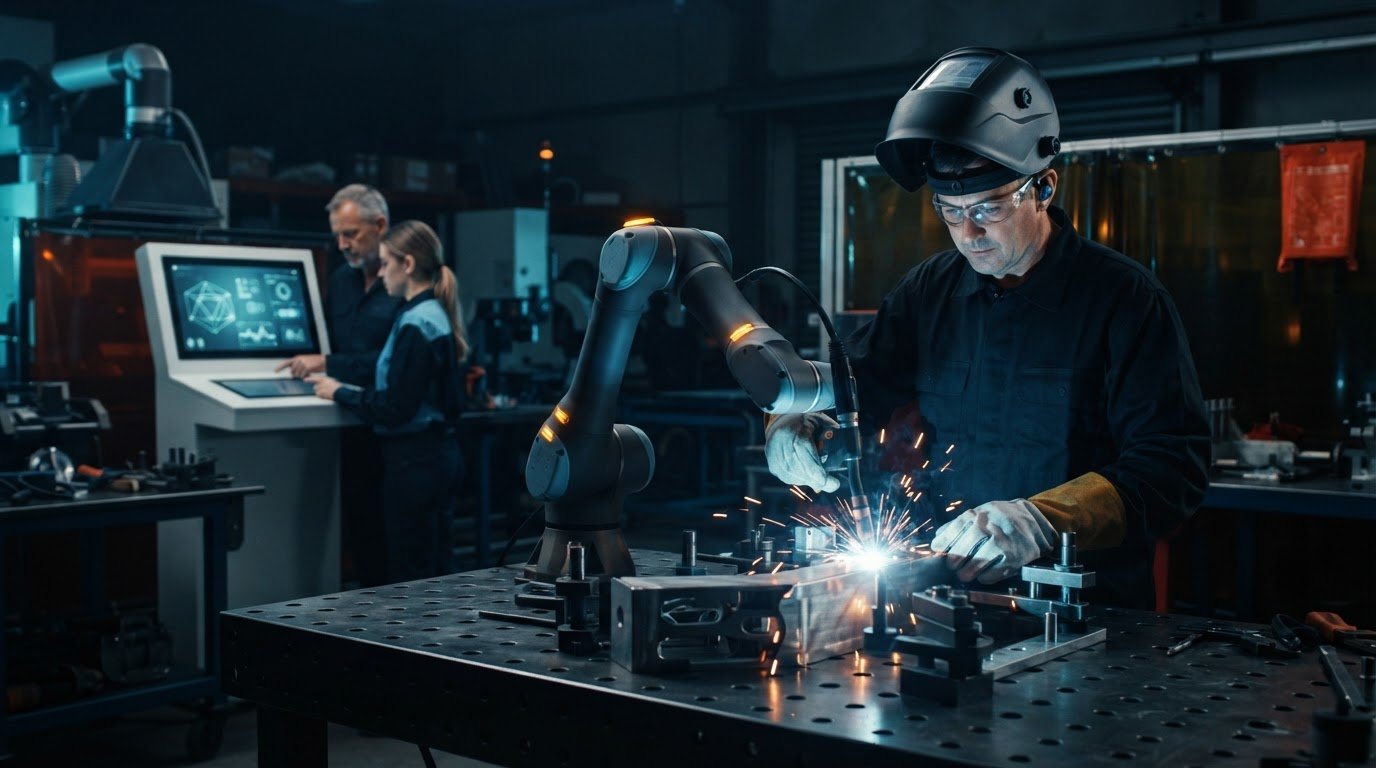
A robot or collaborative robot (cobot) can repeat a taught weld path on parts presented consistently, while an operator supervises the process and checks results. Depending on the system, no-code teaching software may let operators teach paths and adjust parameters without traditional programming.
This differs from a mechanised fixture or manual welding aid. A fixture can hold or position a part, and an aid can support a welder’s technique. Neither necessarily moves the welding torch through a programmed path. Suitability depends on the welding process, part presentation, access, job consistency and production requirements. A task that changes significantly from piece to piece may not be a good fit.
Why consider automation as welders approach retirement?
Retirement planning is also an opportunity to capture process knowledge while experienced staff are available to share it. A welder might explain the best sequence for a joint, where torch access gets difficult or which visual cues signal a quality issue. That insight can help shape how a repeatable task is taught and checked, while leaving room for skilled judgement where the work calls for it.
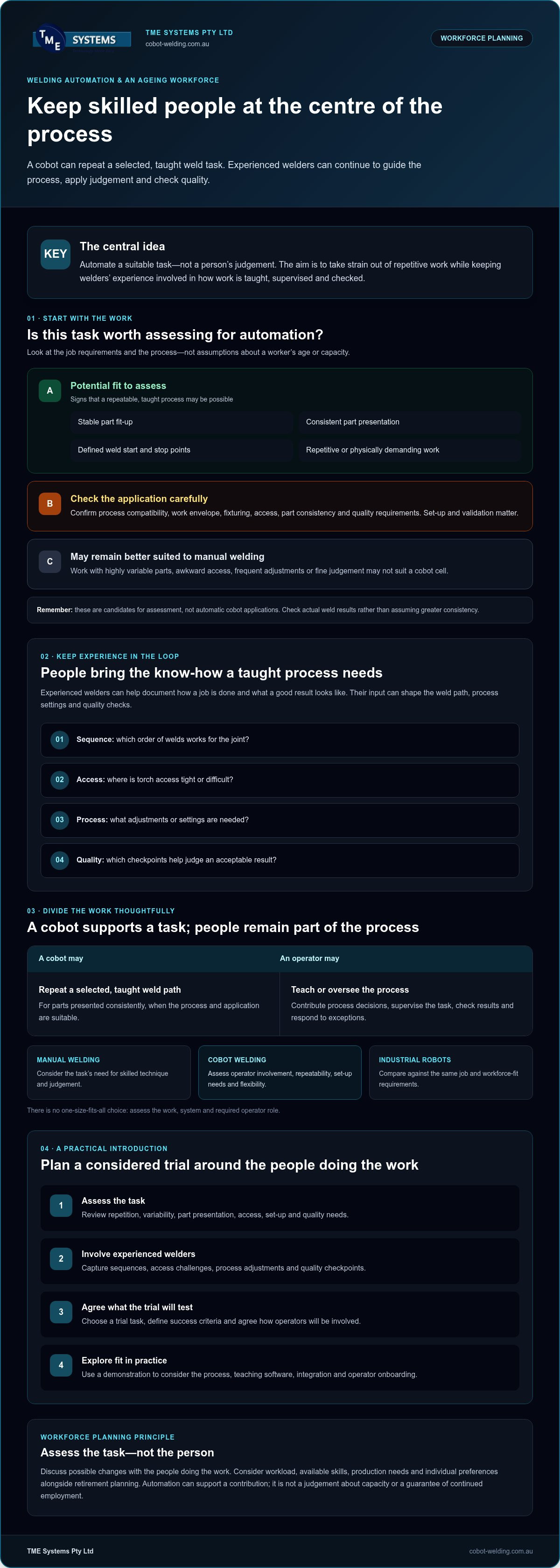
Start by identifying repetitive or physically demanding work, then assess the task rather than the worker. Consider whether the weld is repeatable, how parts are positioned, and what oversight and quality checks are needed. These are candidates for assessment, not automatic cobot applications.
Age is one workforce-planning factor, alongside workload, available skills, production needs and each person’s preferences. Discuss welding automation for an aging workforce with the people doing the work. Involve experienced welders in assessing tasks and shaping any trial. This frames automation as a possible way to support their contribution, not a judgement about their capacity or a guarantee of continued employment.
How welding cobots can support experienced welders and preserve know-how
A cobot can take on a defined, repeatable welding task while experienced welders help decide how that task should be done. Their knowledge is practical: which sequence suits a joint, where torch access is tight, how parts need to sit, and what to check before accepting the weld. Capturing those details helps shape a taught process without treating the operator’s judgement as something to automate away.
Collaborative welding automation uses a robot to repeat a selected weld task while an operator teaches or oversees the process, checks results and responds to exceptions. The division of work depends on the cell, the job and the operator’s role.
Which welding tasks may be suitable for automation?
Start with the job, not the worker’s age. Parts with stable fit-up, consistent presentation and clearly defined weld start and stop points may be worth assessing. Repetitive work can be a candidate if the selected equipment supports the process and the application can be set up and validated appropriately.
Not every weld belongs in a cobot cell. Variable parts, awkward access or work that calls for frequent adjustments and fine judgement may remain better suited to manual welding. Before deciding, confirm the proposed system’s process compatibility, work envelope, fixturing and quality requirements. Check any potential for more consistent repetition against actual weld results rather than assuming it.
How can operators contribute their welding expertise?
Involve welders in mapping the process: the sequence they use, access constraints, parameter adjustments and the checkpoints they rely on to judge an acceptable result. They can help teach a path, refine it where the system allows, and assess sample welds against the job’s requirements. This makes their experience part of process development and ongoing oversight.
No-code teaching software may let operators teach weld paths and adjust parameters without traditional programming, but capabilities vary by system. Check what the selected software supports and provide suitable onboarding. For more context, see this no-code robot welding software guide.
Task allocation should follow a job assessment and discussion with the workforce, not assumptions about what older or younger workers can do. Welding automation for aging workforce planning comes down to a practical question: which tasks could be supported, and where does skilled human judgement remain central?
If a task looks promising, a demonstration can help your team examine its process fit and how operators would work with the cell. You can explore collaborative robot welding systems as one option for that assessment.
Manual welding, cobots and industrial robots: comparing workforce fit
Choosing an approach means looking at the work and the operator’s role, rather than assuming automation is automatically a better fit. Manual welding remains valuable for variable jobs that call for frequent adjustment and skilled adaptation. Cobots and industrial robots may suit more defined work, but differ in setup and in how people interact with the system.
| Approach | Operator involvement | Repeatability | Setup needs | Task flexibility |
|---|---|---|---|---|
| Manual welding | Welder performs and judges the weld. | Depends on the job and the welder’s technique. | Requires suitable tools and workholding. | High for varied work and on-the-spot adaptation. |
| Cobot welding | Operator may teach or supervise a defined process and check results. | Can repeat a taught path, subject to process validation. | Requires assessment of access, fixtures, equipment and risk controls. | Best assessed for selected, recurring tasks. |
| Industrial robot welding | People oversee the operation, setup and quality checks. | Can repeat programmed work when parts and process are controlled. | May involve more extensive cell design and integration. | Depends on the system and the production task. |
When is a collaborative welding robot worth assessing?
Consider recurring work with stable components and a weld process that can be clearly taught. Assess the whole work area, not just the robot. Operator access, available space, fixtures, welding equipment and how parts move through production all affect whether a cell makes sense. A collaborative design doesn’t by itself remove the need to assess risks or determine appropriate guarding and other controls. Required measures depend on the specific system and workplace.
What should an ageing workforce comparison include?
Observe the work and ask operators what it involves. Compare physical demands, task variation, setup and handling, as well as who teaches the process, responds to exceptions and checks weld quality. Include experienced welders in those discussions. Their input can show where automation may support a task and where manual skill remains central.
Also consider how each option affects knowledge sharing and work allocation. A cobot may create a role for an experienced welder in teaching or reviewing a defined process, depending on the job and system. The right choice might be manual welding, a cobot, an industrial robot or a mix across different tasks. Welding automation for aging workforce planning is best assessed as part of wider workforce and production planning, not as a one-size-fits-all answer.
For more detail on cell-level considerations, read the collaborative robot welding cell guide.
How to assess workforce readiness for welding automation
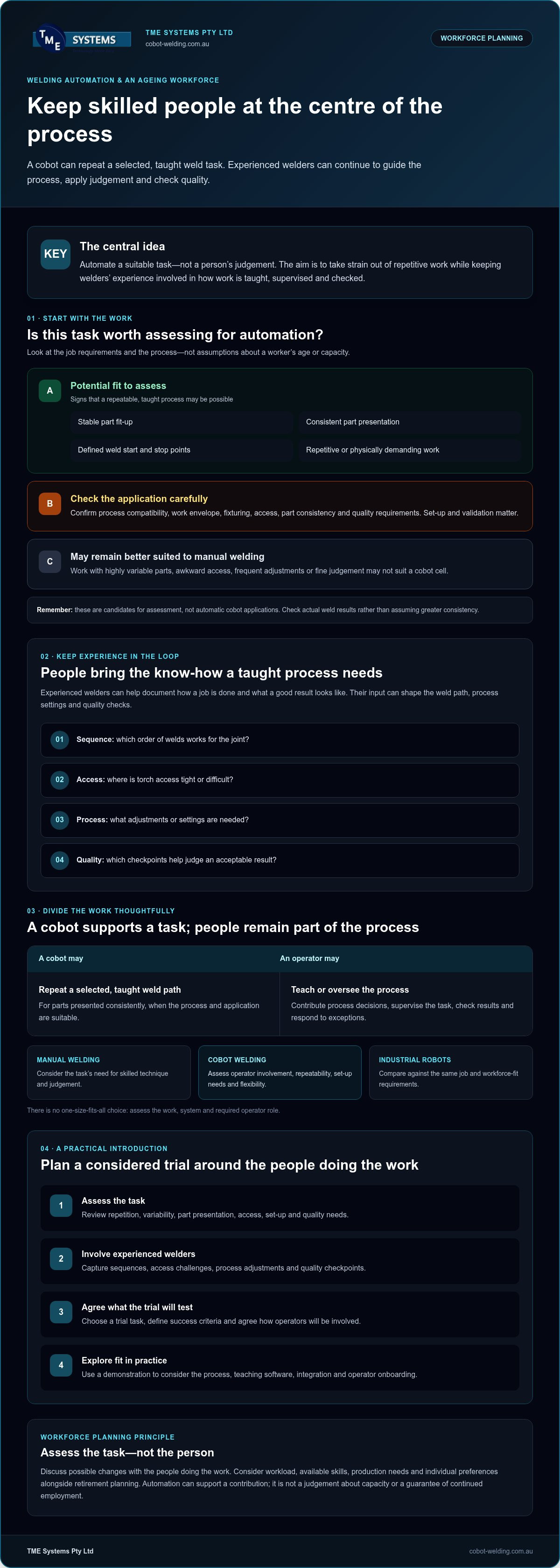
Document the work before choosing automation. Start with what happens on the workshop floor, then involve welders and production leads in deciding whether a task is worth assessing. This gives you a clearer basis for evaluating people, process and equipment before specifying hardware or defining a cell.
A practical first assessment for the workshop
Work through these steps with the people who know the jobs:
- Review the work. Use workshop records to list recurring weld jobs, production volumes, variation between parts and current bottlenecks. Note where work waits, needs rework or depends on a small number of experienced staff.
- Observe the task and ask operators. Speak with welders about which jobs feel tiring, repetitive or difficult to staff consistently. Ask what makes the work challenging rather than assuming age determines someone’s capacity or preferred role.
- Check the practical setup. With relevant technical personnel, review part presentation, existing fixtures, welding equipment, utilities, available space and the surrounding workflow. These details can affect whether a proposed system fits the job and production area.
- Review safety and training needs. Identify potential hazards, operator access, supervision requirements and the skills people would need to teach, run or check the process. Have appropriate personnel verify the applicable Australian WHS guidance and requirements for the specific equipment and workplace before proceeding.
If the job, layout or workforce needs are unclear, pause before selecting a system. A sound assessment may show that a different process change, or no automation, is the more suitable next step.
Bring experienced welders into the transition
Involve operators in selecting a trial task and describing what an acceptable weld looks like. They can help document the sequence, identify access constraints and agree on the quality checks that matter. Clarify responsibilities too: who teaches or refines the process, who supervises operation, and who reviews weld quality. Discuss these roles with the team rather than assuming them.
For practical onboarding considerations, read the cobot welding training guide. A mobile demonstration can also give operators and production leads a chance to consider usability and process fit before deciding on next steps.
For Australian manufacturers exploring welding automation for aging workforce planning, readiness involves people and workflow as much as equipment. To explore collaborative robot welding cells and integration, talk with TME Systems about welding automation.
Plan the next step: trial welding automation around your people
A useful next step doesn’t require committing to a full installation. Agree on one candidate task with welders and production leads, then define what you need to learn from a trial. Focus on whether the process, equipment and operator roles could fit your workshop, not on proving automation at any cost.
Set success criteria before the demonstration. These might include whether the weld path can be taught as intended, whether operators can make required adjustments, how parts are presented, and whether results meet your specified quality checks. Record observations and trial outcomes. They can inform a decision, but don’t guarantee performance in production, where conditions may differ.
What to test in a welding automation demonstration
Ask the demonstration provider what materials and information they can work with. If they confirm these are suitable, bring representative parts, drawings and process requirements. Include the operators who know the task. Their feedback can reveal practical issues that production records alone may miss.
- Can operators teach or adjust the weld path using the proposed system?
- Are access, part loading and checks practical within the intended workflow?
- What weld quality criteria will the team use to assess the trial?
- What differences between the demonstration and your workshop could affect the result?
A mobile demonstration can help your team examine usability and process fit in a practical setting. Treat it as an opportunity to ask questions and identify what still needs checking, not as a promise of a particular outcome. For more preparation advice, see the mobile welding robot demonstration guide.
Move from trial to a supported implementation
If the trial supports further investigation, confirm the proposed scope, integration requirements and operator onboarding before proceeding. Clarify who will teach and supervise the process, how quality will be reviewed, and what arrangements are available for ongoing support. TME Systems supplies and integrates collaborative robot welding cells, with operator training and onboarding. Confirm how those elements would apply to your requirements.
For welding automation for aging workforce planning, a considered trial keeps experienced operators involved as the workshop weighs its options. If you’ve identified a task to explore, discuss your welding automation requirements with TME Systems.
Make your next welding decision a practical one
Supporting an ageing workforce starts with looking closely at the work, not making assumptions about the people doing it. Identify a repeatable task, consult the welders who know it best, and agree on what a useful trial needs to show. That gives your team a grounded way to assess whether automation could support the job while keeping experienced operators involved in teaching, supervision and quality review.
Welding automation for aging workforce planning isn’t a one-size-fits-all fix. The right approach may be manual welding, a cobot for selected tasks, or a combination that reflects your production needs. A demonstration can help your team consider process fit and operator usability before deciding what to do next.
TME Systems offers no-code weld-path teaching software, collaborative welding cell integration, operator onboarding and a mobile demonstration system. To discuss an assessment around your workshop’s requirements, discuss a practical welding automation assessment with TME Systems. A considered first step can help your people shape the transition with confidence.
Frequently Asked Questions
Is welding automation suitable for an ageing workforce?
Welding automation for aging workforce planning may be suitable when the task and system are a good fit, but age alone doesn’t determine suitability. Assess the actual work with the welders who perform it, considering their input, system design and workplace risk assessment. A cobot may take on selected repetitive tasks while welders retain process judgement and quality checks. The right allocation depends on the application, not assumptions about workers’ abilities.
Can welding cobots replace experienced welders?
Cobots can automate selected welding tasks, but they don’t replace the process knowledge needed to define a weld sequence, teach a path and check results. Operators’ roles depend on the application and workshop. They may contribute to teaching, supervision or quality review while other tasks are automated. This doesn’t guarantee job retention, and not every operation requires a person at every step. Plan roles around the actual system and process.
What welding tasks are best suited to automation?
Repeatable jobs with consistent part presentation and a weld path that can be clearly taught are candidates for assessment. Suitability also depends on variation between parts, joint access, fit-up, welding process and production requirements. A recurring component may be worth reviewing, while highly variable work may call for manual adaptation. An application review should confirm the proposed equipment can perform the task and identify suitable safety controls before automation is recommended.
Are welding cobots safe for older workers?
Safety depends on the complete application, not a worker’s age or the cobot label alone. Consider the robot, welding equipment, fixtures, work area and operating procedures together. Have a competent person assess the specific installation and determine suitable risk controls. Check the Australian WHS guidance and requirements that apply to the equipment and workplace. Controls that suit one cell may not suit another, so assess each setup on its own.
Do welders need programming experience to operate a welding cobot?
Not necessarily. Some systems offer no-code teaching, allowing operators to teach weld paths or adjust parameters without traditional programming. Available functions, the interface and training needs vary by system, so don’t assume every cobot works the same way. Ask the supplier to demonstrate the actual teaching and adjustment workflow with operators, then verify that the system’s capabilities match the proposed welding process and job.
How can a workshop introduce welding automation without alienating experienced staff?
Involve experienced welders before selecting equipment. Ask them to help choose a suitable trial task, describe the process and agree on acceptable weld quality measures. Explain what the trial will test, what it won’t establish and how responsibilities may change, including teaching, supervision and review. Treat operators as contributors of process knowledge, not simply end users, and provide relevant onboarding before considering wider adoption.
What should a manufacturer assess before automating welding?
Assess the job and workshop together. Document repeatability, part consistency, production requirements and current process conditions, then check available space, equipment compatibility, operator involvement and safety considerations. Consult experienced welders before choosing a system. They can identify access constraints and quality checkpoints that may not be obvious from records alone. There’s no universal threshold for a suitable task, so verify the application and integration requirements with an appropriate specialist.