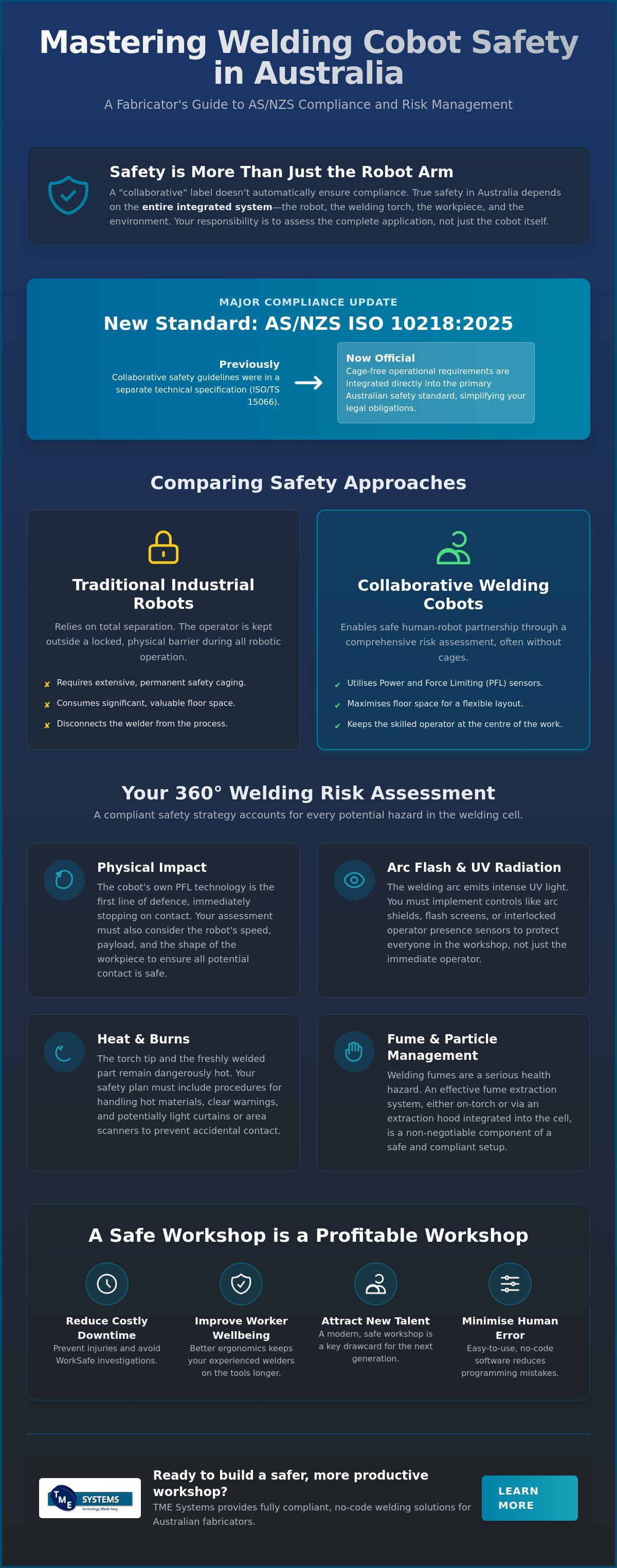

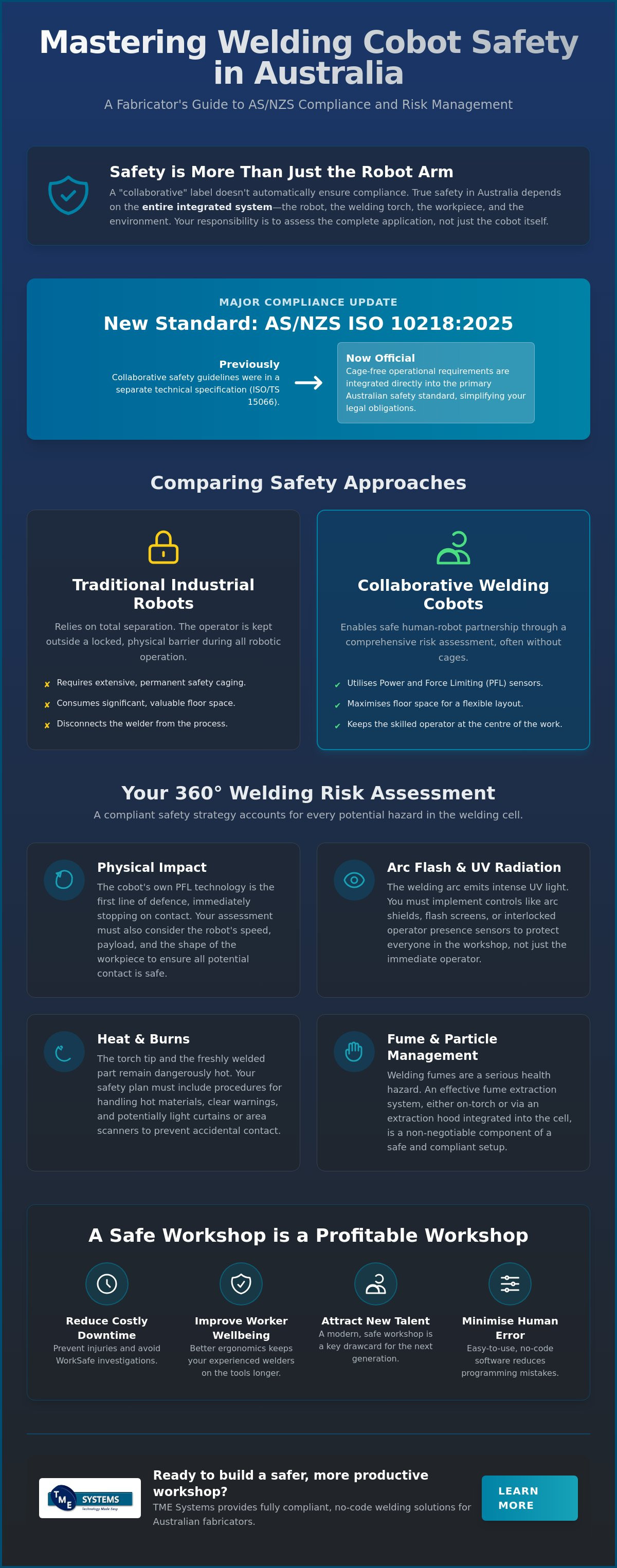
Buying a robot with a "collaborative" label doesn't automatically mean your workshop is compliant with Australian law. In fact, the responsibility for welding cobot safety in Australia rests squarely on how the entire application is integrated, not just the arm itself. You might feel a bit of a headache trying to distinguish between international marketing and the actual AS/NZS standards, especially with the significant updates released in early 2025. It's natural to worry about how a cage-free system will hold up during a WorkSafe audit or if your skilled welders will feel truly safe working alongside new tech.
We understand that your priority is keeping your team out of harm's way while staying competitive. This guide will help you implement collaborative welding safely by meeting the latest Australian requirements and protecting your most valuable asset: your people. You'll learn exactly what the AS/NZS ISO 10218:2025 updates mean for your floor. We'll also walk through the practical steps of a risk assessment, from managing arc flash to fume extraction, so you can build a workspace where operators work with confidence and precision.
Key Takeaways
- Understand the latest AS/NZS ISO 10218:2025 updates to ensure your workshop stays compliant with current Australian safety regulations.
- Learn why a thorough risk assessment must account for more than just physical impacts, including arc flash, heat, and fume management.
- Discover how to create a cage-free production environment that maximises floor space without compromising the safety of your skilled welders.
- Master the essentials of welding cobot safety australia by integrating robotic precision with the hands-on expertise of your existing team.
- See how no-code teaching software simplifies the transition to automation, reducing the risk of programming errors that could lead to workshop accidents.
Understanding Welding Cobot Safety in the Australian Workshop
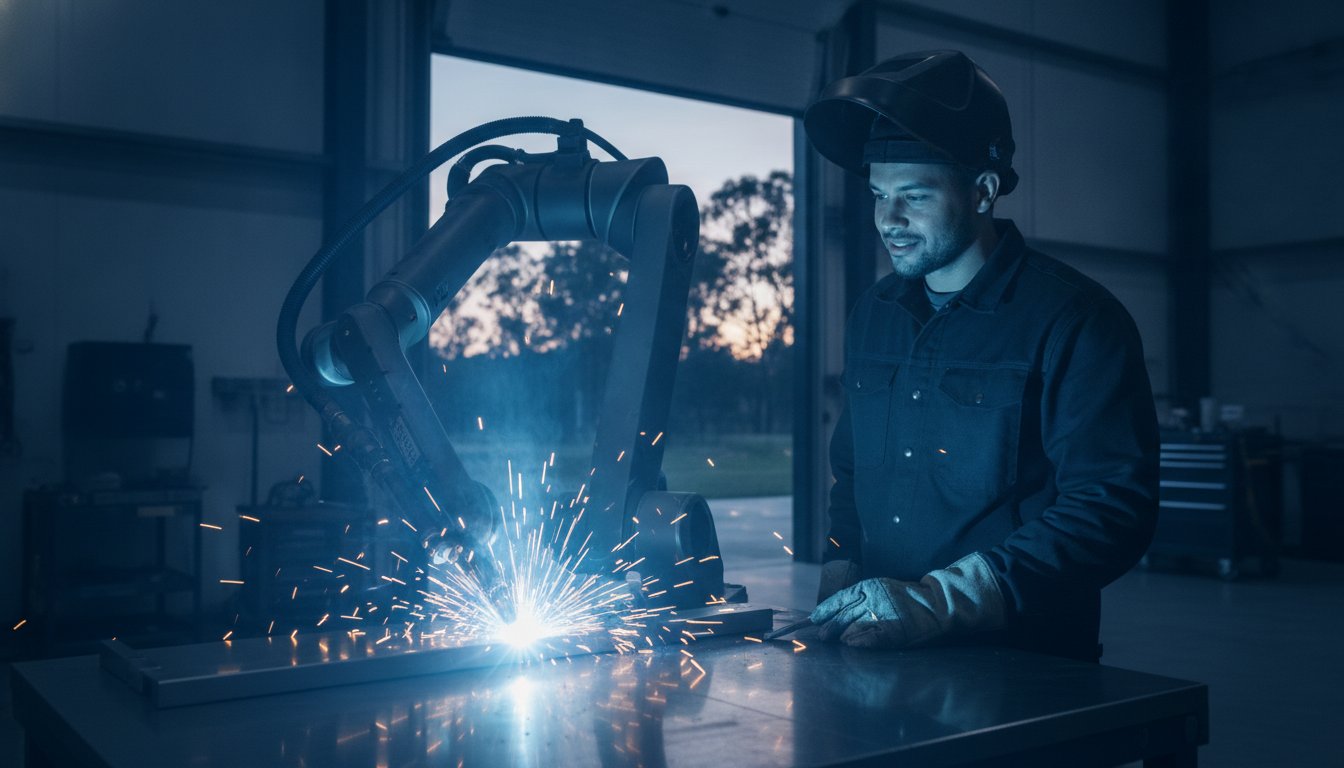
Safety isn't just a compliance hurdle for Australian fabricators. It's the foundation of a productive floor. For years, industrial automation meant bolting down heavy machines behind floor-to-ceiling yellow cages. While effective, these barriers eat up valuable floor space and disconnect the welder from the process. The shift toward welding cobot safety australia represents a change in mindset where we prioritise the partnership between human skill and robotic consistency.
When you introduce a collaborative robot (cobot) into your workshop, you aren't just adding a machine. You're giving your best welders a tool that handles the repetitive, physically taxing runs so they can focus on complex joins and quality control. This collaborative approach keeps the operator at the centre of the work. They remain the decision-maker, while the robot provides the steady hand. It's a move away from "lights-out" automation toward a more flexible, human-led production line that fits the reality of local workshops.
What Makes a Welding Robot "Collaborative"?
The term "collaborative" is often misunderstood. It doesn't mean the robot is inherently harmless regardless of what it's doing. At its core, a cobot uses Power and Force Limiting (PFL) technology. These are sophisticated internal sensors that monitor every movement. If the arm encounters an unexpected obstacle, like an operator's hand or shoulder, it triggers an immediate stop. This sensitivity is what allows for a cage-free environment in many applications.
However, there's a vital distinction between a "safe" robot and a "safe" application. The robot arm itself might be collaborative, but a welding torch is still hot, and the arc still produces UV light and fumes. True welding cobot safety australia means looking at the whole picture. We evaluate the tool, the workpiece, and the surrounding environment to ensure the entire cell protects the worker from every angle.
The Economic Benefit of a Safe Workshop
A safe workshop is a profitable one. When safety is built into the workflow, you reduce the risk of workplace injuries that lead to costly downtime and WorkSafe investigations. With global robot demand doubling between 2014 and 2024, it's clear that automation is the path forward, but only if it's sustainable. Better ergonomics mean your experienced tradespeople stay on the tools longer without the physical strain of manual repetition.
Modern safety tech also helps solve the recruitment puzzle. Young apprentices are drawn to workshops that value innovation and worker wellbeing. By implementing safe, no-code systems, you're showing that your business is a forward-thinking place to work. You're not just protecting your people; you're building a culture of trust where technology is seen as a support, not a threat.
Australian Standards and Compliance for Robotic Welding
Achieving proper welding cobot safety australia requires more than just reading a manual. You need a clear grasp of the AS/NZS 4024.1 series, which serves as the primary machinery safety framework in this country. While many manufacturers look to international benchmarks, Australia has its own specific adoption of these rules. For instance, the Australian Standard AS 4024.3301:2017 provides the definitive technical requirements for industrial robot safety that every local integrator must follow. It's the baseline for ensuring your robotic investment doesn't become a liability.
On February 5, 2025, Standards Australia published significant updates to the core robotics standards: AS/NZS ISO 10218-1:2025 and AS/NZS ISO 10218-2:2025. These updates are a major milestone for fabricators. They now officially incorporate safety requirements for collaborative applications that were previously found in the ISO/TS 15066 technical specification. This consolidation means that the rules for cage-free operation are now part of the primary standard, making it easier for you to understand your legal obligations when setting up a collaborative cell.
Key Regulations Every Manager Should Know
Managers must pay close attention to AS/NZS 4024.1201, which outlines the principles for risk assessment. It's not enough to claim a robot is safe. You have to prove it through a documented process of identifying hazards and reducing risks. Additionally, AS/NZS 4024.1501 focuses on the design of safety-related parts of control systems. In a welding context, this means ensuring that your safety sensors and emergency stops are integrated correctly to meet the required performance levels for your specific workshop environment.
The Legal Responsibility of the Fabricator
Under Australian Work Health and Safety (WHS) laws, you have a non-delegable duty of care to provide a safe workplace. A common trap is assuming that a "CE" mark from a European manufacturer guarantees compliance in Australia. While it's a helpful indicator of quality, it doesn't automatically satisfy local regulators or WorkSafe auditors. You're responsible for the entire application, which includes the robot arm, the welding torch, and the workpiece itself.
Proper documentation is your best defence during an inspection. You need to maintain records of your risk assessments, operator training logs, and maintenance schedules. If the regulatory landscape feels overwhelming, seeking expert welding system integration can help you bridge the gap between a box of parts and a fully compliant, high-production workshop. This approach ensures that safety is designed into the system from day one, rather than being an afterthought that causes delays later.
Collaborative vs. Industrial: Comparing Safety Approaches
Traditional industrial robots are rigid assets. They require massive safety perimeters and interlocking gates that eat up floor space. If a gate is opened, the entire process halts. In contrast, welding cobot safety australia prioritises a flexible footprint. By removing bulky steel cages, you can integrate automation into tight production lines where a traditional cell would never fit. This allows your team to work in close proximity to the machine, turning the robot into a versatile tool rather than a sequestered hazard.
The move to a collaborative setup replaces physical interlocking gates with sophisticated sensor-based protection. These sensors enable "hand-guiding," a process where a skilled welder can physically move the robot arm to teach it a new weld path. It’s intuitive and fast. To keep this safe, a system-wide emergency stop (E-stop) remains essential. This E-stop must be integrated across the entire cell, ensuring that the robot, the wire feeder, and the power source all shut down instantly if a safety limit is breached.
When is a Cage Still Necessary?
Collaborative doesn't always mean cage-free. If your application demands high-speed cycles that exceed safe collaborative speeds, physical guarding is still the best option. You must also consider the workpiece itself. Sharp edges, heavy parts, or extreme heat can create hazards that no sensor can mitigate. In these scenarios, hybrid solutions like light curtains or laser scanners provide a smart middle ground. They offer robust protection while maintaining the visibility and ease of access that fabricators value.
Power and Force Limiting (PFL) in Action
PFL technology allows the robot to monitor the resistance it encounters during every movement. Within the software, you can define safety zones and force thresholds that suit your specific workshop traffic. If the arm touches an object or person, it detects the change in torque and stops immediately. For welding, this logic must extend to the torch. If the robot stops, the welding arc and gas flow must also terminate. This ensures the operator is protected from both mechanical impact and the secondary hazards of the welding process.
Conducting a Risk Assessment for Your Welding Cobot
A common misconception is that a cobot is "safe out of the box." In reality, the legal requirement for welding cobot safety australia depends on a thorough risk assessment of the entire application. You need to look at the robot, the torch, the table, and the operator as one single system. This isn't just a paperwork exercise; it's about identifying exactly where things could go wrong on your specific workshop floor.
Follow these five steps to build a robust safety profile:
- Identify pinch points: Check every movement for spots where the arm could trap an operator against a bench, fixture, or wall.
- Evaluate process hazards: The robot handles the torch, but the arc still creates UV radiation, spatter, and intense heat.
- Apply the hierarchy of controls: Aim to engineer the risk away first. If that's not possible, implement administrative rules or specific PPE requirements.
- Document and train: Record your findings, including any residual risks, and ensure every staff member understands the collaborative boundaries.
- Schedule regular testing: Safety sensors and E-stops must be checked monthly to ensure they respond correctly to unexpected obstructions.
Welding-Specific Hazards in Automation
Because cobots often operate without full enclosures, managing arc flash becomes a priority. You'll likely need portable welding screens to protect other workers in the vicinity from UV exposure. Fume extraction is also critical. Since the robot welds in a consistent spot, you can use fixed extraction arms or high-vacuum nozzles mounted directly to the torch. Without a cage to contain sparks, ensure the surrounding area is clear of flammables and that floor surfaces are fit for purpose.
The Importance of Part Presentation
Safety starts with how you set up the job. If your fixturing is loose, parts can shift, causing the robot to trigger a collision stop or, worse, miss the join and create a fire hazard. Ergonomic loading is just as vital. The goal is to keep the operator in a neutral physical position while they load the "human" side of the welding cell. Clear floor markings help define the collaborative zone, reminding everyone where the robot's reach ends and the safe walkway begins.
If you're ready to see how these safety measures work in a real-world setting, our mobile demo system can bring the technology directly to your workshop floor. This allows your team to see the safety features in action and ask specific questions before you commit to a full installation.
TME Systems: Safe, No-Code Welding for Australian Fabricators
Transitioning to automation shouldn't feel like a gamble with your team's safety. At TME Systems, we believe that the best safety features are the ones that are intuitive to use. By combining Universal Robots hardware with SmoothTool software, we provide welding cobot safety australia that is built into the workflow, not bolted on as an afterthought. Our collaborative robot welding cells are designed to meet the rigorous standards we've discussed, ensuring your workshop stays compliant while your production stays steady.
We take a "turnkey" approach to integration. This means we don't just drop a crate at your door and leave you to figure out the risk assessment. We work as your local partner to ensure the entire cell, from the torch mounting to the fume extraction, is refined for safe, cage-free operation. Our process includes:
- Welding system integration: Customising the cell to fit your specific parts and floor layout.
- Operator training and onboarding: Giving your welders the confidence to master the technology.
- Mobile demo system: Bringing the equipment to you so you can test the safety features in your own environment.
- Ongoing support: Helping you adjust your safety protocols as your production needs evolve.
The Safety Advantage of No-Code Teaching
Traditional robotic programming is often a "black box" that requires specialised coding knowledge. This complexity creates room for error. If a line of code is entered incorrectly, the robot might behave in ways the operator doesn't expect. Our no-code teaching software removes this risk entirely. It allows your skilled welders to physically guide the robot arm through the desired weld path. What they see is exactly what the robot does.
This hands-on method empowers your tradespeople. They remain in total control of the machine, using their years of fabrication experience to set the perfect weld while the software handles the underlying logic. It's an intuitive process that reduces the need for dangerous "dry runs" and minimises the chance of accidental collisions. It's simple. It's safe. It works.
Book a Mobile Demo to See Safety in Action
Reading about safety standards is one thing, but feeling the Power and Force Limiting sensors respond to a light touch is another. We understand that Australian manufacturers need practical proof before making an investment. That's why we offer a mobile demo system that travels across the country to show you exactly how these systems operate in a real-world workshop setting.
During a demonstration, you can discuss your specific compliance hurdles with an Australian expert who understands local WHS requirements. We'll show you how to define safety zones, manage arc flash in a collaborative layout, and ensure your team feels supported throughout the transition. Don't leave your workshop's safety to chance. Book your mobile welding robot demonstration today and see how we can help you protect your people while growing your business.
Future-Proof Your Fabrication with a Safety-First Mindset
Implementing robotic automation doesn't have to be a source of anxiety for your team. By focusing on the latest AS/NZS 4024 standards and conducting thorough risk assessments, you can create a workshop floor that is both highly productive and incredibly safe. You've seen how the shift toward collaborative technology allows your skilled welders to work alongside machines without the need for restrictive cages. This isn't just about meeting regulations; it's about refining your process to protect your most valuable assets while staying competitive in a global market.
At TME Systems, we specialise in bridging the gap between complex robotics and practical workshop reality. Our specialised Australian integration experts ensure your setup is fully compliant with local rules from day one. By using no-code software, we significantly reduce the risk of operator error, making the technology accessible to your existing workforce. Mastering welding cobot safety australia is the first step toward a more efficient, sustainable business. If you're ready to see how these systems adapt to your specific needs, we're here to help.
Secure your workshop’s future-request a safety-first cobot demo
We look forward to supporting your progress and helping your team work with confidence on the production line.
Frequently Asked Questions
Do I legally need a safety cage for a welding cobot in Australia?
A physical cage is not a legal requirement for every installation, but the decision must be backed by a documented risk assessment. If your welding application involves low speeds and minimal mechanical hazards, you can often replace steel barriers with electronic sensors and power limiting technology. You must prove that the setup protects workers from both the robot's movement and the welding process itself to stay compliant with Australian laws.
What are the specific AS/NZS standards for collaborative robots?
The primary standards you need to follow are AS/NZS ISO 10218-1:2025 and AS/NZS ISO 10218-2:2025. These were updated in February 2025 to officially include the safety requirements for collaborative applications that were previously found in separate technical specifications. These documents govern how the robot is built and how it's integrated into your specific workshop floor.
Can a cobot really sense if it hits a person while welding?
Yes, cobots use Power and Force Limiting (PFL) technology to monitor resistance during every movement. If the arm touches a person or an unexpected object, the internal sensors detect the change in torque and trigger an immediate stop. This sensitivity is a core component of welding cobot safety australia, but it must be tested regularly to ensure it responds correctly under workshop conditions.
How do I manage welding fumes and UV light without a full enclosure?
You can manage these hazards by using portable welding screens and point-of-source fume extraction. High-vacuum nozzles mounted directly to the torch or adjustable extraction arms are effective for stationary robotic cells. These tools ensure that arc flash and hazardous fumes are contained at the source, protecting other staff members who are working nearby in an open-plan layout.
Does my existing welder need to be "safety-rated" to work with a cobot?
Your power source doesn't necessarily need a specific safety rating, but the integration between the welder and the cobot must be secure. The robot's control system needs to communicate directly with the welder to shut down the arc and wire feeder instantly if a safety limit is breached. This ensures the entire cell stops as one unit during an emergency or a collision.
Is a risk assessment mandatory for every new robotic welding job?
Yes, conducting a risk assessment is a legal requirement under Australian Work Health and Safety (WHS) regulations. Even if the robot arm is the same, a new job might involve different part sizes, sharper edges, or higher welding speeds. You need to evaluate these changes to ensure your collaborative safety settings are still adequate for the new task.
How often should I test the safety sensors on my welding cobot?
You should test your safety sensors and emergency stop buttons at least once a month. Regular testing ensures that the PFL technology and any external sensors, like light curtains or scanners, are functioning perfectly. It's best practice to keep a written log of these tests to show WorkSafe inspectors that you're actively maintaining a safe welding cobot safety australia environment.
Will a cobot increase my insurance premiums in an Australian workshop?
Implementing collaborative automation generally doesn't increase premiums and can often help your risk profile. By automating repetitive tasks, you reduce the likelihood of manual handling injuries and long-term strain for your staff. Insurers often view the move toward safer, ergonomically sound technology as a positive step in managing workplace liability.