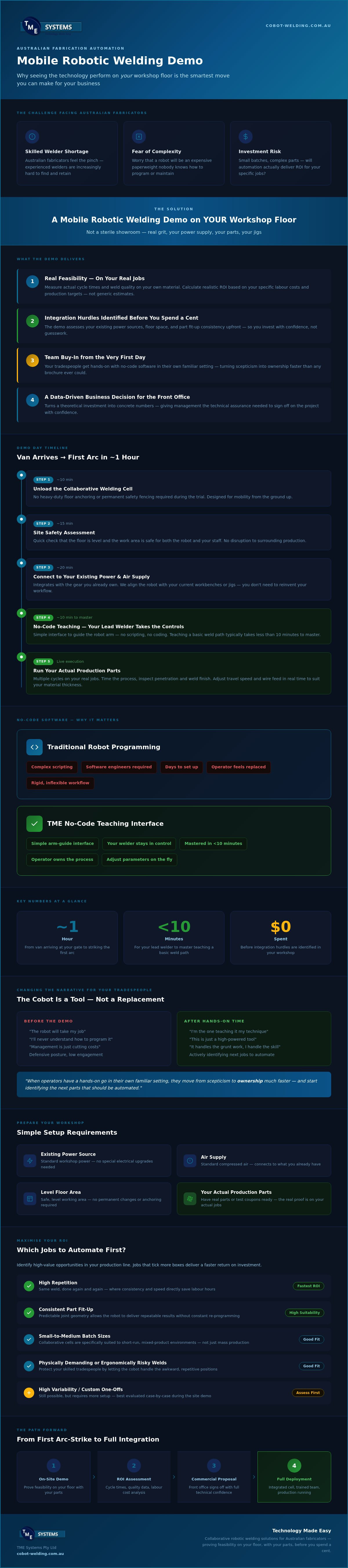

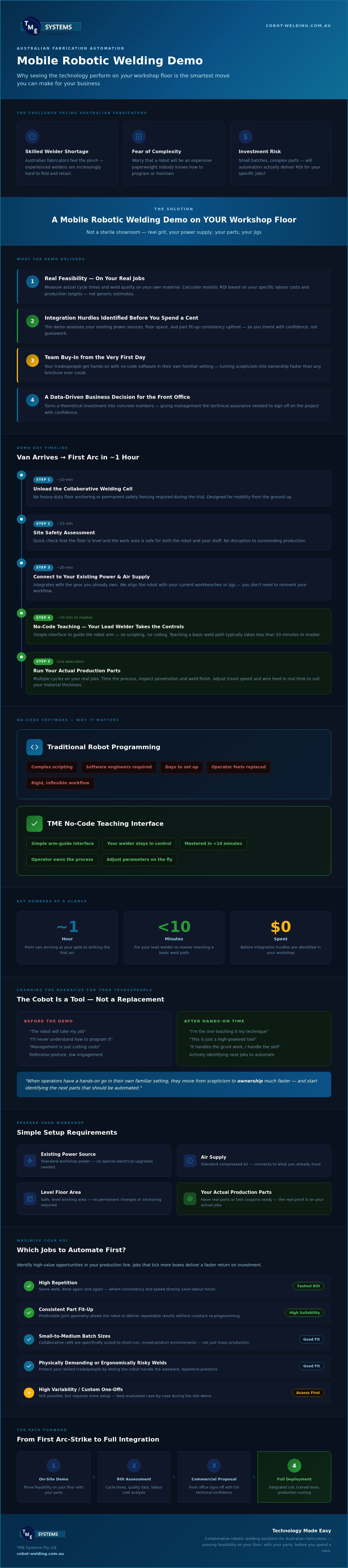
If you've been pushing automation into the too hard basket because your batches are small and your parts are complex, you aren't alone. Many Australian fabricators feel the pinch of the welder shortage but worry that a robot will just be an expensive paperweight that nobody knows how to program. A mobile robotic welding demo is the most practical way to bridge that gap, allowing you to see the technology perform on your own workshop floor.
We agree that any new tool must earn its place in your production line. You're looking for a solution that supports your tradespeople, not one that requires a team of software engineers to maintain. This article explores how an on-site demo proves feasibility, engages your team, and de-risks your investment in automation. We'll preview the real-world ROI of collaborative systems and show you how no-code software puts the power back into the hands of your welders. By the end, you'll understand why seeing this tech in action is the smartest move you can make for your business in 2026.
Key Takeaways
- Learn why testing a robot on your own workshop floor is the only way to truly validate feasibility for your specific parts and production environment.
- Discover how a mobile robotic welding demo allows your tradespeople to get hands-on with no-code software, ensuring team buy-in from the very first day.
- Understand the simple setup requirements, including power and air needs, to properly prepare your space for a successful on-site visit.
- Identify the high-value opportunities in your production line by assessing which jobs will deliver the fastest return on investment.
- See the clear path from the first arc-strike to full integration, including how a collaborative cell adapts to your existing power sources and equipment.
The Value of a Mobile Robotic Welding Demo for Australian Workshops
Watching a robot perform a perfect weld in a sterile, air-conditioned showroom is one thing. Seeing that same machine handle your grit, your power supply, and your specific part jigs is quite another. For many Australian fabricators, the gap between high-tech theory and workshop reality feels too wide to bridge. A mobile robotic welding demo closes that gap by bringing the proof of concept directly to your floor, where the real work happens.
This isn't just a sales pitch on wheels; it's a hands-on feasibility study. When you see the robot tackle your most repetitive or difficult small-batch jobs, the "it won't work here" mentality starts to fade. You can measure actual cycle times and weld quality on your own material, which allows you to calculate a realistic ROI based on your specific labour costs and production targets. It turns a theoretical investment into a data-driven business decision.
De-risking Your Automation Investment
The biggest fear for any workshop manager is investing in a complex system that ends up sitting idle because it's too hard to use. A mobile demo identifies potential integration hurdles before you spend a single cent. We look at your existing power sources, floor space, and part fit-up consistency to ensure the technology fits your current workflow. Comparing the modest cost of a site visit against the massive risk of an idle industrial robot makes the demo a vital first step. It provides the front office with the technical assurance they need to sign off on the project with confidence.
Building Operator Confidence from Day One
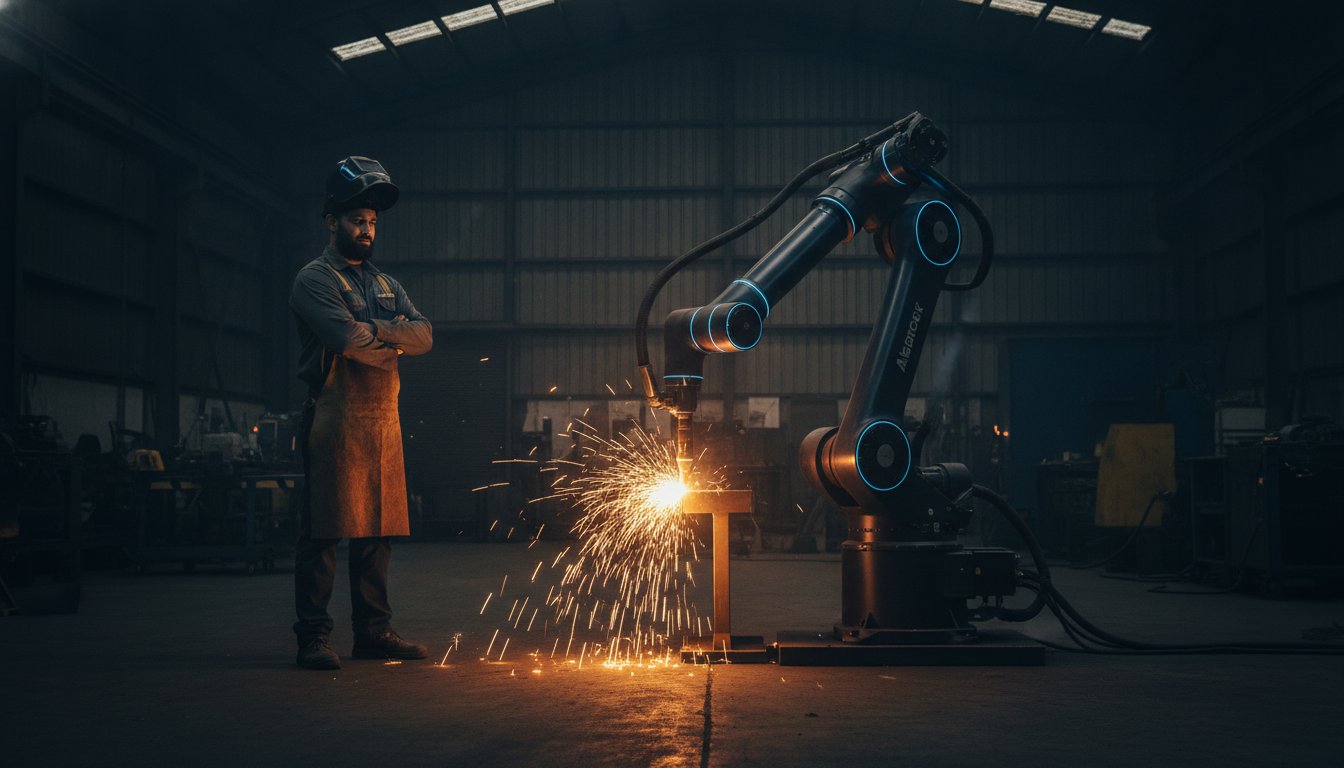
Automation often triggers a defensive reaction from skilled tradespeople who fear their expertise is being replaced. A mobile robotic welding demo changes that narrative by positioning the cobot as a high-powered tool rather than a replacement. When your best welders see how the no-code teaching software works, they realise they're still the ones in control of the weld parameters and technique. They aren't learning to code; they're teaching a tool to handle the grunt work. Experience shows that when operators have a hands-on go in their own familiar setting, they move from scepticism to ownership much faster. They start identifying the next parts that should be automated, which is the key to long-term success.
A mobile robotic welding demo is designed to be as non-intrusive as possible. We understand that your workshop floor is a productive space, and the last thing you need is a three-day setup process just to see if a robot works. Usually, we can go from the van arriving at your gate to striking the first arc in about an hour. It's a methodical process that mirrors how the system would actually function if it were a permanent fixture in your shed.Setup and Integration Basics
The process starts with unloading the collaborative robot welding cell. Because these units are designed for mobility, they don't require heavy-duty floor anchoring or permanent safety fencing during the trial. Our team performs a quick site assessment to ensure the floor is level and the work area is safe for both the robot and your staff. We then connect the system to your existing power source and air supply. One of the biggest advantages of this technology is its ability to integrate with the gear you already own. We'll align the robot with your current workbenches or jigs, proving that you don't need to reinvent your entire workflow to accommodate automation.
The No-Code Teaching Experience
Once the system is live, we hand the controls to your lead welder. This is the part of the day where the no-code software really shines. Instead of typing lines of complex script, your operator uses a simple interface to guide the robot's arm. We'll walk them through teaching a basic weld path, which typically takes less than ten minutes to master. We'll show them how to adjust parameters on the fly, such as travel speed and wire feed, to suit the specific material thickness of your parts. Seeing a skilled welder take charge of the machine in minutes is often the lightbulb moment for the whole team. It demonstrates that the robot is a tool for them to use, not a computer they have to fight.
After the initial teaching session, we move straight into live execution. We encourage you to have your actual production parts or test coupons ready. There's no substitute for seeing the machine lay down a clean, consistent bead on a job you do every day. This live trial is the perfect time to explore our collaborative robot welding cells and see how they handle the heat and dust of a real Australian fabrication environment. We'll run multiple cycles, allowing you to time the process and inspect the penetration and finish of every joint during the mobile robotic welding demo.
Evaluating Your Parts and Workflows During the Demo
During a mobile robotic welding demo, the focus shifts from the machine's capabilities to your specific inventory. We aren't there to show off a generic demo part that was programmed in a factory. We want to see your "low-hanging fruit". These are the parts that take up too much of your skilled welders' time but are repetitive enough to automate. Identifying these jobs is the fastest way to see a return on your investment. It's about finding the sweet spot where the robot handles the volume, freeing your team for the high-value, bespoke work that requires a human touch.
We'll look at everything from simple straight runs to complex multi-pass joints. If you've been hesitant about automation because you work with tricky materials like aluminium or thin-gauge stainless steel, the demo is the time to test those limits. Watching the robot maintain a perfectly consistent travel speed on a 1.6mm stainless sheet often settles the debate. It proves that the technology can handle the heat management required for delicate work without the risk of burn-through or warping.
Part Suitability Assessment
Not every part in your shop is a candidate for automation. We use a practical set of criteria to assess "cobot-friendly" parts, focusing on reach, weight, and joint access. For small-batch, high-mix workshops, the no-code software is a game changer. It allows you to switch between different parts in minutes rather than hours. During the mobile robotic welding demo, we'll help you categorise your parts. Some will be perfect for the robot, while others might still require manual intervention due to awkward angles or poor fit-up. This honesty ensures your automation strategy is built on a solid foundation of what's actually possible on your floor.
Workflow and Fixturing Strategy
Robotic welding relies heavily on repeatability. If the part isn't in the same spot every time, the robot won't find the joint. We'll review your current jigs and fixtures to see how they might need to evolve. Often, a jig designed for a human operator allows for more variation than a robot can handle. Our specialist will suggest simple, cost-effective fixture improvements to tighten up your tolerances. We then run the clock to calculate cycle times compared to your current manual processes. You'll see exactly how much time is saved when the arc stays on longer and the "human factor" of fatigue or repositioning is removed from the equation.
How to Organise Your Workshop for a Successful Demonstration
To get the most value from a mobile robotic welding demo, a small amount of preparation goes a long way. You don't need to halt production or clear half the shed, but ensuring the tech can hit the ground running means more time spent looking at your parts and less time hunting for an extension lead. A successful visit is about creating a realistic environment where the robot can prove its worth under your actual working conditions.
Start by selecting a few "problem" parts. These should be cleaned, tacked, and ready for the arc to be struck. If you spend the first hour of the demo grinding rust or trying to find a jig that fits, you're losing valuable time that could be spent refining weld parameters. Having a bin of parts ready to go allows us to run multiple cycles, giving you a clear picture of how the system handles heat soak and repeatability over a longer run.
Technical Requirements Checklist
The technical needs for a mobile unit are surprisingly modest, but they are non-negotiable for a safe and productive session. We'll need a level floor surface to ensure the robot base is stable and the arm can move through its full range without vibration. While the collaborative nature of the robot means it doesn't need a heavy cage, we still need to establish a clear safety perimeter to keep bystanders at a safe distance from the arc and moving parts. Please ensure we have easy access to:
- Power: Access to a standard 15A outlet is usually sufficient, though we can integrate with your existing 3-phase power sources if required for specific high-output cells.
- Compressed Air: If the welding torch or cleaning station requires air, having a drop point nearby is essential.
- Work Surface: A sturdy, level welding bench or your existing jigs where the parts can be securely positioned.
Personnel and Time Management
Choosing who attends the session is just as important as the technical setup. We recommend involving the business owner to talk through the numbers and the shop foreman to oversee the workflow integration. Most importantly, make sure your lead welders are there. They are the ones who will be using the tool, and their feedback on the no-code interface is vital. Their buy-in is often the difference between a successful rollout and a machine that gathers dust.
Allocate at least half a day for the visit. This gives your team enough breathing space to ask questions, test "what-if" scenarios, and really get a feel for the software. Come prepared with a list of your most common welding pain points, whether it's a specific joint that always fails or a part that's a nightmare to weld manually. When you're ready to see how these solutions fit into your specific shed, you can book your mobile robotic welding demo and we'll bring the tech to you.
From Demonstration to Deployment: Next Steps with TME Systems
Once the van leaves and the dust settles after your mobile robotic welding demo, the focus shifts to the data. We sit down with you to review the cycle times recorded and the quality of the welds produced on your actual parts. This isn't just about technical specs; it's about operator feedback. If your lead welder is excited about how easy the no-code software was to use, you've already cleared the biggest hurdle to successful automation. We use these real-world results to build a business case that makes sense for your specific workshop, comparing the demo's output against your historical manual averages.
Refining Your Integration Plan
The transition from a demo to a permanent installation is where we customise the solution to fit your shed. We'll finalise the choice of welding power source and torch configuration to ensure it matches your material requirements, whether you're primarily running heavy plate or thin-gauge sheet. We also plan the physical layout of your permanent cell, ensuring it doesn't disrupt the existing flow of parts through your shop. Looking ahead to 2026, we'll discuss upcoming software updates and new features that will continue to simplify the programming process and expand the robot's capabilities. Our goal is a seamless fit that feels like a natural extension of your team's existing skills.
Long-term Support and Training
Success in the long run depends on more than just the hardware. Comprehensive on-site cobot welder training ensures your team feels confident and capable from day one of daily production. We don't just drop the machine and leave; we stay until your operators are comfortable refining programmes and troubleshooting on their own. This hands-on onboarding process is designed to turn your welders into automation champions who can lead the charge on future projects.
Accessing local Australian technical support means you aren't waiting for a response from a different time zone when you have a deadline to meet. We're just a phone call away, ready to help with refining a programme or adjusting a setup. We view every deployment as a long-term partnership rather than a one-off transaction. By building a roadmap for future automation together, we ensure your investment continues to pay off as your business grows and your production needs evolve. A mobile robotic welding demo is only the beginning of that journey.
Securing Your Workshop's Future with Practical Automation
The manufacturing landscape in 2026 demands higher efficiency, but it shouldn't come at the cost of your team's sanity or your bottom line. By choosing a mobile robotic welding demo, you're taking the guesswork out of automation. You've seen how the technology handles your actual production parts, witnessed your tradespeople master the no-code software in minutes, and established a clear path toward a measurable ROI. It's about making a decision based on the reality of your workshop floor, not a glossy brochure.
As an Australian-owned and operated business, TME Systems is here to support you every step of the way. We specialise in no-code welding automation and provide national support and integration services to ensure your transition is seamless. Don't let the fear of complex tech hold your business back from its next phase of growth. Book your mobile welding robot demonstration today and see exactly how we can help you refine your processes. We're ready to help you build a more productive, resilient workshop for the years ahead.
Frequently Asked Questions
Do I need to be a programmer to use the no-code welding software?
No, you don't need any coding experience to operate the system. The no-code interface is designed specifically for tradespeople, allowing them to teach the robot by physically moving the arm or using a simple touchscreen. This means your best welders can lead the automation process without having to learn complex software languages or computer science.
How much space does the mobile welding demo unit actually take up?
The unit is quite compact and usually requires a clear area of about 3 by 3 metres. This provides enough room for the robot's full range of motion and a safe perimeter for your team to observe the arc. We can typically set up in a standard welding bay, ensuring your workshop's daily production continues around us without a hitch.
Can the demo robot work with my existing MIG or TIG power source?
Yes, our systems are designed to be highly adaptable. During a mobile robotic welding demo, we show you how the cell integrates with most modern welding power sources already on your floor. This flexibility allows you to keep using the brands you trust while adding the precision and consistency of a collaborative robot arm.
Is there a cost involved in booking a mobile robotic welding demo?
We view the demo as a practical feasibility study for your specific business. While there's a commitment of time and resources to bring the equipment to your site, the value lies in the data you gain about your own parts. Please reach out to our team to discuss the current booking schedule and any site-specific requirements for 2026.
What materials can we test during the on-site demonstration?
You can test almost any material your workshop currently handles, including mild steel, stainless steel, and aluminium. We encourage you to have a variety of test coupons or production parts ready. This allows us to demonstrate how the robot maintains perfect travel speeds and heat management across different material thicknesses and joint types.
How long does a typical mobile demo session last?
A standard session usually takes between three and four hours from start to finish. This timeframe allows us to unload the equipment, perform safety checks, and let your operators get hands-on with the teaching software. We make sure there's plenty of time for live welding and answering any technical questions your team might have.
Can the cobot handle small batches of only 5 or 10 parts?
Small-batch work is exactly where this technology excels. Because the setup time for a new part is so fast, you can profitably automate runs as small as half a dozen units. It's a practical solution for job shops that deal with a high mix of parts but struggle to find enough skilled labour for repetitive tasks.
What safety standards do collaborative welding robots follow in Australia?
Our systems meet the rigorous requirements of Australian safety standards for collaborative robots, including ISO 10218-1 and ISO/TS 15066. These standards define the force and speed limits that allow the robot to work safely alongside your team. We'll explain these safety features in detail during the mobile robotic welding demo to ensure everyone feels confident.