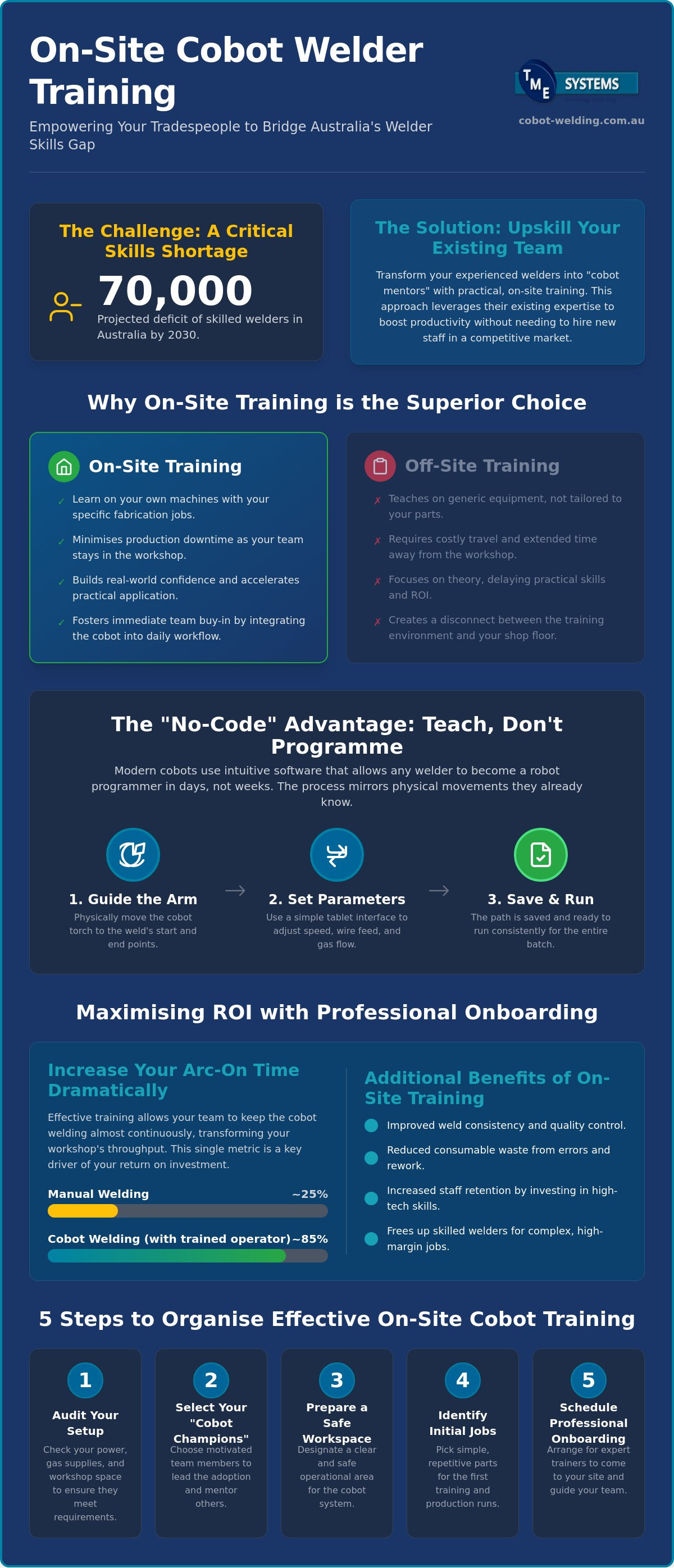

Australia is projected to face a deficit of 70,000 skilled welders by 2030; a gap that threatens the survival of local fabrication workshops. You likely feel this pressure every time a big contract lands on your desk and you realise your best blokes are already flat out. It is natural to worry that on-site cobot welder training might be too complex for your current team or that the downtime required for learning will stall your production when you can least afford it.
This guide shows you how to turn your existing tradespeople into confident robot "teachers" without a single line of complex code. We believe that technology should adapt to the welder, not the other way around. By focusing on practical, hands-on-the-torch mentorship, you can bridge the skills gap while keeping your team on the workshop floor. We will explore how no-code software and structured onboarding allow your staff to master new weld paths in days, boosting your arc-on time to nearly 85% and ensuring consistent quality across even the smallest batches.
Key Takeaways
- Learn how to empower your existing team by turning experienced tradespeople into "cobot mentors" who lead your workshop's transition to automation.
- Understand why on-site cobot welder training is the most efficient way to upskill staff on your own machines using your specific fabrication jobs.
- Discover the "No-Code" teaching method that allows operators to program new weld paths by physically moving the cobot arm instead of writing software.
- Get a practical five-step checklist for preparing your workshop, from auditing power and gas supplies to selecting your internal "Cobot Champions."
- See how professional onboarding reduces consumable waste and increases arc-on time, ensuring your investment pays for itself through improved weld consistency.
The Role of On-Site Training in Modern Australian Fabrication
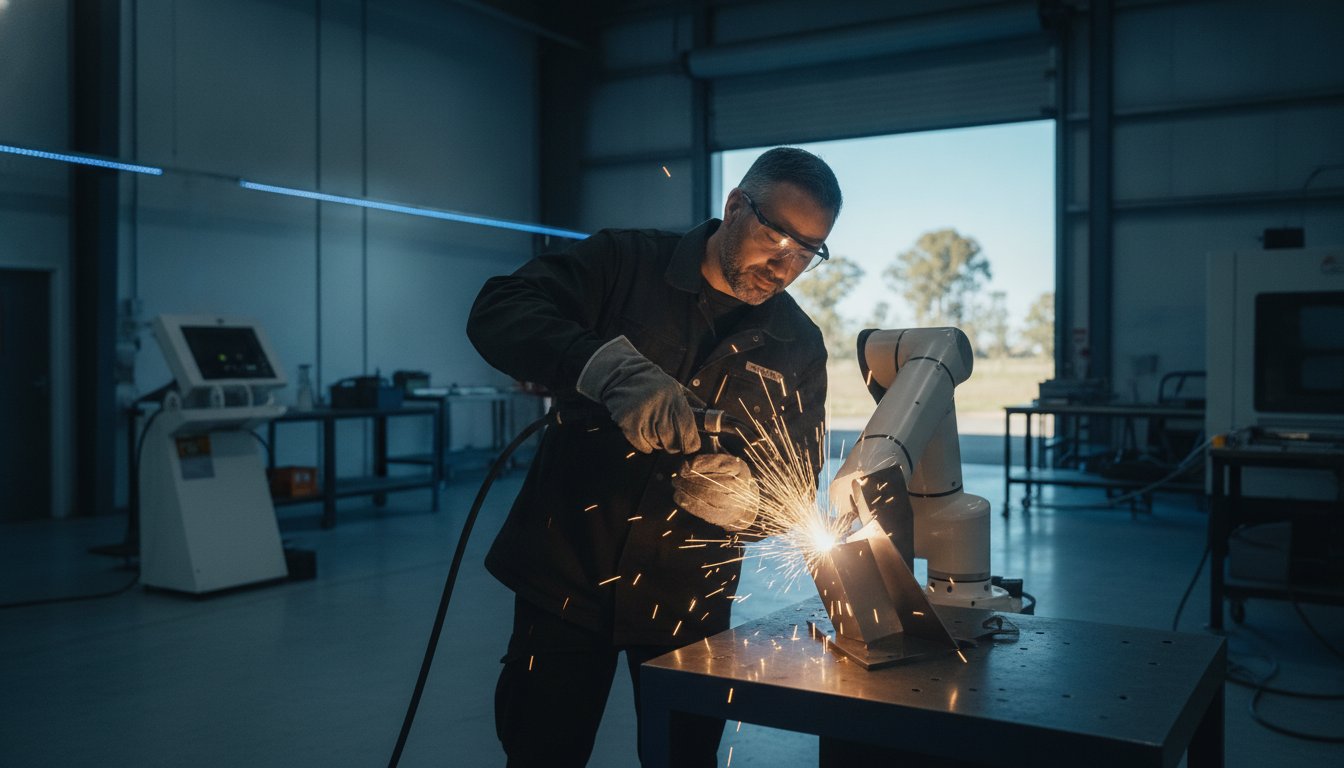
Traditional vocational education and training (VET) often struggles to keep pace with the rapid advancements in automation. While a classroom might teach the theory of robotics, it rarely prepares a welder for the specific rhythms and pressures of a busy Australian workshop. This is where on-site cobot welder training fills the gap. Instead of sending your best people away for weeks to sit in a computer lab, training happens where the work actually gets done. It transforms the technology from an intimidating piece of hardware into just another tool in the shed, much like a new pulse MIG or a high-end plasma cutter.
Successfully adopting a collaborative robot (cobot) requires a significant psychological shift for your senior welders. They move from being the ones holding the torch for every single pass to becoming process managers and mentors to the machine. By training on-site, they see firsthand how the cobot handles the "grunt work" of repetitive fillets, leaving them free to tackle the complex, high-margin fabrications that require a human touch. This transition reduces the "fear factor" because the team sees the machine as a helper that supports their craftsmanship rather than a threat to their job security.
Addressing the Australian Welder Shortage
Australia is currently facing a massive hurdle, with a projected 70,000-person welder deficit by 2030. Most workshop owners know they can't simply hire their way out of this problem anymore. On-site training is the fastest way to increase your workshop's throughput by maximising the capacity of the staff you already have. When your team learns to set up a cobot for a batch of ten or twenty parts, your arc-on time can jump from a manual average of 25% to nearly 85%. This isn't just about speed; it's about retention. Providing your crew with high-tech skill development on the floor shows them that your business is investing in their future, making them more likely to stay for the long term.
Empowering Tradies with Intuitive Tech
The key to rapid adoption is keeping the human operator at the centre of the workflow. For a seasoned welder, the idea of "coding" or "programming" is often a deal-breaker. However, "teaching" a robot is a completely different story. With no-code software, an operator physically moves the cobot arm to the start and end points of a weld, clicking a button to record the path. It feels natural because it mirrors the physical movements they've spent years perfecting. This is why operator friendly welding robots are becoming the standard for local fabricators. The technology adapts to the user, ensuring that your most experienced tradies remain the most valuable assets in your shop.
What Does a Comprehensive Cobot Onboarding Programme Look Like?
A solid on-site cobot welder training programme focuses on the reality of your production line, not a simulated environment. It begins with the basics of the hardware but quickly moves into the specific parts your team welds every day. The goal is to move from "how does it work?" to "how do we make it work for us?" in a matter of hours. Effective onboarding ensures that the operator is not just a button-pusher but a master of the process, capable of adjusting gas flow, wire speed, and travel speed via a simple tablet interface.
Daily maintenance and troubleshooting are essential components of this curriculum. Operators need to know how to clean the shroud, check the wire feed tension, and ensure the gas coverage is consistent. These aren't complex engineering tasks; they are the same basic housekeeping habits every good welder already possesses. By integrating these checks into the training, you ensure the system stays productive and avoids unnecessary downtime. If you want to see how this looks in your own workshop, you can request a mobile demo system to test the workflow with your actual parts.
The No-Code Advantage in Training
Traditional industrial robotics often required weeks of classroom learning just to understand the syntax of a proprietary coding language. Modern no-code robot welding software slashes this training time significantly. Research indicates that a three-day on-site course is typically enough to develop personnel into confident programmers for small to medium-sized products. They learn to guide the cobot arm by hand to set linear, circular, and even complex multi-pass welds. Instead of typing coordinates, they are simply showing the machine the best way to lay a bead.
Safety and Australian Standards
Safety remains the foundation of any collaborative system. While cobots are designed to work alongside humans, they still require a documented risk assessment under Australian standards like AS/NZS 4024.3303:2017. Training covers the setup of collaborative zones where the robot reduces speed or stops if a person enters the workspace. It also ensures every staff member understands e-stop protocols and the specific hazards of automated welding, such as arc flash and fume extraction. For a deeper dive into compliance, our guide on welding cobot safety australia provides a detailed breakdown of the legal requirements for local workshops.
On-Site vs. Off-Site Training: Choosing the Right Path
Deciding where your team learns to operate new technology is just as important as the tech itself. While off-site centres offer a controlled environment, they lack the specific variables of your workshop. Choosing on-site cobot welder training means your team works with your specific MIG or TIG power sources, your gas mixes, and your unique floor layout. This removes the "translation" step where a worker returns from a course only to find the settings don't quite match the gear in their own bay. It's about making the transition feel like a natural extension of their current daily routine.
Cost is another major factor for any fabrication business. Sending three or four welders to a capital city for a week involves flights, accommodation, and meals. More importantly, it means those three or four torches aren't burning back at the shop, which can stall your production for days. Training on-site allows you to keep the team in their natural environment. You can organise the sessions around your existing production peaks, ensuring that the learning process supports your output rather than hindering it.
When you train on-site, you can account for variables that an off-site centre simply can't replicate:
- The exact wire diameter and alloy type used in your daily runs.
- Your workshop's specific shielding gas flow rates and nozzle setups.
- The height and ergonomics of your existing welding tables.
- The integration with your current power sources, whether they are older transformer units or modern inverters.
Why Training on "Real Parts" Matters
There's no substitute for working on the actual jobs that pay the bills. During an on-site session, we don't just weld test plates; we tackle your most common production items. This allows us to solve real-world jigging and fit-up issues on the spot. If a part isn't sitting right in the jig, we fix it there and then. By the end of the training, your team hasn't just learned a skill; they've developed "recipes" and programs for your top jobs. This leads to immediate productivity gains because the cobot is ready to produce live parts the moment the trainer leaves.
Minimising Workshop Disruption
Training the whole crew together, rather than just one "champion," builds a stronger workshop culture. When everyone understands how to "teach" the arm, nobody feels left behind. It also prevents a single point of failure if your one trained operator is away or moves on. We often recommend a "Train the Trainer" model during these sessions. By identifying a lead operator who can support others, your workshop becomes self-sufficient. This long-term approach to knowledge retention is much easier to achieve when the learning happens in the very place the work is performed.
5 Steps to Organising Effective On-Site Cobot Training
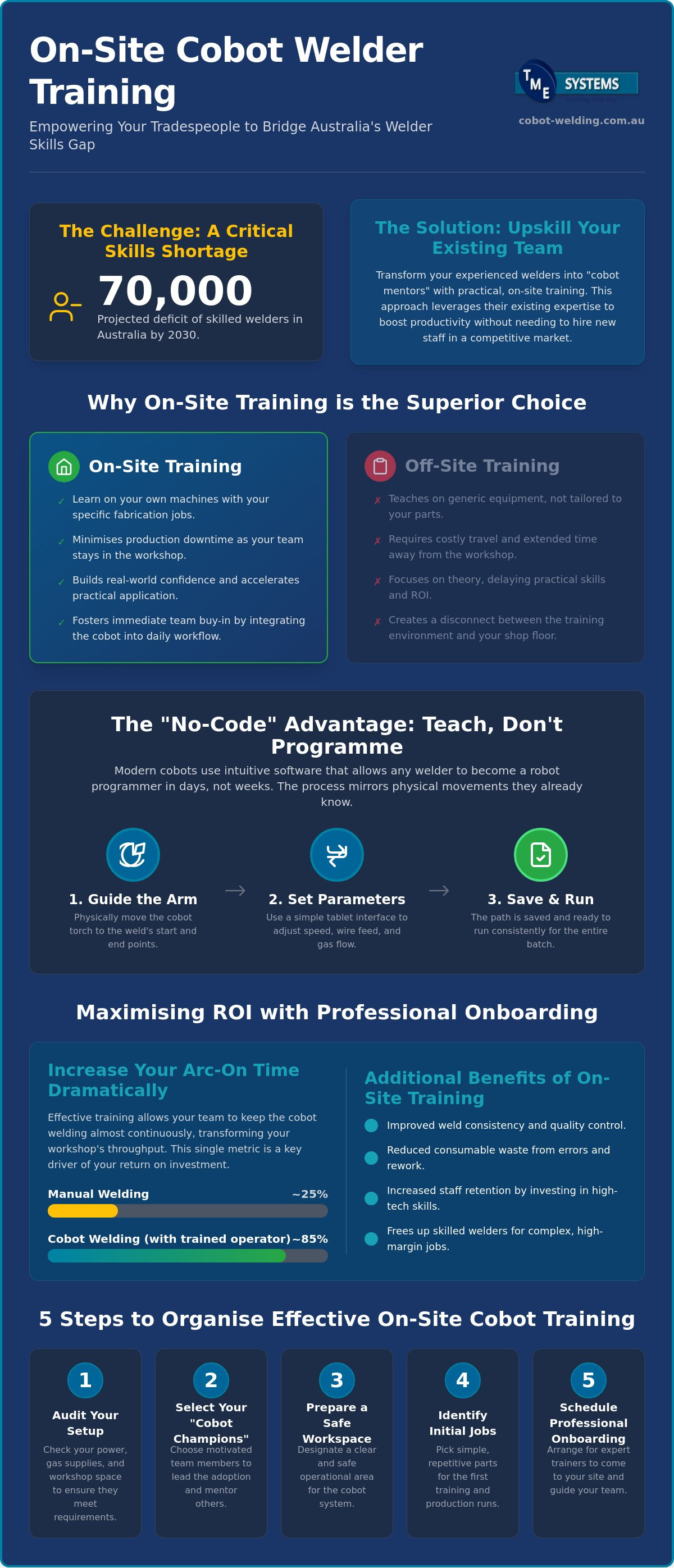
The difference between a successful automation rollout and a frustrated team often lies in the preparation done before the trainer steps onto your floor. To get the most out of your on-site cobot welder training, you need a clear plan. It isn't enough to just clear a corner of the shop; you need to ensure the environment is primed for learning and production from the very first hour. This methodical approach ensures that your investment starts paying for itself immediately.
- Step 1: Audit your power and gas supply. Ensure the dedicated welding bay has the correct power outlets and gas regulators ready to go. There is nothing more disruptive than spending the first morning of training hunting for a hose fitting or installing a new circuit. Professional welding system integration can help identify these requirements early.
- Step 2: Selection of "Cobot Champions". Identify the staff members who will lead the charge. These are often your most experienced welders who have an interest in improving workshop flow.
- Step 3: Preparation of jigs and clean parts. Have at least 20 to 30 identical components ready for live welding practice. Training on "real" jobs allows the team to solve actual fit-up challenges during the session.
- Step 4: Scheduling dedicated focus time. Treat the training days as a "no-interruption" zone. If your champions are constantly pulled away to help with other urgent jobs, they won't retain the knowledge needed to run the cell independently.
- Step 5: Post-training review and KPIs. Once the training is complete, set clear production goals. This might include a target for increased arc-on time or a specific number of batches to be completed by the cobot each week.
Preparing the Workshop Floor
Space is a premium in any Australian workshop. Before the training begins, ensure there is adequate room for the collaborative work zone so operators can move safely around the arm. You also need to organise your fume extraction and flash protection specifically for the new cell. While cobots are collaborative, the welding process itself still produces light and fumes that must be managed. Checking your stock of contact tips, nozzles, and wire is also vital; you don't want to run out of consumables right when the team is getting into their rhythm.
Selecting Your Cobot Champions
It is a common myth that you need a computer whiz to run a robot. In reality, your best manual welder is often your best cobot operator. They already know what a good weld looks like and understand how heat input affects different materials. When selecting your champions, look for staff who have a natural knack for process improvement. These individuals will help build a culture of innovation on the tools, showing the rest of the team that the cobot is a partner that makes their job easier, not a replacement for their hard-earned skills.
Maximising ROI with Professional Onboarding and Support
Investing in a cobot is a significant step for any Australian fabrication business. However, the real return on investment doesn't come from the hardware alone. It comes from how effectively your team integrates that hardware into their daily workflow. Professional on-site cobot welder training ensures that your staff aren't just "having a go" but are operating with precision from day one. This proactive approach reduces the costly rework and consumable waste that often occurs when a team is left to figure out a new system through trial and error.
Operator confidence is the primary engine of machine uptime. When your team knows exactly how to adjust a path or clear a minor fault, the cell keeps running. If they lack that confidence, the cobot might sit idle the moment a small challenge arises. By providing structured onboarding, you empower your staff to take ownership of the technology. They begin to see the cobot as a reliable partner that helps them hit production targets without the physical strain of manual repetitive welding. This shift in mindset is what transforms a workshop from a traditional shop into a modern, high-output facility.
Ongoing Support and Refinement
Success isn't just about the initial training period. The first 30 days post-onboarding are critical for cementing new habits and refining weld paths for different batches. TME Systems acts as a practical mentor during this phase, offering the robotic welding technical support needed to keep your workshop moving. Whether it's a quick remote check of a program or a phone call to fine-tune a specific parameter, having a local partner ensures that small hurdles don't become major bottlenecks. This ongoing relationship allows your team to continue upskilling long after the trainer has left the floor.
Calculating the Productivity Gains
The ultimate proof of successful on-site cobot welder training is found in your production data. Workshops that invest in professional onboarding often see their arc-on time climb toward the 85% benchmark mentioned earlier in this guide. Beyond sheer speed, the consistency of a robotic weld significantly reduces the need for secondary grinding and cleanup. This saves hundreds of hours of labour over a year, allowing your skilled welders to focus on more complex, high-margin projects. You can find a deeper breakdown of these metrics in our guide on how to improve welding productivity with cobots. TME Systems remains your long-term partner in this journey, ensuring your workshop stays competitive in an increasingly automated industry.
Future-Proof Your Workshop with Hands-On Automation
Transitioning to automation shouldn't feel like a leap into the unknown. By choosing on-site cobot welder training, you ensure that your team remains at the centre of the process. They learn to use intuitive, no-code software on your actual production jobs, moving from initial setup to live welding in hours rather than weeks. This pragmatic, workshop-first approach turns a complex technology transition into a manageable skill upgrade for your existing crew.
With the ongoing support of Australian-based integration specialists, you can bridge the skills gap while preserving your workshop's unique craftsmanship. You aren't just buying a machine; you are building a more resilient, productive business that is ready for the manufacturing landscape of 2026 and beyond. Your most experienced welders are your best assets, so it makes sense to give them tools that adapt to their skills.
Book an on-site cobot demonstration and training consult today to see how easily your team can master the next generation of fabrication technology. It is time to take the pressure off your staff and start hitting your production targets with confidence.
Frequently Asked Questions
Do my welders need to know how to code to use a cobot?
No, your team doesn't need any programming or coding experience to operate the system. We use intuitive no-code teaching software that allows a welder to "teach" the arm by physically moving it to the required start and end points. If they can lay a bead manually, they can set up a cobot program in minutes without touching a single line of code.
How long does a typical on-site cobot training programme take?
A standard on-site cobot welder training course usually takes three days to get your personnel confident with small to medium-sized products. For more advanced setups involving multi-axis positioners or touch sensing, we offer an additional two-day module to ensure your team can handle the most complex fabrication jobs in your shop.
What happens if we hire a new staff member after the training is finished?
We focus on a "train the trainer" model during our sessions so your internal champions can onboard new staff themselves. This approach builds long-term self-sufficiency and ensures that knowledge stays within your workshop. If you have a large intake of new hires, we can also organise follow-up refresher courses to maintain high productivity levels.
Is on-site training safe for the rest of the workshop staff?
Yes, safety is the first priority during every session and we train your staff to meet AS/NZS 4024.3303:2017 standards. We show your team how to set up collaborative zones where the robot safely slows or stops if someone enters the workspace, alongside standard flash protection and fume extraction protocols to protect everyone on the floor.
Can we train on different materials like aluminium and stainless steel?
Absolutely, the training is tailored to the specific alloys and jobs you handle daily. We show your operators how to adjust parameters for aluminium, stainless steel, and mild steel, ensuring they understand how to manage heat input and travel speeds for consistent, high-quality results across your entire product range.
Do we need to buy special jigs before the training starts?
You don't need to invest in expensive, proprietary jigging systems for the training to be effective. We can work with your existing setups or show you how to build simple, repeatable jigs using your current workshop equipment. The goal is to ensure the cobot can find the joint every time without requiring a massive upfront spend on new hardware.
What kind of technical support is available after the trainer leaves?
You'll have access to ongoing technical support and integration advice once the initial on-site cobot welder training is complete. This includes remote support for refining complex weld paths and assistance with adjusting the system as you introduce new parts to your production line, ensuring the cell remains a high-performing asset.
Will a cobot replace my senior welders?
A cobot is a tool designed to empower your senior welders, not replace them. It handles the repetitive, monotonous runs that cause physical strain, which allows your most experienced tradespeople to focus on the complex, high-margin fabrications that require their unique problem-solving skills and years of experience on the torch.