
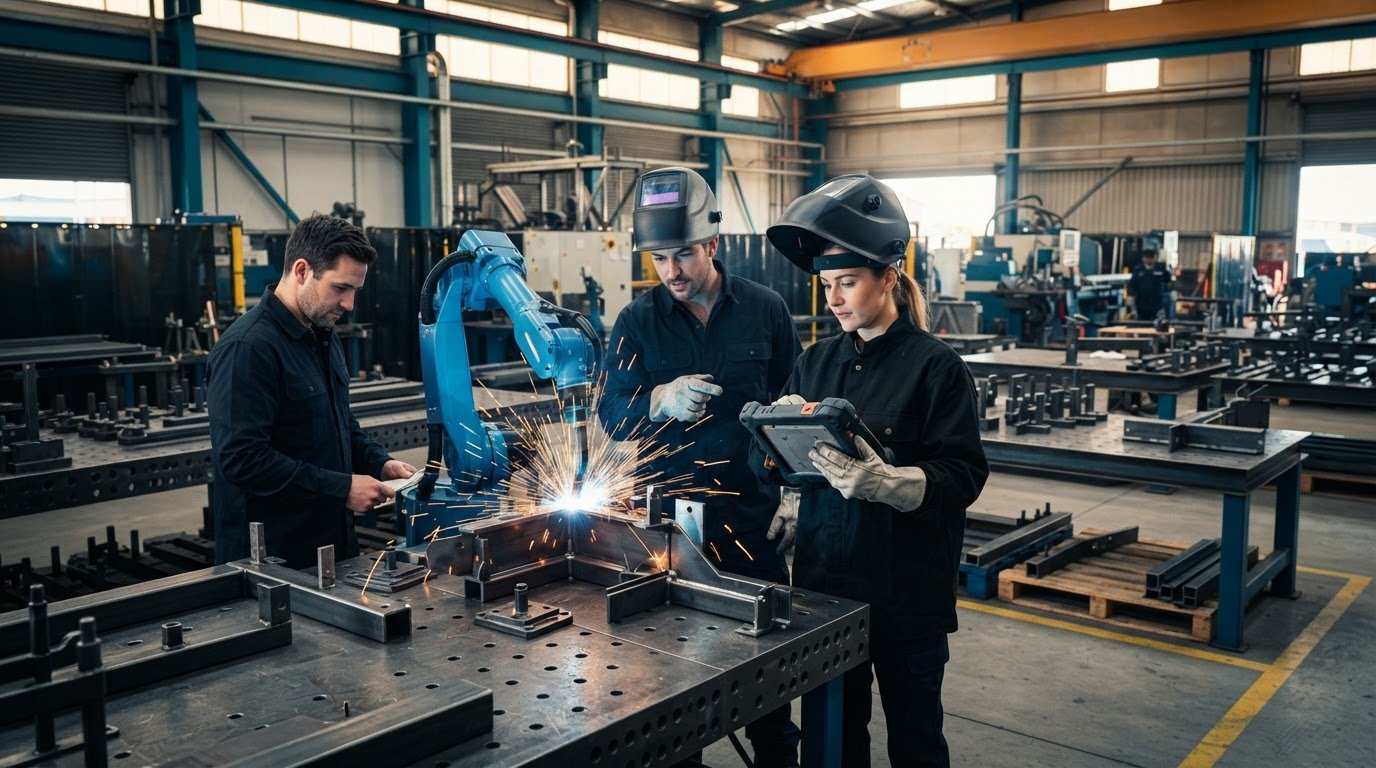
Permanent hires aren’t the only way to address a welding capacity gap. Practical alternatives to hiring more welders include organising work more effectively, making better use of existing staff and automating suitable, repeatable welding tasks. The right approach depends on labour availability, recruitment costs and how much time your project allows for change.
When deadlines are tight, recruiting can seem like the most direct fix, but finding skilled people and fitting them into a workflow takes planning. Automation, meanwhile, isn’t suitable for every weld or production setup. It works best when it supports the skills of the people on the floor.
This article explains how Australian manufacturers can compare the options, weigh labour and project pressures, and identify where automation may help. It also covers the factors that shape a cost comparison, what to consider before changing a welding process, and how system integration and operator onboarding can support implementation.
Key Takeaways
- Compare recruitment with changes to workflow and automation, weighing labour availability against project deadlines and the time needed to bring new staff up to speed.
- Plan temporary workforce needs around the project’s workload, duration and required welding skills so extra capacity matches the work.
- Assess robot and cobot costs as a complete system, including integration and the changes needed to fit your production process.
- Use earnings data as one part of the hiring-versus-automation comparison, alongside utilisation, repeatability and the tasks your team needs to complete.
- Look for repeatable welding tasks as potential automation candidates, while keeping operators central to teaching and adjusting the process.
Recruitment costs and welding labour availability
Hiring can add capacity, but recruiting skilled welders takes time and brings ongoing employment costs. Jobs and Skills Australia reports national employment growth for Australia’s Structural Steel and Welding Trades Workers occupation group is 1,100 people annually. Jobs and Skills Australia also reports that 79,100 people are employed nationally in the group. Those figures describe a broad occupation group, not the number of available applicants in your town or trade.
Availability also needs to be weighed against current workloads. Jobs and Skills Australia reports that 96% of workers in the occupation group work full-time. Average working hours are 46 hours per week, according to Jobs and Skills Australia. For a workshop with a backlog of repeat weldments, extra hours from an existing team may not be a sustainable answer. Compare the work waiting, the skills required and the realistic capacity of your crew before starting recruitment.
Recruitment costs go beyond wages. Include advertising, interviews, onboarding, personal protective equipment, supervision and the time an experienced employee spends training a new starter. Project timing matters too: a permanent hire may suit a steady workload, while fixed employment costs can be harder to absorb after a short-term contract ends. Build your comparison from payroll and production records, rather than relying on a headline wage figure.
For Australian workplaces, robotic welding must be considered alongside machinery risk controls, operator competency and the quality requirements for the weld. WorkSafe Victoria’s guidance for on-site structural welding references AS/NZS 1554.1:2014 and calls for qualification and competency checks, a welding specification, a procedure developed by a qualified person, qualified supervision and inspection sign-off. Treat these as quality assurance steps for structural welding, not as a complete statement of every robot-cell requirement.
Redesigning a product or improving fabrication flow can reduce welding hours by shortening welds where appropriate, simplifying fit-up and reducing rework. For example, review a bracket assembly’s joint layout, fixture access and part handling before changing its design. Then map each operation, from cutting and preparation through welding and inspection. A more efficient sequence can reduce time spent repositioning parts and correcting inconsistent gaps.
Automation and outsourcing have different trade-offs. A robot may struggle with variable parts, awkward access or frequent changeovers; outsourced welding can add transport, coordination and quality-control steps. For a small Australian workshop, assess one repeatable job: record weld time, changeover effort, rework and delays, then compare these with the full cost of an automation cell and its integration. This gives you a grounded basis for weighing alternatives to hiring more welders.
Temporary and project-based workforce needs
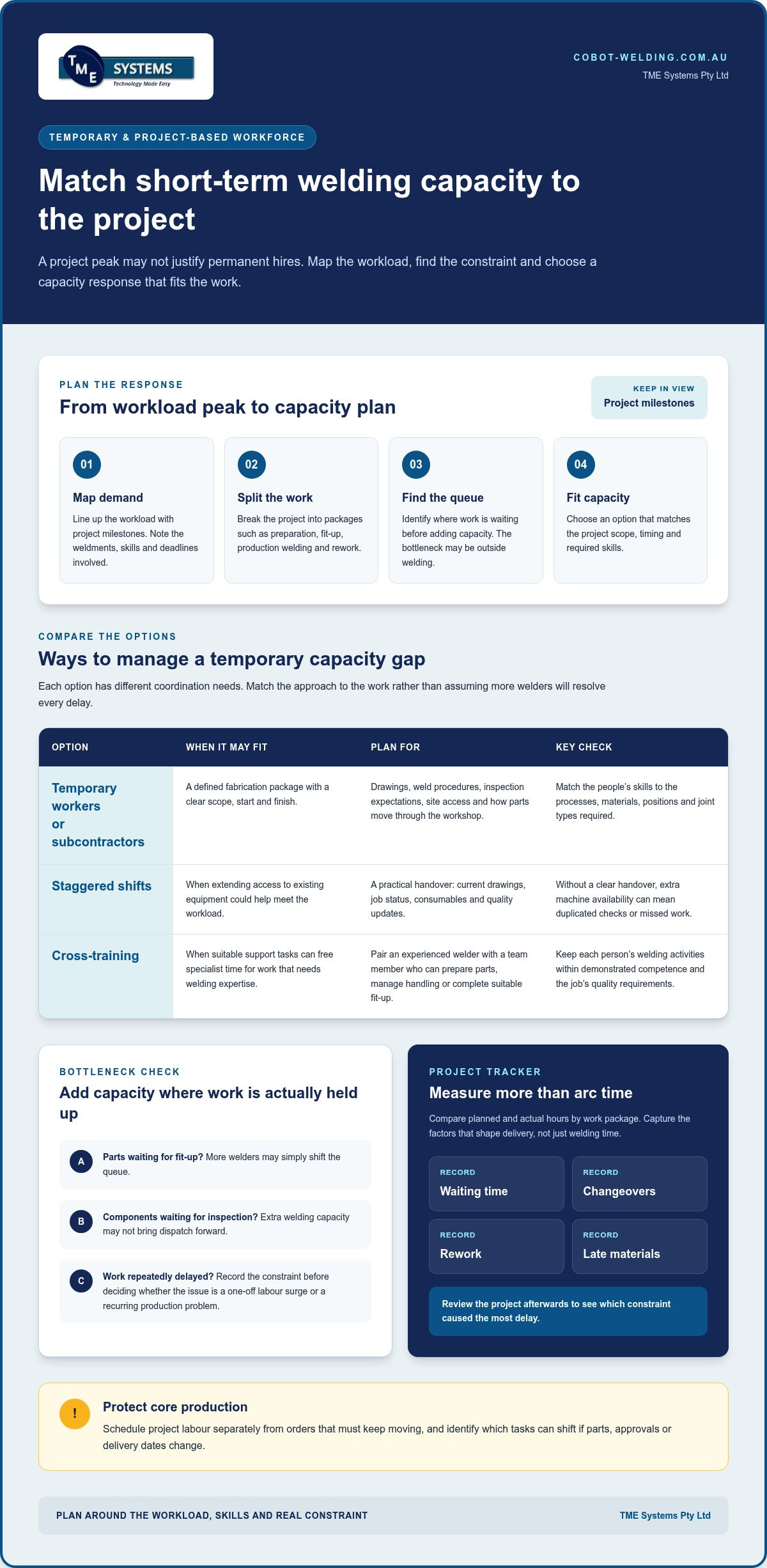
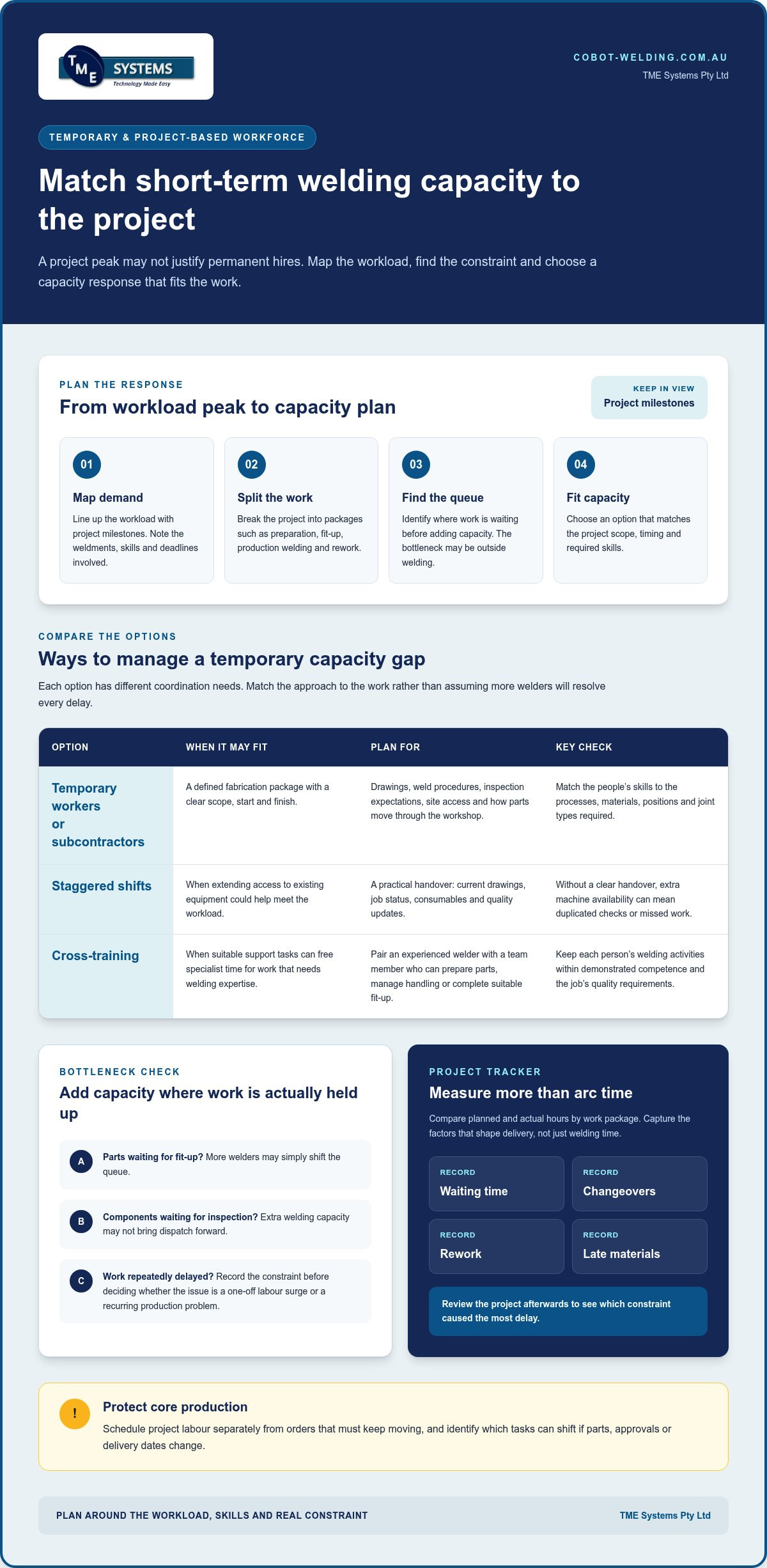
A project peak doesn’t always justify permanent hires. A shutdown, contract award or delayed delivery can create a short-term welding bottleneck, while the workload may settle once the job is complete. Map demand against project milestones first. Note which weldments need extra labour, what skills are involved and when each task must be finished.
For a defined workload, temporary workers or specialist subcontractors can add capacity without increasing permanent headcount. This may suit a fabrication package with a clear scope, start and finish. It still takes careful coordination: external workers need to understand drawings, weld procedures, inspection expectations, site access and how parts move through your workshop.
Before adding people, divide the project into work packages. For example, separate frame preparation, fit-up, production welding and rework. Then identify where the queue forms. If parts are waiting for fit-up, adding welders may simply move the bottleneck. If finished components are waiting for inspection, extra welding capacity won’t bring dispatch forward.
- Match skills to tasks: list the processes, materials, positions and joint types each work package requires.
- Set handover points: define who checks drawings, fit-up, weld completion and inspection records.
- Protect core production: schedule project labour separately from orders that must keep moving.
- Plan for change: identify which tasks can move if parts, approvals or delivery dates shift.
Staggered shifts can extend access to existing equipment, but they need practical handovers. The next crew needs current drawings, job status, consumable details and updates on quality issues from the previous shift. Without a clear handover, longer machine availability can lead to duplicated checks or missed work instead of useful capacity.
Cross-training can also help manage short-term peaks. Pair an experienced welder with a team member who can prepare parts, manage handling or complete suitable fit-up tasks. Keep welding activities within each person’s demonstrated competence and the job’s quality requirements. This frees specialist time for work that genuinely needs welding expertise.
Use a simple project tracker to compare planned and actual hours by work package. Record waiting time, changeovers, rework and late materials, not just arc time. After the project, review which constraint caused the most delay. This evidence can help you distinguish a one-off labour surge from recurring work that calls for a different production approach.
If the same suitable weldment returns across contracts, compare recurring demand with a more repeatable process. Exploring cobot welding for repeatable tasks may help you assess whether automation could complement temporary labour, rather than trying to cover every project peak with additional workers.
How much do welding robots and cobots cost in Australia?
There isn’t a single price that applies to every Australian welding robot or cobot installation. The price depends on the case and is given after a quote request; key cost factors include the robot, welding equipment, fixtures, safety measures, integration, commissioning and operator training. A basic arm price alone won’t show the full investment needed to weld parts consistently in your workshop.
Start by defining the work the system must perform. A cell for one repeatable component differs from a setup handling varied parts, frequent changeovers or complex joint access. For example, a welded frame may need dedicated fixtures to hold components accurately. Fixture design, along with the welding power source and torch, affects the system requirements.
Also consider how the equipment fits your production floor. Layout changes, material handling and connections to existing equipment can add design and integration work. Safety controls must suit the cell’s actual operation and the people working around it. A cobot’s collaborative design doesn’t remove the need to assess risks and plan appropriate safeguards for the task.
- Robot and welding package: match arm capability, torch, power source and wire feeding to the parts and welding process.
- Fixtures and tooling: consider how each component is located, clamped and accessed for its weld sequence.
- Integration and setup: include layout, equipment connections, commissioning and any required workflow changes.
- People and upkeep: allow for operator training, routine maintenance, consumables and technical support arrangements.
To make a useful comparison, choose a representative job and record its current production steps. Include preparation, loading, welding, changeovers, inspection and rework. Then document the expected production mix and any likely design changes. A system designed around a single sample part may not suit the wider range of work that follows.
Ask for a breakdown that separates equipment from integration and implementation tasks. This makes it easier to compare proposals on the same scope, rather than comparing a robot arm with a complete welding cell. Check what the project requires of your staff, floor space and existing production process. A lower initial equipment figure may not mean a lower overall cost if extra fixtures or workflow changes are needed.
Finally, assess utilisation. If a cell would sit idle between short jobs, the investment may be harder to justify than for steady, repeatable work. Consider whether several suitable components can share the setup and how readily operators can change between them. These practical details help determine whether automation fits your production plan and budget.
What is the cost comparison between hiring welders and automating welding in Australia?
Compare the full cost of employing people with the full cost of automating a defined welding task. Jobs and Skills Australia reports median full-time weekly earnings for Australia’s Structural Steel and Welding Trades Workers occupation group were A$1,688 per week. This provides a wage benchmark, not the complete employment cost or the cost of a robot system.
For a hiring comparison, use your workshop’s payroll figures and include the costs associated with each role. Consider recruitment, induction, protective equipment, supervision and paid training time. Include overtime where it applies, and account for the time experienced welders spend supporting new starters. These costs vary with the role, roster and project requirements.
For automation, compare the cell’s total cost with the work it will actually perform. Include equipment, fixtures, integration, commissioning, training, maintenance and consumables. A robot used occasionally for one job has a different financial case from a system used regularly across suitable parts. Utilisation matters because costs continue whether the cell is producing or waiting.
Use a like-for-like task to make the comparison meaningful. For example, track a repeatable assembly from preparation through welding, inspection and rework. Record the labour hours involved, delays between steps and production volume. Then estimate how automation would change those tasks. Don’t count every current labour hour as a saving if an operator still loads parts, checks welds or manages changeovers.
- Set the scope: choose the same components, weld requirements and production assumptions for both options.
- Include ongoing costs: account for wages and employment overheads, or cell maintenance and operating inputs.
- Consider capacity: assess whether the process addresses the actual constraint, such as welding time or part preparation.
- Test workload variation: compare steady demand with quieter periods and project peaks.
Automation can make stronger financial sense when repeatable work keeps the cell productively occupied. Hiring may be more practical when demand is irregular, jobs change often or the work depends on varied manual skills. A mixed approach may also fit: operators handle complex assemblies while automation takes on suitable repeatable welds. Base the comparison on your actual production mix, not the assumption that automation replaces every welding role.
Finally, test the result against a cautious production plan. Account for changeovers, downtime, inspection and the time operators need to learn the process. Check whether the cell frees skilled workers for other tasks, rather than removing the need for their judgement. This gives you a more useful basis for comparing employment costs and automation investment than wages alone.
Which welding tasks are best suited to robotic or cobot automation?
Start with the weld, not the robot. A suitable task has a repeatable joint, consistent parts and a clear sequence. For example, brackets welded in the same position across a production run may suit automation better than one-off repairs on varied assemblies.
Repeatability matters because the system follows a taught path. If parts shift between batches, gaps vary or the joint is difficult to access, the weld may need adjustment. Review how the component is cut, fitted and held. A fixture that locates parts consistently can make the task easier to automate.
Check the whole job cycle, not just arc time. The operator may need to load parts, clamp them, start the programme, inspect the weld and unload the assembly. If handling takes longer than welding, automation may not address the main constraint. Map every step, from incoming component to finished weld, before choosing a candidate.
- Look for consistent parts: repeated brackets, frames or subassemblies with stable joint locations.
- Review access: check whether the torch can reach each joint without awkward repositioning.
- Assess changeovers: note how often part sizes, fixtures or weld sequences change.
- Keep quality visible: define how operators inspect the completed weld and manage defects.
High-volume work isn’t the only possible fit. A job with moderate output may still suit automation if its weld sequence is stable and changeovers are straightforward. Conversely, a large batch can be a poor candidate if every part needs individual adjustment. The key is whether the joint can be presented to the torch reliably.
Consider the people and skills involved. Operators can prepare components, load fixtures, monitor the process and inspect output, while experienced welders focus on complex work or refine the procedure. A cobot may suit a cell where a person works nearby, but the task, workspace and risk controls still need careful assessment. A conventional robot cell may better suit a dedicated production area.
Before committing, assess a representative part in practice. Gather the drawing, material details, weld sequence and current handling method. Identify where distortion, fit-up variation or access problems arise. Then determine whether better fixturing or a changed sequence could make the task more consistent. This helps distinguish a genuine automation candidate from a job that first needs process refinement.
If your workshop has repeatable welds and wants to assess a suitable cobot application, discuss a cobot welding application.
Include a plan to develop the people who will set up and support the process. Moving into robotic welding may involve training in automation. Welder-to-welding-engineer transitions may call for further learning in engineering, welding inspection, robotic welding, materials, nondestructive testing, welding standards and metallurgy.
More than 80% of students enrolled in welding engineering receive job proposals from Australian industries before graduating. Welding instructors share 85% of core skills with welders, welding engineers share 67% of core skills with welders and welding supervisors share 76% of core skills with welders. These figures offer context when considering how existing welding experience may relate to other roles in an automated operation.
TME Systems: No-Code Teaching Software
TME Systems’ No-Code Teaching Software lets operators teach weld paths and adjust parameters without traditional programming. No coding experience is needed. It can suit workshops introducing repeatable welding tasks into a collaborative robot workflow while keeping operators involved in setup and adjustments.
For implementation, TME Systems’ Collaborative Robot Welding solution and Welding Automation Integration connect the robot with welding equipment and the production process. The Mobile Demo System brings a welding cell to your site for evaluation, helping your team consider how robotic welding could fit the workshop. Operator training and onboarding support staff as they learn to work with the system.
If you’re assessing whether no-code robotic welding suits your production needs, contact TME Systems to discuss your application.
Choose the next step that fits your workshop
Turn production pressure into a clear trial question: which task is holding up work, and what would help your team complete it more smoothly? Use the answer to guide a practical discussion about whether a process adjustment, workforce change or automation could suit your operation. The best alternatives to hiring more welders start with a specific production need, not a technology decision made in isolation.
TME Systems helps Australian manufacturers explore that fit through No-Code Teaching Software, Collaborative Robot Welding and its Mobile Demo System. The focus is on giving operators a practical way to teach and adjust weld paths, while keeping people central to the process.
Bring a representative component or repeatable task into the conversation, along with the workflow challenge you want to address. This gives you a grounded starting point for assessing a potential application and its place in your production plan.
Contact TME Systems Pty Ltd to discuss a welding automation application and take the next step at a pace that suits your workshop.
Frequently Asked Questions
What alternatives can Australian manufacturers use instead of hiring more welders?
Practical alternatives to hiring more welders include reallocating preparation and handling, refining part designs, using project-based labour or automating repeatable welds. The best option depends on where production is constrained. If fit-up or material movement delays welding, adding welding capacity alone won’t solve the problem. Track a representative job from preparation to inspection, then assess whether a workflow change, temporary support or a cobot addresses the actual bottleneck.
Can Australian businesses use labour hire, subcontractors, or offshoring to meet welding demand?
Yes. Labour hire and subcontracting can add capacity for a defined workload, while offshoring may suit components that can be clearly specified and transported. Compare the options against your delivery schedule, coordination needs, quality checks, freight and the time required to manage handovers. For example, urgent assemblies may be harder to outsource than standard parts planned well ahead. Set out the scope, acceptance criteria and responsibilities before allocating work.