
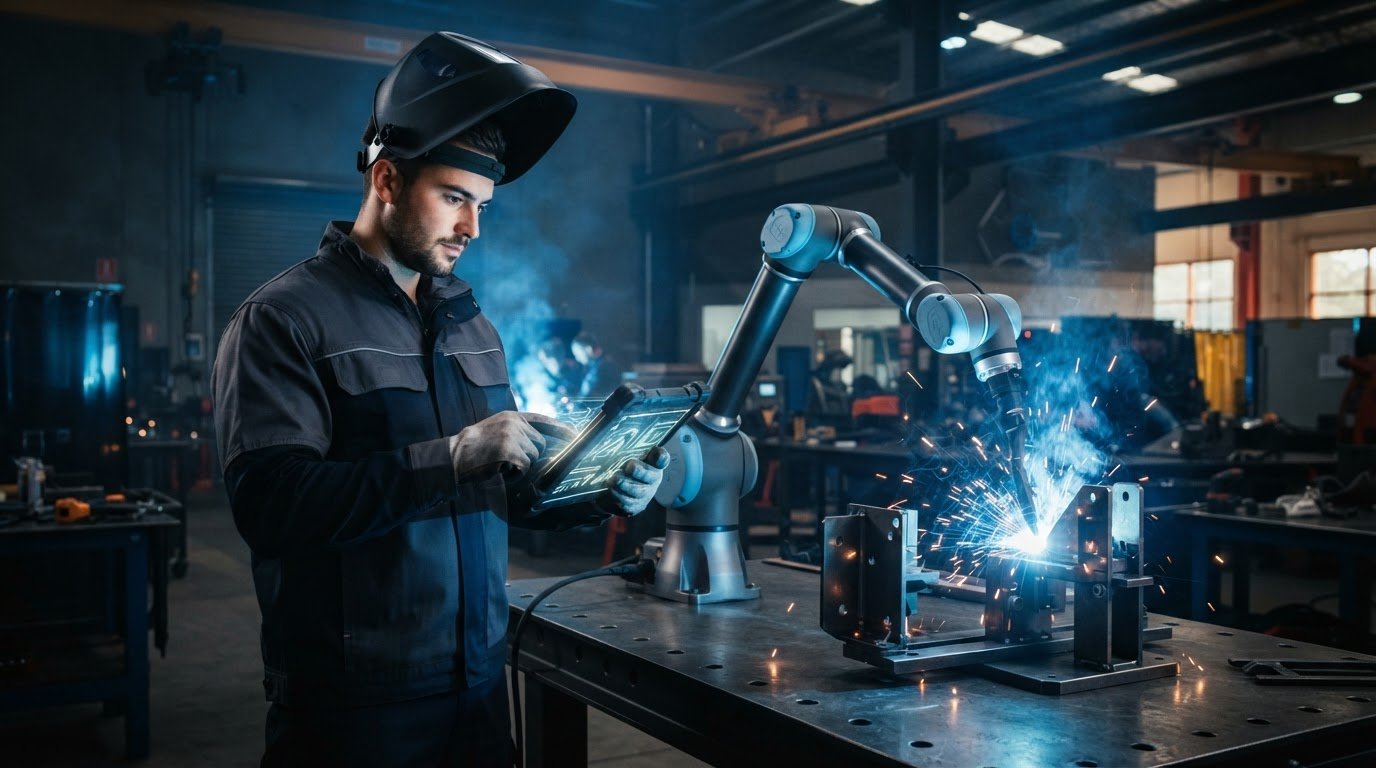
Automation can make welding more attractive to young workers when it gives them a skilled role alongside the technology. Collaborative welding robots still need human operators, and the welding industry needs 82,500 welders per year annually from 2024-2028. Attracting young welders with automation means showing that the work can combine hands-on welding knowledge with learning how to teach and operate a robot.
It’s understandable to wonder whether robots will reduce demand for welders or change what the job involves. For Australian manufacturers, the practical opportunity is to build new skills into the work while keeping welders’ judgement and process knowledge central.
This article explains how automation can appeal to younger workers, reshape demand for skilled welders and help operators build confidence with collaborative robots. Training matters: the goal is not to replace welding expertise, but to extend it with the skills needed to work effectively alongside automation.
Key Takeaways
- Collaborative welding robots still need skilled human operators, so automation can reshape welding work rather than remove the need for people.
- Look at repetitive welding tasks to understand where a robot could support production while welders focus on process knowledge and quality.
- Show prospective workers how hands-on welding skills can sit alongside practical experience with robotics and digital tools.
- Build training around both welding fundamentals and automation, helping operators develop the confidence to teach and adjust robot weld paths.
- Connect with schools and trade programmes to introduce students to modern welding roles and the skills they involve.
Collaborative welding robots
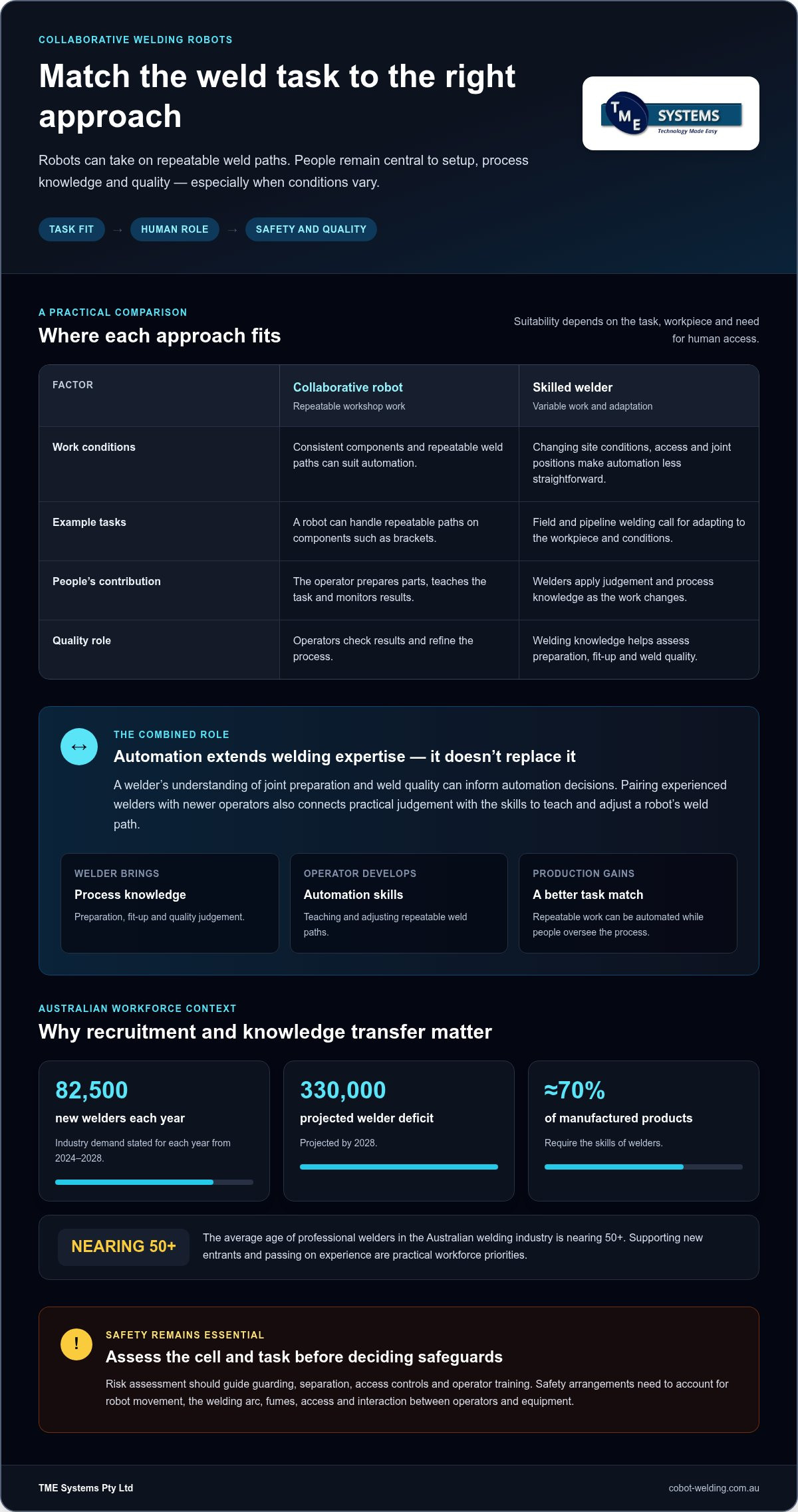
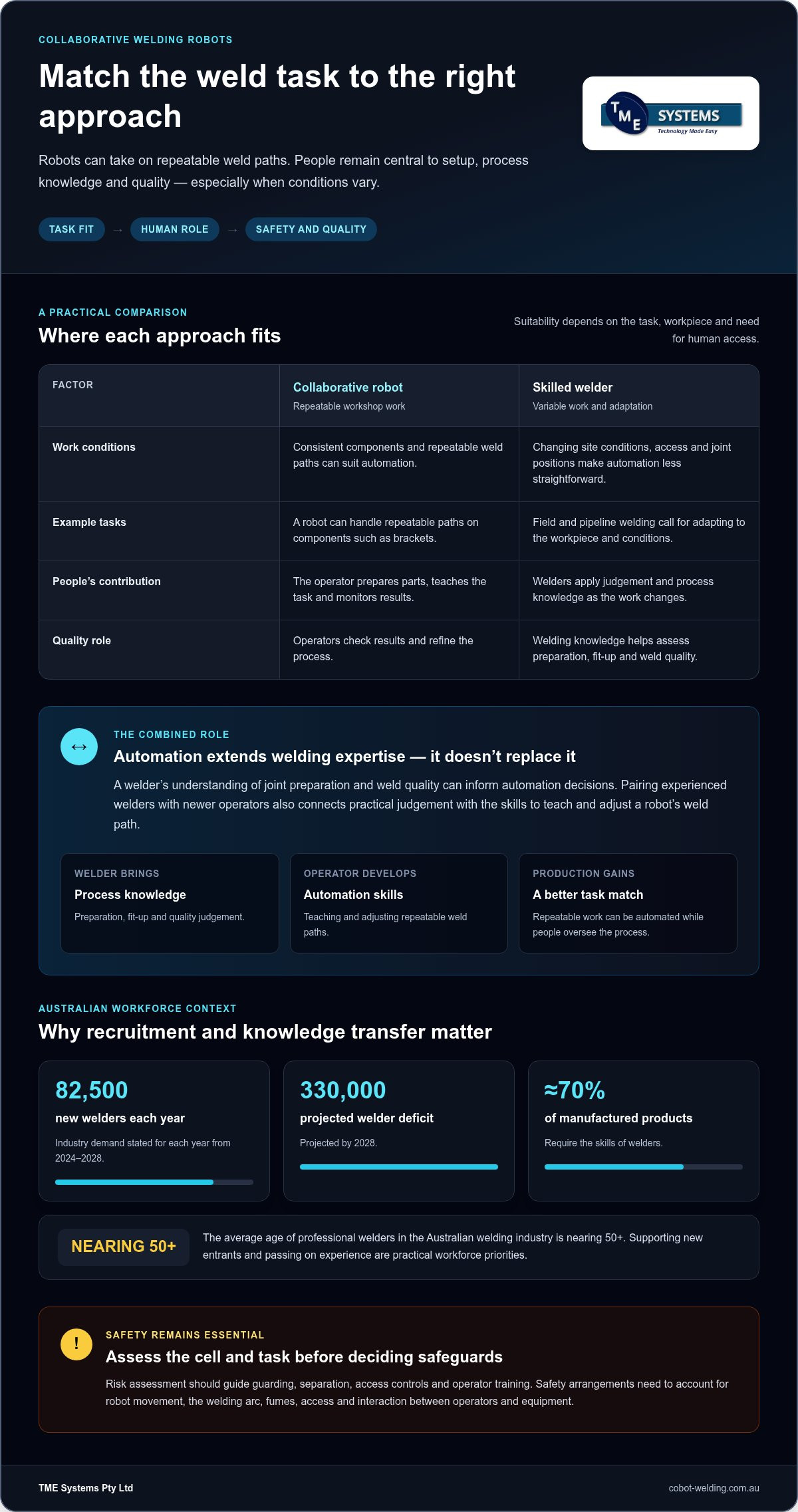
Collaborative welding robots combine automated welding with human setup, supervision and process knowledge. Whether they fit depends on the task, workpiece and need for human access.
Collaborative Welding Robot Applications
A collaborative welding robot can handle repeatable weld paths while an operator prepares parts, teaches the task and monitors results. This can suit consistent components such as brackets, where repeatability matters. Field and pipeline welding present a different challenge: changing site conditions, access and joint positions make automation less straightforward. Skilled welders remain central to those jobs, where adapting to the workpiece is part of the task.
The Australian welding workforce faces substantial demand. The industry needs 82,500 new welders every year annually from 2024-2028, and the projected deficit is 330,000 welders by 2028. These figures make recruitment and retention practical concerns for manufacturers. Robotics can change the tasks available in a workshop, but it doesn't remove the need for people who understand weld preparation, fit-up and quality.
Age adds pressure. The average age of professional welders in the Australian welding industry is nearing 50+ years. As experienced workers approach retirement, employers need to make welding jobs visible to new entrants and support knowledge transfer. Pairing an experienced welder with an operator learning a repeatable robotic welding task can connect practical judgement with new automation skills.
Changing Perceptions of Welding
Automation can change how young people picture welding by shifting some repetitive work to a robot. In a collaborative cell, an operator can set up and supervise a process instead of manually repeating the same weld throughout a shift. This can help with recruitment by showing candidates a pathway that combines hands-on trade knowledge with technical problem-solving.
Robotic welding does not remove workplace hazards. In Australian workplaces, safety arrangements must address robot movement, the welding arc, fumes, access and interaction between operators and equipment. The right safeguards depend on the cell and task; a risk assessment should guide guarding, separation, access controls and operator training. Automated welding may also allow welders to work farther from fumes and toxic gases.
Support for Automation and Apprenticeships
Australian support may include apprenticeship incentives and state or territory manufacturing grants. These programs can support workforce training or eligible automation projects, subject to their conditions and eligibility criteria. For a welding business, a practical first step is to align the project scope with the relevant program, then connect apprenticeship learning to real tasks such as preparing parts or teaching a repeatable weld path. This links recruitment with capability building.
How Is Automation Changing the Demand for Skilled Welders?
Automation changes which welding tasks people perform; it does not make welding knowledge irrelevant. That distinction matters in Australia, where manufacturing depends on workers who can connect process skills with production needs.
Automation and Welder Shortages
Automation can help manage a welder shortage by taking on repeatable tasks while skilled people set up, monitor and refine the process. For a manufacturer making the same component repeatedly, a robot may handle consistent weld paths while operators prepare parts and check results.
This changes the mix of skills needed on the workshop floor. A welder who understands joint preparation and weld quality can contribute to automation decisions that a robotics specialist may not make alone. The practical transition is to combine welding knowledge with system operation, rather than treat them as competing careers.
That distinction matters because approximately 70% of manufactured products require the skills of welders. Automation may support production volume, but it doesn’t remove the need to understand how materials fit, how a weld should perform, or when a result needs attention.
An Ageing Welding Workforce
An ageing workforce can intensify shortages when experienced welders leave faster than new workers develop practical skills. The Australian welding industry’s average professional welder age is nearing 50+ years, making knowledge transfer an important workforce consideration.
Automation can create a useful bridge between experience and new careers. An experienced welder can explain why a joint needs a particular approach, while a newer operator learns how to teach and adjust that path on a robot. This exchange keeps process judgement visible as work changes.
Recruitment also depends on showing entrants that welding skills can lead to evolving roles. A pathway that combines hands-on practice with digital systems gives apprentices a clearer picture of how trade knowledge can develop throughout a career.
Shortages and Demand for Welders
Demand for welders reflects the work manufacturers need to complete, while shortages limit the skilled labour available. When production volume rises, repeatable robotic tasks can support output, but people are still needed to prepare work, oversee processes and resolve quality issues.
The key is to match automation to the task. A stable, repeatable weld may suit a robot; variable work that depends on adapting to fit-up or access still calls for a skilled person. This helps employers decide where automation can ease pressure without assuming every welding job can be automated.
For teams considering this transition, collaborative robot welding cells can connect repeatable production work with operator involvement. Planning the division of tasks first helps define which skills existing workers and new recruits will need.
Can Technology Help To Attract New Welders To Hire?
Yes, cobots can make manufacturing more appealing by connecting welding skills with modern production technology. Their strongest recruitment value comes from giving new workers a practical role in operating and improving automated tasks.
Cobots and Manufacturing Appeal
Cobots are collaborative robots that work alongside people on assigned production tasks. They can introduce new welders to robotics without removing the hands-on judgement that welding requires.
That combination can make a welding career easier to picture for technology-minded applicants. In a Dell study, 80% of Gen Z respondents aspired to work with cutting-edge technologies, and 77% were willing to mentor co-workers on technology. A cobot demonstration can make those possibilities tangible: an operator sees how a weld path is taught, tested and refined.
Productivity is another part of the appeal. A cobot can weld 300 brackets in one-third the time of a manual welder. The article also reports cobots can perform boring work at a productivity rate two to four times higher. These examples show how automation may take on repetitive volume, while people focus on setup, material handling and weld quality.
Familiar, intuitive controls can make setup and troubleshooting easier to approach for workers who use mobile devices every day. A useful workflow is to select the job, teach or adjust the weld path, then check the result before production continues. If a fault occurs, clear prompts and accessible settings can help an operator work out whether the issue involves the path, part position or process parameters. Training still matters: a screen can simplify interaction, but it cannot replace sound welding judgement.
Cobots Supporting Welders
Cobots support welders by handling repeatable movements while people retain responsibility for the workpiece, process and quality checks. This can reduce some monotonous tasks and give operators more involvement in production decisions.
For a system such as FastARC CX1000, assess features that affect the operator’s daily work: how weld paths are taught, how parameters are adjusted, what troubleshooting information is shown, and how the system fits the intended task. These are the practical points that shape training and usability; don’t assume a model name alone tells you how it operates.
For employers investing in automation, the recruitment message should be concrete: new workers can learn welding and build skills around robotic production. In a Dell study, 91% of Gen Z respondents said employer technology would influence their choice between similar job offers. Showing the actual operator role helps turn that interest into a credible career picture.
Technology expectations among younger workers
Technology can shape how younger Australians view welding careers. Employers can make opportunities clearer by showing how new systems fit into real workshop tasks.
Concerns About Job Replacement
Concerns about job replacement are easier to address when employers explain which tasks change and which still need human judgement. A welding system, for example, may repeat a set path while a worker checks fit-up, chooses an approach and reviews the result. This distinction matters to applicants weighing whether welding offers a stable career path or simply a short-term role beside machinery.
McKinsey estimates approximately 2.7% of welder jobs filled in 2022 will be considered “job keepers” in approximately 10 years. This forecast underlines why workers may ask how roles will evolve. Employers can discuss the actual transition in their workshop: which manual tasks remain, what automated processes add, and how workers can develop relevant skills.
Automation’s Appeal to Young Workers
Automation’s appeal lies in combining trade skills with opportunities to learn digital systems. Generation Z is defined as people born between 1997 and 2012. A practical introduction can show how welding knowledge connects with teaching a path, adjusting a process and identifying a production issue.
A projection placed Generation Z at about 27% of the workforce by 2025. Millennials and Generation Z were also projected to make up more than half of the workforce by 2025. For Australian employers, these projections point to the value of explaining modern welding work in terms new entrants recognise: technical learning, problem-solving and visible skill progression.
The American Welding Society defines early-career welding professionals as people under 35 years old or with less than five years of industry experience. That gives employers a useful way to think about support for newer workers, regardless of age. Pairing an apprentice with an experienced welder on a defined production task can connect foundational practice with developing system skills.
Make the role tangible during recruitment. A workshop visit can let candidates observe how an operator prepares a part, teaches a welding system and checks the completed weld. Explain which decisions stay with the worker and what training helps them make those decisions. Clear examples replace broad claims about technology with a realistic picture of the work.
For employers attracting young welders with automation, the message should be balanced: technology changes tasks, but welding knowledge remains part of the job. Show candidates a pathway from manual practice to working with automated systems, and explain how each stage builds on the last. This gives applicants a concrete view of opportunities in modern manufacturing.
Upskilling welders to operate automation
Welding automation works best when operators understand both the weld and the system producing it. A welding-first, automation-second pathway builds on trade knowledge, then adds robot operation and process adjustment. This connects familiar workshop skills with collaborative systems used in production.
Training should use real welding tasks, not automation theory alone. An operator can start by identifying a suitable repeatable job, preparing the workpiece, teaching the weld path and checking the result. Each stage connects a practical welding decision with an action in the system. For example, understanding joint fit-up helps an operator recognise why a taught path may need adjustment.
A modular approach helps teams build capability over time. A useful programme can develop skills in:
- Preparing components and recognising the weld requirements of a task.
- Teaching a robot the intended path and refining its position.
- Adjusting process settings and observing the resulting weld.
- Identifying a fault, making a controlled change and reviewing the outcome.
- Communicating process knowledge across welding and automation roles.
These modules support ongoing development in both welding and automation. They also address a hybrid skills gap: welders may lack digital and systems integration skills, while automation engineers may lack foundational welding and materials knowledge for high-integrity work. Pairing those strengths in training helps teams understand the whole process, not just a machine or weld.
Apprenticeships can evolve, too. Adding automation and digital content to existing apprenticeship standards connects new skills with established welding foundations. An apprentice learning a manual weld, for instance, can also study how a robot repeats a suitable path, what the operator monitors and how quality checks inform adjustments. This makes automation part of trade learning rather than a separate career track.
Access to specialist equipment and training environments can constrain capability development at scale. A mobile or shared training setup can give learners practice with real equipment, while workplace mentoring connects that practice to production requirements. The aim is to give operators supervised opportunities to apply each skill before taking responsibility for a live task.
Training can also create a faster bridge from study to contribution. A student with automation skills may be able to make an impact at a company within 30 days of graduating. To build that readiness, connect classroom learning with practical system operation, process knowledge and ongoing coaching. Build your team’s welding automation skills through a training pathway grounded in real production tasks.
TME Systems: No-Code Teaching Software
TME Systems helps Australian manufacturers connect operator skills with collaborative welding automation. Its No-Code Teaching Software lets operators teach weld paths and adjust parameters without writing code, keeping practical process knowledge in the operator’s hands.
For teams exploring how this approach could fit their workshop, Collaborative Robot Welding brings the robot and welding process together. The Mobile Demo System brings a welding cell to your site for evaluation, while Welding Automation Integration connects automation with production requirements, existing welding equipment and fixtures. These services can help employers consider how to introduce cobots and develop operator capability alongside the equipment.
Contact TME Systems to discuss how no-code teaching and collaborative welding automation could fit your team’s needs.
Turn workforce planning into a practical next step
A practical approach to attracting young welders with automation starts with a real production need, not a technology purchase. Choose a repeatable task, identify the decisions that still rely on a welder’s judgement, then consider how a new operator could learn both parts of the work. This gives recruitment conversations a clear example of the skills and opportunities a modern welding role can involve.
TME Systems offers No-Code Teaching Software, Collaborative Robot Welding and a Mobile Demo System to help Australian manufacturers explore this approach. These solutions can support teams considering how operators will teach weld paths and how a collaborative cell could fit their processes. The next step is to connect those possibilities with your workshop’s production requirements and workforce development plans.
Contact TME Systems to discuss your welding automation needs and explore a practical way forward. With a clear task and the right operator skills in view, your team can take its next step with confidence.
Frequently Asked Questions
Will Robots Replace All Human Welders?
No, welding robots will not replace all human welders because many tasks still depend on human judgement and adaptability. Field repairs, pipeline work and unusual joint positions can involve changing conditions that are difficult to automate. Even in a workshop cell, people are needed to prepare parts, assess weld quality and respond when a component or process behaves differently. The role may change, but welding expertise remains useful.
What factors discourage young Australians from choosing welding careers?
Young Australians may be discouraged by the perception that welding is dirty, physically demanding or hazardous, especially if they have not seen a modern workshop. Repetitive manual tasks and unclear career pathways can also make the work seem less appealing. Employers can address these concerns by showing the real working environment, explaining how safety is managed and describing how trade skills can develop into roles involving equipment and process improvement.
How can automation make welding jobs more attractive to young people?
Automation can bring technical learning into a welding role, giving new workers opportunities to engage with both the weld and the equipment. A candidate could see how an operator teaches a system to follow a component’s joint, then checks the completed work. That practical view can make the career more tangible. Attracting young welders with automation works best when employers explain the actual tasks, not just the technology.
What skills and training do young welders need to work with welding automation?
Young welders need sound welding fundamentals, the ability to prepare parts consistently and training in the system they will operate. A useful learning task is to teach a weld path, observe the result, then adjust the setup with guidance. Operators also need to understand process settings, recognise quality issues and follow workplace safety procedures. Training should connect each robot control to the welding outcome it affects.
What are the risks and limitations of using automation to attract and retain young welders?
Automation can disappoint workers if the role is presented as effortless or training does not match the equipment and production task. Robots are less suited to work with inconsistent fit-up, difficult access or frequent changes. Integration with welding equipment, power sources, fixtures and workflow matters, too. Safety depends on the application, tooling, process and site risk assessment, so employers need to explain how the system will work in that specific environment.