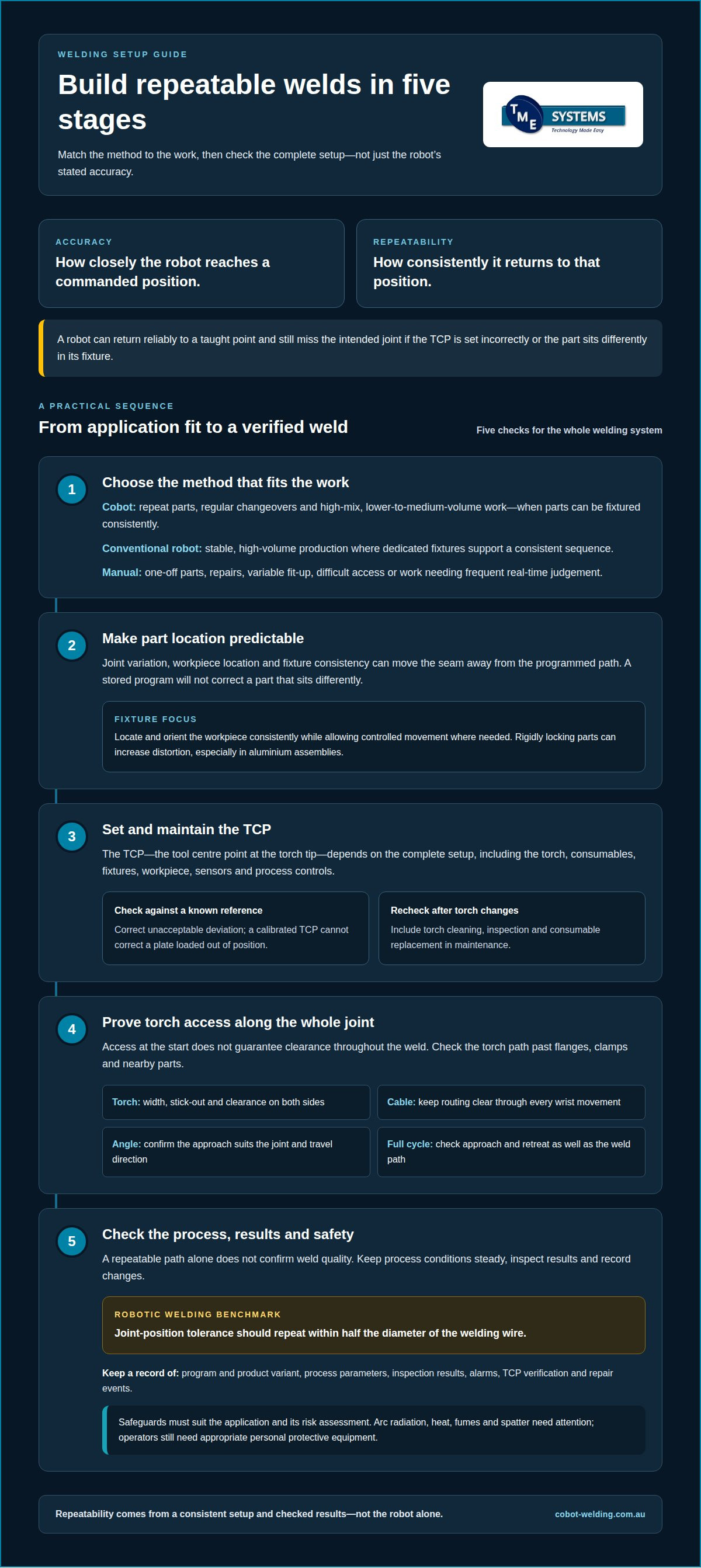

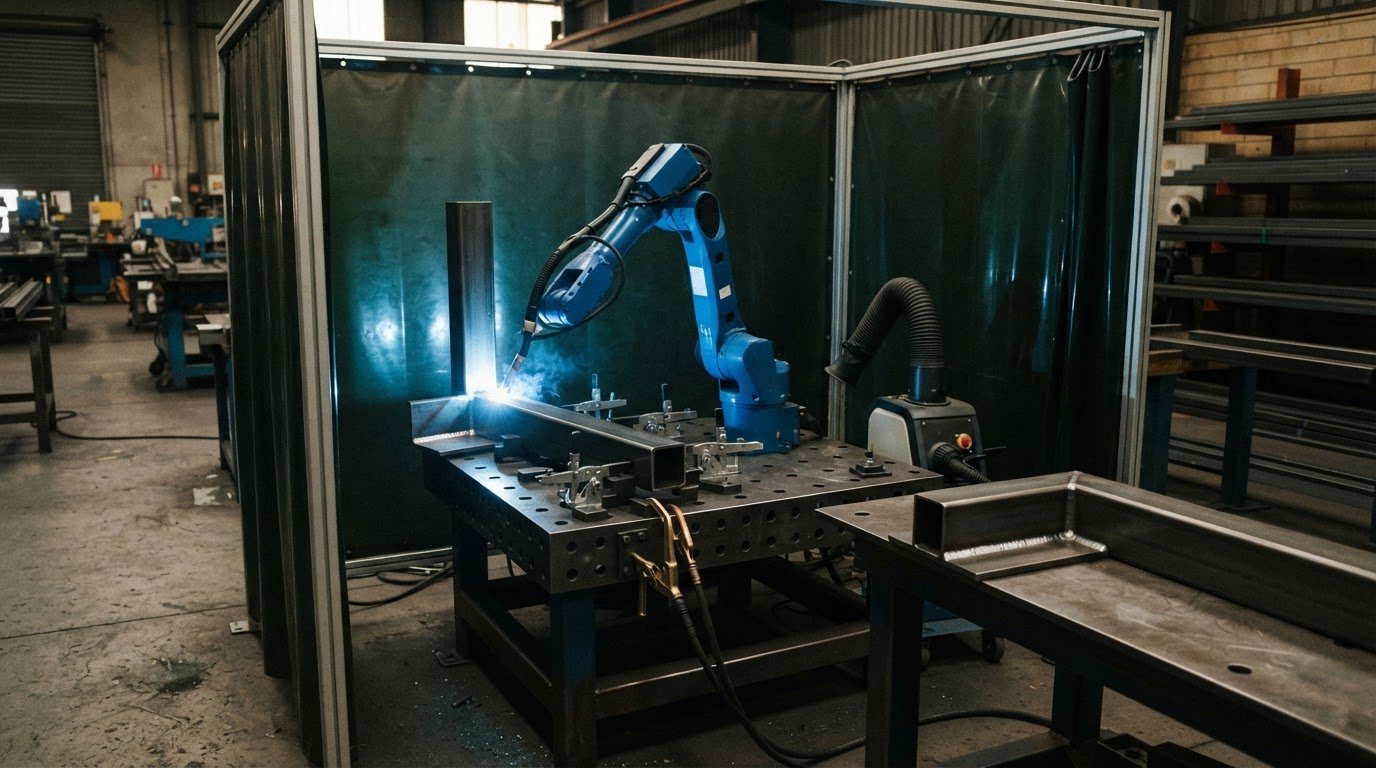
The most automated welding option isn’t automatically the best fit for every job. Cobot weld repeatability depends on consistent part positioning, suitable torch access and a process that doesn’t need constant adjustment. Cobot welding can suit repeat parts with regular changeovers, while conventional robotic welding often fits stable, high-volume production. Manual welding remains valuable for variable work and hard-to-reach joints.
It’s understandable to focus on the robot’s stated accuracy, but that’s only part of the result. TCP performance, fixture consistency, joint variation and torch access all affect whether the weld follows the intended path.
This article compares cobot, conventional robotic and manual welding, then explains the difference between accuracy and repeatability. It also covers how TCP setup, torch clearance and application type affect results, helping you assess where a cobot may fit your production work.
Key Takeaways
- Match the welding method to the work: repeatability, production stability and the need for operator judgement all matter.
- Assess the complete torch setup, not just the robot’s positioning figures, when aiming for consistent weld paths.
- Consider torch clearance, cable routing and approach angles early, as restricted access can make a programmed path impractical.
- Use part consistency, batch patterns and changeover needs to judge whether cobot welding suits your application.
How Does Cobot Welding Compare With Robotic and Manual Welding?
Each welding method suits a different balance of repetition, variation and operator judgement. Conventional robotic welding often fits stable, high-volume production, where dedicated fixtures support a consistent sequence. A robotic cell can execute many welds during a production shift, so even a small process deviation may affect parts before it is detected. Cobot welding offers flexibility for repeat parts and frequent changeovers, particularly in high-mix, lower-to-medium-volume work.
Manual welding remains valuable for one-off parts, repairs and assemblies with variable fit-up. A skilled operator can respond to changing gaps or joint positions as work progresses. By contrast, cobot weld repeatability relies on predictable joint locations and consistent fixturing. Programs can be saved and recalled for repeat orders, but a stored path won’t correct a part that sits differently in the fixture.
Uniform welds need stable process settings as well as a repeatable path. Wire feed, voltage and travel speed influence the process, including heat input and bead formation. With CMT, or Cold Metal Transfer, arc behaviour and transfer settings must suit the material, joint and required travel speed. A repeatable cycle comes from keeping conditions steady and checking results, not from the robot alone.
Conventional robotic welding is often assessed against tight joint-position tolerances. A useful benchmark is repeat positioning within half the welding wire’s diameter. For cobot or manual work, suitable tolerance depends on the joint and process. Compare weld results across repeat parts, and record parameter changes so adjustments don’t become the only route to consistency.
Safety remains part of every welding system. Arc radiation, heat, fumes and spatter require safeguards suited to the application and its risk assessment. Operators still need appropriate personal protective equipment; a cobot’s sensors don’t remove that need. Choose cobot welding when parts can be fixtured consistently and the torch path repeats. Keep manual welding for difficult access or frequent real-time judgement, and reserve conventional robots for stable production where dedicated tooling makes sense.
TCP repeatability versus robot accuracy
Robot accuracy describes how closely it reaches a commanded position. Repeatability describes how consistently it returns to that position. In welding, the TCP, or tool centre point, is the reference point at the torch tip. A robot may return reliably to a taught point yet miss the intended joint if its TCP is set incorrectly.
TCP performance depends on the complete welding setup, not the robot alone. Torch mounting, consumable condition, fixtures, workpiece location, sensors and process controls all affect the tip’s relationship to the joint. A calibrated TCP, for example, cannot correct a plate loaded out of position. Variation in gap, alignment or joint location can also move the seam away from the programmed path, whether the robot follows a stored program or an operator teaches it.
Improve repeatability by checking the TCP against a known reference and correcting unacceptable deviation. Include torch cleaning, inspection and consumable replacement in maintenance, then recheck the TCP after changes that may shift the torch.
The risk of treating repeatability as proof of weld quality is that a consistently misplaced path can produce consistently misplaced welds. A robot’s return to the same coordinates doesn’t confirm fusion, bead profile or joint fit; inspection and process controls remain necessary. Record the program and product variant, process parameters, inspection results, alarms, TCP verification and repair events to help trace variation. At production scale, an unnoticed deviation can affect hundreds of additional parts before detection.
For an application where TCP checks, torch setup and fixture coordination need to work together, consider cobot welding system integration.
For robotic welding, weld-joint position tolerance should repeat within half the diameter of the welding wire. TCP repeatability depends on the complete welding system, including the robot, torch, consumables, fixtures, workpiece, sensors and process controls. Well-designed fixtures should locate and orient the workpiece consistently while limiting unwanted movement. They should allow controlled movement where necessary to avoid over-constraining parts and increasing distortion under heat, while supporting parts and allowing controlled thermal expansion; rigidly locking parts can increase distortion, especially in aluminium assemblies. The cobot’s sensors are designed to prevent potential dangerous situations and collisions with people or other robots.
Torch access, cable routing and approach angles
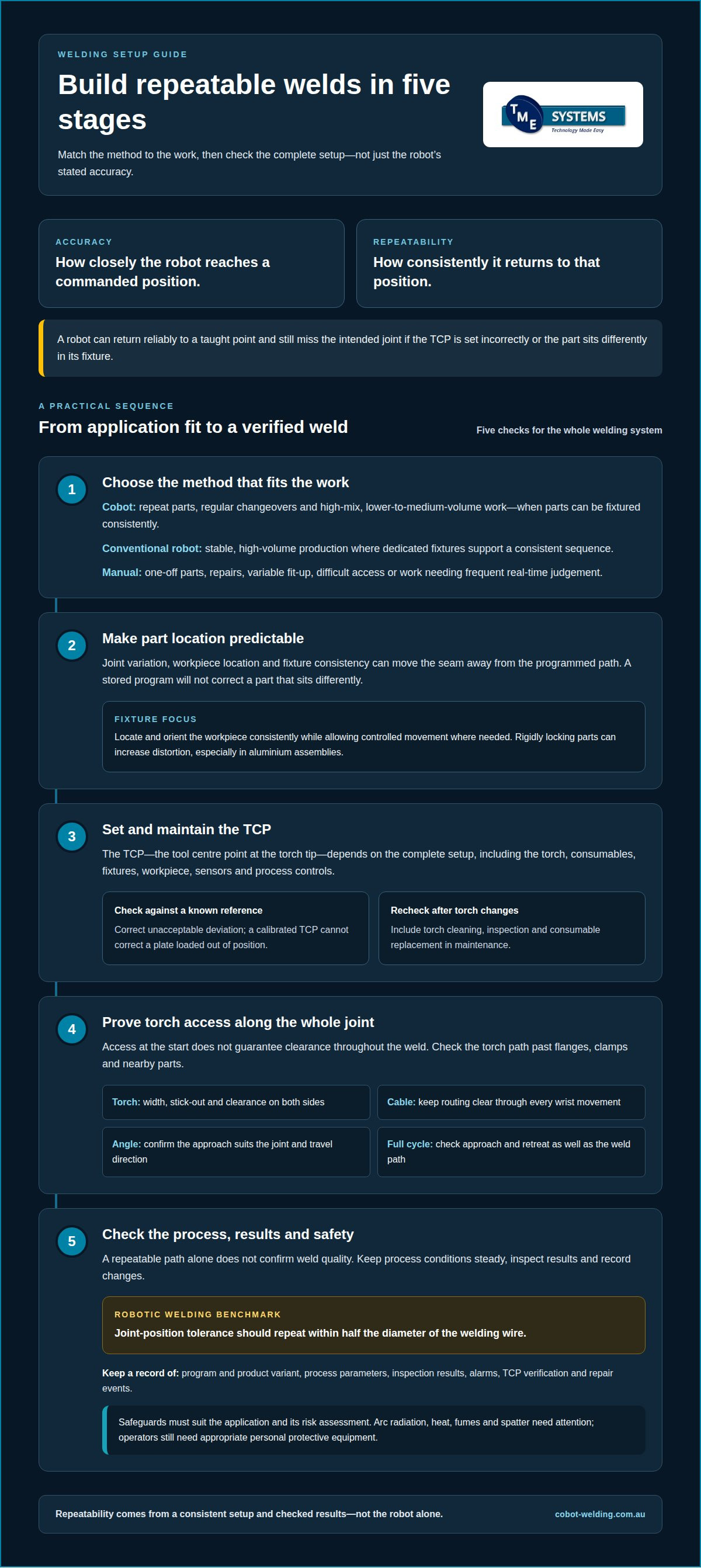
Assess torch access along the whole joint, not just at its starting point. Torch width, stick-out, clearance on both sides and part orientation affect whether the nozzle can reach the seam. A joint beside a flange, for example, may be accessible at one end but blocked as the torch travels past the flange.
Fixturing, torch geometry, cable movement and workpiece variation all affect cobot weld repeatability. A fixture that locates parts differently can shift the joint, while changing consumables can alter the torch’s effective stick-out. Even a sound programmed path may then miss the intended position.
Cable routing matters throughout every wrist movement. A cable that catches on a fixture or pulls tight near a corner can restrict the torch angle or disturb its path. During teaching, check the cable and torch together at each approach and retreat, including around clamps and nearby parts. Keep the route clear throughout the cycle, not only at the weld start.
Approach angle also affects access and travel direction. A square-on path may suit an open butt joint, while a fillet joint beside a frame member may need a tilted torch. Confirm the torch can reach the joint without the nozzle, neck or cable contacting the fixture. Include the required travel angle and clearance in the taught path.
Drawings and available three-dimensional models help assess joint access, orientation, fixturing and manufacturing sequence before production. A controlled trial can reveal collisions, restricted movement or spatter landing on nearby surfaces. Check the full taught movement, then refine the fixture or path where access is obstructed. If the torch cannot approach consistently, repeatability will remain difficult, however carefully the path is taught.
Industries and applications
Repeat fabricated components in industrial equipment and machinery can suit cobot welding. Frames, mounts, guards and subassemblies often have defined joints and recurring work. A cobot can handle repetitive torch movement while skilled staff retain responsibility for setup, process control and inspection. This can support production efficiency without removing the operator’s role.
Application fit depends on the operation, not its industry label. A frame with accessible, consistent joints may suit a stored program. A similar frame with variable fit-up or joints requiring frequent adjustment may call for more manual judgement. Batch size matters alongside setup and teaching time, fixture requirements, weld length and complexity, and how often the part returns.
There’s no single minimum quantity that makes a part suitable. A smaller recurring batch may be a stronger candidate than a larger one-off order when the same program and tooling can be reused. For example, repeat orders of a machinery mount may justify refining its fixture and weld path. A one-time assembly with changing joint positions may offer less opportunity for reuse.
Before choosing an application, consider material grade and thickness, joint details, weld symbols, and relevant code, inspection or procedure requirements. These details help establish whether the process and tooling suit the component. Also consider how operators will load parts, manage changeovers and respond to alarms. Training supports consistent operation, while clear inspection records help keep quality visible across repeat jobs.
Use these application factors to assess where operator capability and automation can work together. Explore operator training and onboarding to support consistent cobot welding in production.
TME Systems
TME Systems helps Australian manufacturers assess how no-code cobot welding could fit their parts, production flow and repeatability requirements. If you’re weighing up torch access, fixture needs or operator involvement, TME Systems can discuss integration with your existing equipment, fixtures and processes.
No-Code Teaching Software lets operators teach weld paths and adjust parameters without writing code. TME Systems’ Mobile Demo System brings a welding cell to your site for a demonstration, helping your team see how the process may fit an application. The right setup still depends on the workpiece, joint access and consistency of the parts being welded.
For a practical discussion about your welding application and the options that may suit it, contact TME Systems.
Set a clear target for your next welding decision
Before adopting automation, bring production and welding staff into the same conversation. Agree what an acceptable weld looks like, which variations need intervention, and how operators will respond if a cycle changes. This gives cobot weld repeatability a practical quality target, rather than treating robot performance as the finish line.
Use those criteria to decide whether to refine the process, demonstrate a cobot on a suitable job, or keep the work manual. Include the people who will operate and inspect the system, so their experience shapes the evaluation. A grounded discussion can distinguish a real production need from an assumption about automation and give your team a clearer path forward.
Contact TME Systems to discuss cobot welding and explore what could suit your operation. Start with the work your team wants to improve, then build the next step around practical requirements.
Frequently Asked Questions
What repeatability can welding cobots achieve, and how is it specified?
There isn’t one repeatability figure that applies to every welding cobot and setup. Check the robot’s stated positional repeatability alongside its test conditions, then assess the complete torch, fixture and workpiece arrangement. For a real job, the useful measure is whether the system repeatedly places the weld within the joint’s requirements. Validate this with production parts and documented inspection criteria.
How does cobot positioning repeatability differ from weld path accuracy?
Positioning repeatability describes how closely the cobot returns to a taught location; weld path accuracy describes how closely the torch follows the intended joint. A path can repeat consistently yet remain offset from the seam. For example, a part loaded against a worn fixture stop may shift the joint while the cobot follows its stored motion precisely. Assess the resulting weld, not motion alone.
How do welding cobots compare with industrial robot weld cells for repeatability?
Both cobots and conventional robots can repeat programmed weld movements, but suitability depends on the production task and cell setup. Industrial robot cells often support stable, high-volume work with dedicated tooling. Cobot welding can suit recurring parts and changeovers where operators need to teach or adjust jobs. Compare results across representative parts, including changeovers and operator interventions, rather than assuming either robot type guarantees better weld quality.
How can weld repeatability be measured and validated in production?
Track first-pass yield, rework time, operator interventions and spatter-clean-up effort across repeat jobs. Pair those measures with weld inspections and records of the program, product variant, process settings, alarms and repairs. For example, if intervention rises after a fixture change, the trend may help identify a setup issue. Review results against the job’s acceptance criteria, then investigate variation before it becomes routine.