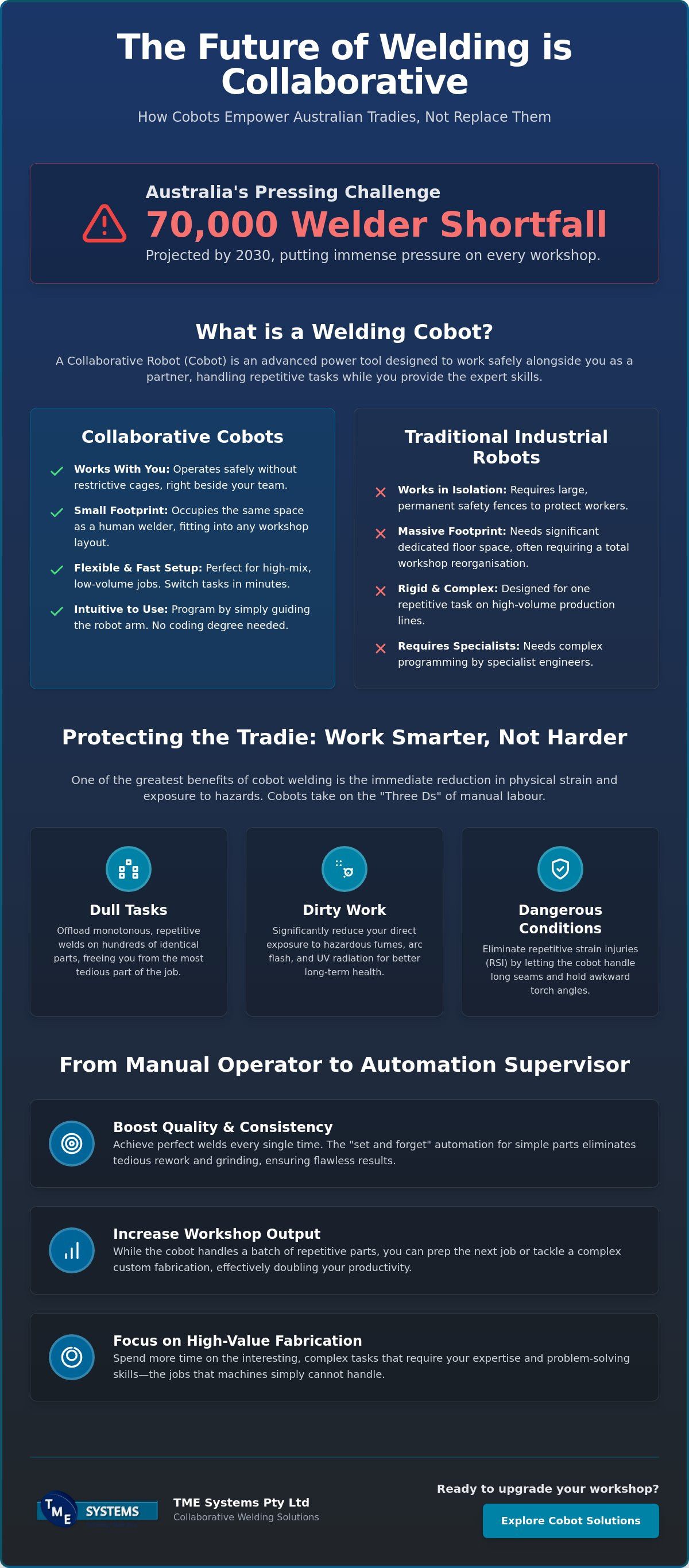

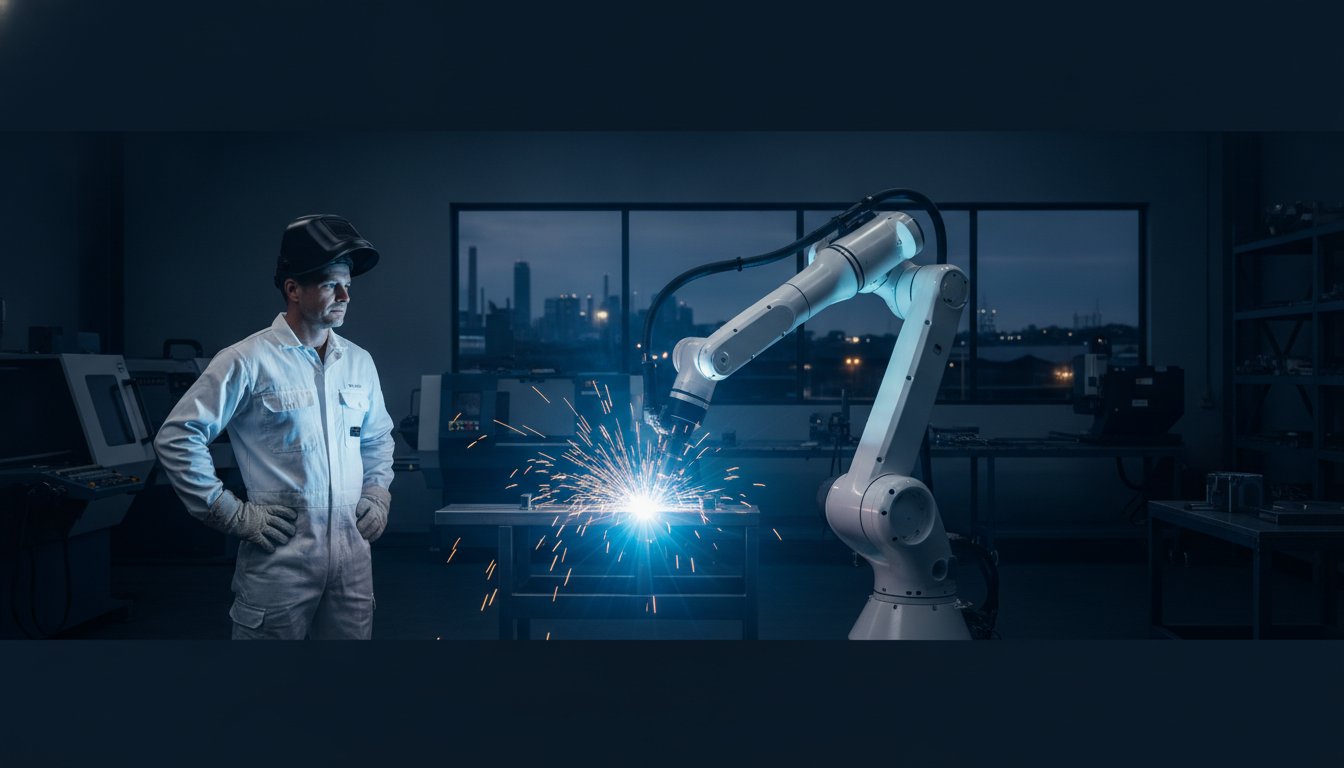
By 2030, Australia is projected to face a shortfall of 70,000 welders, a massive gap that puts immense pressure on every workshop and tradie across the country. You likely know the physical toll of a long shift spent on repetitive welds while managing hazardous fumes and UV exposure. It is natural to feel uneasy when automation is mentioned, especially if you have spent years honing your craft and do not want to be replaced by a complex machine you cannot control.
The reality is that the cobot welding benefits for welders are designed to support your skills rather than replace them. You will discover how these tools allow you to work safer and more efficiently without needing a computer science degree or any prior coding knowledge. This article explores how adopting collaborative tech reduces physical fatigue, ensures consistent quality, and lets you spend more time on the complex, interesting fabrication tasks that machines simply cannot handle.
Key Takeaways
- Discover why cobots are collaborative partners that work safely alongside you without the need for restrictive safety cages or massive floor space.
- Learn how to protect your long-term health by offloading the repetitive tasks that cause physical strain while reducing your exposure to hazardous fumes.
- Explore the cobot welding benefits for welders, including how intuitive lead-through teaching lets you use your existing trade skills without needing to learn complex code.
- See how "set and forget" automation for simple parts eliminates the need for tedious rework and grinding, allowing you to focus on high-value fabrication.
- Understand how professional integration and operator training ensure your new gear works seamlessly with your existing power sources and workshop flow.
Understanding the Shift: What is a Welding Cobot?
A welding cobot is a force-limited robotic arm integrated with a standard power source to assist manual operators. For decades, automation was a luxury reserved for massive car manufacturers with huge budgets and even bigger floor spaces. Those traditional systems were dangerous, fast-moving, and required heavy steel cages to keep workers safe. Today, the shift toward collaborative technology has changed the logic of the workshop floor. A cobot is designed to work alongside you as a partner; it does not need a three-metre-high safety fence or a restricted zone to operate safely.
When you consider the cobot welding benefits for welders, the most immediate advantage is how the technology fits into your existing workflow. These units are typically delivered as complete Collaborative Robot Welding Cells. These are turnkey setups that can be moved into position, plugged in, and ready to work within a few hours. This approach brings the automated welding process to the local fabrication shop, making it accessible to businesses that don't have the room or the desire for traditional, "black box" industrial robots.
Collaborative vs. Traditional Industrial Robots
Traditional industrial robots excel at high-volume production lines where the same weld is repeated ten thousand times without variation. They move at high speeds and have no awareness of their surroundings, which is why they must be fenced off. In contrast, cobots are built for the "high-mix, low-volume" reality of most Australian workshops. You might be welding custom brackets in the morning and trailer frames in the afternoon; a cobot can be switched between these tasks in minutes. They are designed for flexibility and ease of use in tight spaces.
- Small Footprint: Cobots occupy roughly the same floor space as a human welder, meaning you don't have to reorganise your entire shop layout to fit one in.
- Built-in Safety: Advanced sensors monitor every movement. If the arm makes contact with an object or a person, it stops instantly to prevent injury.
- Ease of Setup: Because they are lighter and less complex than traditional robots, they can be redeployed across different stations as your production needs change.
The "Power Tool" Philosophy
It is best to think of a cobot as a highly advanced power tool rather than a replacement for your trade skills. Just as a cordless drill didn't replace the carpenter, the cobot doesn't replace the welder. It is an evolution of the welding torch that handles the steady movement and repetitive arcs while you control the process. You remain the "brain" of the operation. Your knowledge of heat management, travel angles, and material behaviour is what guides the machine. With the introduction of No-Code Teaching Software, you can simply move the robot arm by hand to show it where to weld. This ensures the cobot welding benefits for welders are felt immediately, as there is no need to learn complex computer languages to get the job done.
Protecting the Tradie: Health and Safety Advantages
Welding is a demanding trade that asks a lot from your body. Years spent hunched over a bench or squeezed into tight jigs take a heavy toll on your back, neck, and shoulders. One of the most significant cobot welding benefits for welders is the immediate reduction in this physical strain. By letting a machine handle the heavy lifting and repetitive movements, you are not just improving production; you are protecting your own health. It is about working smarter, not harder, to ensure you don't end your career with chronic joint pain.
Automation works best when it takes on the "three Ds": tasks that are dull, dirty, or dangerous. Instead of spending eight hours a day performing the same monotonous weld on a hundred identical parts, you can set up the cobot to handle the grunt work. This shift allows you to focus on the technical setups and complex fabrications that require a human touch. While Boosting workshop output is a primary goal for many businesses, the real value for the operator is a safer, less fatigued environment that prioritises quality over sheer physical repetition.
Eliminating Repetitive Strain Injuries (RSI)
Long, continuous seams are notorious for causing muscle fatigue. Maintaining a steady hand and a perfect arc over a metre-long weld requires intense concentration and static muscle loading. A cobot maintains that perfect torch position without tiring. This eliminates the need for you to hold awkward body positions for extended periods. When the robot takes over the repetitive fabrication jigs, you reduce the risk of long-term joint damage. This means fewer visits to the physio and a much lower chance of developing a career-ending injury.
Reducing Hazardous Exposure
Health and safety regulations in Australia are tightening for a good reason. Recent changes have reduced the workplace exposure standard for welding fumes from 5 mg/m3 to a much stricter 1 mg/m3. Using a cobot allows you to step back from the fume plume during the actual weld cycle. You are still in control of the cell, but you aren't right in the thick of the smoke and arc flash. This significantly lowers your cumulative UV exposure and inhalation of airborne contaminants. For a deeper look at how these systems help you stay compliant with OH&S standards, you should read our guide on Welding Cobot Safety in Australia.
This technology is a tool for career longevity. Many experienced tradies find themselves forced out of the workshop early because their bodies simply can't keep up with the physical demands anymore. By integrating these systems, you can transition from a manual operator to a process specialist. You keep your trade knowledge and your paycheck while the machine does the hard yards. If you want to see how these systems fit into your daily routine, you can explore our collaborative robot welding cells to see the difference for yourself.
From Manual Operator to Robot Programmer (Without the Code)
The biggest hurdle to adopting automation isn't usually the cost or the floor space; it's the fear of the keyboard. Many experienced tradies worry that bringing in a robot means they'll need a degree in computer science just to strike an arc. This couldn't be further from the truth. Modern cobot welding benefits for welders include a shift toward "lead-through" or "hand-guiding" teaching. This process allows you to physically grab the robot arm and move it through the weld path, using your existing hand-eye coordination to show the machine exactly where the joint starts and ends.
You aren't writing lines of code. Instead, you are recording your best technique for the robot to repeat perfectly. This changes your role from a manual "spark-maker" to a process manager. In a typical Australian job shop where you might only have a batch of ten or twenty parts, you don't have hours to spend on complex setups. Lead-through teaching means you can change jobs in minutes, making automation viable for small-batch fabrication that was previously too slow to automate.
The Magic of No-Code Teaching Software
Our No-Code Teaching Software acts as the bridge between your trade skills and the machine's precision. If you can move a torch along a seam, you can programme the cobot. The interface is usually a simple touchscreen tablet where you can adjust weld parameters like volts, amps, and travel speed on the fly. Because these systems include essential safety features in cobots, you can stand right next to the arm while you fine-tune the programme. You remain the expert. The robot is simply a tool that records your trade knowledge and executes it with 100% consistency, shift after shift.
Solving the Skills Gap
Australia is facing a massive shortage of qualified tradespeople. Cobots help solve this by allowing a senior welder to "multiply" their impact. Instead of being tied to one bench all day, a highly skilled operator can set up two or three Collaborative Robot Welding Cells and oversee the quality of all of them at once. This makes the trade far more attractive to a younger, tech-savvy generation who want to work with modern tools. TME Systems provides the operator training and onboarding needed to ensure this transition is seamless. We don't just drop off a box; we make sure your team has the confidence to manage the technology effectively. This ensures the cobot welding benefits for welders are felt across the entire workshop, from the youngest apprentice to the most seasoned foreman.
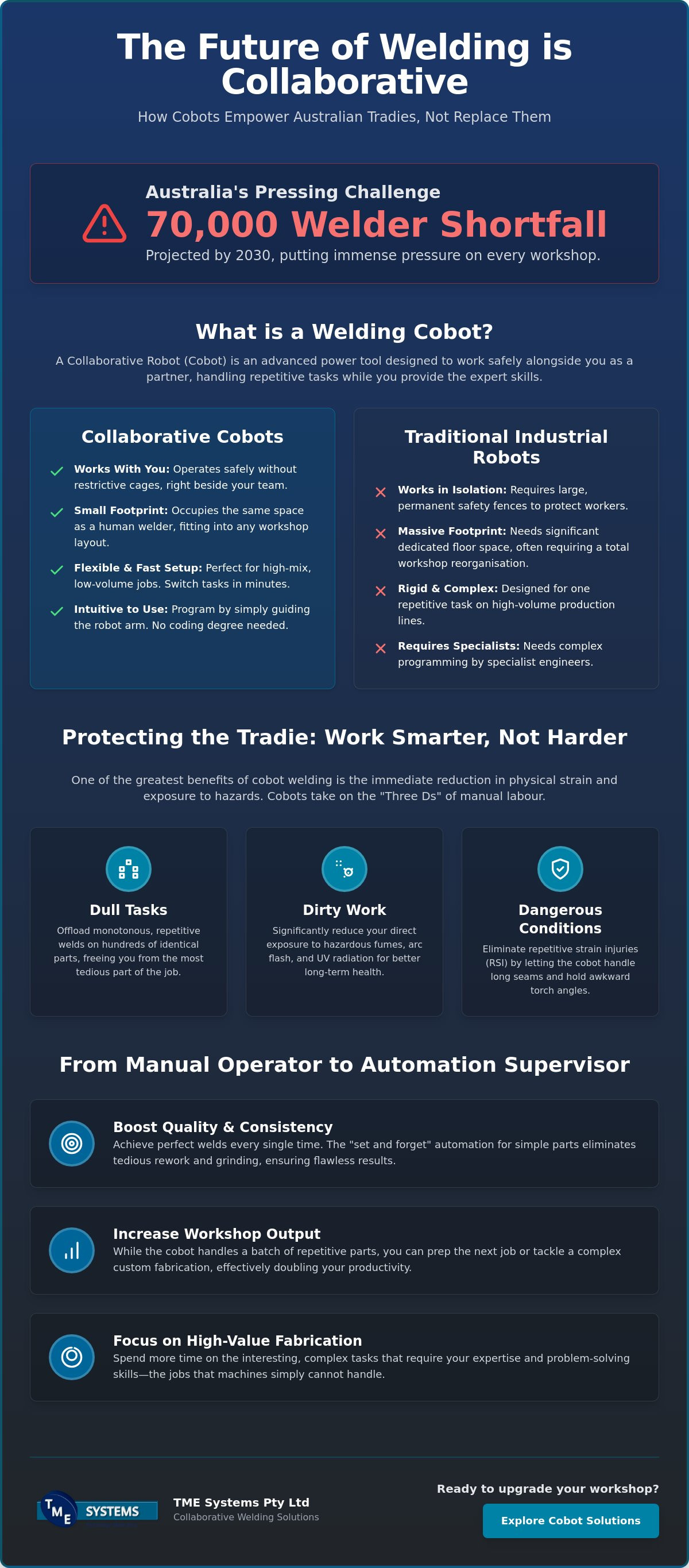
Boosting Workshop Output and Job Satisfaction
The frustration of rework is a major drain on any workshop. Spending hours grinding back a weld that didn't penetrate correctly or fixing a warped joint is exhausting and demoralising. One of the most practical cobot welding benefits for welders is the "Perfect First Time" result. When you set up a cobot, you ensure that every single bead is laid with the same precision, regardless of whether it's the start of the shift or five minutes before knock-off. This level of reliability changes the atmosphere of the shop, moving away from a "fix it later" culture to one of consistent excellence.
This reliability allows for a "set and forget" approach for the simpler, more repetitive components. While the cobot handles the high-volume parts, you are free to tackle the more interesting and complex fabrication projects that actually require your expertise. There is a genuine sense of satisfaction in seeing a row of identical, high-quality beads. It proves that you are managing a high-performance cell rather than just grinding through a pile of repetitive tasks. This shift in focus is a key reason why many Australian workshops are seeing a boost in overall team morale.
Consistency and Quality Control
Human fatigue is a reality on any workshop floor. A machine doesn't have a "bad Friday" or lose focus when the temperature in the shed hits forty degrees. Because the robot has absolute control over travel speed and torch angle, it produces cleaner finishes with significantly less spatter. This precision has a direct impact on the following stages of production. Automated welding consistency can reduce post-weld grinding time by up to 50%. This saving keeps you away from the vibration and dust of unnecessary finishing work, letting you move straight to the next job with confidence.
Focusing on the Craft
Automation doesn't take away the craft; it highlights it. By offloading the boring work to the robot, you can focus on the critical stages like tacking, fit-up, and custom fabrication. These are the areas where a welder’s intuition and experience are irreplaceable. Learning to manage and programme these systems also future-proofs your career. In 2026, having experience with collaborative tech is a massive advantage on any CV, marking you as a forward-thinking specialist in the Australian fabrication industry. If you want to see this technology in action on your own floor, you can book a mobile demo system to experience the shift in output first-hand.
Getting Started with TME Systems’ Collaborative Solutions
Moving from a manual setup to an automated one is a big step for any Australian fabrication business. You need more than just a robotic arm; you need a system that works with your current gear and your specific projects. TME Systems acts as a practical partner that understands the realities of the local workshop floor. We don't just sell technology. We provide the integration and training needed to ensure the cobot welding benefits for welders are realised from the very first arc. Whether you are dealing with heavy structural steel or thin aluminium, the setup must be tailored to your specific environment.
Professional integration is what ensures the cobot communicates effectively with your existing power source. Without this, you're left with a piece of equipment that doesn't fit your workflow. Our team focuses on making the technology adapt to you, not the other way around. This hands-on approach demystifies the transition and ensures your team feels supported throughout the entire process. We know that innovation only works when it's accessible and reliable for the people using it every day.
The TME Integration Process
Every workshop is different. We customise our Collaborative Robot Welding Cells to suit your specific fabrication needs, whether that involves MIG, TIG, or specialised aluminium work. Our onboarding process is designed to be thorough and steady, ensuring your operators are confident and capable from day one. We stay invested in your success long after the initial setup. For a detailed look at how we maintain these systems and keep your production moving, you can read our guide on Robotic Welding Technical Support.
Experience the Difference Today
The best way to understand the cobot welding benefits for welders is to see the gear in action. We offer a mobile demo system that brings the technology directly to your workshop. This gives you and your team the chance to "have a go" at teaching the robot yourself. You will see exactly how the no-code software works and how quickly a job changeover can happen on your own floor. There is no substitute for seeing the machine handle your specific parts in your own environment. If you are ready to see how collaborative tech can support your team and improve your daily output, you can book your mobile cobot welding demonstration today.
Secure Your Future on the Workshop Floor
Adopting collaborative technology isn't about replacing your trade skills; it's about giving you better tools to do the job. By offloading the physical strain of long, repetitive seams and staying clear of hazardous fume plumes, you can focus on the high-value fabrication that truly requires your expertise. The cobot welding benefits for welders centre on this balance of safety, precision, and career longevity. You remain the expert, using your existing trade knowledge to guide a machine that never gets tired or loses focus.
TME Systems is here to ensure this transition is practical and straightforward. Our systems feature specialised no-code teaching software and are supported by Australian-based integration teams who understand local fabrication standards. We don't just provide gear; we provide a partnership that keeps your workshop competitive and your team safe. The best way to see how this fits into your daily routine is to experience it for yourself on your own workshop floor.
While you focus on upgrading your workshop floor with the latest tech, ensuring your back office is well-equipped is just as vital for smooth operations; for all your workplace stationery and essentials, Mega Office Supplies offers a comprehensive range of products to support your business.
See the future of your workshop – Book a Mobile Demo with TME Systems
Your trade knowledge is the most valuable asset in the shop. We are simply here to help you apply it more efficiently and safely for years to come.
Frequently Asked Questions
Do I need to know how to code to use a welding cobot?
No, you don't need any computer programming knowledge to operate these systems. You use "lead-through" teaching, which involves physically moving the robot arm to the start and end points of the weld. Our No-Code Teaching Software handles the background logic, so you only need to focus on setting the correct volts, amps, and travel speed via a simple touchscreen tablet.
Can a cobot weld as well as a human with 20 years of experience?
A cobot repeats exactly what a skilled welder teaches it. While the machine lacks the "on-the-fly" intuition of a veteran tradie to compensate for poor fit-up, it provides 100% consistency once the path is set. It doesn't get tired or distracted, meaning the last weld of the day is identical to the first, which is a major boost for workshop quality control.
Is a welding cobot safe to work next to without a cage?
Yes, cobots are specifically designed to operate safely alongside humans without restrictive safety fencing. One of the primary cobot welding benefits for welders is the ability to share a workspace. These arms use force-limiting sensors to monitor their surroundings, though a proper risk assessment of the welding arc and fume extraction is still required for every setup.
How long does it take to learn how to use a no-code welding robot?
Most experienced welders are comfortable setting up basic parts within a few hours of hands-on training. Because the interface uses standard welding terminology rather than technical jargon, the learning curve is very shallow. You can usually move from unboxing to production-ready welds in less than a day with the right onboarding support.
What happens if the cobot hits something or someone while welding?
The robot will stop instantly if it detects any unexpected resistance. The built-in sensors are incredibly sensitive and are designed to halt all movement before any injury occurs. This "force-limiting" technology is what distinguishes a collaborative robot from a traditional industrial robot, which would continue its path regardless of obstructions.
Can a cobot handle small batches, or is it only for thousands of parts?
Cobots are actually ideal for "high-mix, low-volume" work common in Australian job shops. Because the changeover between jobs only takes a few minutes, it is often viable to automate batches as small as five or ten parts. You don't need massive production runs to see a return on the time spent setting up the cell.
What kind of maintenance does a welding cobot require?
Maintenance is straightforward and focuses on regular calibration and standard power source care. The robotic arm itself requires periodic servicing to check the joints and internal wiring, similar to any other high-end workshop machinery. Keeping the torch consumables clean and the software updated ensures the system remains accurate and reliable over the long term.
Will a cobot replace the need for qualified welders in my shop?
No, the technology is a tool designed to support qualified tradespeople, not replace them. A cobot still needs a welder's expertise to set the correct parameters and oversee the process. The cobot welding benefits for welders focus on removing the "grunt work" of repetitive seams, allowing you to use your skills on more complex and rewarding fabrication tasks.