
The robot arm is rarely the best place to judge the cost of a welding cell. When buying a cobot welding cell, the real fit depends on how easily it can handle your parts, weld paths and production flow. The price depends on the application and is provided after a quote request; programming, fixturing, guarding, batch size and integration all shape the total.
Equipment matters, but the cell also needs to produce consistent welds and fit the jobs your workshop runs. Consider how parts will be fixtured, how operators will teach and adjust weld paths, and what the site risk assessment requires. Compare cobot and conventional robotic approaches against your production needs, floor space and flexibility. For high-mix, low-volume work, a cobot is most practical when related jobs share fixtures, process knowledge and weld strategies.
Key Takeaways
- Include programming, tooling and fixtures in the cost picture: each additional part family can add work beyond the initial cell setup.
- Safety design is part of cell selection. TS-15066 supplements ISO-10218 with guidance for industrial-only cobot systems and workplace safety, according to the International Organization for Standardization.
- Batch size is only one part of the decision; part variety, changeovers and production flow also influence whether a cobot suits your work.
- Match the cell to your welding process, cycle-time needs, safety requirements and plans for future expansion, rather than judging it by the robot arm alone.
Programming and fixturing costs for additional part families
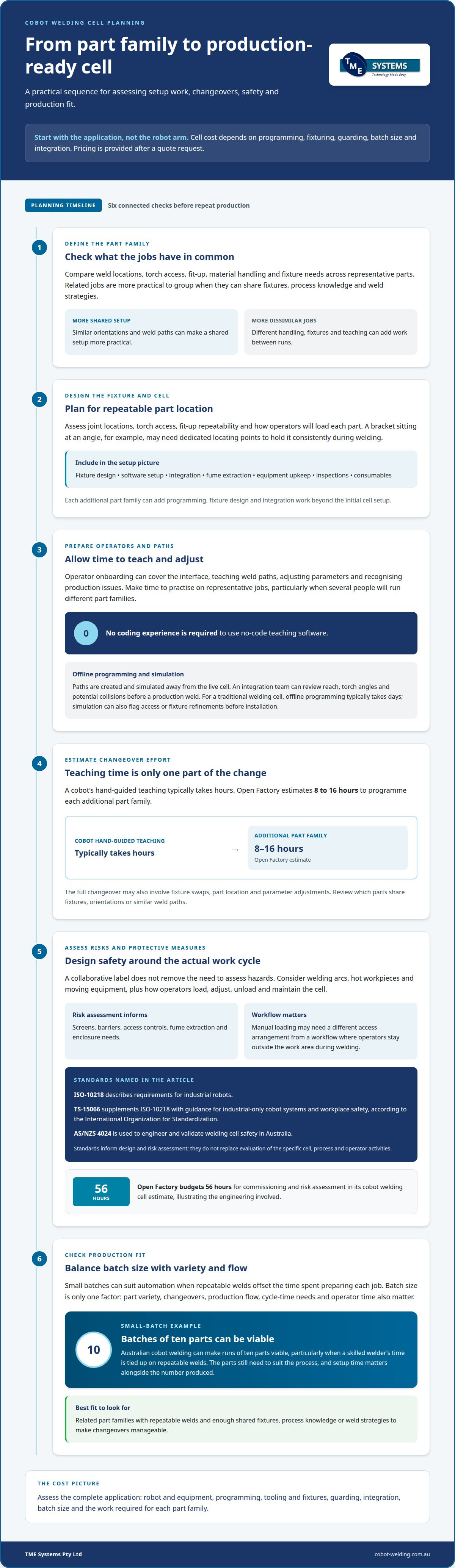
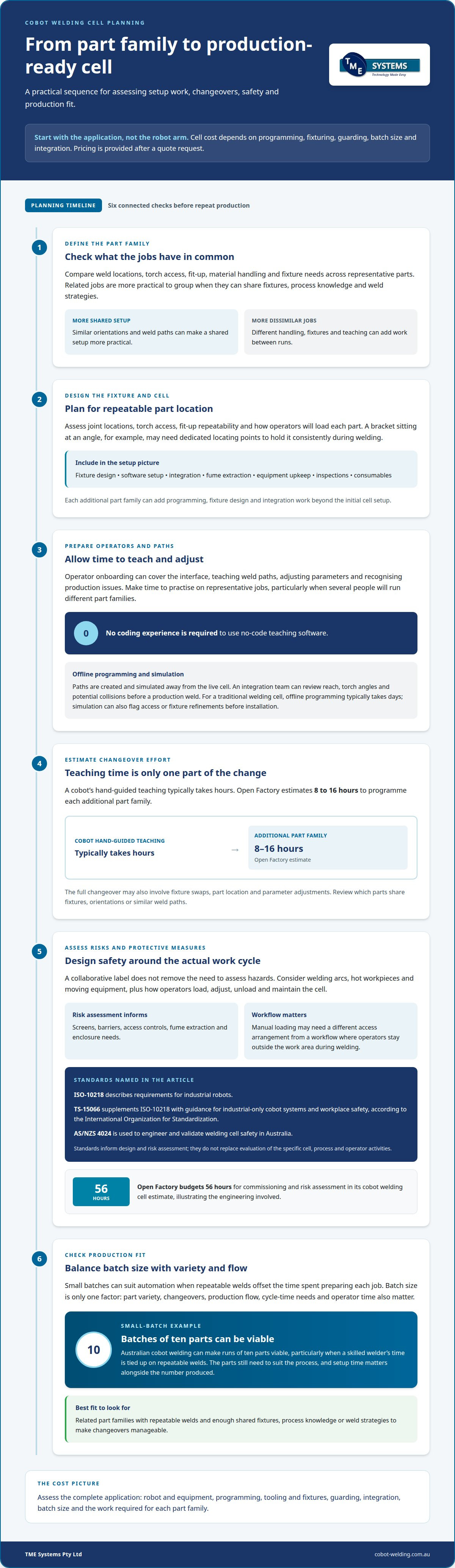
Allow for more than robot acquisition when planning welding automation. Each part family can add programming, fixture design and integration work.
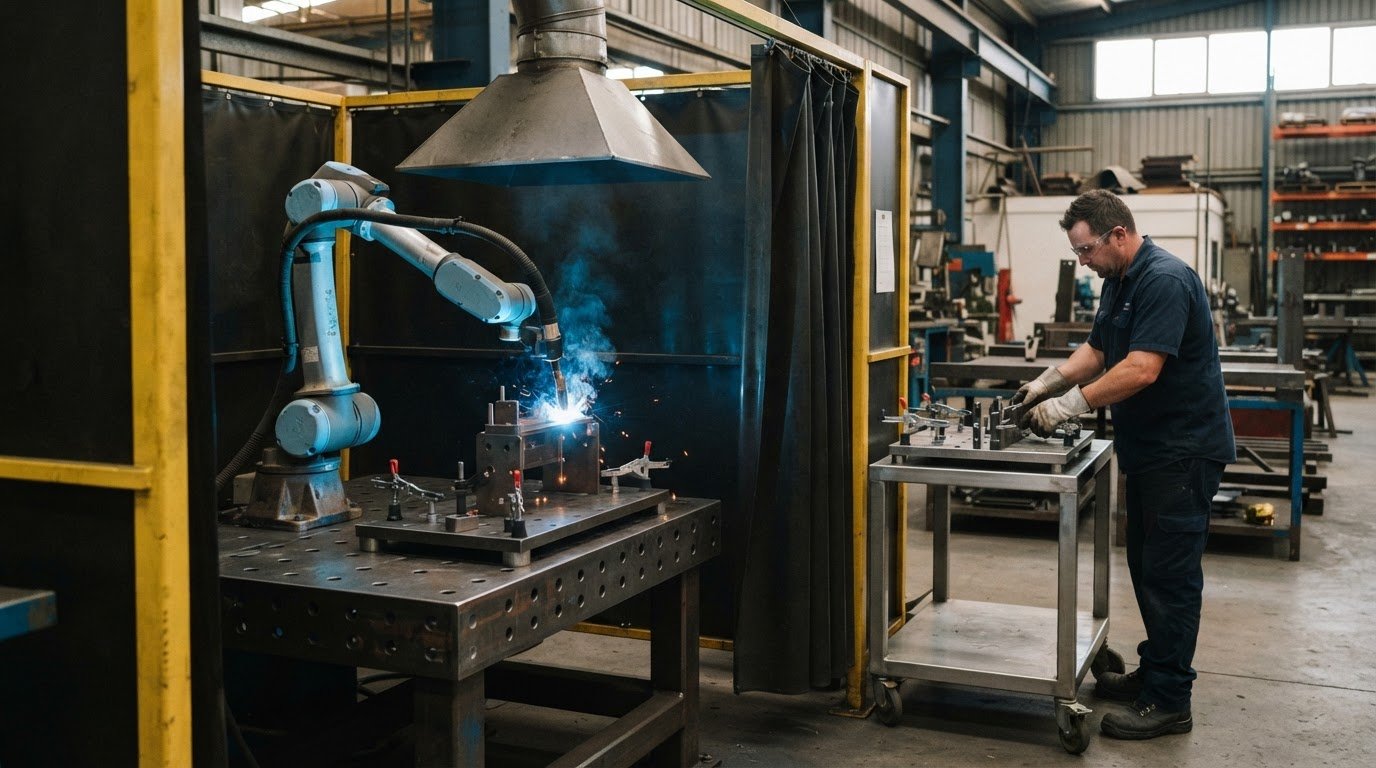
Assess joint locations, torch access, fit-up repeatability and how operators will load each part before designing a fixture. A bracket that sits at an angle, for example, may need dedicated locating points to hold it consistently during welding. Fixture design, software setup and integration all affect the work involved. Also identify site requirements such as fume extraction, and plan for equipment upkeep, inspections and consumables.
Operator onboarding is part of a successful setup. Training can help staff understand the interface, teach weld paths, adjust parameters and recognise issues during production. Include time for operators to practise on representative jobs, especially if several people will run different part families. No coding experience is required to use no-code teaching software.
Offline Programming and Simulation
Offline programming is the creation and simulation of robot paths away from the live welding cell. It lets an integration team review reach, torch angles and potential collisions before running a production weld. For a traditional welding cell, offline programming typically takes days; this can help when complex paths need careful preparation. Simulation can also identify where part access or fixture design needs refinement before installation.
Programming and Changeover Time
Programming and changeover time is the work of teaching a new weld path and preparing the cell for another part family. A cobot’s hand-guided teaching typically takes hours, while Open Factory estimates 8 to 16 hours to program each additional part family. The figure is only part of the changeover: fixture swaps, part location and parameter adjustments also influence the production interruption.
Review which parts share fixtures, orientations or similar weld paths, and how operators will manage changeovers. Grouping related parts can make a shared setup more practical. Dissimilar jobs may need different preparation, fixtures and teaching, adding time between runs. This helps you judge whether the selected part families suit operator-led teaching and repeat production.
Safety screens, guarding and risk assessment
A cobot’s collaborative label doesn’t remove the need to assess hazards in its welding application. Screen design, fume extraction and access controls should reflect the tasks and operator workflow.
Cobot Safety and Protective Enclosures
Collaborative applications can still involve welding arcs, hot workpieces and moving equipment. Assess how operators load fixtures and whether they work near the cell during welding. The site risk assessment should determine whether screens, barriers or other protective measures are needed, and how access is controlled. The design should reflect the actual task and operator workflow.
Collaborative Robot Safety Standards
Safety standards provide a framework for assessing robot hazards and designing protective measures. ISO-10218 describes requirements for industrial robots. TS-15066 supplements ISO-10218 with guidance for industrial-only cobot systems and workplace safety, according to the International Organization for Standardization. In Australia, welding cell safety is engineered and validated to AS/NZS 4024. These standards inform the initial design and risk assessment; they don’t replace evaluating the specific cell, welding process and operator activities.
Guarding and Fume Management
Plan fume extraction to manage airborne welding fume, and select screens and access controls for the welding process and loading method. The site risk assessment should inform the protective measures required. For example, a cell designed for manual loading may need a different access arrangement from one where operators remain outside the work area during welding.
Risk assessment should consider the full work cycle: loading, welding, unloading, adjustments and maintenance. Open Factory budgets 56 hours for commissioning and risk assessment in its cobot welding cell estimate, illustrating the engineering involved. These checks help define safety equipment and enclosure needs before installation. For a cell design shaped around the application, welding system integration can connect guarding, fume management and robot operation.
Is robotic welding viable for small batch sizes?
Small batches can suit automation when repeatable welds offset the time spent preparing each job. Batch size matters, but so do part variety and changeover demands.
Choosing a System for Part Mix
Match the cell’s setup to the parts you actually produce. Ten similar brackets may share a fixture and workflow, while ten unrelated assemblies may require different handling and weld paths. Compare weld locations, torch access, fit-up, material handling and fixture needs across representative jobs. This shows whether a family of parts can share a setup or whether changeovers will interrupt production.
Australian cobot welding makes batches of ten parts viable. That gives smaller runs a practical route to automation, particularly when a skilled welder’s time is tied up on repeatable welds. The part still needs to suit the process, and setup time matters alongside the number produced. A professional integration assessment can consider those factors together.
High-Mix and Small-Batch Welding
High-mix, low-volume welding can suit collaborative automation when you choose related part families and the jobs are similar enough to reuse fixtures, process knowledge and weld strategies. No-code teaching makes operator-led changes practical, but frequent changes between dissimilar jobs can still add setup work. Compare repeat work, changeover effort and operator time rather than relying on batch size alone.
For example, a fabricator making several frame versions may group jobs with similar weld access or part orientation. Shared fixtures and a common workflow can then support more than one job. Dissimilar parts may need separate handling and preparation. Consider part variation, changeover effort and available floor space when deciding whether the proposed setup fits.
Consider the complete work cycle, from loading the part through welding and unloading. A cobot’s typical welding speed is about 20 to 30 inches per minute, so weld length and cycle time help indicate whether the cell can meet production needs. A dedicated industrial welding cell can run the same part thousands of times, making it a stronger fit for sustained repetition.
Review the welding power source, process, part mix and operator workflow together. MIG and TIG applications depend on correctly matching the robot, power source, torch package and process requirements. Also plan the cell’s location and how people will move around it. The aim is to match the setup to real production needs, not to choose by batch size alone.
Cobot and robotic welding cell selection
Before selecting a system, clarify its configuration, integration and operator handover. When buying a cobot welding cell, base the scope on the actual parts, process and production workflow.
Cell Equipment and Inclusions
A clear scope explains how the robot, welding process and supporting equipment are matched to the application. Review how the power source, wire feed, torch and communication method work together, since these affect arc stability and repeatability. Identify the equipment and integration tasks involved, and clarify which interfaces need to be addressed before commissioning.
Questions for Potential Suppliers
An Australian welding automation supplier can assess your requirements and recommend a suitable system. Before buying a cobot welding cell, ask for a written scope that explains the proposed configuration, integration responsibilities, commissioning activities and operator handover. It should also identify what information or equipment your shop needs to provide, so responsibilities are clear before the project begins.
Ask how the recommendation fits your welding process and existing equipment. The power source, wire feed, torch and communication method all affect arc stability and repeatability, so discuss these interfaces early. Clarify how the existing workflow will connect with the proposed setup and what integration work is involved.
Use the discussion to resolve practical questions about scope, responsibilities and handover, rather than comparing robot specifications in isolation. A clear integration plan gives your team a common basis for evaluating the proposed system. To discuss your welding cell requirements, outline the application and the equipment already used in your shop.
TME Systems: Collaborative Robot Welding Cells
TME Systems helps Australian fabricators assess and adopt collaborative robot welding through no-code teaching software, welding system integration and operator onboarding. Its SmoothTool software lets operators teach weld paths and adjust parameters without writing code, making the people who run the cell part of the teaching process.
A Mobile Demo System can bring a welding cell to your site for a demonstration, giving your team a practical way to consider the technology with real parts and workflows. TME Systems also provides operator training and onboarding. These steps help connect early assessment with a defined application, while considering integration and the operator interface together.
Contact TME Systems to discuss your welding automation requirements.
TME Systems provides no-code collaborative welding solutions and integration for Australian manufacturers.
Turn your welding requirements into a practical next step
Start with the work your workshop needs to get done. Identify candidate parts, how often they recur, how operators load them and what may change in production. These details give TME Systems a practical basis for discussing a setup around your actual workflow rather than a generic equipment package.
If you’re buying a cobot welding cell, make the first discussion about the application and the people who will run it. Share representative parts, welds and production patterns, then consider how operator-led teaching and integration could fit your workflow. This helps turn an automation idea into a considered decision while building on the skills already in your workshop.
Contact TME Systems about welding cells to discuss the next step for your shop. A practical assessment can start with the work in front of you.
Frequently Asked Questions
Cobot Welding vs Robotic Welding Cell: Which One Fits Your Shop?
A cobot often suits shops needing flexible production and operator involvement, while a dedicated industrial robot can suit repeated, high-volume work. For example, a fabricator changing between related components may value easier job adjustments; a line running one part repeatedly may prioritise a dedicated setup. Compare part mix, output needs, available floor space and safety design. The application’s risk assessment remains essential for either system.
How can a supplier help you get started with a cobot welder?
TME Systems can discuss your representative parts, production goals and existing equipment to establish a suitable starting point. Integration can be discussed across a wide range of equipment, fixtures and processes. Its Mobile Demo System can bring a welding cell to your site for a demonstration, helping your team consider the technology against its workflow before defining the project scope.
How does a supplier teach a cobot to weld, and what operator onboarding is involved?
With no-code teaching software, operators teach weld paths and adjust parameters without writing code. A supplier can guide the team through using the interface and applying it to the parts they make. Operator onboarding can cover cell operation and the practical adjustments staff need for production. For instance, welders can learn how a path is taught for a repeat job, then how to make changes when the job requires them.
Can you handle the fume extraction and electrical work?
TME Systems can discuss integration with existing welding equipment, fixtures and processes, including power-source requirements. Identify fume extraction and electrical installation requirements in the project scope, and assign responsibility for each. This keeps the integration plan clear and avoids assuming site services are included with the cell. The extraction approach should suit the welding process and workplace layout.
What information should you provide to get a budget for a cobot welding cell?
Share representative part drawings or photos, weld locations, materials, production volumes and the processes you use, such as MIG or TIG. Include existing power sources, fixtures, part variation and how operators load components. Target cycle times or planned future parts can also help define the application. This information supports an informed discussion about integration and project scope.
Is now a good time to purchase a robot welder?
A good starting point is repeatable weld work with consistent fit-up, sensible torch access, stable fixturing and enough recurring production to justify teaching and proving the weld path. Identify where skilled welders spend time on repeat tasks, then assess whether those parts meet these criteria. If the product mix or process is still changing, first decide which related part families can share fixtures and weld strategies.