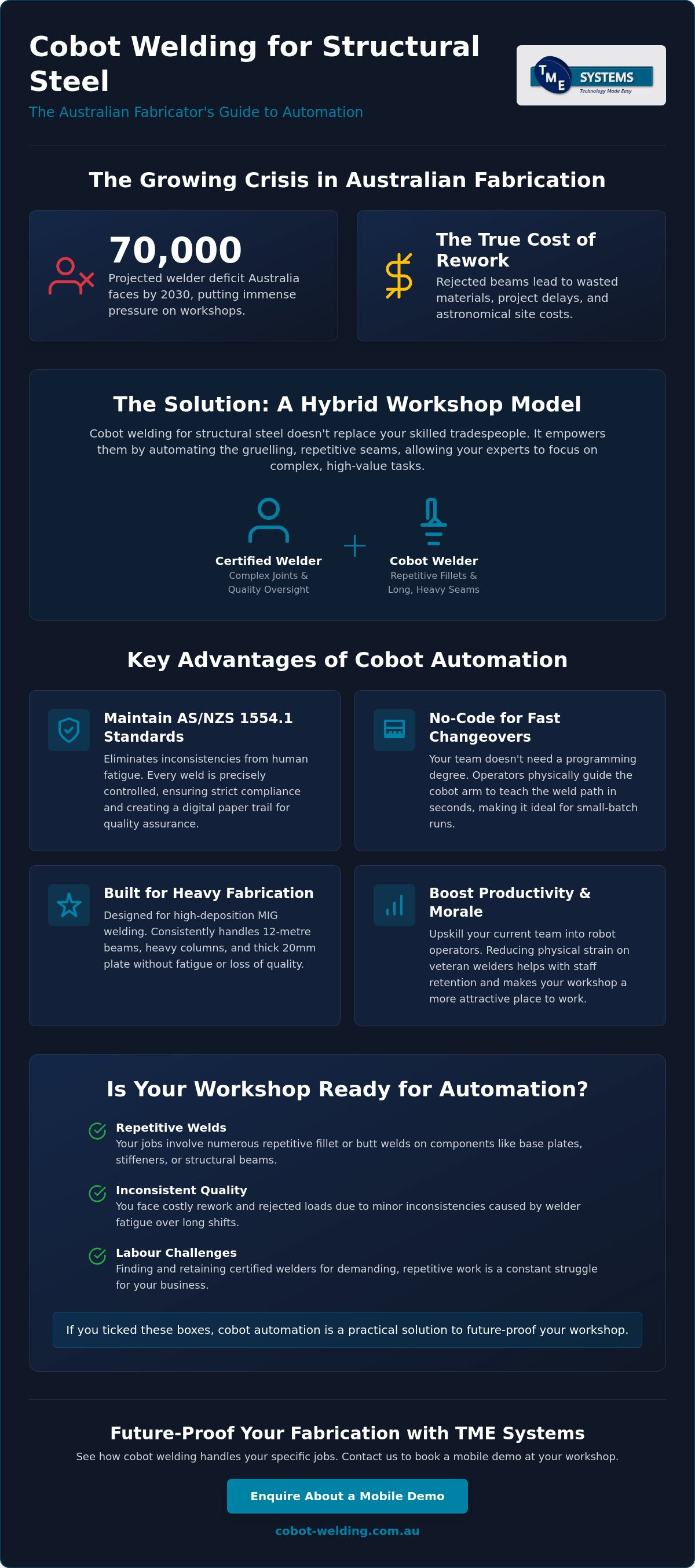

With Australia projected to face a deficit of 70,000 welders by 2030, the pressure on your workshop floor to maintain output while keeping quality high is becoming unsustainable. You’ve likely felt the struggle of finding certified staff who can manage the gruelling, repetitive seams required for heavy fabrication without the inevitable fatigue that leads to errors. It's a common frustration; watching rejected loads eat into your margins because of minor inconsistencies is something no business owner wants to deal with. Implementing cobot welding for structural steel isn't about replacing your skilled tradespeople. Instead, it's about giving them a specialised tool to handle the heavy lifting with absolute precision.
We understand that the leap to automation can feel intimidating, especially when you're managing small-batch runs that require frequent changeovers. This guide will show you how collaborative robots are transforming the industry by automating heavy MIG welds while ensuring strict AS/NZS 1554.1 compliance. We'll demystify the technology to show you why no-code software means your team won't need a programming degree to get results. By the end of this guide, you'll see how to eliminate costly rework and make automation a functional, supportive part of your daily production.
Key Takeaways
- Learn how to combat the national welder shortage by automating repetitive fillet welds on base plates and structural beams.
- Discover how cobot welding for structural steel handles high-deposition MIG tasks and long seams without the need for complex programming.
- Identify if your workshop is ready for automation by evaluating your current batch volumes and specific power requirements.
- Understand how to maintain strict AS/NZS 1554.1 standards by eliminating common stop-start inconsistencies through precision automation.
- See how no-code teaching software and hands-on training empower your existing team to become proficient operators from day one.
Why Australian Structural Steel Shops are Turning to Collaborative Automation
The 2026 reality for Australian fabricators is stark. With a projected deficit of 70,000 welders by 2030, the traditional model of relying solely on manual labour is hitting a wall. Infrastructure projects across the country are filling order books, yet finding certified staff to weld every base plate and stiffener is becoming nearly impossible. This is why many shops are integrating cobot welding for structural steel to bridge the gap. It's a pragmatic response to a market where the demand for steel exceeds the available hands to weld it.
Repetitive fillet welds on base plates are often the biggest productivity killers in a workshop. These joints aren't necessarily complex, but they are relentless. When a human welder spends eight hours a day on these seams, fatigue is inevitable. This physical toll often leads to minor inconsistencies that fail a structural inspection, forcing a costly cycle of grinding and re-welding. By adopting robotic welding technology in a collaborative format, you can move toward a hybrid workshop model. This approach doesn't replace your team; it supports them by taking over the grunt work that causes burnout.
The True Cost of Welding Rework in Structural Fabrication
Every rejected beam represents more than just lost time. You have to account for the gas, wire, and abrasive discs used in the repair, not to mention the impact on your project timeline and client trust. When a load is rejected at the site because of inconsistent penetration or poor aesthetics, the costs of transport and site delays can be astronomical. Cobots provide a level of consistency that manual welding can't match over a full shift. Because the system tracks every weld, it effectively creates a digital paper trail for quality assurance, making AS/NZS 1554.1 compliance much simpler to document.
Addressing the Certified Welder Shortage
Your certified welders are your most valuable asset. Asking them to spend their days on repetitive 6mm fillets is a waste of their expertise. By introducing cobot welding for structural steel, you free up your best tradespeople for complex, high-value joints that require genuine human intuition. This also helps with staff retention. Reducing the physical strain on veteran welders keeps them on the tools for longer. It's about upskilling your existing team, turning manual welders into operators who can manage a fleet of productive machines without needing to learn complex coding.
How Cobot Technology Tackles Heavy Plate and Structural Sections
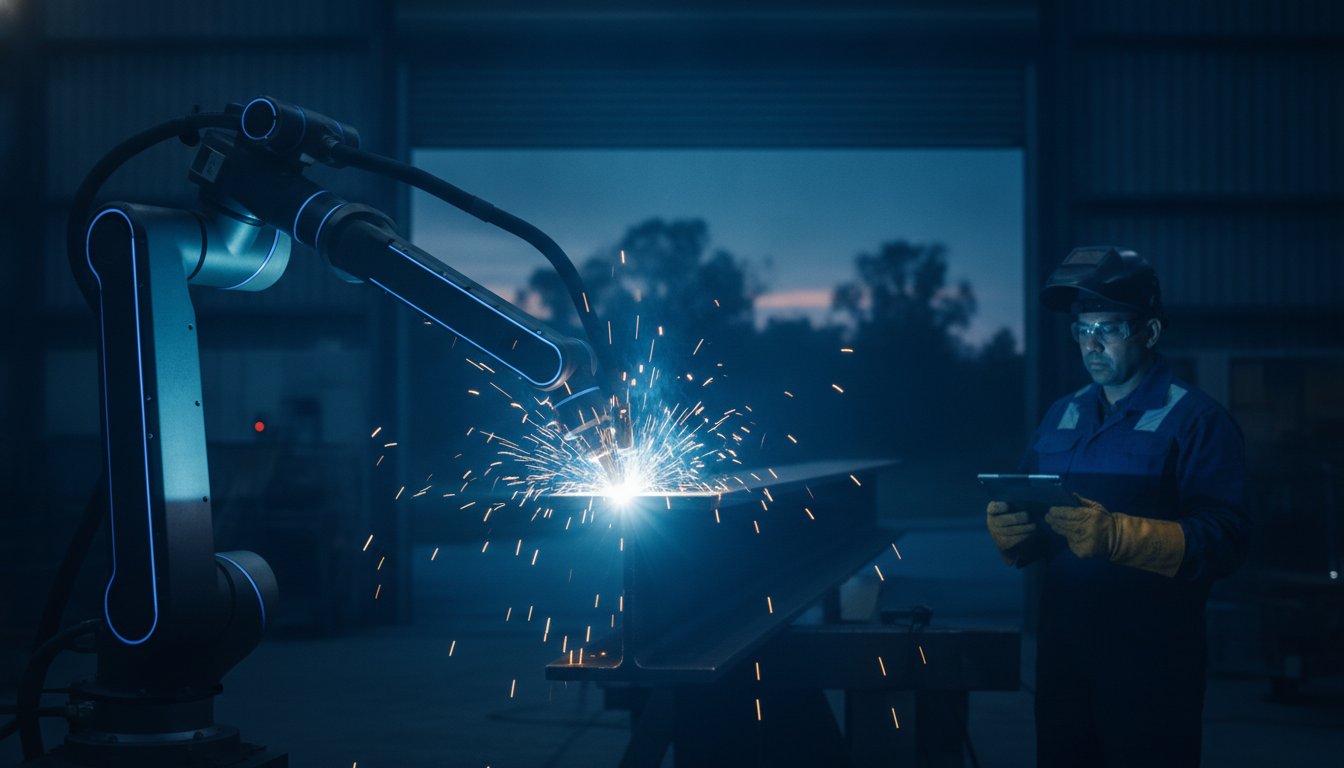
When most people think of automation, they imagine small parts moving quickly on a conveyor belt. However, cobot welding for structural steel is designed for the scale and grit of an Australian fabrication yard. It's built to handle the 12-metre beams and heavy columns that form the backbone of our local infrastructure. The real strength of these systems lies in their ability to perform high-deposition MIG welding with the same precision on the last hour of a shift as the first. This isn't just about laying wire; it's about maintaining deep penetration on 20mm plate while managing the intense heat signatures of structural work.
Traditional industrial robots often failed in structural shops because they were too rigid. If you had a batch of only five beams, the time spent writing code for the robot was longer than the time spent welding them by hand. No-code teaching has changed that equation entirely. It allows a tradesperson to physically guide the robot arm to the weld path, setting start and stop points in seconds. This flexibility is essential for Future-Proofing Your Fabrication against the unpredictable nature of structural batches. If you want to see this technology in action, you can enquire about a mobile demo to see how it handles your specific sections.
No-Code Teaching for Beams and Columns
Operators 'teach' a path by simply moving the cobot arm to the joint. There's no need to type lines of code or understand complex coordinate systems. If the fit-up isn't perfect, the operator can adjust parameters for different plate thicknesses on the fly using a simple tablet interface. This makes automation accessible even for the most unique structural jobs. For a deeper look at this process, read our guide on No-code robot welding software.
MIG Welding Performance on Heavy Structural Sections
Managing heat input is critical when dealing with thick base plates to avoid distortion or brittle zones. A collaborative cell integrates with advanced power sources to deliver consistent weave patterns that meet strict code requirements. These systems ensure that every fillet weld is uniform, which is vital for passing ultrasonic or magnetic particle testing. By automating the long, fatiguing seams on columns, you maintain a level of weld quality that is difficult to achieve manually over a long day.
The Structural Steel Automation Checklist: Is Your Workshop Ready?
Before you commit to a new system, it's vital to assess whether your current operations are actually ready for automation. Not every joint in a structural shop is a candidate for a robot; the goal is to find the sweet spot where the machine handles the volume while your team focuses on the complex fit-outs. Transitioning to cobot welding for structural steel requires a pragmatic look at your workflow, your floor space, and your people. It's about ensuring the technology fits your workshop, rather than forcing your workshop to fit the technology.
One of the first things to consider is your material consistency. While no-code systems are flexible, the robot relies on repeatable paths. If your plate prep or saw cuts vary by several millimetres every time, you'll spend too much time adjusting the path. High-quality jigging and workholding are essential to ensure that the parts stay exactly where the cobot expects them to be. Understanding how cobots are changing metal fabrication helps in seeing that the most successful shops are those that treat the robot as a precision tool within a well-organised production line.
Step 1: Joint Analysis for Structural Batches
Start by identifying the 'low-hanging fruit' in your production schedule. For most structural fabricators, these are base plates, stiffeners, and cleats. These components often involve high-volume, repetitive fillet welds that consume significant labour hours. When you quantify your potential arc-time increases, you'll often find that even small batches of 10 to 20 identical beams can justify the setup time. If a joint is highly irregular or requires constant human intuition to bridge massive gaps, it's usually better to stick to manual welding for that specific task.
Step 2: Workshop Infrastructure and Safety
You need to ensure your infrastructure can support an industrial MIG unit. This usually means verifying you have stable 3-phase power and a dedicated area that won't interfere with overhead crane movements. Safety is another priority; while these robots are collaborative, the welding arc itself is not. You'll need to plan for safety screens or scanners to protect other workers from flash. For a deeper look at preparing your space, check our guide on future proofing welding workshops. Finally, identify a 'champion' in your team. This is the person who will lead the transition, take ownership of the training, and ensure the cell remains productive every shift.
Maintaining AS/NZS 1554.1 Standards While Reducing Rework
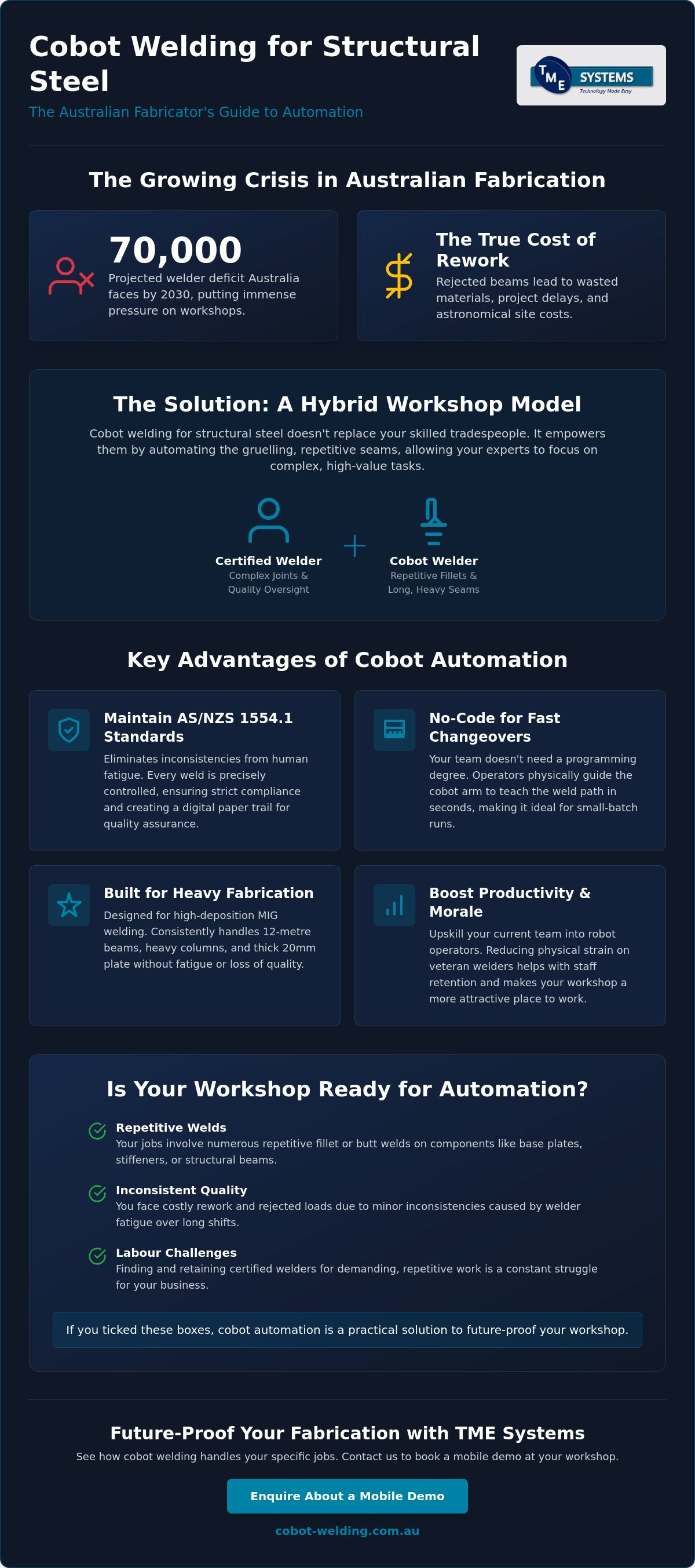
Compliance with AS/NZS 1554.1 is the cornerstone of structural steel fabrication in Australia. It's the standard that ensures every joint in a skyscraper or warehouse is fit for purpose. While your best welders can produce code-compliant work, the human factor remains the biggest variable in quality control. Fatigue, poor visibility, or even a slight tremor at the end of a long shift can lead to inconsistencies. By integrating cobot welding for structural steel, you're effectively locking in your Weld Procedure Specification (WPS). The machine doesn't get tired, and it doesn't 'wing it' when a joint gets awkward.
One of the most significant advantages of automation is the digital paper trail it creates. Modern collaborative cells can log every weld, recording parameters such as voltage, amperage, and travel speed. This data is invaluable for verification, and using a platform like SOCWeld to automate and manage welding documentation provides a level of traceability that manual welding simply can't match. When an inspector asks for proof of compliance, you have the logs to show that every millimetre of that beam was welded exactly to the qualified procedure. This 'first-time-right' approach is what separates profitable shops from those bogged down by the costs of rectification.
Consistency as a Compliance Tool
Cobots excel at the fundamentals that humans find difficult to sustain over long periods. They maintain a perfect torch angle and a steady travel speed, even on long, repetitive seams that would otherwise cause a welder to reposition multiple times. This stability drastically reduces common defects like porosity or lack of fusion, which are often caused by inconsistent arc lengths or travel speeds. Cobots ensure AS/NZS 1554.1 compliance by maintaining precise, repeatable control over welding parameters like travel speed and heat input, effectively removing the variability that leads to non-conforming joints.
The Strategy to Reduce Welding Rework with Automation
Reducing rework starts before the arc even strikes. With no-code software, operators can perform 'dry runs' to verify the torch path. This allows you to check for potential collisions or torch angle issues on a complex column without wasting a single gram of wire or gas. If the path looks good, you can strike the arc with confidence. Real-time monitoring also catches errors early; if the system detects a deviation in wire feed or power, it can stop immediately, preventing a whole beam from being welded incorrectly. This level of precision simplifies the non-destructive testing (NDT) process, as the likelihood of finding a defect is significantly lower. To see how this precision fits into your workflow, you can enquire about our welding system integration services to discuss your specific compliance needs.
Future-Proofing Your Fabrication with TME Systems
Integrating cobot welding for structural steel shouldn't feel like a gamble for your business. At TME Systems, we take a pragmatic approach that respects the traditional skills of your workforce while addressing the modern pressures of the Australian market. We don't just drop a machine on your floor and leave you to figure it out. Instead, we act as a practical mentor, ensuring that the technology adapts to your specific workshop layout and production flow. Our goal is to make innovation feel attainable by providing a reliable partner who understands the day-to-day realities of heavy fabrication.
Our turnkey collaborative cells are built for the grit and scale of structural work. We focus on delivering results that matter to your bottom line, such as reducing rework and maintaining high arc-on time. By combining advanced hardware with our no-code teaching software, we ensure that your team can take ownership of the automation process from the very first day. This supportive transition is designed to build confidence, proving that these tools are here to empower your tradespeople rather than replace them.
Beyond the Hardware: Integration and Support
Successful automation requires more than just a robot arm. We specialise in welding system integration, which means we customise the cell to fit your specific structural steel workflow. Whether you're dealing with massive I-beams or repetitive base plate batches, we help you refine your setup to maximise efficiency. Onboarding your staff is a core part of our service; we provide operator training that focuses on practical, hands-on skills. Because we provide local technical support, you can rest assured that any questions or adjustments are handled quickly, minimising downtime and keeping your projects moving.
Book a Mobile Demonstration
We know that in a workshop, seeing is believing. That's why we offer a mobile demo system that brings the technology directly to your site. This allows you to validate the ease of use with your own welders and see the cobot weld your own structural sections. It's a risk-free way to confirm that the system can handle your specific plate thicknesses and joint configurations. You'll see exactly how the no-code interface works and how it can be adjusted on the fly to suit your production needs.
Book your mobile welding robot demonstration today and see how collaborative automation can support your team.
Ready to Strengthen Your Workshop Floor?
The shift toward automation in Australian fabrication isn't just about keeping up with technology; it's about protecting your margins and your people. You've seen how cobot welding for structural steel can take over the heavy, repetitive work that leads to burnout and costly rework. By focusing on consistency and precision, you ensure that every beam meets AS/NZS 1554.1 standards without the need for constant human intervention. It's a pragmatic solution to the growing labour shortage that keeps your production schedule on track.
As Australian-owned and operated integration specialists, we understand the local industry's unique pressures. Our no-code software is built for your tradespeople, not programmers, so your team can lead the transition themselves. We bring deep experience in compliance requirements to every integration, ensuring your workshop remains both productive and code-compliant. If you're ready to see how these tools fit into your specific workflow, we're here to support you.
Request a Practical Assessment for Your Structural Steel Shop
It's time to make innovation a functional, reliable part of your daily production. We're invested in your long-term success and look forward to helping you build a more resilient workshop.
Frequently Asked Questions
Can cobots handle the heavy MIG welding required for AS/NZS 1554.1 structural work?
Yes, cobot systems are specifically designed to integrate with high-output industrial power sources capable of heavy MIG welding. These cells maintain the precise heat input and penetration required for AS/NZS 1554.1 structural work. By automating the travel speed and torch angle, the system delivers consistent, high-quality fillets on thick plate sections that pass stringent inspections. This reliability ensures that your most critical structural connections meet Australian standards every time.
How long does it take to program a new structural beam joint using no-code software?
Most new joints can be taught in under five minutes using no-code software. Instead of typing lines of code, an operator simply moves the robot arm to the start and end points of the weld. This speed makes cobot welding for structural steel highly effective even for small batches or one-off beams. It significantly reduces the downtime typically associated with traditional robotic programming, allowing your shop to stay productive.
Do I need to hire a programmer to run a cobot welding cell in my workshop?
No, you don't need to hire a specialised programmer to run these systems. The software is designed so that your existing qualified welders can operate the cell after a few hours of training. This approach empowers your current team to manage the automation themselves. It turns your tradespeople into operators who can refine and adjust weld paths without needing any background in computer science or complex coding.
What happens if the material fit-up is inconsistent on a structural assembly?
If fit-up varies, operators can quickly adjust the weld parameters or path via the tablet interface. While automation thrives on consistency, no-code systems allow for rapid tweaks to account for minor gaps or plate variations. For more significant inconsistencies, your skilled welders remain the best judge of how to adapt the settings. This ensures the joint still meets structural integrity standards without needing to start the programming from scratch.
Is a cobot safe to use in a busy structural steel fabrication centre?
Yes, cobots are built with force-sensing technology that stops the arm if it contacts a person. However, a full risk assessment is a legal requirement in Australia under WHS laws to address the risks of the welding arc itself. You'll typically use safety screens, light curtains, or safety scanners to protect staff from flash and heat. This ensures the cell operates safely within your existing workshop flow and busy production environment.
How much floor space does a typical structural welding cobot cell require?
A standard collaborative welding cell has a compact footprint, often requiring as little as 4 to 6 square metres of floor space. Because they don't always require the massive safety fencing of traditional industrial robots, they fit easily into existing production lines. This small footprint allows you to position the cell near your fit-up tables. It keeps the workflow efficient without needing a major workshop restructure or losing valuable floor area.
Can a cobot weld in positions other than flat (1G/1F) for structural work?
Yes, the 6-axis flexibility of the cobot arm allows it to weld in various positions, including horizontal and vertical seams. While flat and horizontal-vertical positions are most common for high-deposition structural work, the system can be taught to handle more complex orientations. This versatility is vital for welding stiffeners, cleats, and gussets onto large columns. It allows you to complete complex assemblies that can't be easily repositioned during the fabrication process.
What is the typical ROI period for a structural steel shop adopting cobots in 2026?
Many Australian fabrication shops report a full return on investment for a cobot welder within 12 to 18 months. This ROI is driven by the significant reduction in rework costs and a marked increase in daily arc-on time. By handling the repetitive seams, the cobot allows your workshop to take on more projects without increasing your headcount. It makes your business more resilient against rising labour costs and the ongoing welder shortage.