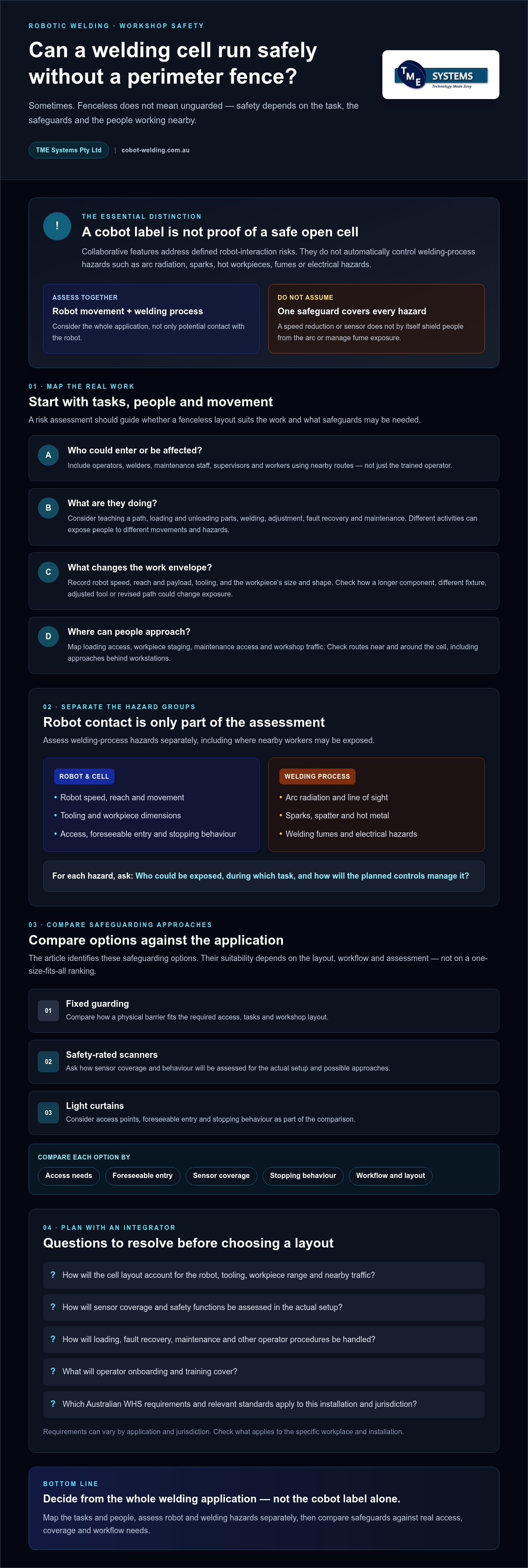

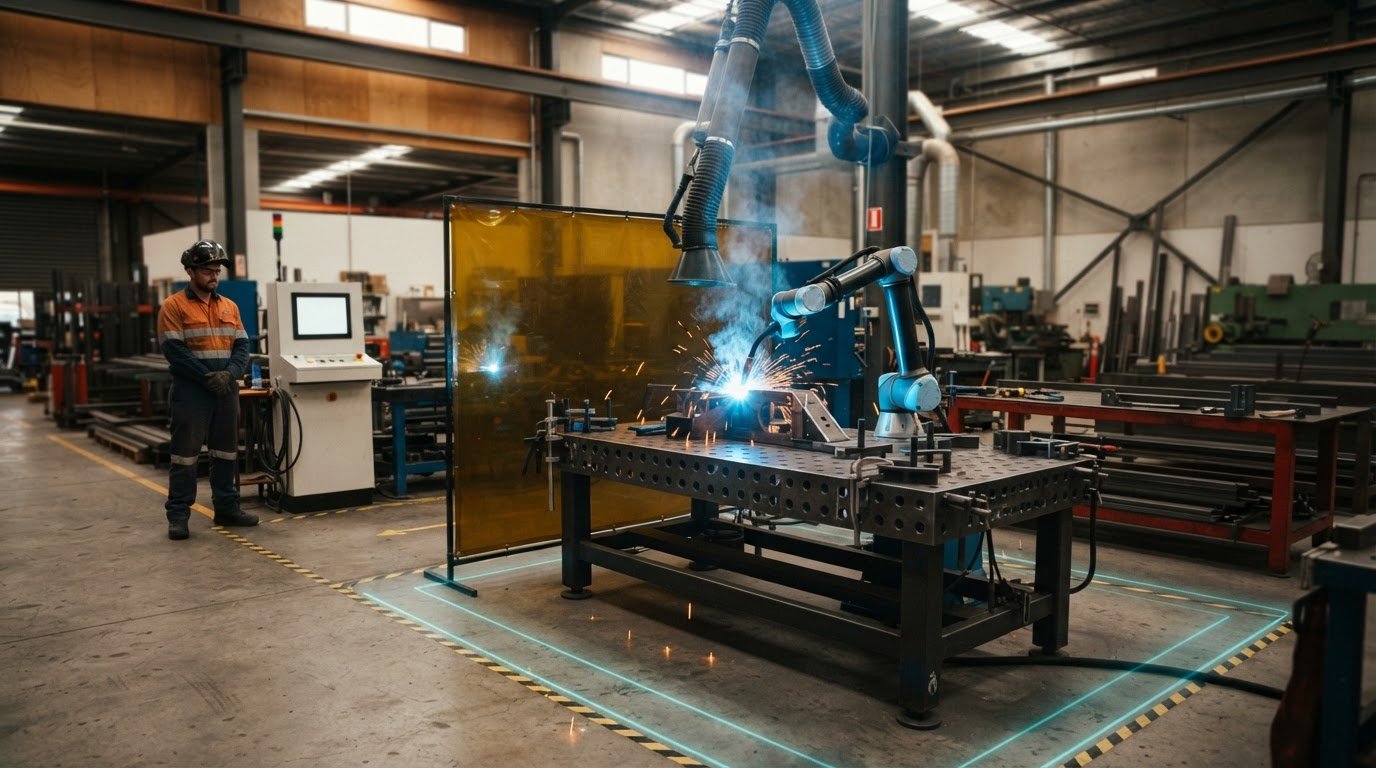
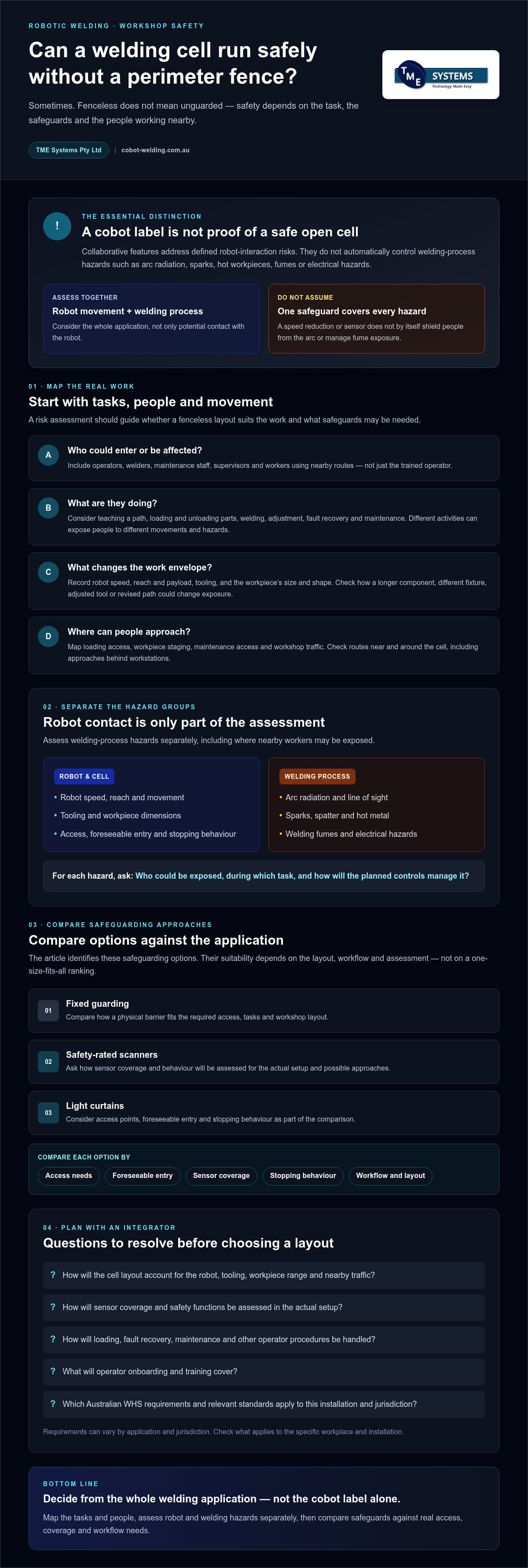
Can a robotic welding cell run safely without a perimeter fence in your workshop? It may be possible, but a collaborative robot label alone doesn’t make an open cell safe. Fenceless robotic welding safety depends on the specific task, equipment, safeguards and people working nearby.
It’s reasonable to want easier access for loading parts and setting up jobs while protecting operators and other workers. The key is to assess the whole welding application, not just the robot’s potential contact with a person. Arc radiation, sparks, hot workpieces and welding fumes need their own controls.
This guide explains what fenceless operation does and doesn’t mean, and how to compare safeguarding options against your workshop layout and workflow. It also outlines practical questions to raise with a competent integrator, including how sensor coverage, safety functions, operator procedures and training will be assessed. Australian WHS requirements and relevant standards can vary by application and jurisdiction, so they need to be checked for your installation. The aim is to help you decide whether an open cell suits your work or another safeguarding approach is more appropriate.
Key Takeaways
- Fenceless robotic welding safety depends on the specific application and safeguards, not simply on whether a robot is labelled collaborative.
- Map the welding task, workpiece range, operator access and workshop traffic before selecting a robot or safeguard.
- Compare fixed guarding, safety-rated scanners and light curtains by considering access, foreseeable entry and stopping behaviour.
- Assess welding hazards such as arc radiation, sparks and fumes separately from robot contact risks.
- Discuss the cell layout, safeguards and workflow together with an integrator, and clarify what operator onboarding will cover.
Fenceless robotic welding safety: what it means and what it does not
Can workers access a welding cell without a fixed perimeter fence? Sometimes, but “fenceless” doesn’t mean unguarded. It describes an application designed without a conventional fixed perimeter fence, where other safeguards are selected to manage the risks of the task and workshop.
Fenceless robotic welding safety means controlling robot movement and welding-process hazards with safeguards suited to the application, not relying on the cobot label as proof of safety. Robot contact protection and welding-process protection are separate considerations. A system may limit certain robot interaction risks, but that doesn’t control arc radiation, fumes or hot workpieces.
What makes a welding cell fenceless?
Removing a fixed fence changes how people can approach the cell. It doesn’t remove the need to prevent or manage hazardous access. The robot’s reach and movement, welding equipment and tooling, and the workpiece’s size and shape all affect where people could be exposed. A long or irregular part, for example, may extend beyond the area assumed in an initial layout.
Consider access for loading, unloading, adjustment and maintenance, along with routes used by workers passing nearby. Assess everyone who could enter or be affected, not just the trained operator. The general overview of Workplace robotics safety describes robot-related hazards and controls, including physical barriers, but a welding cell needs an application-specific assessment.
Why welding hazards remain, even with a cobot
Collaborative features address defined risks from interaction with the robot. They don’t automatically make every welding task suitable for shared space. A person could still be exposed to arc radiation, spatter, hot metal, welding fumes or electrical hazards. Each requires controls suited to the process and the way work is carried out.
For instance, reducing robot speed or using a sensor may affect robot-related risks, but it doesn’t by itself shield nearby workers from the welding arc or manage fume exposure. Nor should you assume a safeguard protects every approach to the cell without checking its coverage and behaviour in the actual setup.
So the first question isn’t simply “Is this a cobot?” It’s “What could harm someone during each task, and how will the planned safeguards control it?” Assess the robot and welding process together, then verify the applicable Australian WHS requirements and relevant standards for the installation and jurisdiction.
How to assess fenceless robotic welding hazards in a real workshop
Start with the work, not the equipment brochure. A risk assessment should guide whether a fenceless layout is suitable, which safeguards may be needed and how people can work around the cell. Choosing a cobot or sensor first can leave gaps, particularly when the workshop handles different parts or changes tasks during a shift.
For an Australian installation, confirm the applicable WHS requirements and relevant standards for your workplace, system and state or territory. The OSHA robotics standards page is a useful overview of robot safety standards, but it is a United States resource, not a substitute for checking Australian requirements.
Map people, tasks and robot movement
List everyone who may enter or pass the work area: operators, welders, maintenance staff, supervisors and workers using nearby routes. Consider each activity separately. Teaching a path, loading a part, welding, clearing a fault and carrying out maintenance can expose people to different movements and hazards.
Record the robot’s speed, reach and payload, along with the torch, other tooling and the workpiece’s size and shape. Identify changes that could affect exposure, such as a longer component, different fixture, adjusted tool or revised robot path. A safeguard that suits one job may not cover another job’s access points or work envelope.
Assess process hazards beyond robot contact
Robot collaboration does not control every welding hazard. Assess arc radiation and line of sight separately from robot contact, and consider the fume extraction, hot-surface controls and spatter protection the process needs. Check whether nearby workstations or walkways could expose people who aren’t operating the cell.
Look at the full working arrangement, not just the robot’s immediate footprint. Where will parts be staged? Can someone approach from behind a workstation or enter during fault recovery? Could a screen, fixture or large workpiece affect visibility or access? These details help test whether a proposed safeguard covers foreseeable ways people may interact with the cell.
Record the task, people at risk, hazards, proposed safeguards and how those safeguards will be checked in the actual setup. Confirm safety functions and sensor coverage for the exact model and system configuration. If you’re reviewing a proposed layout, discussing the task and safeguards together through collaborative robot welding integration can help clarify what needs assessment before a system is selected.
Fenceless safeguards compared with perimeter guarding
No single safeguarding arrangement suits every welding cell. Consider a fixed fence, safety-rated scanner, light curtain or combination of measures against the actual hazards, access patterns and workflow. The aim of fenceless robotic welding safety isn’t to avoid guarding at all costs. It’s to choose and validate safeguards that manage the risks in the particular installation.
When a fixed fence may remain appropriate
A fixed perimeter fence can provide a clear physical boundary and restrict access to the robot’s operating area. It may be worth considering where people could be exposed frequently, robot movement presents higher risks, or reliable separation is difficult to achieve with other measures. Access gates and any associated safety functions still need to suit the task.
A fence doesn’t control welding hazards by itself. Arc radiation, fumes, hot metal and spatter still need suitable controls, including consideration of nearby work areas. Whether a guarded layout is appropriate depends on the complete cell assessment, not on the fence alone.
When sensor-based access control may be considered
Safety-rated scanners or light curtains may be considered where people need access to defined areas during production. A scanner can monitor a configured area, while a light curtain can detect entry across a protected opening. Their suitability depends on the task, equipment and integration of the safety functions.
Detection is useful only if the safeguard responds as intended. A competent assessment should check coverage, potential blind spots, stopping behaviour and restart conditions in the installed system. Confirm the functions and coverage for the exact model and configuration. Don’t assume a device is suitable just because it’s described as safety-rated.
Compare the options using the same practical questions:
- Access: How often must people load parts, teach paths, clear faults or maintain the cell?
- Foreseeable entry: Could someone approach from the side, reach over or around a safeguard, or enter with a large workpiece?
- Stopping behaviour: What happens when a person enters a protected area, and how does the system prevent an unexpected restart?
- Process hazards: What additional measures are needed for arc exposure, fumes, heat and spatter, regardless of the robot safeguard?
A combination of measures may suit some layouts, but it must work as a coordinated system and address the assessed risks. An open arrangement isn’t inherently safer, cheaper or more productive than perimeter guarding. Compare complete, validated designs against your actual jobs and workshop.
A practical checklist for planning fenceless robotic welding
A sound plan starts with the job, identifies suitable safeguards, then checks that the complete system works as intended. Use this sequence to organise discussions with your team and supplier. For background on cell types and workflows, see this guide to collaborative robot welding cells.
- Define the work. List the welding processes, workpiece range, materials, fixtures and expected job changes. Include unusual or oversized parts if they’re part of foreseeable production.
- Map people and tasks. Record who teaches the robot, loads parts, welds, clears faults and carries out maintenance. Include nearby workers and workshop traffic, not only the cell operator.
- Assess the hazards. Consider robot speed, reach, payload and tooling alongside arc exposure, fumes, heat, spatter and electrical risks. Note where people could access the cell during normal work and foreseeable interruptions.
- Choose safeguards from the assessment. Ask the supplier to explain which hazards each proposed measure addresses, which remain outside its scope, and why the design suits the task and layout.
- Verify and document. Request system-level information on safety functions, sensor coverage, operating limits and the intended configuration. Confirm applicable Australian WHS requirements and standards for the workplace and jurisdiction.
- Test and prepare the team. Before production use, check the integrated system against the assessment, including stops, restart behaviour and fault recovery. Set out safe operating, changeover and maintenance procedures, then ensure workers are trained to follow them.
Questions to ask before selecting a system
Ask what happens if a person approaches during welding, enters a protected area or needs to recover from a fault. How are access, stopping and restart managed? What checks are required before maintenance? Request evidence that applies to the exact equipment configuration and planned operating conditions, rather than relying on general product information. Confirm who will document and validate the integrated safeguards.
Commissioning, procedures and operator readiness
Commissioning should confirm that safeguards perform as intended in the installed cell and match the risk assessment. Procedures need to reflect real workshop tasks, including teaching, loading, changeovers and fault recovery. Operator onboarding can help workers understand safe interaction with the system and the limits of its safeguards. For a related operator-readiness resource, read this guide to on-site cobot welder training.
Planning fenceless robotic welding safety is a joint exercise in task definition, integration and validation. To discuss how the welding task, cell layout and safeguards fit together, explore welding-system integration.
Choosing an integration partner for fenceless robotic welding safety
Fenceless robotic welding safety depends on how the complete application is designed, not on one robot feature or sensor. An integrator should consider the welding equipment, cell layout, safeguards and operator workflow together. This can reveal practical issues early, such as whether a fixture blocks a sensor’s view or a part change alters access to the robot’s work area.
TME Systems supplies and integrates collaborative robot welding cells for Australian manufacturers, with operator training and onboarding, no-code teaching software and a mobile demo system. These offerings can support planning and operator readiness, but they don’t establish that a particular cell is safe. Suitability still depends on a task-specific assessment and verification of the configured system.
What a useful integration discussion should cover
Bring representative parts, weld requirements and production constraints to the discussion. Include the range of workpiece sizes and shapes, operator tasks, changeovers and nearby workshop traffic. Ask how the proposed workflow and safeguarding assumptions will be recorded, checked against the actual layout and reviewed if your jobs change.
For broader planning context, see this guide to welding system integration guidance. A mobile demonstration can help your team examine a proposed workflow and discuss how it may fit your work. Treat it as a way to explore the application, not as a substitute for a risk assessment or system validation.
From assessment to supported operation
Before production begins, confirm who will verify the integrated safeguards and document the operating limits, procedures and commissioning checks. Operator onboarding should prepare people for safe interaction with the system, including teaching, loading, changeovers and fault recovery. Procedures also need to address maintenance and clarify when the cell must be stopped or access restricted.
Review the assessment and procedures when the process, tooling, workpieces or layout changes. A system assessed for one workflow may need reassessment if those conditions shift. Training can support consistent practice, but it doesn’t replace safeguards or documented procedures.
If you’ve reviewed the assessment criteria and can describe your parts, weld tasks and workshop constraints, discuss a robotic welding application. The aim is to explore what may suit your operation, without assuming that a fenceless setup is the right outcome.
Make your next welding automation decision with confidence
Fenceless robotic welding safety starts with the application, not the cobot label. Assess robot movement and access alongside welding hazards such as arc radiation, fumes, heat and spatter. Then compare safeguarding options against the actual tasks, workshop layout and people who may be nearby.
A considered setup also depends on checking the applicable Australian WHS requirements and standards, and verifying the safety functions for the specific system. Training and clear operating procedures help workers interact safely with the cell as production gets underway. Changes to parts, tooling or layout may call for a review.
TME Systems supplies and integrates collaborative robotic welding solutions for Australian manufacturers, with operator training and onboarding to support safe interaction with cobot systems. These are practical parts of implementation, not a substitute for an application-specific assessment. Have your task and workshop requirements ready, then talk through your robotic welding application with TME Systems. A clear assessment is a practical first step towards finding an approach that suits your team and production needs.
Frequently Asked Questions
Is fenceless robotic welding safe?
It can be, if safeguards are designed and checked for the specific welding task and workshop. Fenceless robotic welding safety isn’t guaranteed by an open layout or a cobot label. Assess robot movement and access alongside arc radiation, fumes, spatter, hot workpieces and electrical hazards. Then confirm that the proposed safeguards address foreseeable risks for operators and nearby workers under the intended operating conditions.
Can a collaborative welding robot operate without a safety fence?
Yes, a collaborative welding robot may operate without a fixed perimeter fence if the complete application has suitable, validated safeguards. The assessment needs to account for the robot’s speed, reach, tooling and workpiece, as well as how operators access the cell. Depending on the risks and workflow, the design may still require other protective measures. A collaborative robot isn’t automatically safe for every shared-space task.
What safeguards can be used instead of a fence around a welding robot?
Depending on the assessment, options may include safety-rated scanners, light curtains, fixed guarding in selected areas or a combination of measures. Each needs to suit the access points, foreseeable entry and required stopping behaviour. These controls address robot-related risks, not every welding hazard. Arc radiation, fumes, heat and spatter need separate consideration. Don’t choose a device until its functions and coverage are checked for the installed system.
Does a welding cobot eliminate the need for a risk assessment?
No. A welding cobot doesn’t remove the need to assess the whole application. Consider each task, including teaching, loading, welding, fault recovery and maintenance, and identify who could be exposed. Assess process hazards as well as robot movement. For an Australian workplace, confirm the applicable WHS requirements and relevant standards for the specific system and jurisdiction. Revisit the assessment if the workpiece range, tooling, process or layout changes.
How do you protect workers from welding arc radiation in a fenceless cell?
Assess line of sight from the cell to operators and nearby workers, then select suitable arc-protection measures for the welding process and layout. This may involve appropriately positioned welding screens or barriers, but their suitability must be checked for the actual application. Consider access routes and other workstations too. Robot speed controls and sensors don’t protect people from arc radiation, so manage this exposure separately from robot-contact risks.
Are safety laser scanners suitable for robotic welding cells?
They may be suitable for some applications, but only if the scanner and its integration meet the system’s assessed requirements. Check the detection field, possible blind spots, stopping distance and restart behaviour in the actual cell layout. Workpieces, fixtures and workshop traffic can affect how people approach the protected area. A scanner doesn’t control arc radiation, fumes, hot metal or spatter, so assess those process hazards separately.
What should an Australian fabricator check before installing a fenceless welding cell?
Define the welding process, workpiece range, operator tasks, nearby traffic and likely job changes. Complete an application-specific risk assessment before choosing the robot, sensors or layout. Ask for evidence covering the exact equipment configuration, safety functions, sensor coverage, operating limits and commissioning tests. Confirm applicable WHS requirements and standards for your workplace and jurisdiction. Also plan documented operating and fault-recovery procedures, maintenance arrangements and operator training before production starts.