
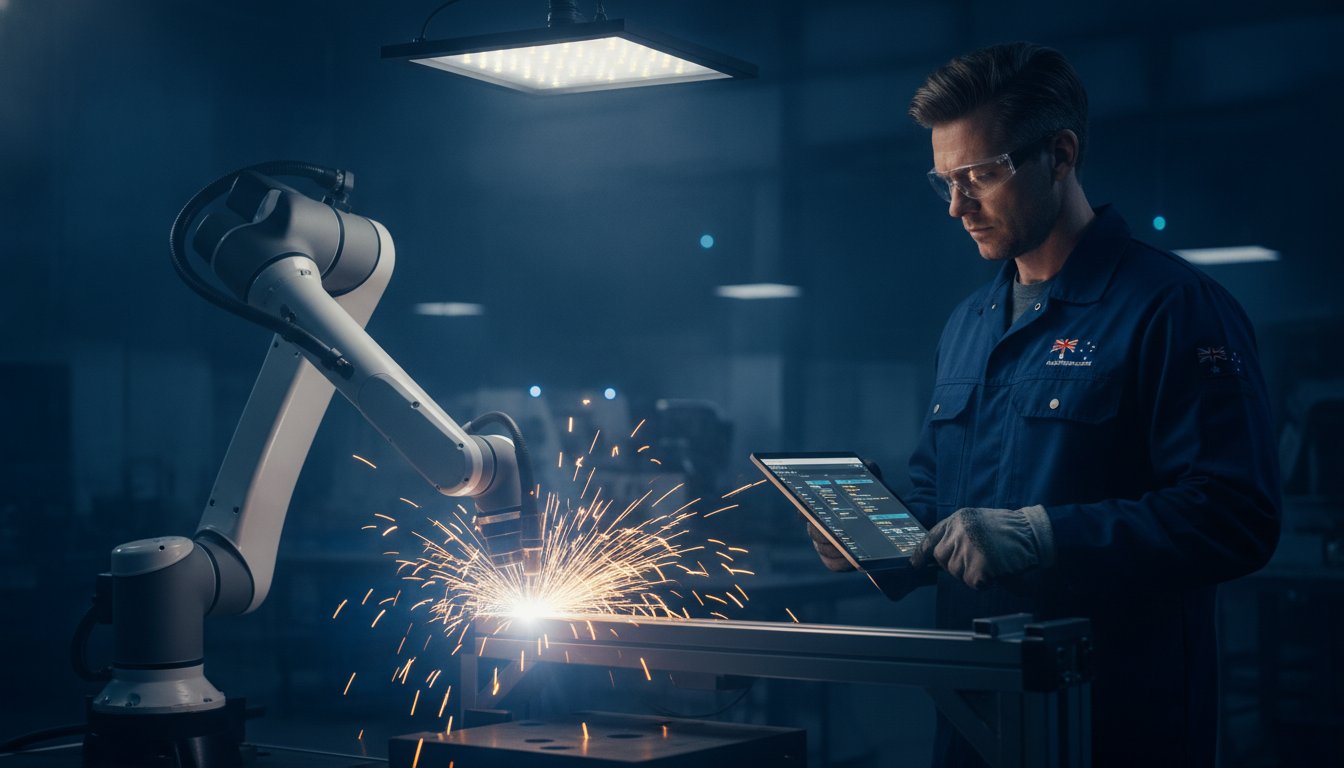
What if your most experienced welder could focus on the complex, high-value jobs while a machine handled the repetitive runs that usually slow your workshop down? You've likely felt the sting of trying to find and keep skilled blokes, only to watch your rework rates climb on those tedious, high-volume tasks. It’s a common frustration across Australian manufacturing, but the latest collaborative robot welding cells are changing the game. These systems aren't designed to replace your team; they're built to empower them by taking over the repetitive work with unmatched precision.
We agree that automation often feels like a massive leap, especially if you're worried it's too complex for your current crew to operate. This guide will show you how to select the right collaborative welding cell to boost your productivity without needing any complex programming skills. You'll learn how to achieve consistent weld quality and higher throughput for small batches while using gear that integrates with your existing setup. We’ll walk through the essential 2026 safety standards, the benefits of no-code teaching software, and how to get a system running that actually delivers a real return on your investment.
Key Takeaways
- Understand how collaborative robot welding cells integrate into your workshop floor to work safely alongside your team without restrictive safety cages.
- Learn to assess your specific production needs to choose between MIG and TIG capabilities for your high-mix, low-volume jobs.
- Compare the flexibility and lower entry costs of cobot systems against traditional automation to find the best fit for your workshop’s budget.
- Avoid common implementation traps like poor part preparation and the "set and forget" fallacy by prioritising operator training.
- Discover a clear roadmap for your first deployment, starting with simple parts and turnkey units to ensure your team builds confidence quickly.
What are Collaborative Robot Welding Cells?
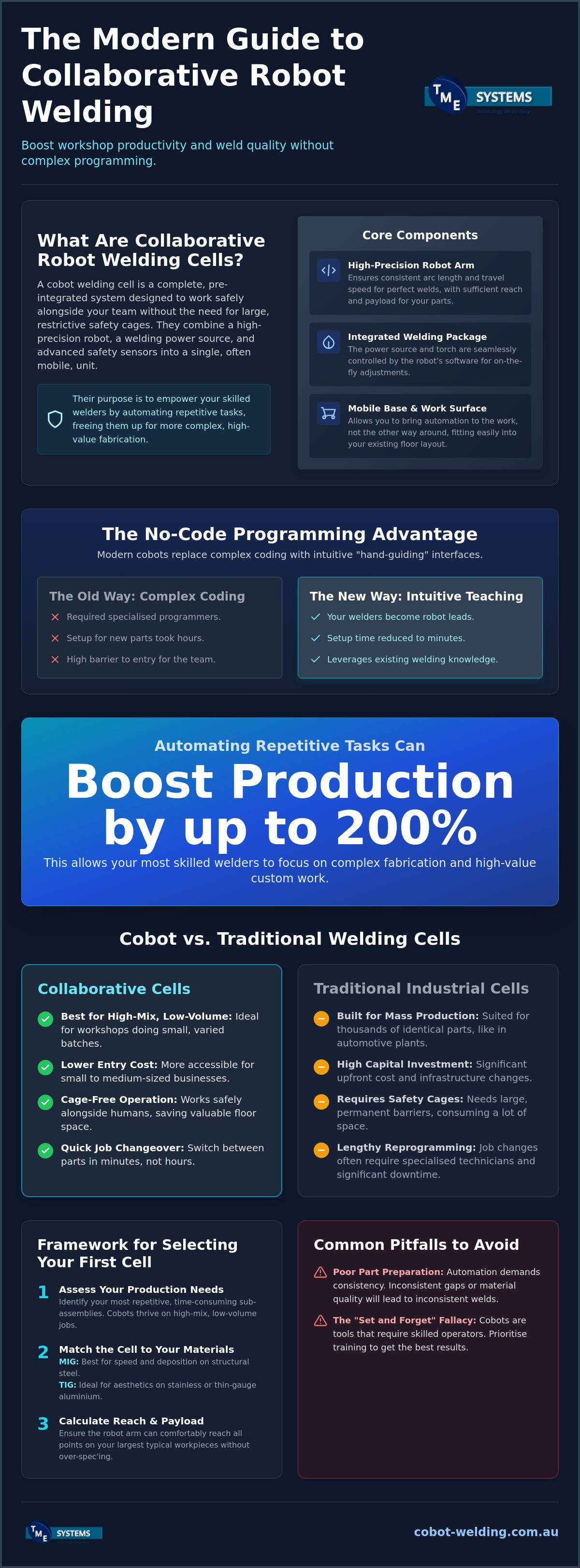
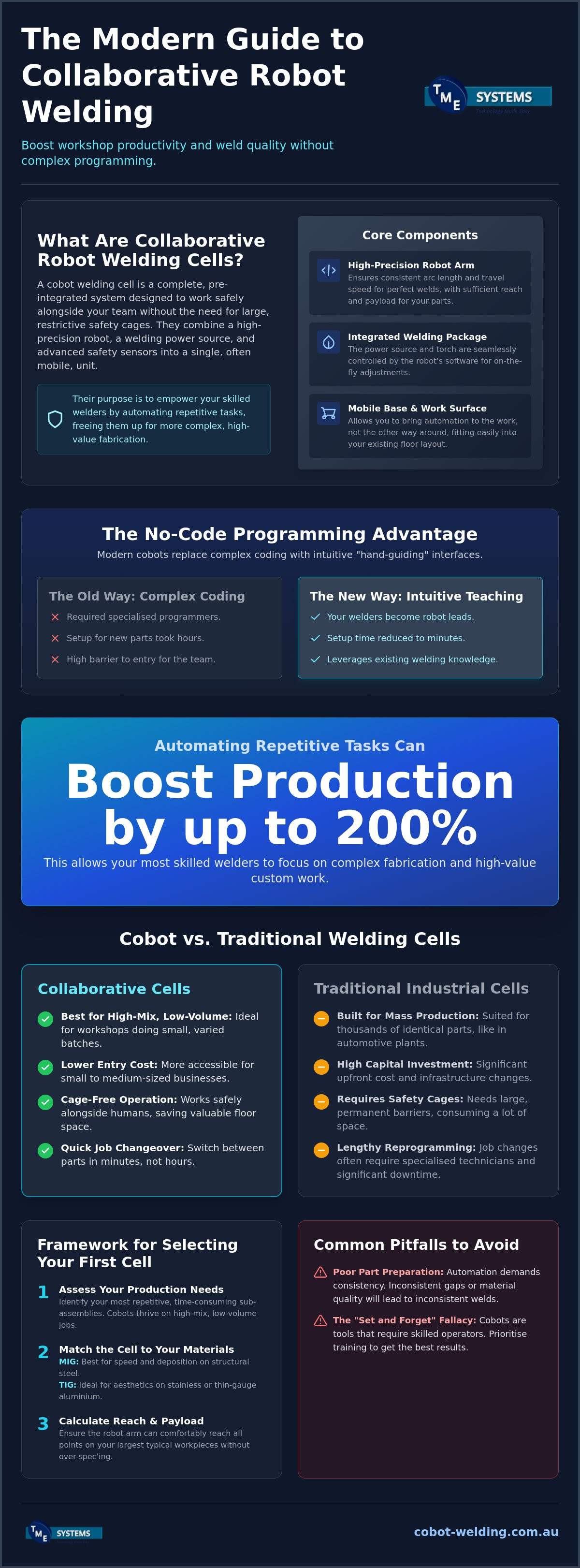
A collaborative robot welding cell is a turnkey unit that combines a high-precision robot arm, a dedicated welding power source, and integrated safety sensors. Unlike the traditional industrial setups found in massive automotive plants, these systems don't require heavy metallic barriers or restrictive safety cages. They are designed to work safely in the same space as your team. The technology behind these units, known as collaborative robots (cobots), has matured significantly by 2026. This allows them to detect even slight contact and stop instantly, ensuring the safety of everyone on the workshop floor.
By 2026, the persistent shortage of skilled trades across Australia has made these systems a practical necessity for many fabrication businesses. Finding a qualified welder who wants to spend eight hours a day on repetitive, identical fillets is getting harder every year. These cells step in to handle that monotonous work. A cobot cell is a flexible fabrication partner for the modern workshop that empowers your existing staff rather than replacing them.
The Core Components of a Modern Welding Cell
The foundation of any cell is the robot arm. For welding, you need an arm with enough reach to cover your largest parts and a payload capacity that can handle the torch and lead. Precision is the non-negotiable factor here. Whether you're running MIG or TIG, the arm must maintain a consistent arc length and travel speed to ensure deep penetration and clean beads.
The welding package itself integrates the power source and torch directly into the robot's control system. This allows for seamless arc control, where the robot can adjust parameters on the fly. Finally, the base and work surface define how the cell fits into your shop. Many Australian workshops prefer mobile stations that can be moved with a pallet jack, allowing you to wheel the automation to the work rather than reconfiguring your entire floor layout.
No-Code Software: The Real Game Changer
In the past, automation was often held back by the need for complex programming. Modern collaborative robot welding cells have ditched the code in favour of intuitive "teaching" interfaces. Instead of typing commands, your welder simply leads the robot arm by hand to the start and end points of a weld. They press a button to record the position, and the no-code software generates the path automatically.
This approach reduces setup time from hours to just a few minutes for new parts. It changes the dynamic of your workshop by turning your current fabricators into "robot leads." They don't need an IT degree to get the best out of the machine. They just need their existing knowledge of heat input, travel angles, and weld pools to guide the system to a perfect result.
Selecting the Right Cell: A Buyer’s Framework
Choosing the right setup isn't just about picking the flashiest robot arm on the market. It's about understanding your specific workload and how it flows through your shop. Most Australian workshops aren't churning out 10,000 identical brackets; they're doing fifty of this and twenty of that. This high-mix, low-volume reality is exactly where collaborative robot welding cells provide the most value, provided you pick a system that's easy to pivot between jobs. If the software is too clunky, the cell will end up sitting in a corner gathering dust.
You also need to match the cell to your primary materials. If your bread and butter is structural steel or heavy plate, a MIG-focused cell is your best bet for speed and deposition. However, if you're working with stainless steel or thin-gauge aluminium where aesthetics are king, a TIG-capable system is the way to go. To find your sweet spot for return on investment, look at your current manual throughput. If your most skilled welders are bogged down by repetitive sub-assemblies, that's your bottleneck. Industry data shows that shops can boost production by up to 200% on welding tasks by automating these specific areas, allowing your team to focus on the complex fabrication work that requires a human touch.
Reach and Payload Requirements
Before you sign on the dotted line, calculate the reach needed for your largest typical workpieces. You don't want a robot that's constantly hitting its limit or struggling to reach the far side of a jig. Payload matters too, but not just for the weight of the torch. You need to account for cable management and any sensors you might add later. Avoid the temptation to over-spec the system. A massive arm might look impressive, but it can be less agile and more expensive to run in a tight Australian workshop floor. If you're unsure about the footprint, exploring a mobile demo system is a practical way to see how the gear fits into your existing layout.
Integration with Existing Equipment
A major question for many owners is whether they can use their current power source or if they need a completely new turnkey package. While some collaborative robot welding cells offer the flexibility to hook up to your existing gear, a dedicated turnkey system often provides better arc control and easier setup. For Australian fabricators, plug-and-play compatibility is vital to avoid weeks of downtime. For more detail on how to marry new tech with your current shop floor, check out our comprehensive integration guide.
Cobot vs. Traditional Welding Cells: Which Suits Your Shop?
Deciding between a traditional industrial robot and a collaborative system often comes down to the nature of your production line. Traditional cells are the heavy hitters of the manufacturing world. They offer incredible speed and can churn through massive volumes with relentless consistency. However, they also come with high upfront costs, significant complexity, and a permanent footprint on your floor. For an Australian business running thousands of identical parts every month, that investment makes sense. But for the typical job shop, those rigid barriers and complex pendants can become a hindrance rather than a help.
In contrast, collaborative robot welding cells are designed for flexibility. They occupy a much smaller footprint and don't require the massive safety cages that define traditional setups. When it comes to safety, you'll need to navigate AS/NZS 4024.3303:2017. This Australian standard focuses on the entire system, ensuring that the robot, torch, and workpiece are all part of a documented risk assessment. Over a five-year period, the Total Cost of Ownership for a cobot often looks more attractive for small to medium enterprises. While annual running costs for consumables and maintenance might sit between $12,000 and $25,000, the lack of expensive specialised programmers keeps your overheads manageable.
Programming Time Comparison
The biggest divide between these two technologies is the "time-to-first-weld" metric. In a traditional setup, a technician might spend hours or even days using a teach pendant to code a complex path. This is fine for long runs, but it's a deal-breaker for small batches. With a cobot, your welder uses hand-guiding to lead the arm through the points. This intuitive approach allows you to get a new part under the arc in minutes. If you want to dive deeper into how this works, our no-code guide explains the transition from coding to teaching in detail.
Flexibility and Portability
Australian fabricators generally prefer "tool-like" robots that can adapt to the day's workflow. Most collaborative robot welding cells are portable enough to be moved with a pallet jack, allowing you to shift the automation to where the work is. You can even switch between manual and automated welding on the same table without tearing down a massive safety enclosure. This versatility is a massive win for workshops that need to pivot quickly. It ensures that the technology remains an active part of your production rather than a stationary machine that only works for one specific job.
Common Pitfalls When Adopting Collaborative Welding
One of the biggest mistakes we see in Australian workshops is the "set and forget" fallacy. Many owners reckon that once the gear is bolted down, the job is done. In reality, while collaborative robot welding cells are incredibly intuitive, your team still needs proper operator training to get the best out of them. Without a solid understanding of how to sequence jobs or maintain the system, you risk the cell sitting idle because the blokes on the floor don't feel confident using it. Success depends on treating the robot as a new team member that needs a bit of initial guidance.
Poor part fit-up is another silent killer of productivity. A human welder can see a varying gap and adjust their travel speed or weave on the fly to compensate. A robot, however, will follow the exact path it was taught. If your prep work is sloppy, the robot will simply weld where the metal should be, not where it actually is. Research shows that robotic welding can reduce defect rates from a typical 5 to 8 percent in manual operations to below 1 percent, but that only happens if your jigging and fit-up are consistent. You can't expect the machine to fix bad preparation work.
Finally, don't ignore the user interface. You could buy the most expensive robot arm in the world, but if the software is a nightmare to navigate, your fabricators will hate using it. We’ve seen shops invest heavily in hardware only to find the "no-code" claims were more marketing than reality. To ensure your investment actually hits the floor running, it's vital to book a mobile demo system so your team can test the software for themselves before you commit.
The Human Factor: Getting Your Team on Board
It is natural for workers to feel a bit of unease when new technology arrives, often fearing that robots are there to take their jobs. You need to address this early by showing them that the cobot is a tool designed to take over the dull, dirty, and dangerous aspects of the trade. By handling the repetitive runs, these systems allow your senior welders to focus on complex, high-value joins that require years of craftsmanship. When the team sees the robot as a way to save their backs and lungs from the grind of repetitive work, adoption happens much faster.
Maintenance and Support Realities
Even the best collaborative robot welding cells require a level of upkeep. While they are built for the workshop floor, "turnkey" does not mean maintenance-free. You still need to manage routine tasks like changing liners, checking torch consumables, and keeping the software updated. The real test comes when something goes wrong. This is why having access to Australian-based experts and technical onboarding is non-negotiable. Waiting weeks for a part or a phone call from overseas is a luxury most local fabricators simply cannot afford when a production deadline is looming.
Implementing Your First Cell: The Path to Productivity
Taking the first step into automation doesn't have to be a daunting leap. The most successful Australian workshops start small by selecting a simple, high-volume part to run through their new collaborative robot welding cells. By picking a part with straightforward joins and consistent geometry, you allow your team to build confidence without the pressure of complex jigging. This "quick win" approach proves the technology works and gets the blokes on the floor comfortable with the new gear before you move on to more difficult fabrication tasks.
Speed of deployment is often the difference between a project that succeeds and one that stalls. This is where turnkey robotic welding units play a vital role. Instead of spending months sourcing individual components and trying to make them talk to each other, these units arrive ready to work. You can have a system integrated and throwing sparks within days rather than weeks. Once the cell is running, you need to track the right metrics to measure your success. Focus on weld consistency and cycle times. While a manual welder might achieve 25 to 35 percent arc-on time, a well-implemented cobot cell can push that figure toward 85 percent, significantly increasing your daily throughput.
Why a Mobile Demo is Your Best First Step
Reading about specs is one thing, but seeing the tech on your own workshop floor is another. A mobile demo allows you to test the system using your actual parts and jigs. It’s the ultimate way to eliminate guesswork before making a capital investment. Your operators can get hands-on with the no-code software, proving to themselves that they can handle the programming without needing a background in IT. This practical trial ensures that the system you choose is a perfect fit for your specific workflow and floor layout.
Ongoing Support and Partnership
At TME Systems Pty Ltd, we reckon that the sale is just the beginning of the journey. We focus on long-term workshop success rather than just shifting hardware. This means providing training programs that evolve as your staff’s skills grow and ensuring you have a local partner to lean on when you want to scale your automation. As your workshop grows, your needs will change, and having a supportive partner makes that transition seamless. If you are ready to see how this technology can transform your production, you can book a mobile welding robot demonstration to see the results for yourself on your own turf.
Future-Proofing Your Fabrication Workshop
Adopting new technology is a significant step, but it's the most practical way to tackle the skilled labour shortage while keeping your workshop competitive. We've explored how the right framework helps you choose a system that fits your specific high-mix workload without adding unnecessary complexity. By focusing on no-code software and consistent fit-up, you can ensure your investment delivers high-quality results from day one.
Modern collaborative robot welding cells are designed to be tools that your crew actually wants to use. They take the strain out of repetitive runs, allowing your experienced fabricators to focus on the craftsmanship that defines your business. With turnkey cells ready for immediate deployment and full integration and training support, the transition is smoother than you might think. Our no-code software is built specifically for the needs of Aussie fabricators who want results without the headache of complex programming.
The best way to understand the value is to see the gear in action on your own floor. Book a Mobile Welding Robot Demonstration for Your Workshop to see how this technology adapts to your parts and your people. It's time to give your team the support they need to work smarter and grow your throughput with confidence.
Frequently Asked Questions
Do my welders need to learn coding to use a collaborative welding cell?
No, your welders don't need to learn coding to operate a collaborative welding cell. Modern systems use intuitive no-code teaching software where the operator simply leads the robot arm by hand to define the weld path. This approach allows a fabricator to set up a new part in minutes rather than hours. It turns your skilled tradespeople into robot leads without requiring any IT background.
Is a cobot welding cell safe to use without a cage in Australia?
Yes, collaborative robot welding cells can be operated without traditional safety cages if a thorough risk assessment is conducted. Australian standards like AS 4024.3303:2017 align with international safety requirements for cobots. These systems feature built-in sensors that stop the robot instantly if it makes contact with a person, though you must still manage risks like arc flash and welding fumes.
What is the typical ROI period for a collaborative welding cell?
A collaborative system typically pays for itself within 18 to 24 months through reduced labour costs and a significant boost in throughput. By increasing arc-on time from the manual average of 25 percent up to nearly 85 percent, your workshop can complete more jobs in less time. This efficiency helps cover the initial investment quickly while maintaining high weld quality and reducing rework.
Can a cobot cell handle both MIG and TIG welding processes?
Yes, a cobot cell can handle both MIG and TIG processes, provided you have the appropriate welding package for each. MIG is often chosen for its speed and ease of use on structural parts, while TIG is preferred for thinner materials like stainless steel or aluminium where a high-quality finish is required. Switching between processes usually involves changing the torch and updating the software parameters.
How long does it take to set up a turnkey robotic welding unit?
A turnkey robotic welding unit can usually be set up and throwing sparks within a few days of arriving at your workshop. Because these units are pre-integrated and tested, you don't have to waste time sourcing and connecting separate components. Most of the initial setup involves positioning the cell, connecting power and gas, and providing basic operator training to your team.
What happens if our workshop power supply is only single-phase?
Most industrial-grade welding cells require a three-phase power supply to handle the demands of the welding power source and the robot controller. If your workshop only has single-phase power, you'll likely need an electrical upgrade to ensure the system runs reliably. It is best to check the specific power requirements of your chosen cell before installation to avoid any delays in getting the system online.
Can the robot cell be moved around the workshop easily?
Yes, many collaborative systems are designed to be moved around the workshop floor using a pallet jack or heavy-duty castors. This portability allows you to shift the automation to where it's needed most, following the natural workflow of your shop rather than being stuck in a fixed location. It makes the technology a flexible tool that can adapt to different projects as they come in.
What materials can a collaborative welding cell handle?
These cells can handle any material your welding power source is capable of joining, including mild steel, stainless steel, and aluminium. The key to success with different materials lies in selecting the right shielding gas, wire, and welding parameters. These settings can all be stored in the robot's software for quick recall, ensuring consistent results every time you switch between different material types.