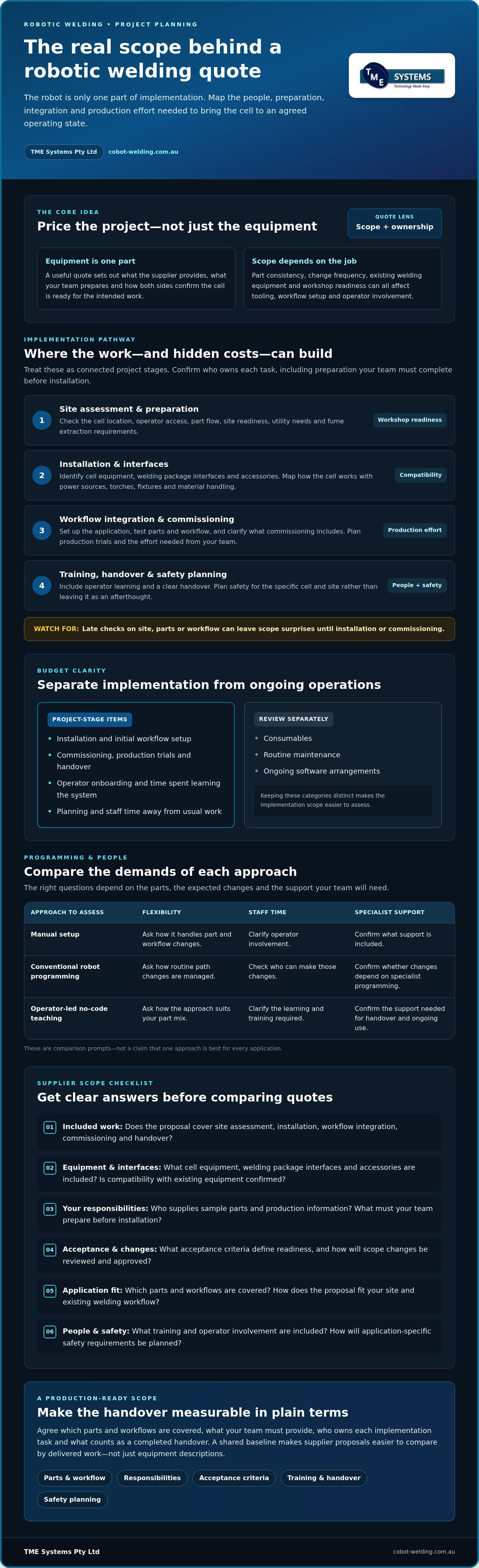

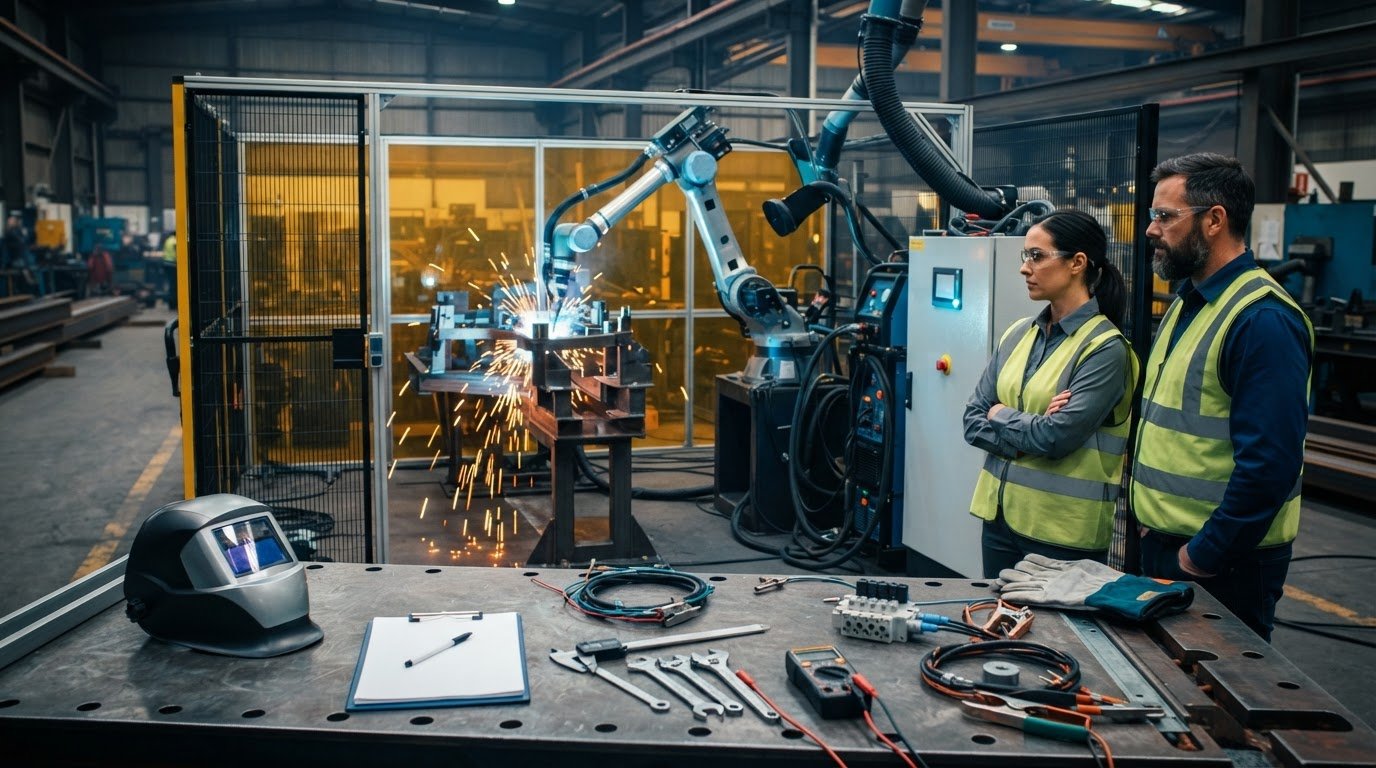
The robot is often the clearest line on a quote, but it may be the least useful figure for judging the full project. The hidden costs of robotic welding implementation can sit in integration, safety measures, commissioning, production disruption and the time your team needs to learn the system.
It’s reasonable to expect a supplier quote to show what’s included. But when integration, site preparation or operator training aren’t clearly scoped, comparing prices alone leaves important questions unanswered. If routine path changes also depend on specialist programming, the system may be harder to adapt than you expect.
This guide will help you build a more realistic implementation budget, compare supplier proposals using consistent scope questions and reduce commissioning risk. We’ll look at work that can sit beyond the equipment, including staff time and production planning, and compare approaches such as collaborative welding cells and no-code teaching software. You’ll also find questions to ask about integration, commissioning, training, equipment compatibility and the safety requirements that apply to your cell and site. The aim is to define a production-ready scope and help your operators learn to use the system with confidence.
Key Takeaways
- See how the hidden costs of robotic welding implementation can build across site preparation, integration, commissioning and the production effort needed to get a cell operating.
- Use a consistent scope checklist to uncover quote exclusions, supplier assumptions, dependencies and resources your team may need to provide.
- Compare manual setup, conventional robot programming and operator-led no-code teaching to understand the demands each approach may place on flexibility, staff time and specialist support.
- Include operator training, handover and application-specific safety planning in the project scope, rather than treating them as afterthoughts.
- Know what to ask before signing, including how the proposed system fits your parts, site and existing welding workflow.
Hidden costs of robotic welding implementation start with the project scope
The hidden costs of robotic welding implementation are the people, preparation, integration and production effort involved in bringing a system to an agreed operating state. Equipment is only one part of the project. A useful scope sets out what the supplier will provide, what your team must prepare and how both sides will confirm the cell is ready for the intended work.
Scope depends on the job, not a standard allowance. A cell handling a narrow range of consistent parts may need different tooling, workflow setup and operator involvement from one expected to handle frequent part changes. Existing welding equipment, its compatibility with the proposed cell and workshop readiness can also affect what’s required. For a neutral overview of typical components and applications, see robotic welding systems.
What should a robotic welding implementation quote cover?
Check whether the proposal identifies the cell equipment, its interfaces with the welding package and any required accessories. Then confirm which stages are included: site assessment, installation, workflow integration, commissioning and handover. Don’t assume a line item labelled “integration” covers every task your application needs.
Record exclusions and customer responsibilities alongside the quoted scope. Who supplies sample parts or production information? What acceptance criteria will be used? How will scope changes be reviewed and approved? Clear answers help you compare proposals based on the work being delivered, not just the equipment descriptions.
Which costs belong in implementation rather than ongoing operations?
Separate one-off deployment work from repeat expenses in your project budget. Installation, initial workflow setup and operator onboarding are project-stage items when they’re included in the proposal. Staff time for planning, production trials and learning the system also deserves attention, particularly if it takes people away from their usual work.
Consumables, routine maintenance and ongoing software arrangements belong in a separate operating-cost review. Keeping these categories distinct makes the implementation scope easier to assess without turning this section into a full total-cost-of-ownership model. For help comparing equipment options before defining the project, refer to the collaborative robot welding cell buying guide.
Before committing, ask each supplier to describe the proposed operating scope in plain terms: which parts and workflows are covered, what your team needs to provide and what counts as a completed handover. This shared baseline helps identify work, responsibilities and costs that an equipment-only quote may leave unclear.
Where implementation costs build: integration, site preparation and commissioning
Once the project scope is outlined, the next challenge is making the cell work in your workshop. Implementation typically involves a sequence of tasks: checking the site, preparing the area, installing equipment, integrating it with the production workflow, testing the application and handing it over to operators. Confirm who is responsible for each task, including any work your team must complete before installation.
Workshop readiness is practical. The cell’s position can affect how parts arrive and leave, operator access to the work area and how the system fits around existing production. Confirm site-specific utility and fume extraction requirements with the integrator rather than assuming they’re covered by the equipment proposal.
Checking the site, parts and workflow early can help prevent late-stage scope surprises.
How do existing equipment and workflow affect integration effort?
Map the equipment and steps the robotic cell needs to work with. These may include the welding power source, torches and fixtures, material handling, and processes that feed parts into or take them away from the cell. Confirm compatibility requirements with your team and the integrator. A mismatch or missing interface detail may require additional setup or adjustment.
Part information matters just as much. Provide representative workpieces, available weld procedures and the sequence parts follow through production. If parts vary or fixtures aren’t ready, the team may need more time to set up and validate the application. Ask how testing will cover the parts you actually intend to run, not just an ideal sample. Workforce preparation also deserves attention; the American Welding Society has covered robotic welding training facility challenges, including the effort involved in developing skills and training resources.
What can delay commissioning or disrupt production?
Installation can be affected by site access, production scheduling, workpiece availability and whether operators can take part in setup and handover. Agree in advance when testing will happen and what production activity may need to pause or move. Ask how acceptance checks, troubleshooting and handover will be recorded, and who will resolve issues found during testing.
For a deeper look at planning these dependencies, see the welding system integration guide. If you’re still assessing application fit, a demonstration can help you discuss parts and workflow before finalising the project scope. Explore collaborative welding cell options as part of that assessment.
Compare robotic welding approaches by programming, flexibility and people requirements
Programming choices affect more than setup. They influence who can adjust weld paths, how quickly the team can respond to a job change and what support may be needed after handover. The right comparison depends on batch sizes, part variation and how often jobs change. There’s no universally cheapest approach: each option requires a different level of operator involvement, programming capability and production stability.
| Approach | Effort and flexibility | Support needs to check |
|---|---|---|
| Manual welding and setup | Operators handle the work directly. This can suit varied jobs or work that changes often, but each task relies on people performing and adjusting the process. | Allow for operator time, skill requirements and the effect of production changes on the team. |
| Conventional robot programming | A specialist creates or adjusts robot paths. A defined, repeatable job may be straightforward to program, while frequent changes or part variation can add programming and validation work. | Confirm who can make changes, how specialist support is accessed and whether that support is included in the proposal. |
| Operator-led no-code teaching | Operators can teach weld paths without writing traditional robot code. This may support routine adjustments by staff, but the application still needs suitable setup, training and validation. | Check software licensing arrangements, training scope, access permissions and what happens when a change needs specialist input. |
Use the table as a prompt, not a price ranking. A stable, repeatable batch may call for a different workflow from short runs with frequent changes. Ask suppliers to assess representative parts and explain how changeovers will work in practice. The no-code robot welding software guide provides more detail on this teaching approach.
How can programming and teaching affect implementation effort?
Ask who will create, adjust and validate weld paths during trials and after handover. Clarify which routine changes operators can make, what training they’ll receive and when specialist programming is required. No-code teaching can reduce reliance on traditional robot coding for routine path adjustments, but it doesn’t remove the need to define support responsibilities and software terms in the project scope.
How should operator time and changeovers enter the comparison?
Include operator participation in application trials, training and workflow refinement when reviewing proposals. Consider how often jobs change and whether staff will be able to manage routine adjustments after handover. Treat expected productivity or labour effects as assumptions to test against your own production conditions, not guaranteed outcomes. This is where the hidden costs of robotic welding implementation may include time that isn’t obvious in an equipment comparison.
A cobot label doesn’t make an installation collaborative by default or remove the need for an application-specific risk assessment. Confirm the safeguards and operating arrangements required for your cell and site before selecting an approach.
Use this checklist to uncover hidden implementation costs before signing
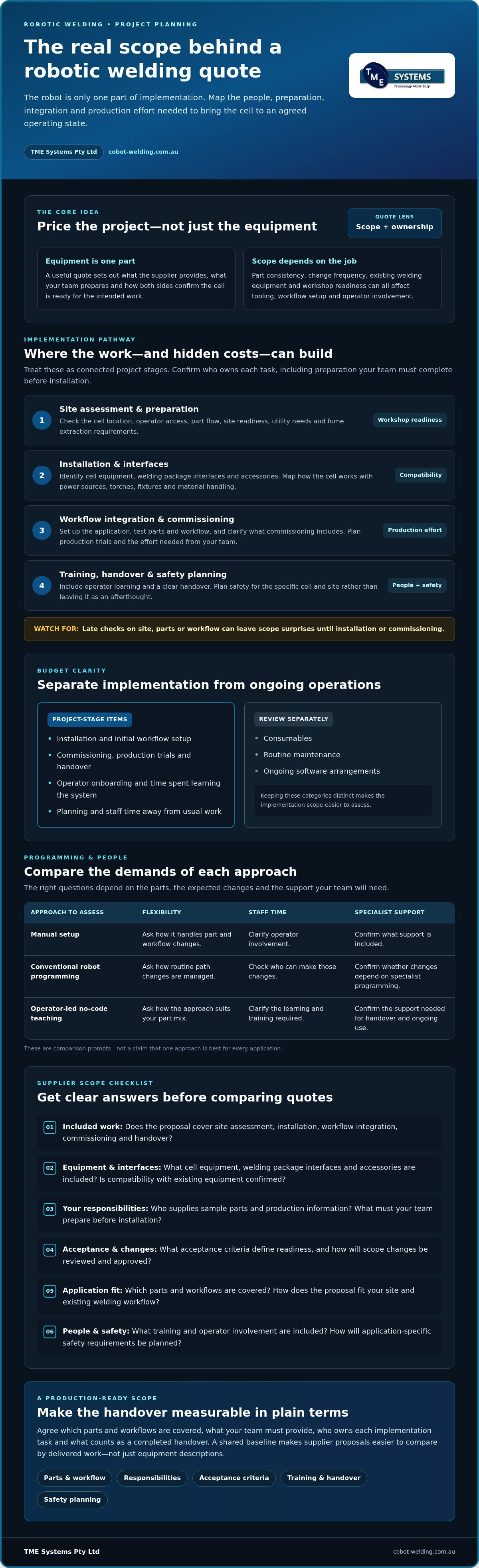
The hidden costs of robotic welding implementation are easier to spot when you check every proposal against the same questions. Ask suppliers to document assumptions, dependencies, exclusions, variation charges and resources your team must provide. Then work through the project in order:
- Define the parts and process. List the parts, weld procedures and production requirements the system is expected to handle. Ask what happens if these change after the scope is approved, and whether additional setup or validation would affect the proposal.
- Confirm site and installation scope. Clarify which site checks and installation tasks are included, what your team must prepare, and whether access, utilities or production scheduling create dependencies.
- Check exclusions and responsibilities. Confirm who supplies fixtures, representative trial parts, process information and staff time. Ask suppliers to identify variation charges and explain how changes will be approved before extra work proceeds.
- Plan operator time and production impact. Allow for operator involvement in trials, training and handover. Discuss when production may need to pause or be rescheduled, and whether fixtures and workpieces will be ready when testing begins.
- Agree acceptance and contingency steps. Set out how commissioning will be tested, what results count as acceptance, how issues will be recorded and resolved, and what happens if the agreed criteria aren’t met.
Use this sentence to compare proposals: “Please document what’s included, excluded and customer-provided, along with all assumptions, dependencies, change charges, trial requirements and acceptance criteria.” It can reveal differences that a headline equipment description may not show.
Which questions should you ask before accepting a proposal?
Ask how changes to parts, weld procedures or production requirements affect the approved scope. Confirm who provides trial fixtures, sample parts and process information, and which staff need to be available. Request clear responsibilities for commissioning, acceptance, handover and support after handover. If an answer is conditional, have the condition recorded in the proposal.
How can a fabricator validate assumptions before committing?
Where possible, test the proposed process on representative parts. Record what the demonstration establishes, such as whether parts can be presented and taught as planned, and what it doesn’t establish, such as performance across untested part variations or production conditions. Agree on quality requirements, throughput measures and acceptance criteria before interpreting trial results.
A mobile welding robot demonstration can help assess application fit before you finalise a project scope. Find out more about arranging a mobile welding demonstration.
Choose a partner who prepares people and the cell
A robotic welding system needs to fit both the production workflow and the people who’ll use it. When comparing partners, assess integration, operator onboarding, documentation and post-handover support as distinct parts of the proposed delivery. Don’t assume training or ongoing assistance is included just because a supplier is delivering the cell. Ask what’s covered, who’s responsible and where your team needs to contribute.
TME Systems offers collaborative robot welding cells, no-code teaching software, welding system integration, operator onboarding and a mobile demonstration system. Discuss these options when defining a project, and confirm what training and support are included for your application. No-code teaching software allows operators to teach weld paths without writing traditional robot code, which may help with routine path adjustments.
What does useful operator onboarding include?
Start with the people who’ll run the cell and the tasks they’ll need to perform. Ask who receives training, whether operators practise teaching or adjusting paths, and how that knowledge will be shared with other staff. The teaching process should work alongside operators’ existing welding knowledge and responsibilities, rather than relying on one person to manage every change.
Check how operator feedback will be gathered during trials and used to refine the workflow. A clear handover should leave staff understanding the agreed process and knowing which adjustments they can make themselves. For further preparation questions, see the cobot welder training guide.
How can you judge whether an implementation partner is the right fit?
Look for a delivery plan that names responsibilities, communication points and an escalation process. Ask how the partner will assess application fit, integrate the cell with your workflow and prepare operators for handover. Clarify what documentation you’ll receive and what support is available after commissioning, including any limits or separate arrangements. These details show whether the proposed partnership covers the practical transition, not just equipment delivery.
A demonstration or application discussion can help your team test assumptions before the scope is finalised. Bring representative parts and questions about teaching, workflow and operator involvement. To discuss a robotic welding application with TME Systems, start an application conversation. Defining responsibilities early helps address the hidden costs of robotic welding implementation and gives operators a clearer path to taking ownership of the system.
Set your robotic welding project up for a confident start
The hidden costs of robotic welding implementation are easier to manage when you define the production-ready scope before comparing proposals. Look beyond the equipment: clarify integration and site work, identify what your team must provide, and agree how commissioning and handover will be assessed.
Compare programming and teaching approaches against your actual parts, batch sizes and change frequency. Plan how operators will learn the system and make routine adjustments. No-code teaching software is designed to let operators teach weld paths without writing traditional robot code, while training and integration should be clearly scoped for your application.
TME Systems offers collaborative welding cells, welding system integration, operator onboarding and a mobile demonstration system to help assess application fit. These are practical options to discuss as you refine project requirements, not guaranteed outcomes.
To discuss your requirements and explore a suitable next step, contact TME Systems about your robotic welding application. A clear scope, practical questions and operator involvement from the outset can help you move towards automation with greater confidence.
Frequently Asked Questions
What are the hidden costs of robotic welding implementation?
The hidden costs of robotic welding implementation can include integration, site preparation, commissioning, staff time, training, production disruption and changes to fixtures or workflows. Which items apply depends on your parts, site and proposed system. Ask suppliers for a written scope that separates one-off project work from ongoing expenses, lists customer responsibilities and explains how changes are handled. Don’t assume every cell needs the same upgrades or support.
Does a robotic welding quote include installation and commissioning?
Not necessarily. Suppliers may define installation, integration, testing, acceptance and handover differently, so check each item rather than relying on a general “turnkey” description. Ask who supplies labour, fixtures and test parts, what successful commissioning means, and how troubleshooting or scope changes are handled. Confirm inclusions, exclusions and responsibilities in writing before comparing proposals. This gives you a clearer basis for assessing what each quote covers.
Can a cobot welding system avoid safety assessment costs?
No. Calling a robot collaborative doesn’t establish that a particular application can operate without safeguards or assessment. Risk depends on the cell, tooling, workpiece, welding process and how people work around the system. Ask the integrator to identify the assessment and control work required for your installation. Before commissioning, verify which Australian workplace safety requirements and standards apply to the specific cell and site.
How much production downtime should I allow for robotic welding implementation?
There’s no reliable downtime allowance that suits every project. The schedule depends on site readiness, installation access, workflow complexity, testing and whether nearby production can continue. Ask for a staged plan showing dependencies, expected interruptions, acceptance activities and contingency points. Check it against order commitments and staff availability. Refine the schedule as the project scope and responsibilities become clearer, rather than treating production disruption as negligible.
What happens if my parts or weld requirements change after implementation?
A change may call for new path teaching, trials, fixture adjustments or process validation. The effort depends on what has changed and how the workflow is set up. Before signing, ask who can make routine adjustments, what training operators need and how larger changes are approved and scoped. Where practical, use a demonstration or trial with representative part variations to test assumptions before finalising the project.
Is no-code software enough to remove robotic welding implementation costs?
No. No-code teaching software can let operators teach weld paths without writing traditional robot code, but it doesn’t remove the need to scope integration, site preparation, commissioning, onboarding or application validation. Ask which tasks operators can perform and which require specialist support. Confirm software access arrangements and training requirements, and, where possible, have operators practise a representative adjustment before committing to the proposed workflow.
How do I compare robotic welding implementation proposals fairly?
Give each supplier the same parts, workflow assumptions and acceptance requirements. Compare what’s included for integration, site work, commissioning and training, as well as exclusions, customer responsibilities and the process for approving changes. Record assumptions about staff time, trial parts and production interruptions instead of treating them as zero. A like-for-like scope helps explain differences between proposals and makes it easier to spot work that may be missing.