
In Weld Australia’s 2026 Industry and Workforce Outlook Survey, 89.2% of respondents said Australia doesn’t have enough qualified welders to meet demand. If production schedules rely on a handful of experienced people, recruitment and training may not ease the pressure quickly. So, how to deal with lack of skilled welders while customer work keeps moving?
The answer isn’t to treat skilled welders as replaceable or to automate every task. Their judgement remains essential. A practical response is to plan workforce needs, develop operators and identify repeatable welding work that could be supported by automation.
This article explains how to protect production capacity while valuing the people who make quality work possible. You’ll learn how to identify the constraint, improve workflow and decide whether operator-led collaborative welding may suit repeatable jobs. It also covers how no-code teaching software lets welders and operators teach and refine weld paths without coding experience, why integration with existing welding equipment, power sources and fixtures matters, and how an on-site demonstration can help assess an application.
Key Takeaways
- To understand how to deal with lack of skilled welders, map critical skills, workload and tasks that depend on one person.
- Reduce avoidable pressure by improving job sequencing, preparation and the information operators need to complete work consistently.
- Match your response to the gap: recruit for missing capability, train to build resilience, and consider automation for suitable repeatable tasks.
- Assess part consistency, fit-up, torch access and fixtures before trialling collaborative welding, then review how it fits your workflow.
- Operator-led teaching software lets welders and operators teach, run and refine weld paths without coding experience. Integration with existing equipment, power sources and fixtures is part of the process.
What a lack of skilled welders means for your workshop
A welder shortage isn’t just an empty position on the roster. It’s a mismatch between the work due, the skills available to complete it and the time production has to deliver. That distinction matters when deciding how to deal with lack of skilled welders: recruitment may be needed, but it won’t fix every constraint on welding output.
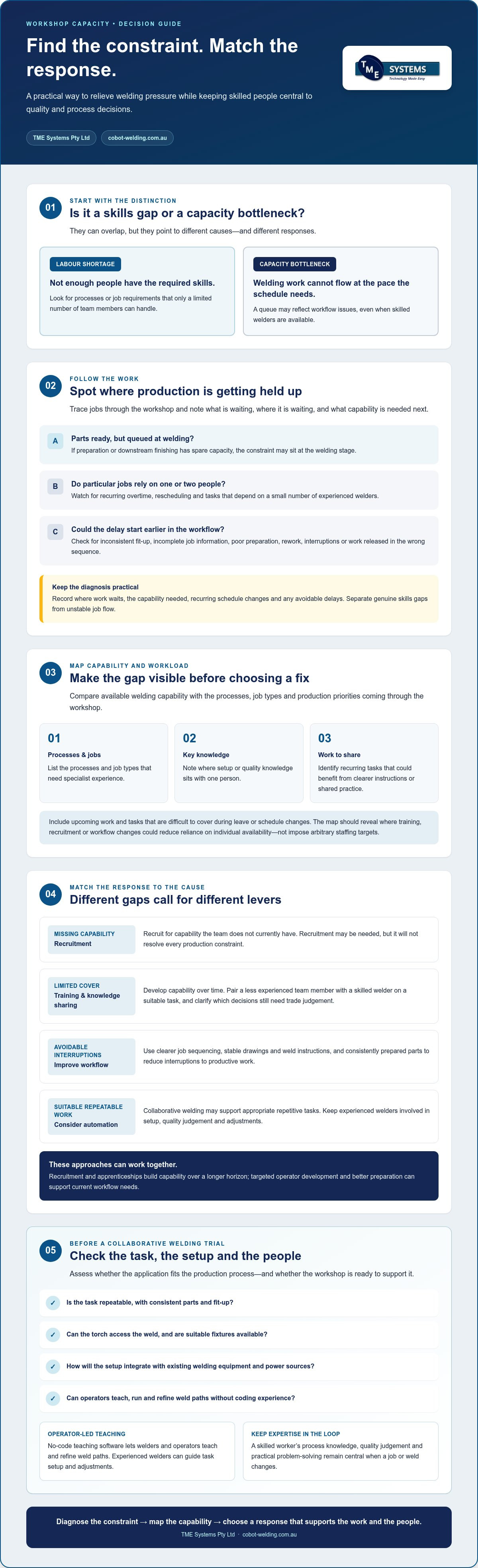
A labour shortage means you don’t have enough people with the required skills; a production-capacity bottleneck means welding work can’t flow at the pace your schedule needs. The two can overlap, but they call for different responses.
For example, jobs may queue at welding because only a few people can complete a particular process or meet its quality requirements. That can put delivery dates under pressure, increase reliance on experienced staff and limit which new jobs the workshop can accept. But a backlog can also build when parts arrive with inconsistent fit-up, job information is incomplete or work is released in the wrong sequence. Those issues create delays even when skilled welders are available.
A skilled worker brings more than the ability to perform a task. In welding, process knowledge and judgement help a tradesperson adapt to changing materials, joints and production conditions. The broader meaning of a Skilled worker also reflects expertise developed through training and experience, not simply the number of people assigned to a job.
How to recognise a welding capacity bottleneck
Follow the work through the workshop. If parts are ready but queue at welding while preparation or downstream finishing has spare capacity, the constraint may sit at the welding stage. Look for recurring overtime, rescheduling and jobs that depend on one or two experienced welders. Then distinguish genuine skills gaps from delays caused by rework, interruptions or unstable job flow.
- Note where work waits and the capability needed to complete it.
- Track recurring schedule changes and reliance on key people.
- Check whether fit-up, preparation or missing information is causing avoidable delays.
Why skilled welders remain central to the response
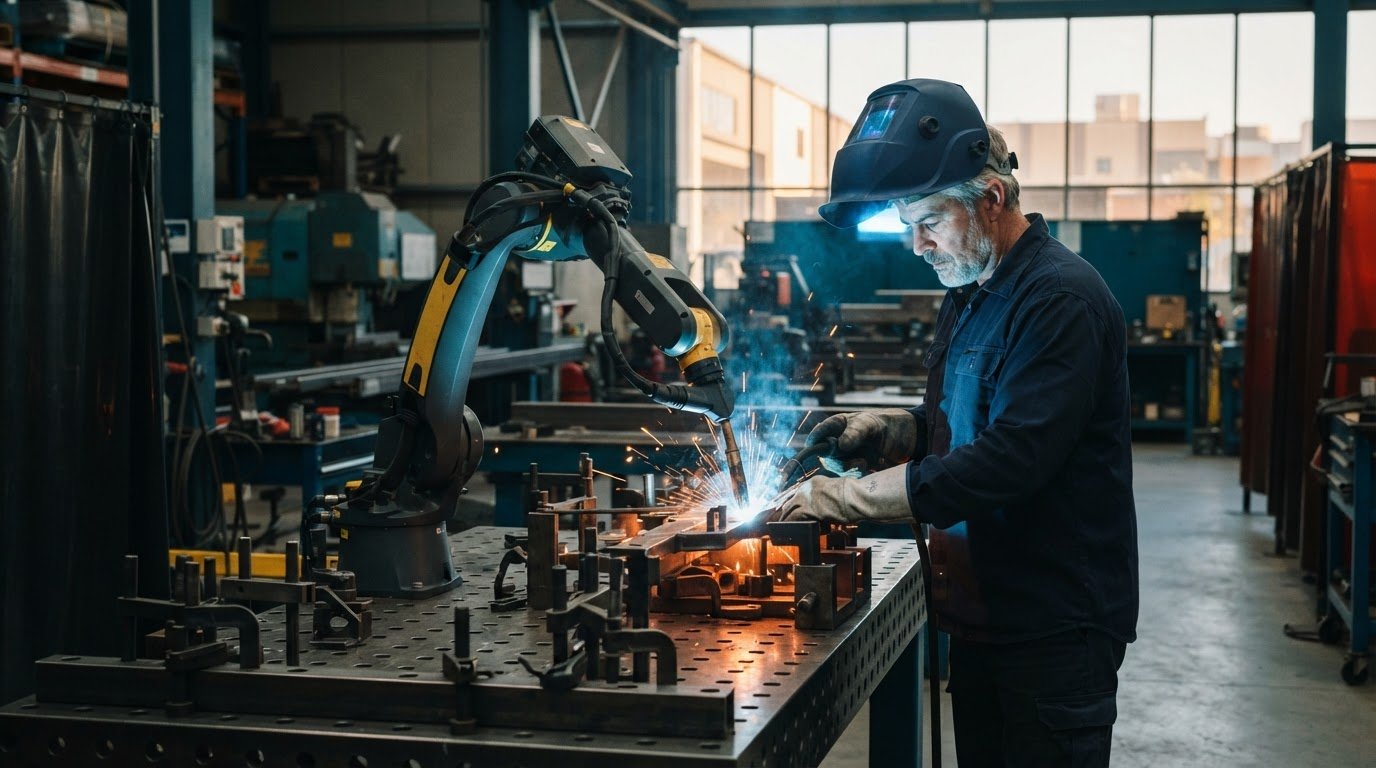
Experienced welders bring process knowledge, quality judgement and practical problem-solving when a job changes or a weld doesn’t behave as expected. Those skills should shape the response, not be treated as a barrier to it. Collaborative welding may support suitable repetitive tasks, with skilled people still involved in setup, judgement and adjustments. The guide to improving welding productivity with cobots explores how automation can complement workshop expertise rather than replace it.
How to relieve welder pressure without losing valuable expertise
Once you’ve identified where welding work is getting held up, look for ways to ease the pressure without putting the burden on the same experienced people. Start with a skills and workload map: compare the welding capability available in your team with the processes, job types and production priorities coming through the workshop. This helps distinguish a capability gap from pressure caused by the way work is organised.
Build a practical skills and workload picture
List the processes and job requirements that matter to current work, then note who can handle each one and where knowledge sits with a single person. Include recurring jobs, upcoming work and tasks that are difficult to cover during leave or schedule changes. The map doesn’t need arbitrary staffing targets. It should show where training, recruitment or workflow changes could make the team less dependent on individual availability.
- Record the processes and job types that need specialist experience.
- Identify jobs where one person holds key setup or quality knowledge.
- Note recurring work that could benefit from clearer instructions or shared practice.
Use what you learn to share knowledge deliberately. Pairing a less experienced team member with a skilled welder on a suitable task can help transfer practical know-how, while clarifying which decisions still need trade judgement. Recruitment and apprenticeships can build capability over a longer horizon; targeted operator development and better preparation can support current workflow needs. These approaches complement each other rather than compete.
Develop people while improving the work
Experienced welders should help define repeatable tasks, acceptable weld outcomes and the adjustments a job may need. Their involvement recognises their expertise and helps ensure process improvements reflect actual workshop conditions. It also grounds automation decisions in practical experience: the goal is to support suitable repetitive work, not remove skilled people from decisions about quality or process changes.
Where collaborative welding fits the production process, structured operator onboarding can help workshop staff learn to teach, run and refine weld paths. TME Systems’ No-Code Teaching Software is designed for operators without coding experience, with experienced welders able to guide how the task is set up and adjusted. A practical guide to on-site cobot welder training can help teams consider what hands-on onboarding involves.
Improving the work itself matters too. Clear job sequencing, stable drawings and weld instructions, and consistently prepared parts can reduce interruptions that pull skilled welders away from productive work. The Future of Welding from the American Welding Society discusses industry trends and emerging technology, useful context when considering how skills and tools may work together.
As you decide how to deal with lack of skilled welders, keep the people closest to the work involved in testing changes. If your skills map points to suitable repeatable tasks, you can explore collaborative robot welding as one part of a broader workforce plan.
Recruitment, training or automation: which response fits the gap?
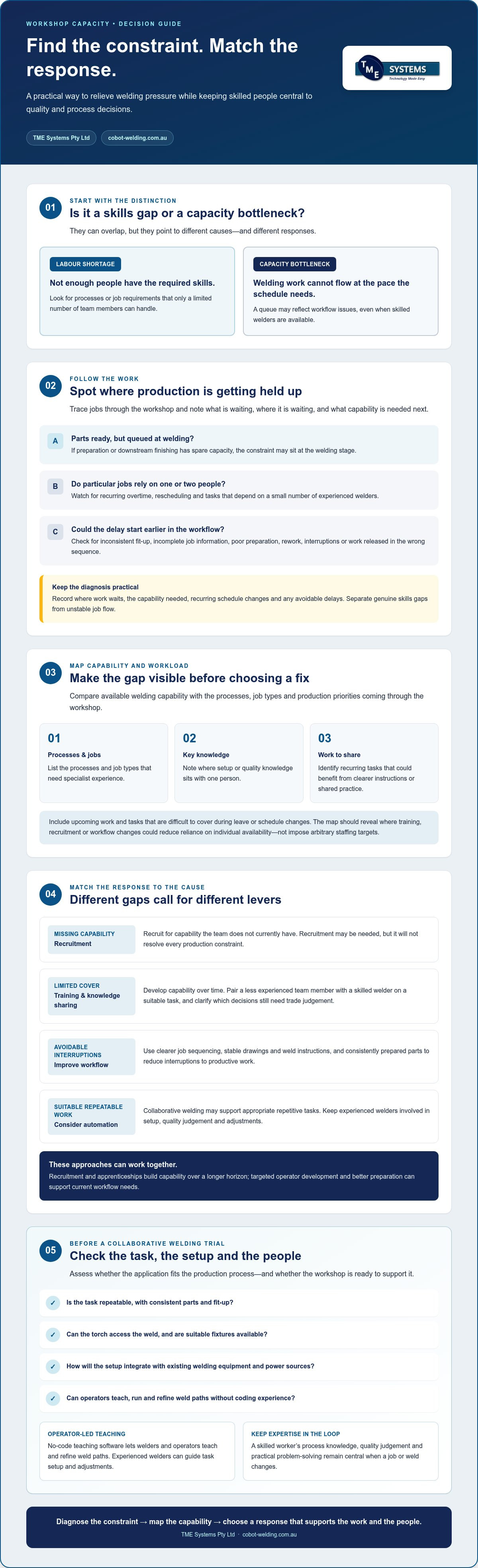
There isn’t one fix for every welding constraint. The right response depends on what’s missing: a capability your team doesn’t have, time to build skills, or a smoother way to organise work. These options can work together. Recruitment adds experience the workshop needs, training builds resilience over time, and workflow changes can reduce delays that don’t require another welder.
Collaborative welding belongs in the mix only where the task and production pattern suit it. It can support skilled welders with repeatable work, but it isn’t a universal answer to a labour shortage. Automation also doesn’t remove the need for welding knowledge or process oversight. Welders’ judgement remains important in setting up work, assessing weld outcomes and deciding how to respond when conditions change.
When recruitment or training should lead
Prioritise recruitment when upcoming work requires a capability your existing team can’t reasonably cover, such as a particular process or job requirement. Training and knowledge sharing address a different need: they spread expertise and reduce reliance on one person over time. If delays stem mainly from job sequencing or preparation, improve the workflow as well rather than treating recruitment as the only lever.
When collaborative welding may help
Consider a task’s repeatability, fit-up, torch access, fixturing and frequency. A high-mix, low-volume workshop may still find useful applications when related part families share features or weld paths. The key is whether the work can be taught and adjusted practically, with skilled people guiding the process. A guide to no-code robot welding software explains how operator-led teaching makes adjustments accessible without coding experience.
| Response | Best suited to | People involved | Workflow impact and considerations |
|---|---|---|---|
| Recruitment | A genuine gap in welding capability or capacity | New hires, supervisors and the existing team | Adds skills to the workforce, but recruitment and onboarding take time. Define the capability needed against actual work. |
| Training and knowledge sharing | Building future coverage and reducing reliance on individual expertise | Experienced welders and developing staff | Strengthens capability over time. Protect opportunities for practical coaching alongside production demands. |
| Workflow changes | Delays caused by sequencing, preparation or job information | Planners, supervisors and workshop staff | Can remove avoidable interruptions. It won’t replace a missing specialist capability. |
| Collaborative welding | Suitable recurring work with repeatable setup and accessible weld paths | Welders, operators and integration specialists | May support production on selected tasks. Assess fixtures, existing equipment, power sources and process needs as part of the application. |
To decide how to deal with lack of skilled welders, match the response to the constraint rather than choosing technology or recruitment by default. A balanced plan can bring in specialist capability, share knowledge and reserve automation for tasks where it supports the team’s work.
How to assess and prepare a welding task for collaborative automation
A good candidate task is more than a weld that needs doing often. Parts must be presented consistently, the torch needs workable access, and the job must fit the way your team prepares and moves work through the workshop. Start with a practical assessment before deciding whether collaborative welding belongs in the process.
Stable fixturing and repeatable fit-up make it easier to teach a weld path that can be used consistently. If parts vary significantly from one job to the next, first understand what causes that variation and whether preparation or fixturing can be improved.
- Select a candidate part or part family. Look for recurring work with similar joints and enough repeatability to teach and assess a path. High-mix production may still offer suitable opportunities when related parts share useful features.
- Review fit-up and torch access. Check how parts are prepared, positioned and held, and whether the torch can reach the welds as required. Note variations that could affect the taught path or weld outcome.
- Assess the production setup. Review existing fixtures, welding equipment, power sources and production processes. Integration with this equipment and the fixtures is part of assessing the application.
- Match the welding process and equipment. MIG or TIG may be supported when the robot, power source, torch package and process requirements are matched correctly. Treat that combination as part of the application, not as an assumption based on the process name alone.
- Trial and evaluate the task. Use a demonstration to assess how the part, setup and weld path work together. TME Systems’ Mobile Demo System brings a welding cell to your site for evaluation; it is a demonstration, not a permanent installation.
- Prepare operators, then review. Plan onboarding and training around the people who will teach and run the work. No coding experience is needed to use the No-Code Teaching Software, which lets operators teach, run and refine weld paths. Review the application with skilled welders and operators as the job is put into practice.
Safety needs attention throughout the assessment. A collaborative robot isn’t guaranteed safe simply because it’s collaborative. Safety requirements depend on the application, tooling, process and site risk assessment.
This staged approach helps you test whether a task fits before making it part of a wider production plan. It also keeps experienced welders involved in decisions about process requirements and weld quality.
To assess a potential application in your workshop, arrange an on-site welding cell evaluation with TME Systems’ Mobile Demo System.
How TME Systems can help your team take the next step
Once you’ve identified the capacity gap and the work that may suit collaborative welding, test the idea against your actual parts and processes. Keep skilled welders involved from the outset. Their knowledge helps shape how a task is taught, what a sound weld looks like and which adjustments matter in day-to-day production.
TME Systems supports Australian manufacturers exploring no-code collaborative robot welding with operator-led teaching software, welding cell solutions, integration, demonstrations and onboarding. The focus is practical adoption: assess a suitable application, account for the equipment and fixtures already in use, and help the people doing the work learn to operate and refine the process.
What an operator-led approach changes
Robot-programming expertise isn’t required to use the No-Code Teaching Software. Welders and operators can teach, run and refine weld paths without coding experience. That gives the people closest to the job a practical role in making adjustments as parts or production needs change, while skilled welders continue to contribute their process knowledge and quality judgement.
This approach doesn’t promise a particular productivity, labour or quality result. Outcomes depend on the application and how it fits into the workshop. It offers a way to explore whether a repeatable task can be taught and run with operators involved, supported by onboarding and training as the team adopts the process.
Turn a potential application into a practical conversation
Bring the details that explain the work: representative parts, how often they recur, current production constraints, and any variation in fit-up or setup. Include the fixtures and welding equipment already in use. Integration with existing welding equipment, power sources and fixtures is part of assessing the application. For MIG or TIG, the robot, power source, torch package and process requirements must be matched correctly.
An on-site demonstration can make the assessment more tangible. TME Systems’ Mobile Demo System brings a welding cell to your site for evaluation, so your team can consider the application in context. It’s for evaluation, not a permanent installation. The discussion can also cover operator onboarding and training, with welders involved in considering how the taught task fits into production.
If you’re considering how to deal with lack of skilled welders, start with the work that’s creating pressure and the people who understand it best. A clear discussion of your parts, production goals and existing setup can help establish whether collaborative welding is worth evaluating for your workshop.
Discuss your welding application with TME Systems, including suitable repeat work, production constraints and an on-site demonstration.
Make your next step a practical one
Deciding how to deal with lack of skilled welders doesn’t require a sweeping change across the workshop. Start with one production pressure point and consider what a workable next step looks like for the people and parts involved. A focused application discussion can turn a broad automation question into a practical assessment of your production goals.
With TME Systems, that conversation can include how operators and welders use No-Code Teaching Software to teach, run and refine weld paths without coding experience. Integration with existing welding equipment, power sources and fixtures is part of the application discussion, alongside onboarding and training. For a closer look, the Mobile Demo System brings a welding cell to your site for evaluation.
Bring your team’s knowledge into the decision. Collaborative welding is a considered workshop change, with skilled people helping shape how the process fits their work.
Discuss your welding application with TME Systems and explore a practical next step for your team.
Frequently Asked Questions
What parts are good candidates for robotic welding?
Parts with repeatable fit-up, sensible torch access, stable fixturing, and enough repeat work to justify teaching and proving the weld path.
Can a cobot help with high-mix low-volume welding?
Yes, provided the right part families are chosen; no-code teaching can make changeovers more practical when jobs are similar enough to reuse fixtures, process knowledge, and weld strategies.
Does robotic welding support MIG and TIG processes?
Yes, when the robot, power source, torch package, and process requirements are matched correctly.
Why is welding power source integration important?
Power source, wire feed, torch, communication method, and weld settings affect arc stability and repeatability; reviewing integration early helps avoid surprises during commissioning.
Is coding experience required for using the software?
No, the software is designed for welders and operators regardless of robot programming experience.
What kind of support do you offer for new users?
Demonstration, onboarding, training, and support to help teams move confidently into collaborative welding.
Is collaborative robot welding safe for workers?
Designed around controlled interaction with operators; final safety requirements depend on the application, tooling, process, and site risk assessment.