
What if the solution to your labour shortage isn't finding more welders, but making the ones you already have significantly more effective? Most workshop owners across Australia are feeling the pinch of a projected 70,000-person welder deficit by 2030. It is frustrating to turn down large batch orders or watch your best tradespeople get bogged down in repetitive, mind-numbing fillet welds when they should be tackling complex projects. You know that keeping the torch moving is the only way to stay competitive, yet the traditional hurdles of automation often feel too high for a mid-sized shop.
We understand that you need practical results, not just more gadgets. The good news is that you can significantly improve welding productivity with cobots by shifting your skilled team from manual repetition to high-value process management. This guide will show you how collaborative technology is redefining workshop throughput. We will explore how no-code teaching and integrated cells allow you to increase arc-on time, slash rework rates, and get junior staff producing quality results faster than ever before. It's about working smarter with the team you already have on the floor.
Key Takeaways
- Understand why the widening skills gap in Australian fabrication makes collaborative technology a practical necessity for workshops looking to scale.
- Discover how to improve welding productivity with cobots by eliminating operator fatigue and leveraging multi-station cells for continuous arc-on time.
- Explore the "no-code" revolution that allows your experienced tradespeople to teach new parts in minutes without needing any traditional programming background.
- Learn how to adopt an "automation mindset" through modular fixturing and part design to ensure your robot stays busy and your setup times stay low.
- Identify why a turnkey approach to integration and operator training is the most reliable way to secure a fast return on your investment.
The State of Australian Fabrication: Why Productivity Must Evolve
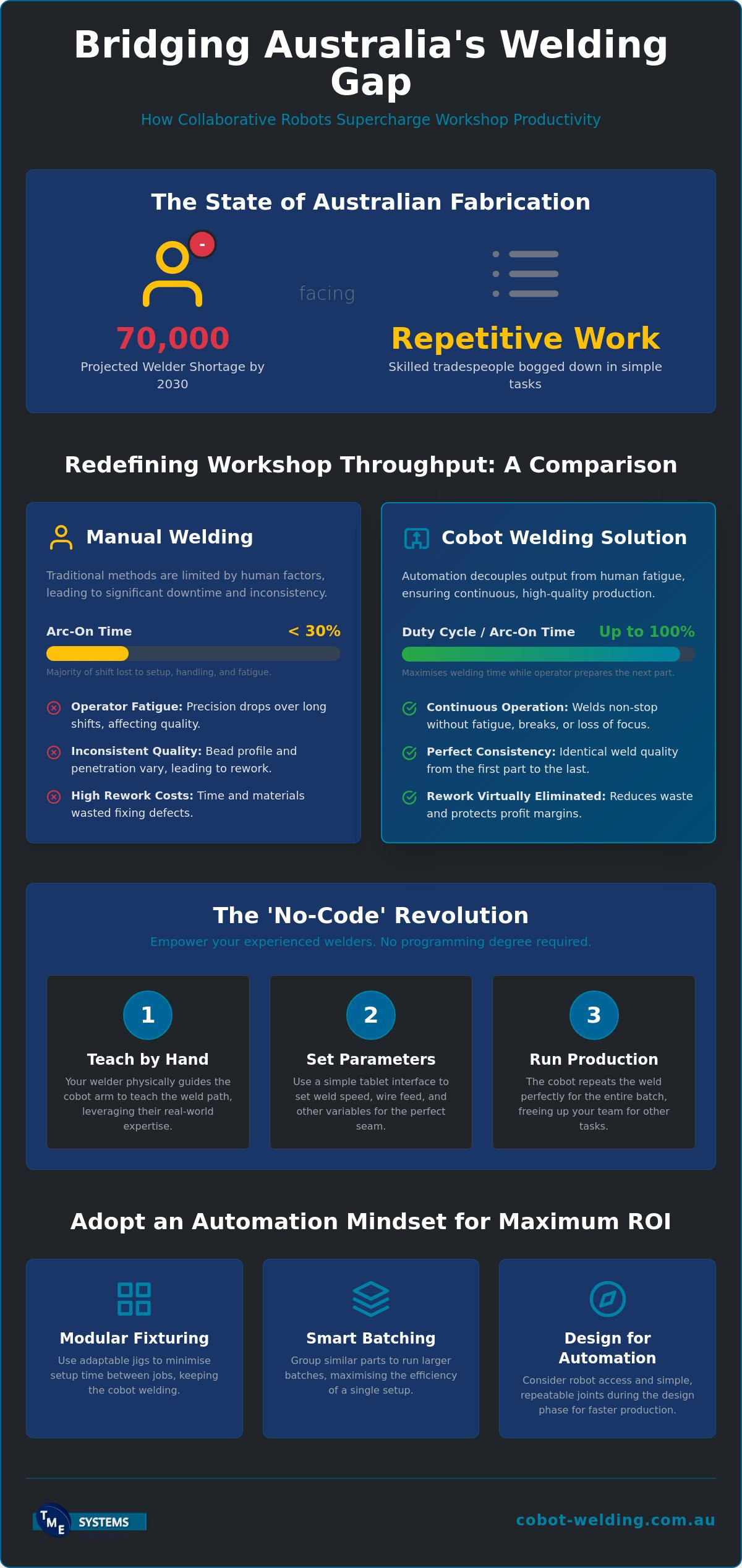
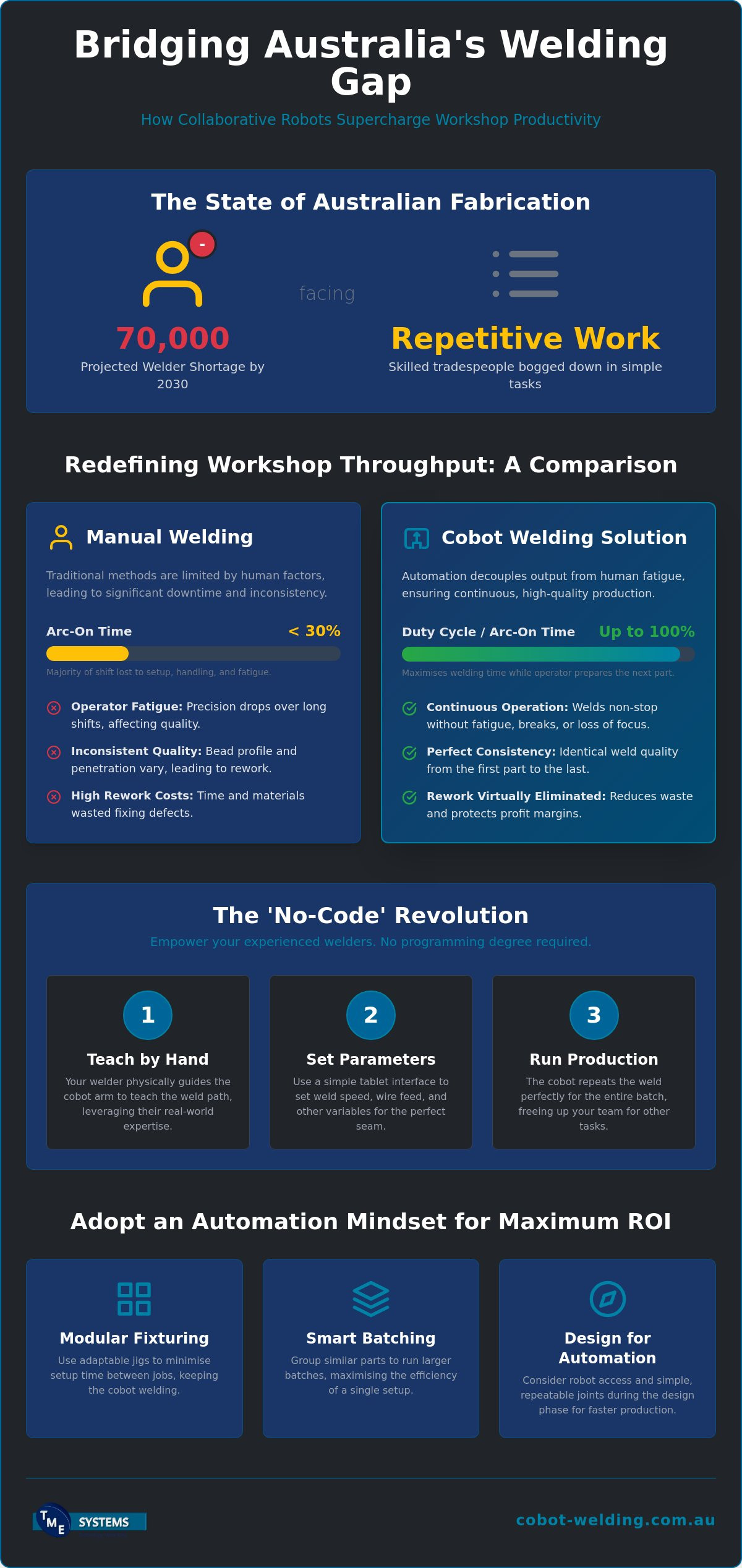
The Australian fabrication landscape is reaching a tipping point. For years, workshop managers have relied on a steady stream of skilled tradespeople, but that tap is running dry. Current projections indicate that Australia will face a deficit of 70,000 welders by 2030. This isn't just a distant statistic; it's a daily reality for owners who can't find staff to man the bays. When your most experienced welders spend their time on simple, repetitive fillets, you aren't just losing money. You're wasting the high-level expertise that keeps your shop profitable and competitive.
In the past, the answer was traditional robotic welding technology. However, these massive, fenced-off systems were designed for car factories, not the high-mix, low-volume production that defines our local industry. Cobots change this dynamic. By handling the "grunt work" of repetitive seams, they allow your team to focus on complex assemblies. When you improve welding productivity with cobots, you stabilise your output. This consistency allows you to quote more competitively on large batches, knowing your margins won't be eaten by rework or unexpected delays.
The True Cost of Manual Welding in 2026
Manual welding is surprisingly inefficient when you look at the raw data. Most manual welders achieve an "Arc-On Time" of less than 30% of their shift. The rest of the day is lost to material handling, jigging, and the inevitable fatigue that sets in after hours of precision work. In Australia, where labour costs are among the highest in the world, paying for that downtime is a heavy burden. A cobot doesn't get tired or lose focus. This means bead quality remains identical from the first weld of the morning to the last one at 5:00 PM, virtually eliminating the need for costly rework.
Sovereign Capability and Local Manufacturing Resilience
Relying on offshore suppliers has become a risky strategy. Local fabricators are increasingly investing in Future-Proofing Welding Workshops to build sovereign capability. Automation is the key to this resilience. It allows Australian shops to produce at a price point that rivals international imports while maintaining superior quality control. By choosing to improve welding productivity with cobots, you aren't just buying a machine. You are securing your shop’s place in a modern, self-reliant manufacturing sector that can handle whatever the global market throws at it.
How Cobots Maximise Workshop Throughput and Arc-On Time
Throughput is the lifeblood of any fabrication shop. It isn't just about how fast a single weld is completed; it's about how many quality parts leave the floor at the end of the week. Many workshop managers find that their production schedules are dictated by the physical limits of their team. When you look to improve welding productivity with cobots, you're essentially decoupling your output from human fatigue. While a skilled welder needs to pause for repositioning, helmet adjustments, and breaks, a cobot maintains a 100% duty cycle. This steady pace ensures that the broader benefits of manufacturing automation, such as predictable scheduling and reduced lead times, become a reality for your business.
The Duty Cycle Advantage
The most immediate shift you'll notice is the increase in active welding time. In the context of robotic efficiency, arc-on time represents the actual duration the welding torch is active and depositing metal, rather than the time spent on setup, cleaning, or repositioning. A human welder, no matter how talented, eventually faces a drop in precision as the day progresses. Heat, fumes, and the physical strain of maintaining a steady hand on long seams take their toll. A collaborative arm doesn't have these limitations. It can handle long, continuous MIG or TIG runs with the same steady travel speed and torch angle every single time. This allows you to improve welding productivity with cobots by letting the machine handle the long, monotonous joints while your staff focus on complex tacking and assembly work.
Consistency and Rework Reduction
Rework is a silent profit killer. Every time a part has to go back for grinding or a second pass, your margins disappear. The cost of a bad weld includes wasted gas, wire, labour, and the opportunity cost of the job that should have been on the bench instead. Cobots provide a level of repeatable precision that is difficult to match manually over an eight-hour shift. This is particularly vital in high-stakes sectors, as seen in our guide on cobot welding for structural steel, where maintaining strict compliance is essential. By ensuring the first part is identical to the thousandth, you virtually eliminate the "rework loop." If you're curious about how this precision looks on your own parts, seeing a mobile demo system in action can help you visualise the impact on your specific workflow. Using a multi-station setup, one operator can even manage two cells at once, loading one side while the cobot welds the other, effectively doubling your output without adding to the headcount.
The No-Code Revolution: Teaching Robots Without Traditional Programming
The biggest barrier to workshop automation used to be the keyboard. For decades, bringing a robot onto the floor meant hiring a specialist programmer or sending staff away for weeks of expensive software training. In 2026, that dynamic has flipped. We have seen a total shift where the role of "Robot Programmer" is being replaced by the "Welding Process Lead." You don't need a computer science degree to get results anymore. If your staff can run a clean bead manually, they already have 90% of the knowledge required to supervise a cobot cell. By removing the "software fear," you empower your best tradespeople to improve welding productivity with cobots using the skills they already possess.
Intuitive Hand-Guiding and Path Teaching
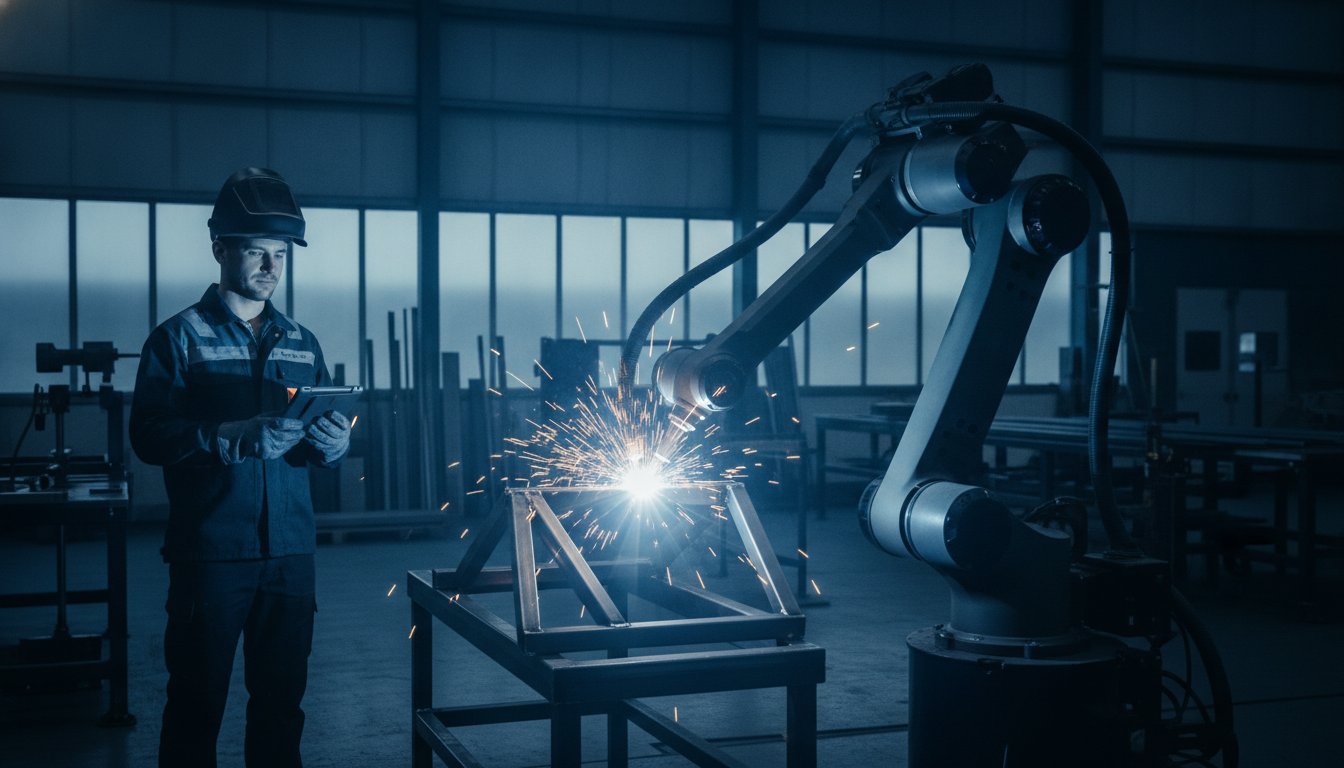
The mechanics of no-code teaching are remarkably straightforward. You simply put the cobot into "lead-through" mode and physically guide the torch along the desired weld path. By hitting a button on the arm to save waypoints, the operator defines the start, middle, and end of the seam. All the technical fine-tuning happens on a rugged tablet interface. You can adjust voltage, travel speed, and wire feed rates on the fly without looking at a single line of code. This accessibility is a core feature of modern No-Code Robot Welding Software, ensuring that the machine adapts to the welder’s expertise rather than the other way around.
Rapid Job Changeovers
There’s a common myth that automation only makes sense for runs of ten thousand identical parts. For the average Australian shop, that isn't the reality. Cobots excel in "low-mix" environments because the setup time is so low. You can switch from a heavy MIG fillet on a trailer frame to a delicate TIG butt joint on a stainless tank in under ten minutes. In a fast-paced workshop environment, teaching a path by hand is five times faster than traditional coding, allowing you to move from a bare bench to a finished part in record time. This flexibility allows you to improve welding productivity with cobots even on custom jobs or small batches of ten to twenty units that would have previously been done entirely by hand. It turns the cobot into a versatile tool that stays busy all day, regardless of how often your production schedule changes.
Optimising Your Workflow: Fixturing, Design, and Batching
A cobot is only as productive as the workflow that feeds it. While the previous sections focused on the technology itself, the real gains happen when you adjust your floor operations to match the machine's capabilities. You can't treat a collaborative cell like a standalone manual bay. To improve welding productivity with cobots, you have to look at the entire journey of a part, from the initial CAD design to the final pallet. This requires a shift in mindset where the focus moves from individual weld speed to the total cycle time of a batch.
Designing for Automation
Successful automation starts in the office. Simple design tweaks can make a massive difference in how easily a cobot can access a joint. This might mean moving a stiffener slightly to provide torch clearance or changing a lap joint to a fillet. Precision in your upstream processes is also non-negotiable. If your laser cutting or folding is out by a millimetre, the cobot might miss the seam entirely. High-quality automation relies on consistent fit-up, which means your parts need to be "robot-ready" before they even reach the welding table. When your tolerances are tight, the machine can do its job without constant manual intervention.
Modular Fixturing and Tooling
Repeatability is the foundation of efficiency. Investing in a high-quality welding table and a modular jig system allows you to build setups that are identical every time. Using toggle clamps and positioning blocks reduces the "air-cut" time spent searching for the part. You want the cobot to spend as much time as possible with the arc on, not waiting for an operator to fumble with a tape measure. For inspiration on how to arrange your workshop for maximum flow, take a look at our guide on Collaborative Robot Welding Cells. A well-organised cell ensures that the transition between parts is seamless and fast.
Batching strategies also play a huge role in your overall throughput. Instead of welding one part at a time, consider a multi-station setup where a junior staff member acts as a "Cobot Tender." They can load and unload parts on one side of the table while the cobot welds on the other. This keeps the machine running continuously and allows your senior tradespeople to manage the broader process rather than being tied to a single bench. If you want to see how these strategies could work in your shop, you can explore our welding system integration services to find a layout that fits your specific production needs. By organising your floor for continuous operation, you ensure that the technology delivers the maximum possible return on investment.
Implementing Cobots: A Strategic Partner Approach
Starting a journey into automation doesn't have to be a leap into the unknown. For most Australian SMEs, the fastest route to a return on investment is a turnkey solution. This means receiving a fully integrated system where the power source, software, and safety protocols are already configured to work together. At TME Systems Pty Ltd, we focus on welding system integration that slots into your current factory layout without forcing you to stop production. We understand that a workshop floor can't afford a week of downtime just to install a new tool. Our goal is to ensure the transition is seamless, allowing you to improve welding productivity with cobots while your existing jobs keep moving out the door.
Integration and Onboarding
Technical specifications are important, but successful automation really starts with cultural buy-in from your workshop floor. If your welders see the cobot as a tool that makes their job easier rather than a threat to their trade, you will see much faster results. This is why the operator training and onboarding programmes offered by TME Systems Pty Ltd are designed to make your team self-sufficient. We don't just drop off a machine and leave. We act as a practical mentor, teaching your staff how to refine processes and adjust the equipment for different jobs. Ongoing support is a core part of the relationship, ensuring that your output remains high for the life of the machine.
Calculating Your ROI
When you look at the numbers, it's helpful to move beyond the initial purchase price and look at the "cost per metre of weld." When you improve welding productivity with cobots, you are effectively lowering your unit cost by reducing rework and saving on consumables through precision application. You also gain the ability to quote on larger contracts that would have previously been impossible with your current headcount. Because a cobot can maintain a continuous duty cycle, the capacity increase often provides a much faster payback period than traditional industrial robots. You aren't just buying a machine; you are investing in a more resilient, scalable business model.
If you are still wondering how this technology fits into your specific operation, the best way to find out is to see it in person. Seeing the equipment handle your actual parts provides the clarity needed to make an informed decision. You can Book a Mobile Demo with TME Systems Pty Ltd to prove the productivity gains on your own workshop floor. It's a hands-on, transparent way to see exactly how these cells can support your team and help your business grow in a competitive market.
Securing Your Workshop's Competitive Edge
The shift toward automation is no longer a luxury for Australian fabricators; it is the most practical way to bridge the skills gap while keeping your shop floor busy. By adopting no-code software, you put the power of automation directly into the hands of your experienced welders. This ensures that your transition is grounded in trade expertise rather than complex coding. When you improve welding productivity with cobots, you aren't just increasing arc-on time. You are building a more resilient business that can quote with confidence on any batch size, knowing your quality and timelines are secure.
We are here to support you with Australian-based integration and technical advice at every step of the journey. The best way to see the results is to witness the technology running your own parts. You can Book a Mobile Welding Robot Demonstration for Your Workshop and we will bring the system directly to your factory. It's a straightforward way to see the gains for yourself before making a commitment. Let your skilled team focus on the high-value work they were trained for while the cobot handles the repetition.
Frequently Asked Questions
How much faster is a cobot compared to a manual welder?
A cobot doesn't necessarily move the torch faster than a human, but it maintains a 100% duty cycle without stopping for breaks or fatigue. While a manual welder might achieve 20% to 30% arc-on time due to repositioning and setup, a cobot can keep the arc active for almost the entire shift. This consistency allows you to improve welding productivity with cobots by doubling or even tripling the number of parts finished per day.
Do I need a specialised programmer to run a welding cobot?
You don't need a specialised programmer or IT expert to operate a modern collaborative system. No-code software allows your existing tradespeople to "teach" the robot by physically moving the arm to the required waypoints. If your team knows how to set a welding power source and maintain a steady path, they have all the skills needed to manage the cell effectively on their own.
Can a cobot handle small batches of 10-20 parts profitably?
Yes, cobots are specifically designed for the high-mix, low-volume production common in Australian workshops. Because the teaching process takes minutes rather than hours, it's often profitable to automate batches as small as 10 parts. This flexibility ensures the machine stays busy throughout the day, even when your production schedule involves frequent job changeovers and custom fabrication tasks that traditional robots can't handle.
What happens if the cobot hits a person or an obstacle?
Collaborative robots are equipped with sensitive force-torque sensors that detect any unexpected contact. If the arm encounters a person or an obstacle, it stops instantly to prevent injury or damage. This safety feature allows the machine to work alongside your team without the need for the bulky safety fencing required by traditional industrial robots, saving valuable floor space in your workshop while maintaining a safe environment.
Is it difficult to integrate a cobot with my existing MIG or TIG power source?
While integration is possible, the most reliable results come from a dedicated welding system integration. This ensures the cobot and the power source communicate perfectly, allowing for real-time adjustments to voltage and wire speed via the tablet. We focus on providing turnkey solutions where the torch, wire feeder, and software are already synchronised, so you can start production without troubleshooting compatibility issues on your own floor.
How long does it take to train a welder to use a no-code cobot?
Most experienced welders can learn the basics of path teaching and job setup in just a few hours. Because the interface is intuitive and uses familiar trade terminology, there's a very short learning curve for staff. By the end of a single day of operator training and onboarding, your team will usually be comfortable enough to set up new parts and manage the cell without constant supervision.
What is the typical ROI period for an Australian workshop adopting cobots?
Many Australian workshops see a full return on investment within 12 to 24 months for a single-shift operation. This period can be even shorter if the machine is used for multi-shift work or high-utilisation projects. When you improve welding productivity with cobots, the savings from reduced rework and increased capacity often cover the initial costs faster than many workshop owners expect, especially given current labour costs.
Can cobots weld complex materials like aluminium or stainless steel?
Cobots are highly capable of welding aluminium, stainless steel, and other complex alloys when paired with the correct MIG or TIG power source. The robot provides the steady travel speed and consistent torch angle required for these sensitive materials, which often leads to better bead aesthetics than manual welding. This precision is particularly useful for achieving high-quality finishes on stainless steel tanks or aluminium frames where appearance is critical.