
Technology can support skilled welders without replacing their judgement. To improve welder retention with technology, manufacturers can use weld data, digital work instructions and accessible automation to make training clearer, improve consistency and reduce the burden of repetitive tasks.
Good welders want to produce quality work, build their skills and know their experience matters. When instructions are unclear or routine work leaves little room to develop, the job can become harder to sustain.
This article explores practical ways Australian manufacturers can use weld data for feedback and quality control, digital instructions for consistent work, and collaborative robots for suitable repetitive tasks. It also explains how thoughtful training and a people-centred rollout can help teams adapt, making technology a useful part of the workshop rather than another obstacle.
Key Takeaways
- Review how welding equipment and interfaces can support safer, more consistent work while keeping operator skill at the centre.
- Use weld data and digital work instructions to give teams clearer feedback, reinforce training and support quality control.
- Make retention part of workforce planning by creating practical onboarding and ongoing opportunities to build welding skills.
- Consider collaborative robots for repetitive welding tasks, with accessible programming that lets operators shape and refine weld paths.
- Explore how no-code teaching software, collaborative robot welding cells and system integration can support a people-centred approach to automation.
1. How is the welding environment changing?
Modern welding equipment can support consistency while keeping skilled operators in control. Auto-darkening helmet filters adjust lens shade in response to the arc, while some power sources help welders develop their skills and produce quality welds despite variations in technique. Clear interfaces also make settings easier to read and adjust, helping operators understand how changes affect the process.
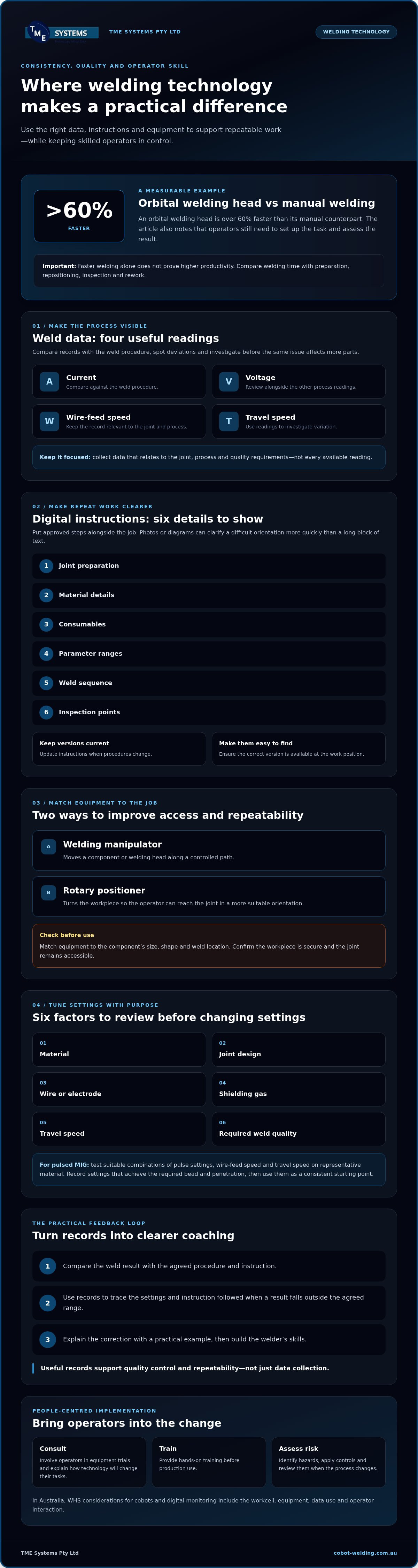
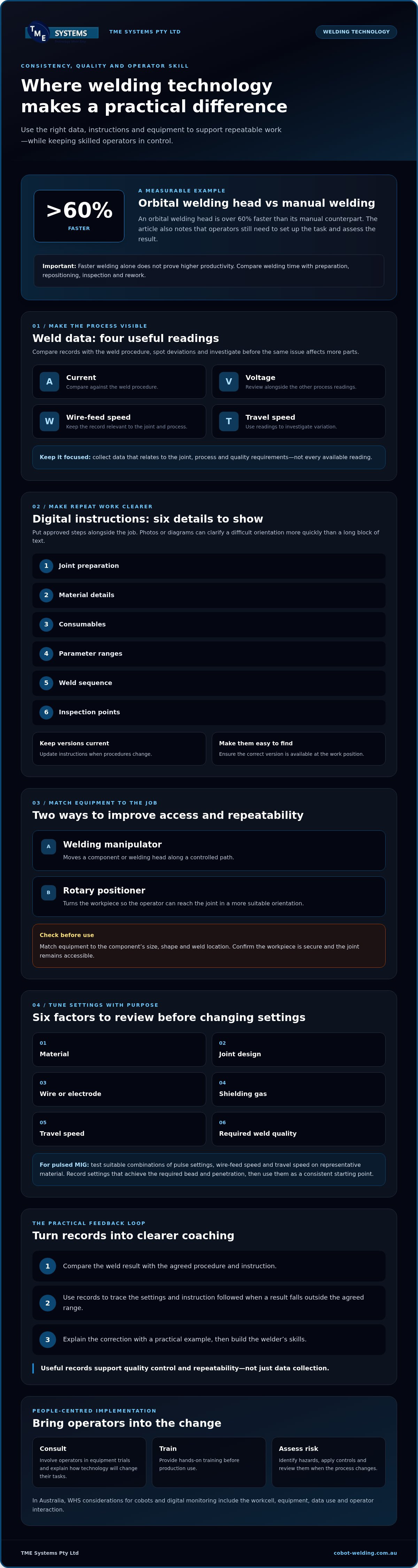
Automation can take on repetitive work and reduce exposure to fumes, radiant heat and physical strain. For example, an orbital welding head is over 60% faster than its manual counterpart. Orbital machines control heat, arc length and rotation speed, while AI-powered vision systems can analyse the weld pool and adjust parameters in real time. These tools can support welding productivity, but operators still need to set the task up and assess the result.
Positioning equipment can make a job easier to access and repeat. A welding manipulator moves a component or welding head along a controlled path; a rotary positioner turns the workpiece so the operator can reach the joint in a more suitable orientation. Match the equipment to the component’s size, shape and weld location. Then confirm the workpiece is secure and the joint remains accessible.
Optimise equipment settings around the weld specification and the job itself. Review the material, joint design, wire or electrode, shielding gas, travel speed and required weld quality before changing settings. For pulsed MIG welding, test suitable combinations of pulse settings, wire-feed speed and travel speed on representative material. Record the settings that produce the required bead and penetration, then use them as a consistent starting point.
Deposition rate matters, but higher output alone does not prove a process is more productive. Compare welding time with preparation, repositioning, inspection and rework. A manipulator or rotary positioner may improve the overall workflow by reducing awkward handling, even if welding speed stays the same.
In Australia, automation and digital-tool costs depend on equipment scope, integration, software, training and the work involved. The price depends on the case and is given after a quote request; compare the full project costs, including setup and ongoing support.
Australian grants or subsidies for welding technology and training are programme-specific. Eligibility depends on factors such as the project, business circumstances, location and which costs the programme allows.
Introducing equipment without adequate training or worker consultation can result in incorrect setup, inconsistent welds, avoidable rework and reduced trust. Involve operators in trials, explain how the technology will change their tasks, and provide hands-on training before production use.
2. Weld data monitoring and digital work instructions
Weld data is most useful when it helps a welder decide what to do next. A monitoring system can capture settings such as current, voltage, wire-feed speed and travel speed. Operators and supervisors can compare a weld against its procedure, spot deviations and investigate before the same issue affects more parts. Focus on data that relates to the joint, process and quality requirements rather than collecting every available reading.
Digital work instructions put approved steps alongside the job. For a repeat weld, an instruction might show joint preparation, material details, consumables, parameter ranges, sequence and inspection points. Photos or diagrams can clarify a difficult orientation more quickly than a long block of text. Keep instructions current when procedures change, and make the correct version easy to find at the work position.
Monitoring and instructions can work together to support weld quality and repeatability. If a result falls outside the agreed range, the record helps the team trace the settings used and the instruction followed. A trainer can use the example to explain a correction and build practical skills, instead of offering a vague reminder to “watch the settings”. Clear, consistent records can also reduce avoidable variation and help teams stay competitive.
Reducing weld metal volume starts with the joint, not simply increasing travel speed. Review the drawing, fit-up, root gap and specified weld size, then check whether the process and sequence suit the part. An oversized weld, for example, can add deposition time and increase the volume requiring inspection. Consistent preparation and clear dimensional checks can help prevent over-welding and rework.
Digital records can make workforce development more visible. Use a skills matrix or training record to track each worker’s process experience, completed instruction, practical assessment and relevant qualifications. Identify the next skill to develop, such as setting parameters or interpreting a weld procedure, then record coaching and sign-off. Supervisors can use this information to assign work and discuss progression.
What digital tools help welders track skills, qualifications and career progression? A skills matrix, learning management system or digital training record can organise completed training, assessments, qualifications and development goals. Link entries to specific processes or tasks so workers and supervisors can see what has been learned and what comes next.
In Australia, WHS requirements mean employers should identify welding and automation hazards, assess risks, apply controls and train workers for their tasks. For cobots and digital monitoring, include the workcell, equipment, data use and operator interaction in the assessment, then review controls when the process changes.
To connect data, instructions and automation in one workflow, consider how cobot welding integration could support the requirements of your weld cell.
3. Welder workforce shortages and retention
For Australian manufacturers, a shortage of skilled welders can put production under pressure and increase demands on existing employees. Recruitment is only part of the response. Employers also need to understand why workers leave, where skills are concentrated and which roles will need experienced welders next. Mapping these needs against current projects helps managers plan training and recruitment around the work ahead.
New starters need practical support before they’re expected to work independently. Strong onboarding and training can help companies retain 82% of new hires. In a welding workshop, this means showing a new employee how to prepare a joint, follow the work procedure, use equipment and raise quality concerns. A named trainer and regular feedback make it easier to address questions early.
Make progression visible to attract and develop a broader workforce. Show, for example, how an apprentice can move from supervised practice towards setting up equipment, reading welding procedures and supporting quality checks. Clear assessment criteria help each employee understand what to practise next. Mentoring can also help people from different backgrounds see a place for themselves in manufacturing.
Pay attention to fatigue when teams face vacancies or high production demands. Repeated movements, awkward access and prolonged concentration can make a shift harder to sustain. Review the job step by step, including workpiece position, handling, task rotation and recurring rework. Where a repetitive weld is suitable, automation may take on repeated motions while the welder focuses on setup, inspection and decisions that require experience.
Retention is easier to manage when supervisors look beyond an individual resignation. Track departures, vacancies, onboarding progress and training records together. If new starters repeatedly leave before learning a particular task, for example, review the instruction, coaching and workload at that stage. Regular conversations can also reveal practical issues such as unclear expectations or limited opportunities to build skills.
Technology can support development when it gives workers useful feedback. A digital training record can help a supervisor and employee identify completed learning and agree on the next capability to practise. Weld data can make coaching more specific: discuss an observed process setting or quality issue, then agree on a practical adjustment. Use these tools to support, not replace, conversations between workers and supervisors.
Before changing a workflow, involve welders in choosing a trial task and reviewing the results. Ask the team to compare the training, setup and inspection steps for a recurring weld, for example. Their input can reveal where instructions need clarification or equipment changes affect the job. This gives workers a direct role in improving their work environment and helps managers make informed workforce decisions.
4. Cobot automation and accessible programming
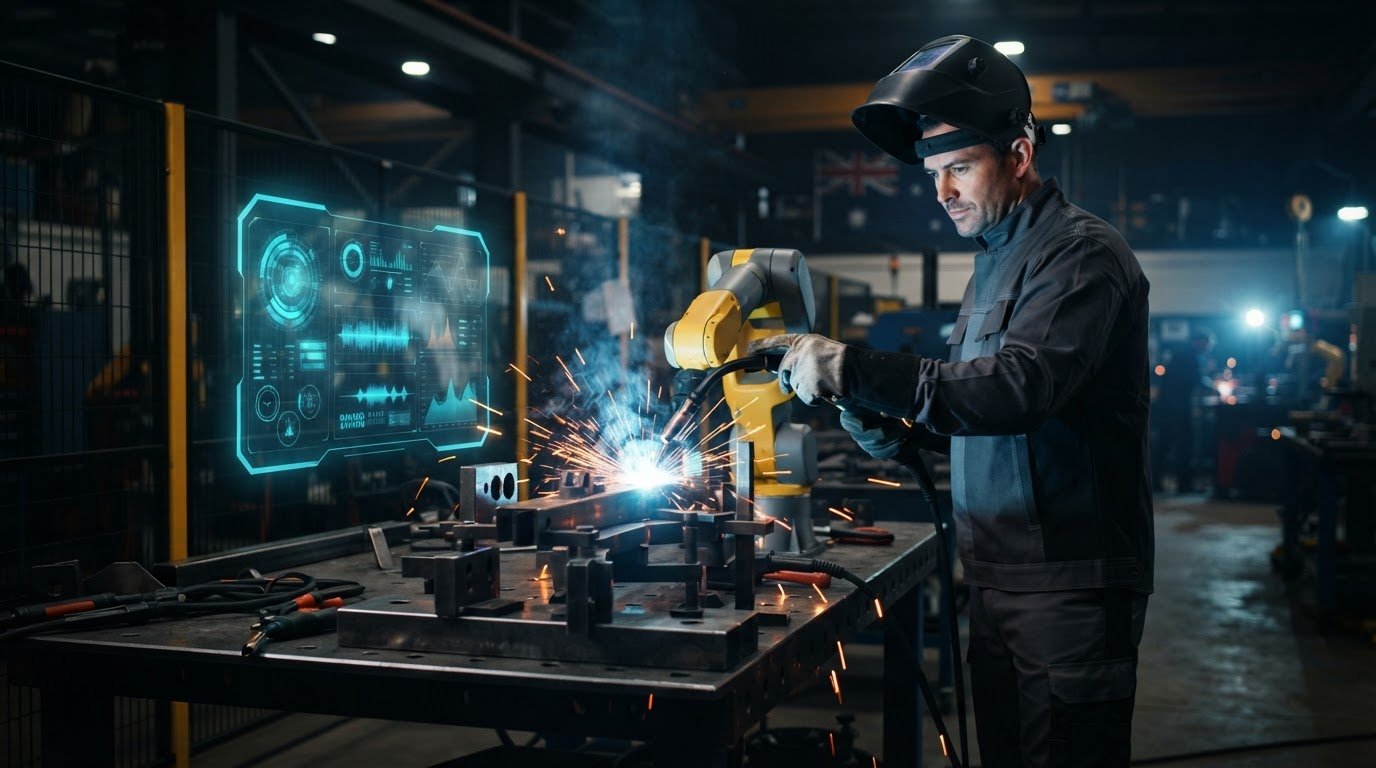
A collaborative robot can repeat a weld path while an operator prepares parts, checks fit-up or inspects finished work. For example, a cobot could repeat a fillet weld on a batch of brackets, leaving the welder to manage setup and quality. The value comes from matching automation to a suitable task, not removing people from welding operations.
Accessible teaching is central to this approach. Traditional robot programming can require specialist skills, making small job changes harder to manage. No-code teaching lets an operator guide the robot along a weld path and adjust parameters through an interface, without writing conventional code. The operator’s knowledge of torch angle, joint access and bead appearance remains essential.
Start with a task that has a stable part, repeatable fit-up and a clear weld procedure. Map the current process, including loading, clamping, welding, unloading and inspection. Identify where the operator needs to intervene. A cobot may improve efficiency if it reduces repeated torch movement without adding handling or setup work.
One automotive supplier increased production output by 400% after deploying 20 collaborative robots. That example shows what a broad automation programme achieved in one setting, not a guaranteed result for every workshop. The outcome depends on the application, production flow, part consistency and how well the new equipment fits existing work.
Before a trial, involve welders in choosing the job and defining success. Agree on the weld quality checks that matter, who will teach the path and how parameter changes will be recorded. Run sample parts, inspect the results and refine the sequence with operators. This makes their experience practical input, rather than treating automation as a change imposed on the team.
Plan training around real operating tasks. Operators need practice setting up the workpiece, teaching or adjusting the path, starting and stopping the cycle, responding to faults and checking welds. Clear roles matter too: a cobot can repeat a taught motion, but people still assess fit-up, consumables and final quality. Include these responsibilities in onboarding.
Accessible cobot automation is suited to repetitive work with a defined process. It may be less useful for one-off parts, frequent design changes or jobs where manual adjustment dominates the cycle. Compare the full workflow before committing. A Collaborative Robot Welding Cell provided by TME Systems Pty Ltd may suit a production need when repeatable tasks, operator involvement and practical training align.
Robotic welding automates repetitive tasks and can reduce human error while increasing productivity. For continued skills development, Weld Australia offers programmes aligned with Australian standards such as AS 1796 and AS/NZS 2980 for welders to expand their knowledge and technique across plate and pipe welding and a variety of processes.
5. Technology and welder recruitment and retention
Technology can influence whether a welding role feels like a place to build a career. When recruiting, show candidates how equipment supports learning, quality and progression, not just output. A workshop demonstration can show an apprentice how digital instructions guide a task or how an operator teaches a robot a weld path. Candidates get a clearer picture of the work and the skills they could develop.
Training tools can give new starters a practical way to build confidence. Augmented reality welding systems can simulate multiple processes, while augmented and virtual reality training lets apprentices practise realistic scenarios in a controlled environment. Trainees can rehearse techniques without using metal, gas or wire consumables. Instructors can then connect that practice to hands-on welding equipment and real work procedures.
Keep the human coaching. A simulator can help a trainee repeat a sequence, but a trainer still needs to explain what a good weld looks like and why settings matter. Link each exercise to a clear next step, such as preparing a joint, selecting a process or interpreting a welding procedure. This progression helps employees see how training can lead to greater responsibility.
How can welding training and virtual reality improve welder retention? It can give apprentices a controlled way to practise processes, build confidence and receive feedback before live welding tasks. Pair that practice with trainer guidance and a visible skills pathway, so learning leads to practical opportunities at work.
Technology adoption also affects retention. Ask employees what slows their work, then trial a relevant tool with their input. Use surveys during phased adoption and provide training on the new system. Operators could, for example, test digital instructions on a task, identify unclear steps and help refine them before wider use. This practical involvement can help improve welder retention with technology.
Measure outcomes instead of assuming new equipment improves employee retention. Track departures, vacancies, onboarding completion, training progress and employee feedback before and after a change. Where practical, compare similar teams or roles and record other workplace changes that could affect results. If retention changes alongside clearer training, use staff feedback and exit interviews to understand the connection.
Also assess whether the technology improves day-to-day work. Review rework, quality concerns, time spent learning tasks and operator confidence alongside retention data. For employers seeking to improve welder retention with technology, output alone is an incomplete measure. Employee feedback can guide adjustments to the rollout, task allocation and training plan.
To discuss a people-centred approach to welding automation, contact TME Systems and explore what could suit your operation.
TME Systems: No-Code Teaching Software
TME Systems offers No-Code Teaching Software that lets operators teach weld paths and adjust parameters without traditional programming. No coding experience is needed. The software can help manufacturers make welding automation more accessible to the people who understand the work. Collaborative Robot Welding Cells and Welding System Integration can support the wider process, while the Mobile Demo System brings a welding cell to your site for evaluation.
Consider this approach when repetitive welding tasks are suitable for automation and operator involvement matters to the rollout. Start with the task, your team’s experience and the training needed to use the system confidently. To discuss how TME Systems’ options could fit your welding operation, visit cobot-welding.com.au.
Make the next change with your team
Technology is most useful when it addresses a real workshop need and gives operators a voice in how work changes. To improve welder retention with technology, make the next step a practical team decision: identify a task that causes frustration, agree on what better work looks like, and involve welders in testing an approach. Their feedback can help shape the rollout and the training that follows.
TME Systems offers No-Code Teaching Software, Collaborative Robot Welding Cells and a Mobile Demo System for manufacturers exploring accessible welding automation. The right starting point depends on your team’s tasks and production needs, so ground the discussion in the work you want to improve.
Contact TME Systems to discuss your needs and explore an approach that supports your people as well as your production. A considered first step can help your team build confidence in what comes next.
Frequently Asked Questions
How is the welding environment changing?
Welding work is increasingly shaped by connected equipment, digital records and operator-focused interfaces. A welder may select a job, follow its procedure on screen and review process information alongside the task. This can make it easier to find the right instructions and understand what has changed between jobs. For manufacturers, usability and clear information are part of the welding environment, not merely production overhead.
What technology helps improve welder retention in Australia?
Tools that support learning and give operators control over their work can help make a role more engaging. No-Code Teaching Software lets operators teach weld paths without coding experience. Integration with existing welding equipment, power sources and fixtures is discussed as part of planning. Pair the technology with operator onboarding, then involve welders in choosing trial tasks and shaping the new workflow.
How can welding technology reduce fatigue, injury and repetitive work?
Automation can take on suitable repetitive welding tasks and may reduce operator exposure to hazardous fumes, radiant heat and physical strain. It does not remove the need to assess the whole job. Review the task, workstation layout, handling requirements and operator interaction, then consider which steps technology should support. Automating a repeated weld cycle, for instance, may let a welder focus on setup and inspection, while safe work practices remain essential throughout production.
How do collaborative robots and welding automation affect welder job satisfaction and retention?
Collaborative robots may support job satisfaction when they reduce monotonous work and let welders use their judgement in setup, quality checks and process improvement. The outcome depends on how the change is introduced. Explain what the robot will handle, train operators to teach or adjust its work, and give the team a voice in refining tasks. If automation limits skill development or feels imposed, it may undermine trust rather than support retention.