
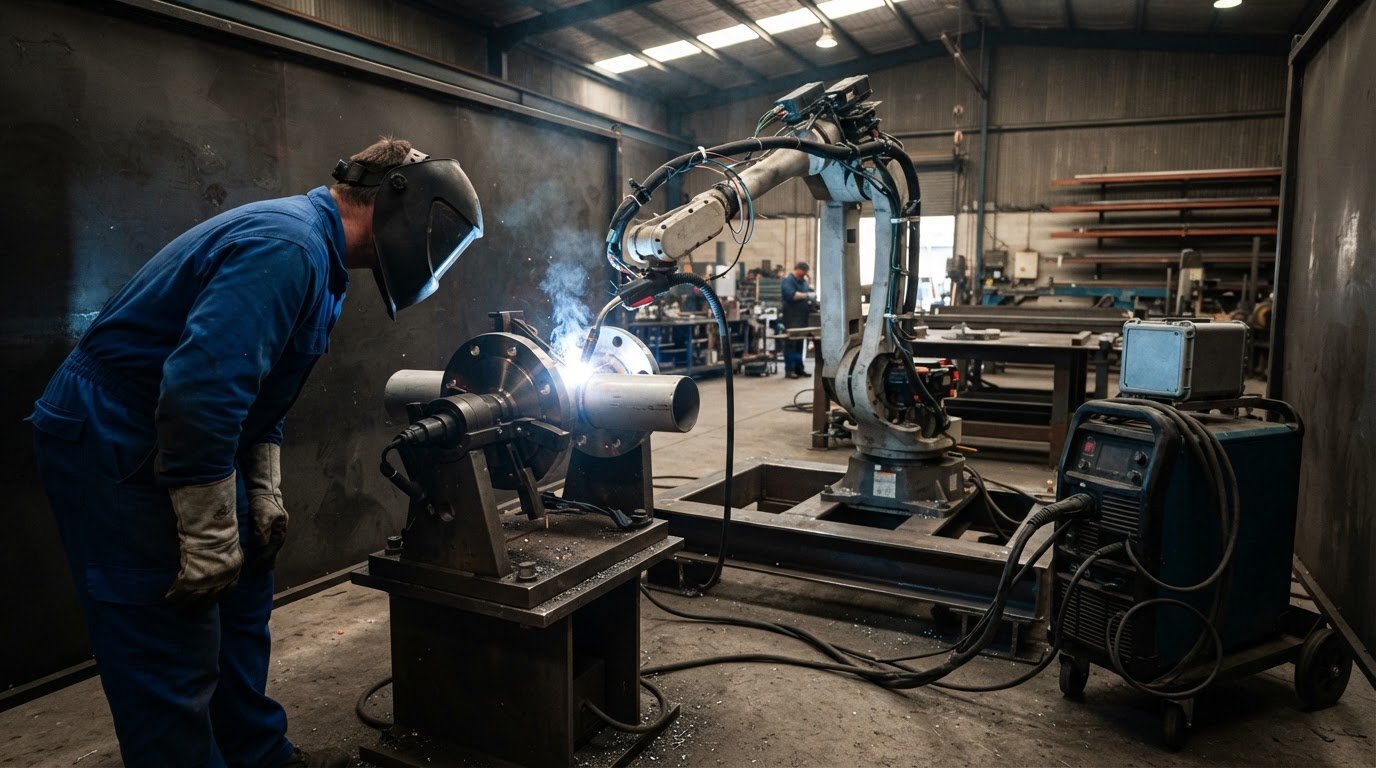
A robot doesn’t become a welding solution through hardware alone. The most useful questions to ask a robotic welding supplier cover how weld data is captured, whether a cobot can handle production variation, where bottlenecks may appear, and how the system will integrate with your existing equipment and workflow. For a general-purpose robot, that means discussing both the welding power source and the software and controls needed to run and adjust the process.
It is natural to focus first on the robot, but consistent welds also depend on how parts are prepared, positioned and presented to the cell. A useful discussion connects these practical details with your production goals, so you can see where automation fits and what operators will need to manage it.
This article covers questions about traceability, varied production, bottlenecks and integration, as well as operator training and facility requirements. The aim is to help you assess the complete welding setup, rather than the robot in isolation.
Key Takeaways
- Ask where weld parameters are captured and how the records help spot quality issues or process inefficiencies.
- Map how the robot, welding power source, fixturing and production workflow will work together before integration.
- Clarify how operators will learn to teach weld paths, troubleshoot issues and carry out routine maintenance.
- Assess the installation space, fume extraction and safety needs alongside the cell’s fit with your production floor.
1. Arc data monitoring and weld traceability
Ask how the welding power source measures weld parameters and how those readings become useful records. A power source can measure output voltage, wire feed speed and weld time hundreds or thousands of times a second. For traceability, ask how arc monitoring captures and controls parameters at the power source, whether software records data for each weld, flags deviations and lets supervisors review trends across a production run.
Useful records can help trace a quality issue to a particular weld parameter, rather than relying only on final visual inspection. They can also reveal process inefficiencies. For example, repeated changes in wire feed speed may prompt a closer look at the weld procedure or part preparation. Ask what data the system captures, how operators access it and how a flagged result can guide a practical adjustment.
Data can't compensate for poor fit-up. Robotic welding repeats programmed movements, so inconsistent part position or joint gaps can undermine weld consistency. Automation may struggle with joint gaps from zero to a ¼-in. gap. Ask how the system handles your parts’ actual variation, and whether preparation, fixturing or sensing needs attention. Consistent fit-up helps the cell produce quality welds and can reduce scrap or rework.
Assess ease of use as well as the data feature list. Can welders understand a fault message, adjust a parameter and resume production without specialist programming? A clear interface can make traceability useful during everyday welding, not just troubleshooting. Ask how the setup handles different jobs and parameter changes, too.
For mild steel around 2 to 3 mm thick, choosing one weld torch over another is not a major concern. For jobs requiring over 300 amps, a water-cooled torch is typically suggested; air-cooled torches are generally sufficient at lower amperages. These practical questions help assess whether the system’s weld quality, usability and affordability fit the work.
4. Welding-system integration
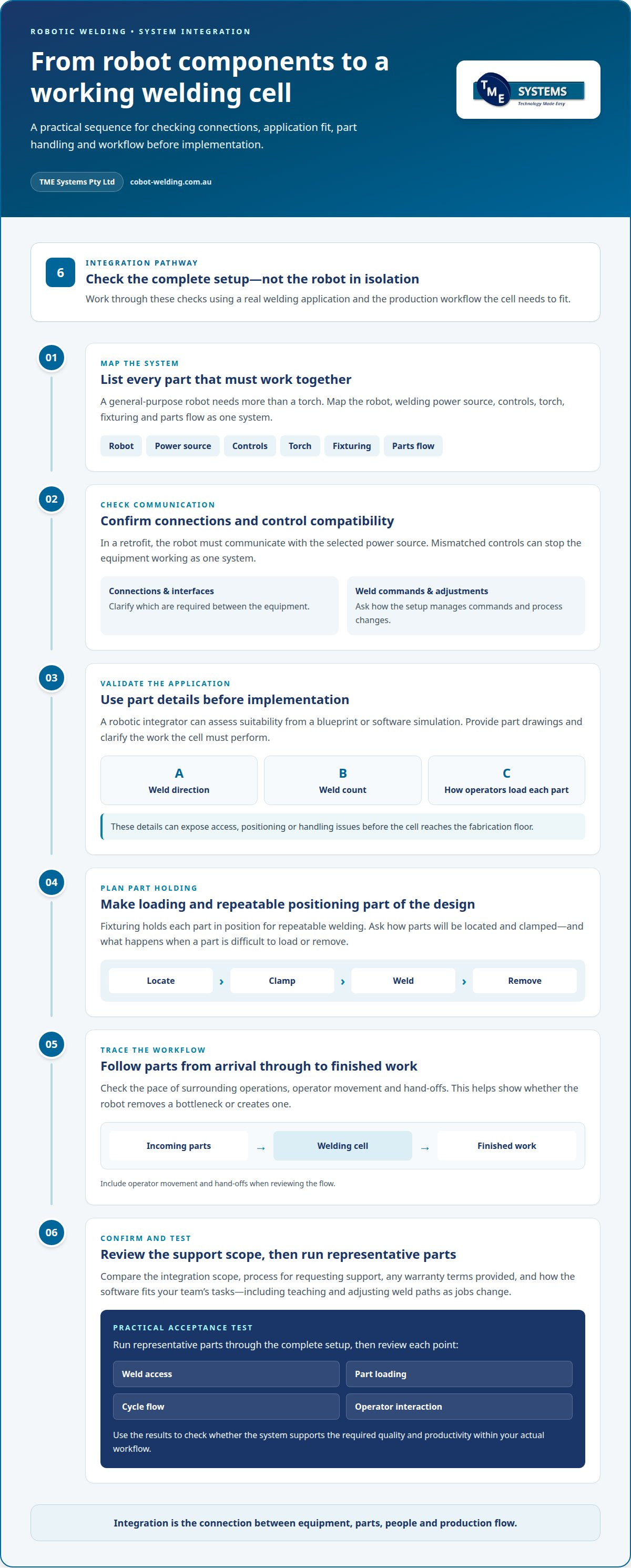
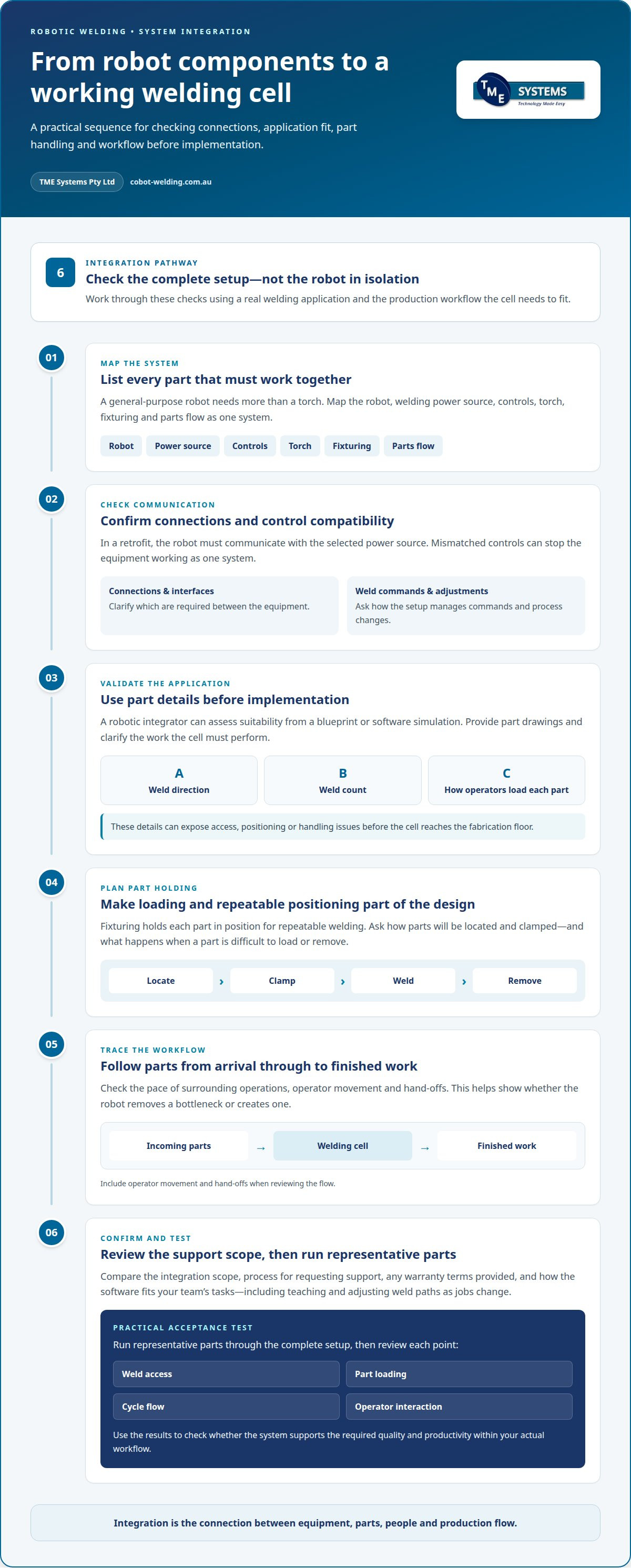
A general-purpose robot needs more than a torch to become a working welding system. Map the robot, welding power source, controls, torch, fixturing and parts flow. In a retrofit, the robot must communicate with the selected power source, and mismatched controls can prevent the equipment from working as one system. Ask which connections and interfaces are required, and how the setup manages weld commands and process adjustments.
Then test the proposed integration against a real welding application. A robotic integrator can assess suitability from a blueprint or software simulation before implementation. Provide part drawings and clarify the weld direction, weld count and how operators will load each part into fixture tooling. These details help expose access, positioning or handling issues before the cell reaches the fabrication floor.
Fixturing holds each part in position for repeatable welding. Ask how parts will be located and clamped, and what happens when a part is difficult to load or remove. The cell also needs to fit the pace of surrounding operations. Trace the workflow from incoming parts to finished work, including operator movement and hand-offs, to see whether the robot removes a bottleneck or creates one.
Ask how the proposed setup integrates with your robot, power source and existing controls. Compare the scope of integration, the process for requesting support and any warranty terms provided. Consider how the software fits your team’s tasks, including how easily operators can teach weld paths and adjust them as jobs change.
Use a practical acceptance test: run representative parts through the complete setup, then review weld access, loading, cycle flow and operator interaction. This shows whether the robotic welding system supports the required quality and productivity within your actual workflow. For a project involving several connected components, welding system integration is a useful next step to explore as you plan the cell.
4. What operator training, programming support, and ongoing technical support does the supplier provide?
Ask what operators will be able to do independently after training, then match the answer to your production tasks. Training should cover teaching weld paths, adjusting settings, troubleshooting common faults and carrying out preventive maintenance. For example, an operator may need to teach a revised path after a part design changes, then recognise when a fault requires maintenance support. This gives you a practical view of the skills the system requires.
Ask how onboarding works on the actual welding cell, not just through general instruction. A useful session lets operators practise loading a part, selecting its program, starting a weld cycle and responding to a routine fault. Find out how training accounts for different experience levels across your team. Current welders may understand weld quality and process adjustments, while needing guidance on robot controls and programming.
Clarify what programming support looks like after handover. Can operators teach or adjust weld paths themselves, or will they need specialist help for each variation? Ask how the system handles a new part, a changed weld path or a revised sequence. The answer helps you understand which tasks your team can manage and when technical assistance may be needed.
Preventive maintenance training should include practical checks, such as inspecting connections, cleaning fixturing and checking the tool centre point. Ask who teaches these tasks, how they fit into routine upkeep and what support is available when troubleshooting goes beyond an operator’s role. Training existing technicians can also help ensure common checks do not depend on one person.
Finally, ask how ongoing training keeps operators’ system knowledge current as production needs change. Compare the support process for a fault, a new operator and a new part program. Clear responsibilities help supervisors plan onboarding and keep the team confident with day-to-day operation. The goal is a welding system your workers can use, maintain and adjust as their tasks evolve.
4. What facility, power, ventilation, and floor-space requirements does a robotic welding system need?
Start with the intended installation location, because it affects cell dimensions, safety measures and overall design. Mark the proposed footprint on a floor plan, then allow space for the robot, fixture, part loading and operator movement. A compact collaborative robot welding cell may require less space than a traditional industrial robot, but the complete work area still needs careful planning.
Map the production route before settling on a position. For example, check whether an operator can move a part from fabrication to the fixture without crossing another work area or blocking a walkway. Consider how parts enter and leave the cell, where controls sit and how maintenance access will work. A cell that fits on paper can still interrupt operations if loading or unloading creates a queue.
Compare the facility’s available electrical supply with the requirements of the robot, welding power source and associated equipment. Ask what connections the installation needs and how cables will be routed without obstructing access. The power source must also communicate with the robot, so include controls and interfaces in the integration plan.
Plan ventilation around the welding process and cell location. Robotic welding can increase fume generation, which may mean additional fume extraction equipment is needed. Check how extraction will fit around the cell and whether it affects access for loading, maintenance or fixture cleaning. If highly flammable materials are used nearby, assess the risk of a welder igniting them when choosing the location.
Safety planning matters near people and moving equipment. Traditional welding robots generally need a restricted area or robust enclosure; suitable cages and screens protect employees from the arc and moving parts. A cell near a high-traffic area may need additional features to alert workers. To assess how a collaborative robot welding cell could fit your floor, review the proposed layout, services and operator flow together.
TME Systems: No-Code Teaching Software
TME Systems’ No-Code Teaching Software lets operators teach weld paths and adjust parameters without traditional programming. It suits teams who want experienced welders to refine weld tasks themselves, rather than rely on conventional robot programming for every adjustment.
For a broader project, TME Systems also offers Collaborative Robot Welding Cells and Welding System Integration. These services can connect operator-led teaching with your welding equipment and production workflow. The Mobile Demo System brings a portable welding cell to your site, so your team can evaluate the approach hands-on.
If you’re considering robot welding, contact TME Systems to discuss a setup for your production needs, or visit cobot-welding.com.au.
Turn your supplier discussion into a practical next step
Questions to ask a robotic welding supplier are most useful when they lead to a clear decision, not just a longer specification sheet. Before moving ahead, define what a successful first application would look like for your team, including the production problem you want to solve and how you will assess the result. This gives your next conversation a practical focus grounded in workshop needs.
Bring that goal to TME Systems and discuss an approach that fits your operation. A focused conversation can help you consider how welding automation may work in your production setting and what to explore next. You do not need every technical detail settled before getting started.
Contact TME Systems to discuss your needs and take the next step at a pace that works for your team.
Frequently Asked Questions
What are the software and hardware requirements for repurposing a general-purpose robot into a welding robot?
Assess whether the robot’s reach, payload and controller suit the torch, cable package and weld paths your parts require. The software should let operators teach and adjust weld paths, while the setup needs an appropriate torch mount and a way to manage cables through the robot’s movements. Useful questions to ask a robotic welding supplier include how the arrangement will be tested on representative parts before production.
Should I use a shock sensor or clutch to mount the torch to the robot?
A shock sensor lets the torch barrel deflect during a collision, reducing the chance of deformation. Compare the protection approach with your recovery procedure: ask how the device resets and how operators restore torch alignment after contact. A jig that maintains the torch barrel’s mechanical tool centre point can speed recovery after a crash. Consider consumable changes and inspection access when deciding on the mounting arrangement.
What materials, part sizes, and welding processes can a robotic welding system handle?
Suitability depends on the material, component geometry, joint design and the torch’s access to the weld. MIG and TIG can both be used when the robot, power source, torch package and process requirements are correctly matched. High-mix, low-volume work can suit automation when the right part families are chosen. Compare representative components, including awkward joints, rather than assessing only your easiest part.
What production volume and cycle time can the robotic welding cell achieve?
Cycle time varies by part and depends on weld length, repositioning, loading and unloading. Time a representative run with the intended fixture, including operator handling, changeovers and planned checks in your estimate. Then compare that cycle with the production schedule and batch pattern. This shows whether the cell can meet demand consistently, rather than relying on an idealised welding-only time.
What are the installation, commissioning, and lead times for a robotic welding cell in Australia?
Installation and commissioning schedules depend on cell design, equipment coordination, site readiness and the testing needed for your parts. Useful questions to ask a robotic welding supplier include which tasks must be completed before delivery, how commissioning trials are structured, and when operators take part in onboarding. Map those stages against production commitments, allowing the team to plan the transition and prepare work instructions without assuming a standard lead time.
What safety standards and Australian regulations apply to robotic welding cells?
Safety requirements depend on the cell design, work process and site risk assessment. Document who operates, loads and maintains the equipment, then assess hazards from robot movement, welding activity and the surrounding work area. Use that assessment to identify the applicable Australian workplace obligations and standards. Record the safeguards, operating procedures and training needed, and review them if the process or cell layout changes.