
A robot on its own isn’t a welding solution. What to look for in a robotic welding integrator is the ability to connect the equipment, process and production task: assess your needs, integrate the system, account for application-specific safety, and prepare operators to use it. That end-to-end view matters whether you’re automating a repeatable weld or adapting to changing production demands.
It’s natural to focus on the cobot, but the surrounding details determine how well a system fits your workshop. Part presentation, fixtures, welding equipment, operator access and workflow all need to be considered together. A collaborative robot’s design alone doesn’t make the complete cell safe.
This guide explains how to assess parts, volumes, welding processes and production goals when planning cobot integration. It also covers safety and the practical components a welding cell may need, including equipment, fixtures, software and operator training. Use it to frame the key questions for a project in Australia.
Key Takeaways
- Bring part details, production volumes, shift patterns and cycle-time targets into the early discussion to help shape an integration around real workshop needs.
- Assess the support around a cobot, including operator training, maintenance and practical help as the system is implemented and used.
- Plan cell layout and operator access alongside safety measures; a collaborative robot alone doesn’t make the whole cell safe.
- Look at the complete system, from welding equipment and fixtures to tooling and software, so its components work together for your production task.
Integrator consultation and production-needs analysis
A sound consultation links your parts, welding process and production demands to an appropriate automation solution. To judge what to look for in a robotic welding integrator, consider how thoroughly they assess these factors before recommending an approach.
Assessing production requirements
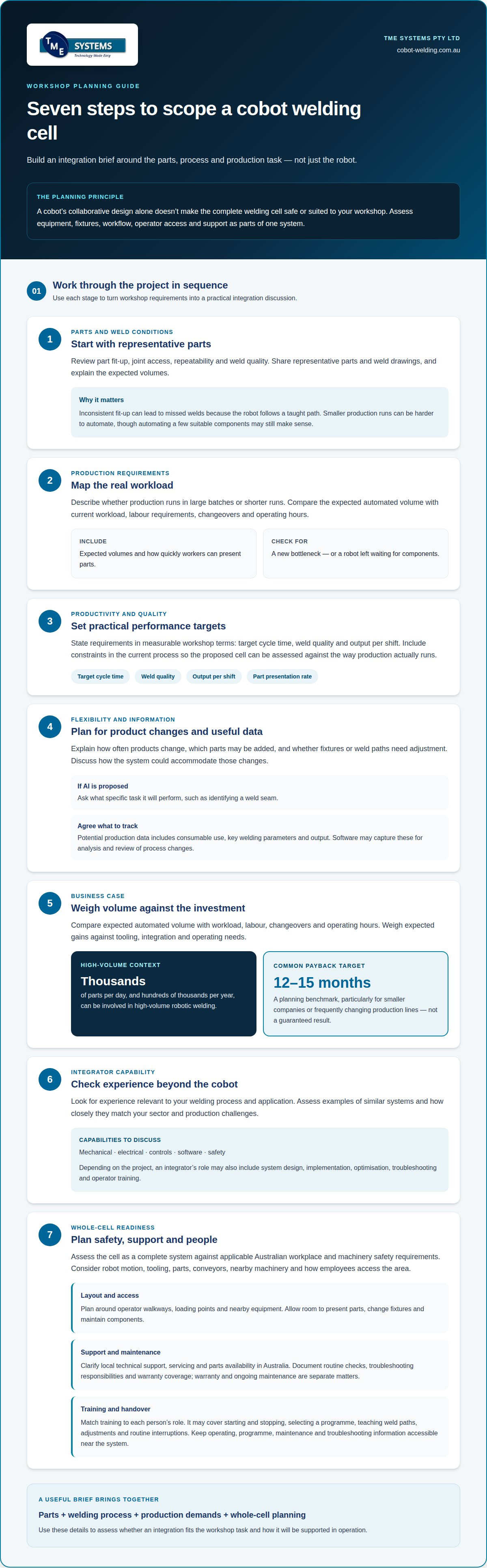
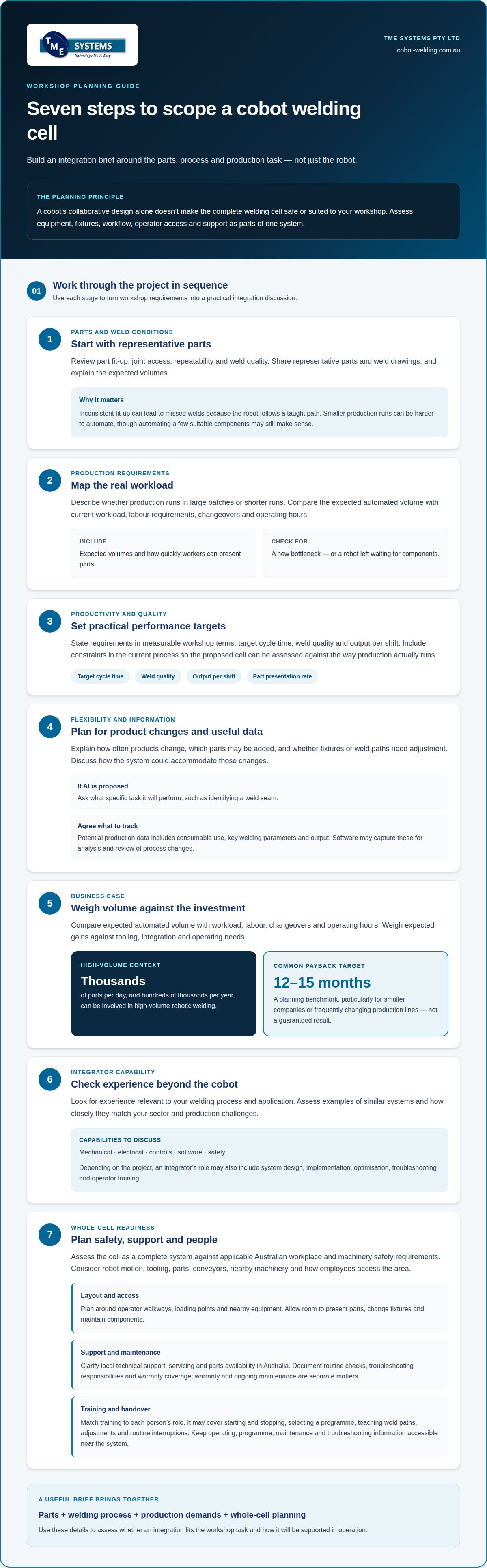
The integrator should review part fit-up, joint access, repeatability and weld quality. Inconsistent fit-up can lead to missed welds because the robot follows a taught path. Share representative parts, weld drawings and expected volumes, whether you run large batches or shorter production runs. Smaller runs can be harder to automate, but automating a few suitable components may still make sense.
Look for experience relevant to your welding process and the capabilities needed for the application, such as mechanical, electrical, controls, software and safety expertise. Review examples of similar systems and consider how closely they match your sector and production challenges. This is a practical way to assess what to look for in a robotic welding integrator.
Setting productivity and accuracy targets
Describe productivity and quality requirements in practical terms, such as target cycle time, weld quality and output per shift. Include constraints in the current process, including how quickly workers can present parts. This helps assess whether the cell can meet production targets without creating a new bottleneck or leaving the robot waiting for components.
Planning for flexibility and production analytics
Explain how often products change, which parts may be added, and whether fixtures or weld paths need adjustment. Discuss how the system could accommodate those changes. If AI is proposed, ask what specific task it will perform, such as identifying a weld seam, rather than treating it as a benefit on its own.
Agree which production data would be useful to collect, such as consumable use, key welding parameters or output. Software may capture these data for analysis, helping teams review performance and identify process changes.
Reviewing production volume and return on investment
Compare expected automated volume with current workload, labour requirements, changeovers and operating hours. High-volume robotic welding can involve thousands of parts per day and hundreds of thousands per year. A common payback target is 12 to 15 months, particularly for smaller companies or frequently changing production lines. Use it as a planning benchmark, weighing expected gains against tooling, integration and operating needs.
How Does an Integrator Add Value Around a Cobot?
An integrator’s role can extend beyond installing a cobot. Depending on the project, it may include system design, implementation, optimisation, troubleshooting and operator training.
Accessing local technical support and servicing
Local technical support matters when a fault interrupts welding operations or a component needs attention. Consider how the support process works, which system components it covers, and how servicing and parts availability are handled in Australia. Clear communication helps your team explain an issue, share relevant system information and get practical troubleshooting guidance. Support should also suit your operators’ capabilities, from routine use to more advanced programming.
Planning maintenance, troubleshooting and warranty support
Maintenance helps keep the robot, welding equipment and fixtures working as intended. A support plan can set out routine checks, troubleshooting responsibilities and how to record maintenance issues. Staff can note when a fault occurred, which program was affected and any visible symptoms before escalating it. That context helps technical support distinguish an equipment fault from a process or setup issue.
Make sure warranty terms are clear in the project documentation, including the equipment covered and how to handle a claim. Keep manuals, system details and service records together for reference when a fault arises. Warranty coverage and ongoing maintenance are separate matters, so understand what each involves.
Providing training and documentation
Operator training should cover the controls and tasks staff will use during welding operations. This may include starting and stopping the system, selecting a program, teaching weld paths, making adjustments and responding to routine interruptions. Match training to each person’s role, so production staff can run the cell and designated personnel can make relevant path changes.
Useful documentation includes operating instructions, program information, maintenance guidance and troubleshooting steps. Keep it accessible near the system and explain how updates are recorded. This supports consistent shift handovers and helps new operators learn without relying on informal instructions alone.
For manufacturers planning a cell as well as ongoing operator support, cobot welding system integration brings these considerations into the wider project.
Where Does Machine Safety Fit?
In Australia, assess a robotic welding cell against applicable workplace and machinery safety requirements as a complete system. A cobot’s collaborative design alone doesn’t establish that the cell is safe. Consider robot motion, tooling, parts, conveyors, nearby machinery and how employees access the area.
Assessing facility space and workplace safety
Plan the cell footprint around operator walkways, loading points and nearby equipment. Allow space to present parts, change fixtures and maintain components, rather than planning around the robot arm alone. A packaging station beside the cell, for example, can disrupt material flow or create a bottleneck if workers need to cross an operating area.
During layout planning, identify where operators will stand to load parts, inspect welds and respond to interruptions. Check sightlines around guarding and vision equipment, as well as maintenance access. The layout should account for workpieces and welding tools alongside robot movement, so routine tasks don’t take people into hazardous areas.
Reviewing machine risks and applicable standards
A machine safety risk assessment should examine hazards across the complete cell, including robot movement, tooling, workpieces, conveyors and nearby machinery. It should also consider how employees approach the system during production, setup and maintenance. This helps determine safeguards for the actual layout and tasks, rather than relying on the cobot’s classification alone.
Depending on the assessed hazards, safeguards may include gates, interlocking switches, keyed lock systems, safety mats, light curtains or scanners. These are options to evaluate, not a universal checklist. The integrator should identify applicable Australian requirements and explain how the selected measures address access and operating risks. Welding can expose workers to heat, fumes and hazardous materials, so consider how the cell design manages those exposures.
Components of a turnkey robotic welding system
A welding cell involves more than a robot and power supply. Its components need to work together for the specific application, part presentation and production demands.
Selecting welding processes, robots and equipment
Start by matching the process to the weld: robotic systems can perform MIG, TIG, arc, spot and laser welding. The integrator should engineer a combination of robot, controls and welding equipment suited to the application. Brand choice depends on compatibility with the equipment and system design, so assess the proposed configuration rather than assuming one brand fits every job.
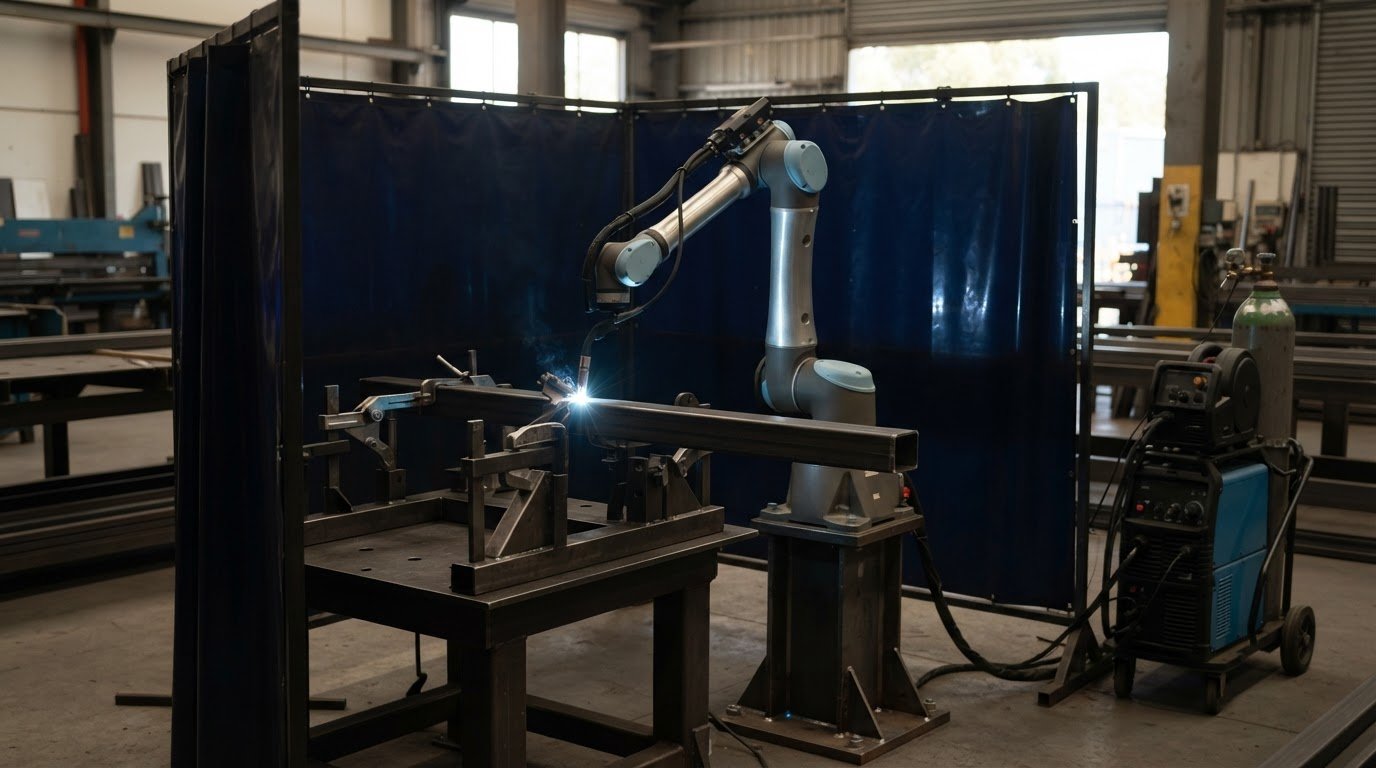
A cell may include a collaborative robot, welding power source, torch, fixtures and other equipment. Sensors or cameras may help locate seams, position welds, or verify clamp and part position. For MIG welding, the torch needs to manoeuvre around tooling and reach the joint. Fixture design also matters: it must hold parts consistently while leaving a workable path for the torch.
Testing cell acceptance and weld quality
Agree on acceptance criteria before the welding system is installed. Use representative parts to test weld placement, clamping, repeatability, cycle time and the required quality standard. Simulation can help assess performance before installation, while physical trials show how the complete cell handles actual parts and fit-up.
Review finished welds for defects such as porosity, cracking, burn-through, distortion, incomplete fusion or penetration, and undercutting. Record results against agreed criteria and identify adjustments before handover. This gives both teams a clear basis for acceptance, rather than relying on a successful demonstration with only an ideal part.
Discuss the full equipment scope, acceptance tests and future tooling needs in your robotic welding system project. Planning for jigs and accessories helps surface requirements that could otherwise affect implementation, schedule or investment. A turnkey system should also fit into existing workstations and leave a practical path for changing applications as demand shifts. That joined-up view helps manufacturers stay competitive while keeping the cell centred on real production work.
TME Systems: No-Code Teaching Software
TME Systems’ no-code teaching software lets operators teach weld paths and make adjustments without writing code. It’s designed for teams that want to use their welding knowledge to refine a task without relying on traditional robot programming for each change.
TME Systems provides collaborative robot welding cells and integration services, bringing the robot together with existing welding equipment, fixtures and production processes. Its Mobile Demo System brings a portable welding cell to your site for a hands-on evaluation of collaborative welding.
If you’re assessing an application or planning an integration, contact TME Systems to discuss the next step.
Take the next step with a production-ready plan
Knowing what to look for in a robotic welding integrator helps turn an automation idea into a practical project brief. Start by selecting a candidate welding task and agreeing how it fits your production operation. This gives your team a focused basis for discussing how automation could support existing skills and future requirements.
TME Systems offers no-code teaching software, collaborative robot welding cells, integration, demonstrations, onboarding, training and ongoing support. The next step is to discuss your candidate task and explore how operators could teach its weld paths and how a cell might fit your production flow.
Contact TME Systems to discuss your project and consider a practical path forward for your workshop.
Frequently Asked Questions
What Is An Integrator?
A robotic welding integrator designs and assembles an automation solution around a manufacturer’s production task. The role connects the robot with welding equipment, fixtures, controls and operator workflows, rather than simply supplying a robot. For example, an integrator considers how a part is loaded and positioned, how the weld is made, and how staff will use the system during ordinary production.
What Happens During a Robotic Integration Project?
A project typically moves from defining the application to designing, configuring and commissioning the cell. The team first agrees on the parts and tasks involved, then develops the system around the process and site. Before handover, the setup is tested against agreed production requirements. Operators can then learn the relevant controls and workflows, while the manufacturer prepares the cell for routine use and ongoing support.
Why Is Buying a Robot Different from Integrating a Robotic System?
Buying a robot provides the central machine, but integration makes it work as part of a production operation. The robot still needs suitable welding equipment, fixtures, controls and a way to present parts consistently. For instance, a robot may reach a weld joint, yet the application can still falter if the fixture blocks the torch or the part isn’t positioned reliably. Integration addresses those connected details.
How to compare robotic welding integration quotes, costs and return on investment in Australia?
Compare proposals by checking the scope of equipment, fixtures, controls, installation, testing, training and support. Costs depend on the project, including its configuration, integration scope, tooling and application requirements. To assess potential returns, compare expected production use with current labour time, rework, consumables and changeovers. Use the same assumptions when reviewing each proposal.
What certifications and qualifications should Australian welding integrators have?
Their qualifications and expertise should suit the application, with the mechanical, electrical, controls, software and safety capabilities the project needs. Check their experience in your sector and similar systems they have implemented.