
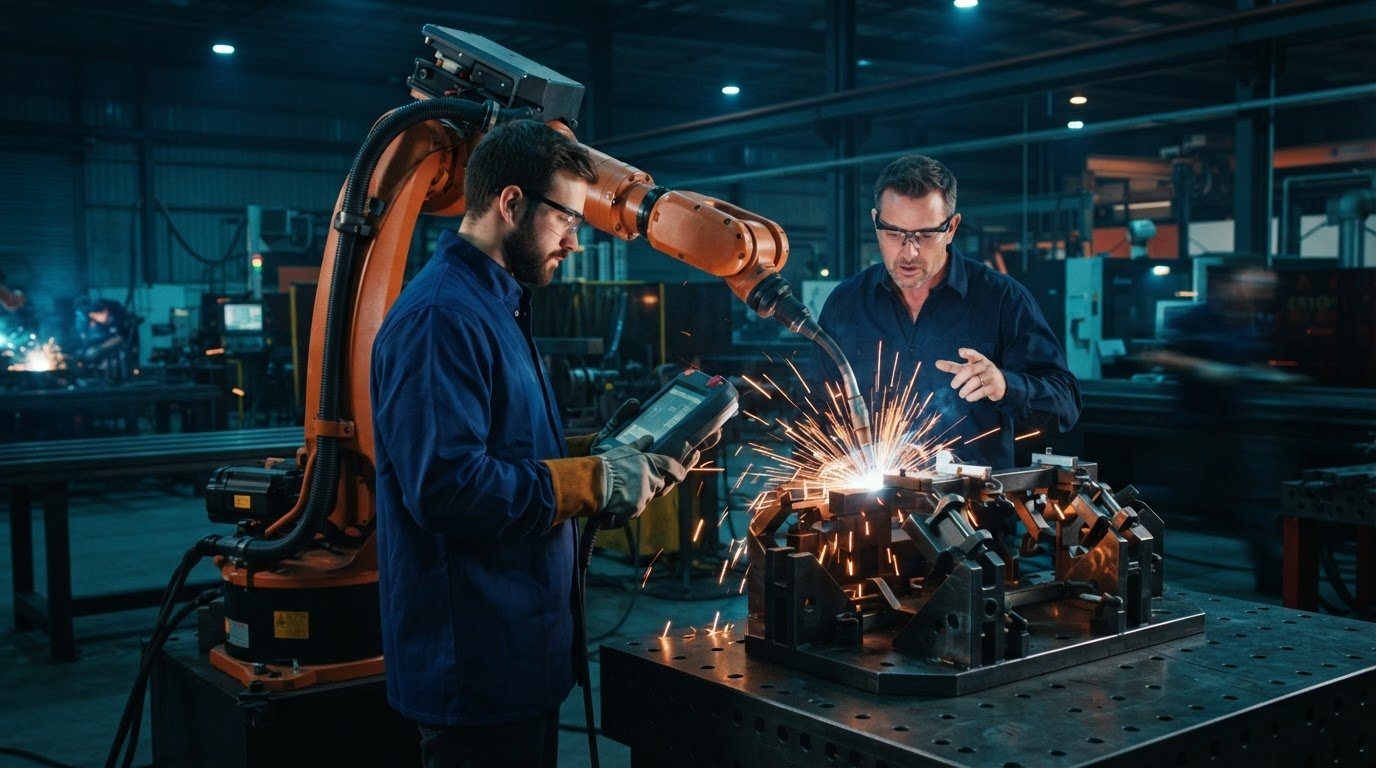
Robotic welding operator training builds the skills to set up, program and operate a welding robot safely, then check that its work meets the job requirements. In the Australian competency, learners must use software, including canned cycles and sub-routines, to program welding operations on at least two occasions. Training is most useful when it reflects the system, welding process and experience of the people using it.
It’s understandable to expect programming to be the hardest part. In practice, operators also need to interpret specifications, determine weld coordinates, make adjustments and trial programs. Training that connects these skills to real production tasks makes them easier to apply on the workshop floor.
This article explains what training covers, how programming practice and good operating habits fit together, and why application-based instruction matters. It also looks at on-site training after installation and how instruction can be adapted to different robotic welding systems and experience levels, from operators learning the controls to experienced welders building programming skills.
Key Takeaways
- Build programming confidence by learning to interpret job specifications, set weld coordinates and trial programs against production requirements.
- Good practice includes checking that robot movements are smooth and that the programmed process produces work to specification.
- Training is easier to apply when it reflects your welding process, materials, fixtures and production goals.
- On-site instruction can help operators learn the controls and routines on the system they’ll use in production.
- Match the training to operator experience, from foundational operation through to programming and troubleshooting skills.
Robot programming knowledge and good practice
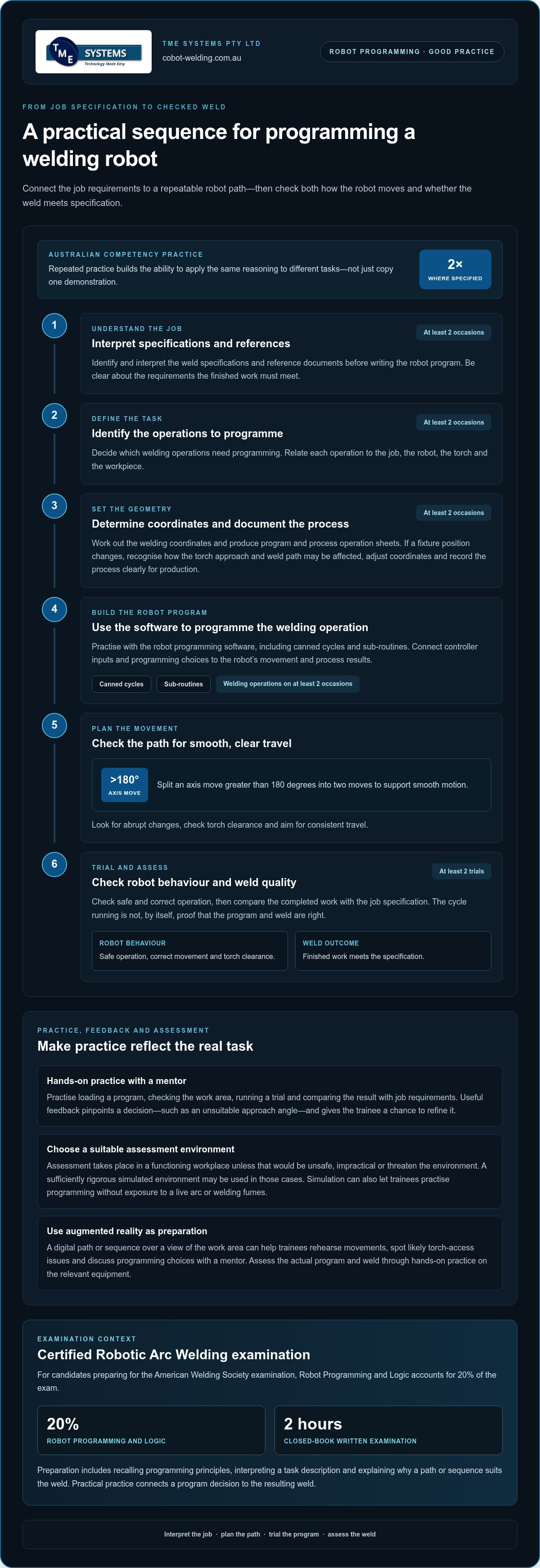
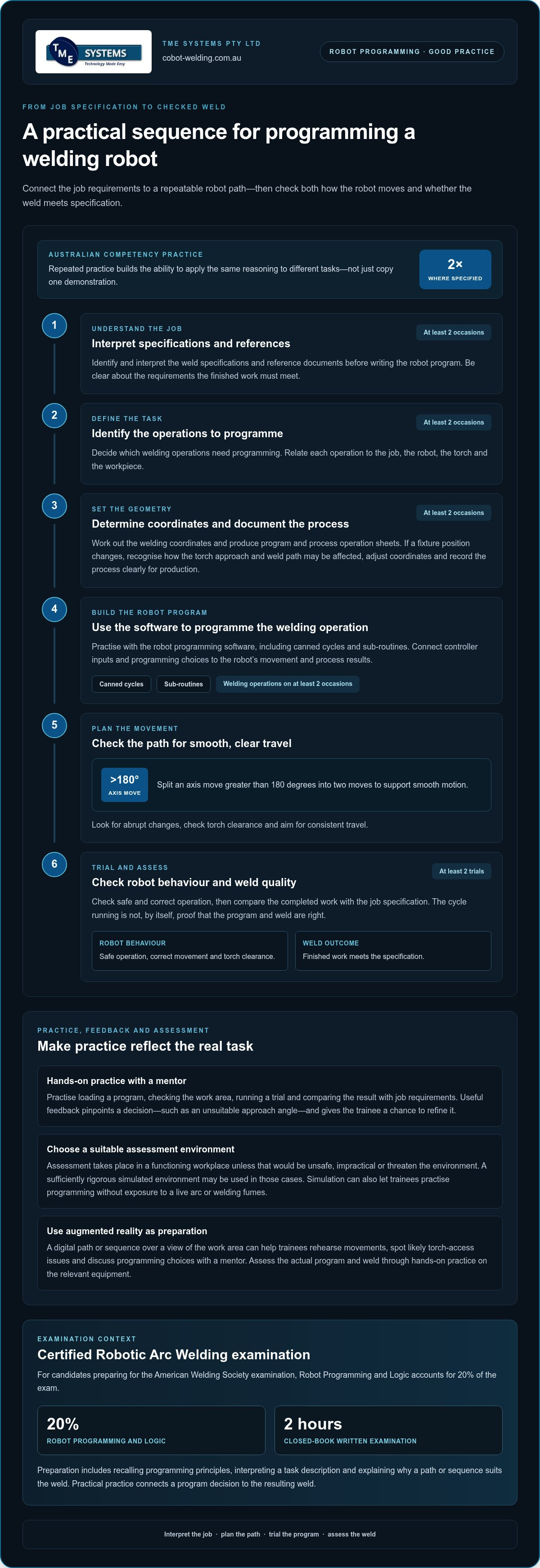
Effective robot programming connects the weld specification to a repeatable path and process. In Australia, the relevant competency expects learners to identify and interpret specifications and reference documents on at least two occasions when writing welding robot programs. They also identify operations for programming on at least two occasions. This practice builds the ability to apply the same reasoning to different tasks, rather than relying on a single demonstration.
Before programming, learners need to understand the weld requirements and how the robot, torch and workpiece relate. They determine welding coordinates and produce program and process operation sheets on at least two occasions. For example, a change in fixture position can affect the torch approach and weld path. The operator needs to recognise the change, adjust the coordinates and record the process clearly for production.
Movement planning matters too. Robot programmers are advised to split axis moves greater than 180 degrees into two moves to support smooth motion. Trainees can practise checking the planned path for abrupt changes, torch clearance and consistent travel. They then trial the program on at least two occasions, checking safe and correct operation and whether the completed work meets the specification. The point is to assess both robot behaviour and weld quality, not simply whether the cycle runs.
Practical examination preparation
For candidates preparing for the American Welding Society’s Certified Robotic Arc Welding examination, Robot Programming and Logic accounts for 20% of the exam. The written examination is closed book and lasts two hours. Preparation should therefore include recalling programming principles, interpreting a task description and explaining why a path or sequence suits the weld. Practical practice can reinforce that knowledge by linking a program decision to the resulting weld.
Hands-on practice, mentoring and assessment
Hands-on practice connects controller inputs with robot movement and process results. A mentor can observe a trainee loading a program, checking the work area, running a trial and comparing the result with job requirements. Feedback is most useful when it pinpoints a decision, such as an unsuitable approach angle, and gives the trainee a chance to refine it.
Assessment should reflect the task being learned. It takes place in a functioning workplace unless assessment there would be unsafe, impractical or threaten the environment. In those cases, a sufficiently rigorous simulated environment may be used. Simulation also lets trainees practise programming without exposure to a live arc or welding fumes.
Augmented reality practice
Augmented reality practice can support early learning by showing a digital path or sequence over a view of the work area. Trainees can rehearse movement sequences, identify likely torch-access issues and discuss programming choices with a mentor before using the robot. Treat this as preparation, then assess the actual program and weld through hands-on practice on the relevant equipment.
What is welding robot operator training?
Robotic welding operator training develops the skills to prepare, programme and run automated welding equipment for production. It combines welding knowledge with practical use of robot controls and programming tools.
Training Programme Structure and Duration
A programme combines instruction with practical work using robot controls, programming software and welding tasks. Its structure matters because operators need to understand how their choices affect the cell and finished weld.
In Australia, on-site cobot welding operator training is typically delivered over 1 to 3 days; off-site training is typically 1 to 2 days. Duration depends on the training format and scope. A course may move from control basics to teaching a path, running a task and reviewing its result.
Operator Roles and Practical Skills
Operators prepare and run a cell, monitor its operation and respond to changes in a welding task. Practical learning can cover selecting a program, positioning a workpiece, using a teach pendant and checking the result against job requirements.
Training also covers software functions, including canned cycles and sub-routines. The Australian competency requires learners to use software to program welding operations on at least two occasions. Robotic welding operator training should connect these exercises to the operator’s actual responsibilities and equipment.
Qualifications and Entry Requirements
Robot operator training and manual welding qualifications develop related but distinct skills. Manual welding qualifications focus on direct control of the process; robot training adds cell operation and programming. Welding experience helps operators judge the finished weld, while programming practice builds familiarity with the robot interface.
For the Australian robotic welding programming unit, no licensing, legislative or certification requirements apply at the time of publication. The unit was developed for post-trade engineering fabrication training and recognition of post-trade programming skills. The specified programming level is AS 1554 Structural Purpose (SP) or equivalent.
Programming and Operating a Welding Cell
Cell operation follows a practical sequence: interpret the job, prepare the equipment and workpiece, create or select a program, then run and assess the weld. A teach pendant lets an operator record positions at the robot; offline programming allows paths to be prepared in software. The right method depends on the system and task.
Operators monitor the process and respond to issues such as a shifted workpiece or a weld that misses its specification. Risks include exposure to an arc and welding fumes. Simulated practice lets trainees practise without exposure to a live arc or welding fumes. Operating procedures should reflect the cell and workplace conditions.
For Australian fabricators, robotic welding operator training is most relevant when it prepares people for the controls, tasks and decisions they’ll handle in production.
Application-based training for welding processes
Application-based training connects programming practice to operators’ welding work. In a fabrication shop, robotic welding operator training can use the team’s materials, fixtures and production goals, rather than treating programming as a separate classroom exercise.
A programme can be tailored to the parts and processes the team handles. For example, a trainee working with a repeatable bracket can practise positioning it in a fixture, teaching the torch path and reviewing the weld. A different material or joint design may call for different process settings or movement. Relevant examples help operators apply their skills to actual work.
Training should also reflect the cell’s workflow. If parts are loaded by hand, operators can learn how loading and positioning affect the programmed path. If a fixture locates several components, practice can focus on the reference points guiding the robot. Robotic welding operator training becomes more relevant when learners understand why a program suits one setup but may need adjustment if the fixture or part changes.
Useful training activities can include:
- Reviewing the job specification and identifying weld locations.
- Preparing the workpiece and fixture for the intended position.
- Teaching or adjusting the path to suit the joint and torch access.
- Running a trial, inspecting the result and recording process changes.
Application documents help make tasks repeatable. Trainees can work from relevant specifications and reference documents, then record program and process operation details. Notes might identify the part, fixture arrangement, weld sequence and settings used. Clear records help another operator understand the setup and compare results when production conditions change.
Troubleshooting practice should include realistic variations. A fixture may be repositioned, a part may sit differently, or a weld may miss its specification. The trainee can identify what changed, inspect the setup and program, make a controlled adjustment and assess the result. This builds judgement about whether an issue relates to positioning, the robot path or the welding process.
For Australian manufacturers, application-based robotic welding operator training links instruction to the team’s materials, fixtures and production priorities. Operators practise the work they need to deliver and learn to document how each task is programmed and run.
Application-based practice can also support preparation for professional certification. The American Welding Society offers Certified Robotic Arc Welding (CRAW) certification for people who can programme and execute a robot weld according to industry standards. The AWS CRAW program requires a minimum of six months' experience in manual or semiautomatic arc welding processes for both Operators and Technicians. Welding Processes accounts for 15% of the AWS CRAW examination, giving process knowledge a defined place in the assessment.
Ongoing learning can be connected to the same practical work and recorded over time. AWS CRAW renewal can be met through documented completion or instruction of at least 40 contact hours in relevant training courses. AWS CRAW recertification requires evidence of at least 80 contact hours of qualifying activities, documented as 8 CEUs or 80 PDHs. Robotic welding technicians work with engineers and operators to monitor weld quality, optimize performance, and refine production processes. Training that includes shared review of welds and process adjustments can help prepare teams for this collaborative work while keeping learning activities relevant to production.
On-site training after system installation
Training on the installed system lets operators practise with the equipment, controls and fixtures used in production. Instead of learning from a generic example, they can work through a representative part and see how each program decision affects the application.
On-site cobot welding operator training is typically delivered over 1 to 3 days. Off-site cobot welding training is typically delivered over 1 to 2 days. On-site instruction suits teams who need practice with their installed cell, while off-site sessions provide a separate learning environment. The right format depends on the equipment, task and skills the team needs to develop.
At the installed system, an instructor can relate technical explanations to the cell’s layout. Operators can identify teach pendant controls, examine torch access around a fixture and practise loading a workpiece. They can then run a training task and observe the robot follow its programmed path. This approach connects reference material with the equipment operators use each shift.
A useful on-site session can follow a clear sequence:
- Review the cell layout, controls and relevant operating references.
- Demonstrate a representative welding task and explain the programmed sequence.
- Let operators practise setup and operation on the installed equipment.
- Discuss the result, identify adjustments and repeat the task where appropriate.
Off-site instruction can suit introductory learning or a team preparing for a new application. A separate training environment gives learners space to become familiar with controls before applying that knowledge at work. It can also help when production scheduling makes the installed cell difficult to access. The trade-off is that operators may need to adapt what they learned to their own fixtures and workflow.
Remote training can support discussion of programming concepts, reference documents and operating sequences across locations. For example, a trainer can review a program with operators at different sites and explain how to interpret its steps. Practical work still requires access to the relevant system, so remote instruction works best when paired with hands-on practice at each location.
For manufacturers with multiple sites, a shared training framework can help teams use consistent terminology and document processes comparably. Each site can then apply the framework to its own cell, workpieces and production flow. A checklist of setup steps, program references and common troubleshooting examples gives operators a useful reference without assuming every environment is identical.
Plan instruction around the installed system and its application: the parts, fixtures, operator tasks and production sequence. This keeps technical explanations connected to the work the team needs to deliver.
Training tailored to robotic welding systems and operator experience
Useful training starts with the robotic welding system, the work it performs and the operator’s current skills. A team running short production batches may need to teach and adjust programs often. A team making repeat components may focus more on consistent setup, parameter control and recognising changes in weld quality. Learning should match these day-to-day demands.
System differences matter. Operators need to understand their controller, torch arrangement, fixtures and program workflow. For example, a trainee moving from manual welding may already recognise joint fit-up and weld defects but still need guided practice teaching robot positions and adapting a path. Someone familiar with robot operation may need more focus on welding parameters and how settings affect the finished weld.
Training can be adapted by experience level:
- New robot operators: Learn the controls, cell workflow and how to run an existing program.
- Experienced welders: Connect knowledge of weld quality and joint preparation with robot path and process choices.
- Current operators: Refine programming, parameter adjustment and troubleshooting on representative production tasks.
- Team leaders: Build the capability to explain routines and support consistent practice across the team.
This distinction helps avoid a common mismatch: teaching basic welding concepts to experienced welders, or expecting new operators to interpret robot behaviour before they understand the controls. A trainer can use a real part and fixture to assess what the learner already understands, then focus practice on gaps. One operator may need to improve torch approach planning, while another needs practice identifying whether a poor weld relates to positioning or process parameters.
Robotic welding technicians also troubleshoot equipment, adjust welding parameters and check that quality standards are met. Their training needs to connect system behaviour with weld outcomes. A structured exercise can ask the learner to inspect a sample, review the program and settings, identify a likely cause, make a controlled correction and assess the next result.
For manufacturers building internal capability, train-the-trainer cobot welding training is typically delivered over 2 to 3 days. It can help selected staff develop the skills to coach colleagues using shared terminology, demonstrations and task-based practice. The approach suits teams that need consistent instruction across shifts, while still adapting examples to each operator’s experience.
Match the training plan to your system and operator roles, then build practice around the work your team needs to deliver. Explore collaborative robot welding cells to see how a cell can fit your automation plans.
A career pathway recommends training in robotic programming and an apprenticeship or internship in automated welding systems, alongside advanced certifications in welding robotics or automation systems and specialised training in collaborative robotics.
TME Systems: No-Code Teaching Software
TME Systems Pty Ltd offers No-Code Teaching Software that lets operators teach weld paths and adjust parameters without traditional programming. No coding experience is needed. The operator-focused software suits manufacturers who want their teams to work directly with welding tasks, including when programming experience varies. TME Systems Pty Ltd also offers Collaborative Robot Welding, Welding Automation Integration and a Mobile Demo System that brings the welding cell to your site for evaluation.
If you're considering how no-code teaching could fit your process, visit cobot-welding.com.au to learn more about TME Systems Pty Ltd's approach.
Turn training plans into confident practice
Before introducing automation into a production task, decide what operators need to handle independently. Consider who will teach or adjust weld paths, who will monitor the process and which tasks need technician support. These priorities give your team a practical basis for setting learning goals.
Robotic welding operator training is most useful when it helps people apply their fabrication knowledge through the controls and workflows of their system. Focus on how operators will use the equipment in real work, and build capability around the tasks they’ll take responsibility for.
TME Systems offers No-Code Teaching Software, Collaborative Robot Welding and a Mobile Demo System that brings the welding cell to your site for evaluation. These offerings help you explore how operators interact with robotic welding and which learning approach suits your operation. Start by discussing your parts, processes and team’s experience with TME Systems.
Contact TME Systems about operator training to discuss the next step for your team. A considered plan can help operators build confidence through practical work.
Frequently Asked Questions
What Australian welding, machinery, and workplace safety standards apply to robot welding operators?
Requirements depend on the task, equipment and workplace risk assessment. The Australian robotic welding programming unit specifies programming to AS 1554 Structural Purpose (SP) level or equivalent, while no licensing, legislative or certification requirements apply to that unit at the time of publication. For a specific cell, the employer’s safety controls should reflect its robot, tooling, welding process and site conditions. The assessment requirements also refer to the National Vocational Education and Training Regulator Act 2011, according to the Federal Register of Legislation.
What jobs, salaries, and career pathways are available for robotic welding operators in Australia?
Robotic welding operators prepare and run cells, monitor operations and respond to changes in welding tasks. In Australia, the programming unit is designed for post-trade engineering fabrication training and covers programming skills; no licensing, legislative or certification requirements apply to the unit. The material provides no Australian salary figures.