
A robotic welding cell can be expanded after installation if its layout leaves room for added capacity, modular fixtures or new processes. Scaling production with modular welding cells can mean adapting the existing setup in stages as demand and product requirements change, rather than starting again. Planning for access, part positioning and future floor space helps make those changes practical.
It’s understandable to want more output without disrupting the production floor. A modular approach can make it easier to adapt the cell to the work, the operator and the parts being welded. This article explains how a cell can grow after installation, how layout choices affect production flow, and what to weigh when comparing expansion with replacement.
Key Takeaways
- Plan cell capability around likely product changes so expansion can build on the existing setup.
- Assess how part handling, loading and station hand-offs affect cycle time, not just robot speed.
- Match added welding capacity to production demand to avoid committing capital before it is needed.
- Weigh potential operating savings against integration and equipment costs when assessing return on investment.
Can a robotic weld cell be expanded after installation?
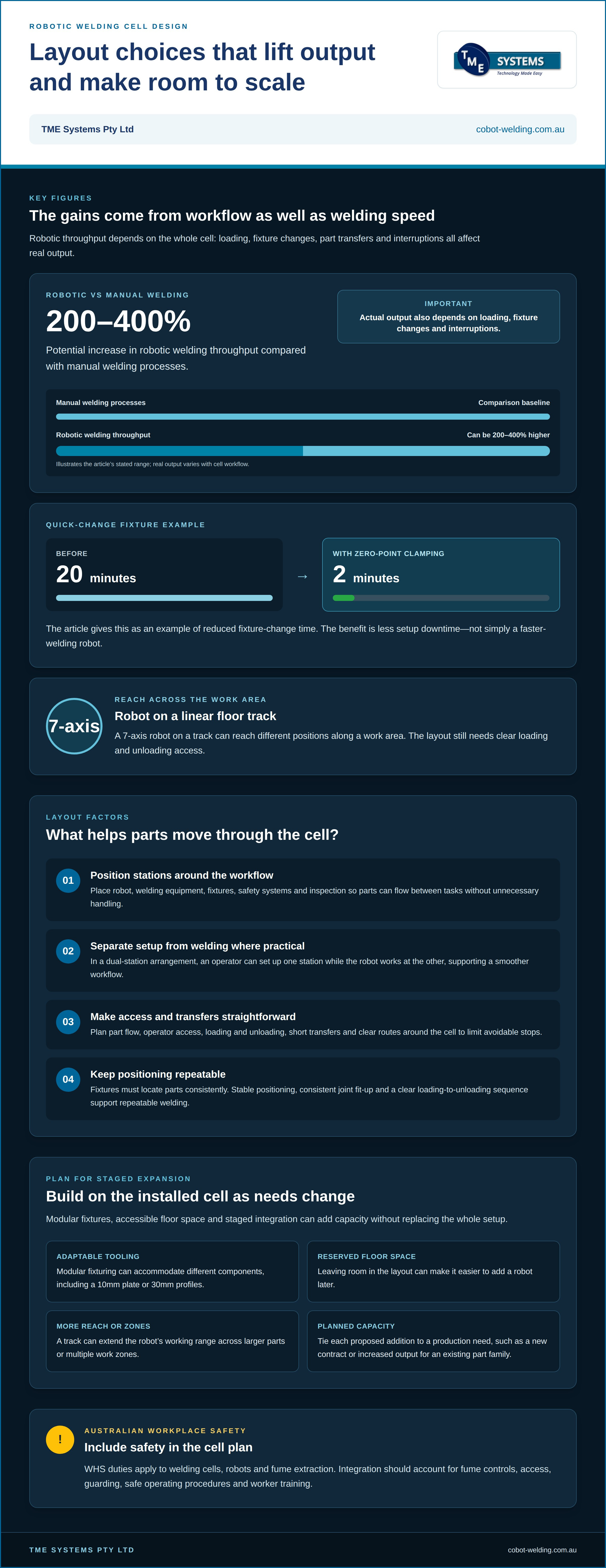
Yes. A cell planned around modular fixtures, accessible floor space and staged integration can add capacity without replacing the whole setup. Expansion may accommodate a new part family, another work zone or an additional process in the existing workflow.
Modular Cell Expansion
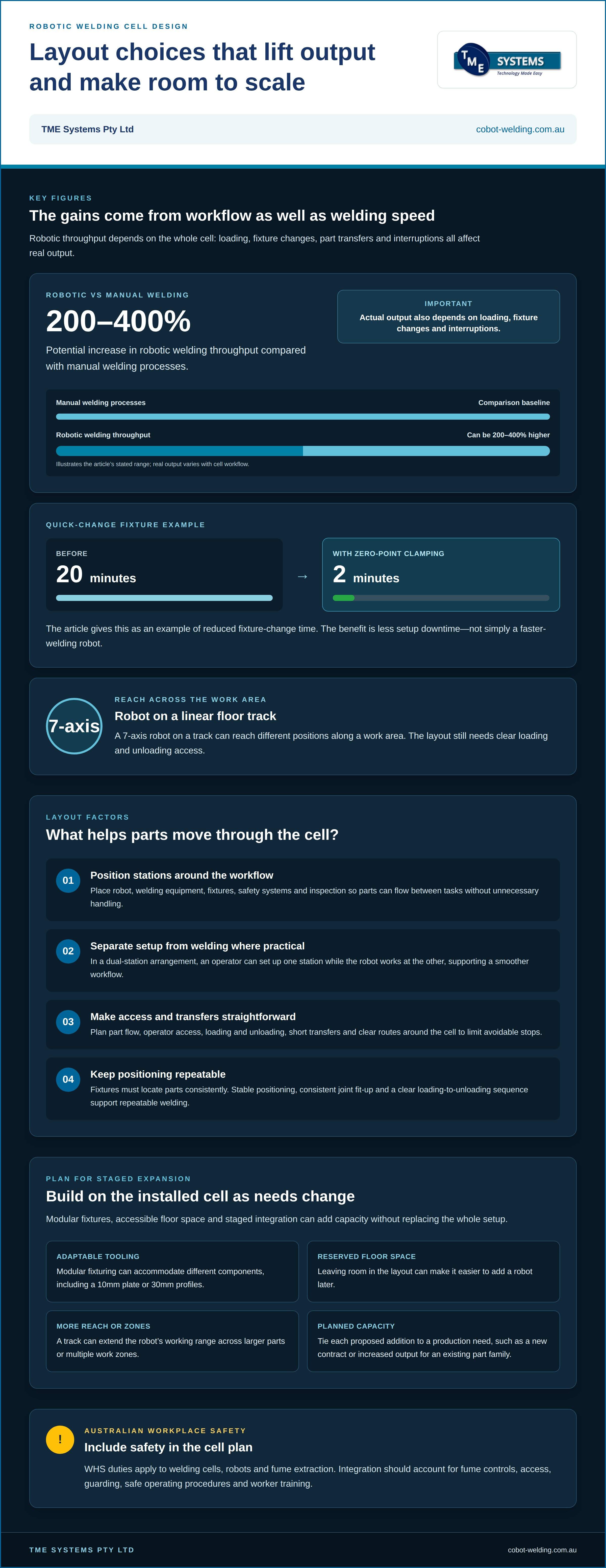
A modular robotic welding cell uses adaptable equipment and tooling so production capability can grow in stages. That matters when demand or part requirements change, because expansion can build on the installed cell rather than start from scratch. Modular fixturing can accommodate different components, such as a 10mm plate or 30mm profiles. Reserved floor space can also make it easier to add a robot later.
Work Envelopes and Work Zones
A robot’s work envelope is the area it can reach to weld or handle a part. Plan the envelope around the component, fixture and operator access. A track can extend the robot’s working range across larger parts or multiple work zones, giving the cell room to take on new tasks. Careful positioning helps prevent blocked access and awkward part transfers.
Material Handling and Adjustable Fixtures
Material-handling robots move components between defined points, while adjustable fixtures hold parts in position for welding. Together, they can reduce manual handling between operations and make changeovers easier to manage. Each fixture must still locate parts consistently, since changes in clamping or fit-up can affect weld repeatability. The right arrangement depends on the parts, workflow and planned cell capacity.
Repeatable robotic welding depends on stable part positioning, consistent joint fit-up and a clear sequence from loading to unloading. For example, a workflow can separate operator loading from the robot’s welding task, helping reduce interruptions while keeping the operator involved in production.
In Australia, WHS requirements apply to welding cells, robots and fume extraction through duties to identify and manage workplace risks. Cell integration should account for fume controls, access, guarding, safe operating procedures and worker training.
How does weld cell layout reduce production time?
A well-planned layout cuts avoidable movement, loading delays and interruptions between welding tasks. During design, installation and commissioning, a provider should consider part flow, operator access, equipment integration, inspection and the production demands the cell must meet.
Cell Equipment and Components
A fabrication cell brings together the robot, welding equipment, fixtures, safety systems and stations needed for production. Their positions matter: a poorly placed fixture can add handling, while an inspection station near the cell can help parts move smoothly through the workflow.
For example, a 7-axis robot on a linear floor track can reach different positions along a work area. The layout should also allow clear loading and unloading, so operators aren’t waiting for the machine or reaching across the work zone.
Manual and Automated Cell Performance
Manual welding relies on an operator to position and weld each component; automation can repeat programmed movements and settings. Robotic welding throughput can increase by 200% to 400% compared with manual welding processes, although the cell’s real output also depends on loading, fixture changes and interruptions.
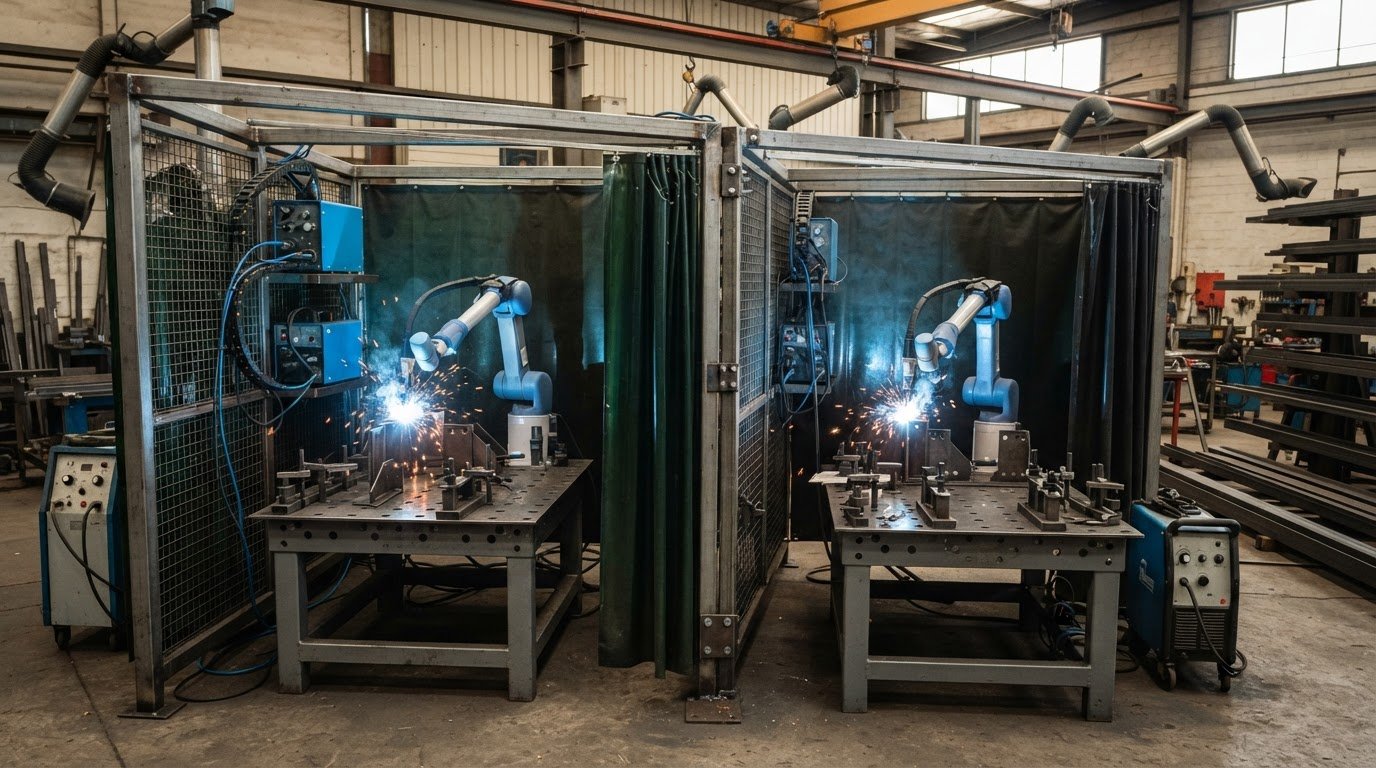
Layout can increase output without asking the robot to weld faster. In a dual-station arrangement, an operator can set up one station while the robot works at the other, supporting a smoother workflow and more consistent production.
Modular Design and Reconfiguration
A modular layout uses adaptable equipment that can be modified or redeployed as products change. That flexibility matters when a new part or production program no longer suits the original configuration.
Quick-change fixtures and planned connections can simplify reconfiguration. Zero-point clamping, for example, can reduce fixture-change time from 20 minutes to two minutes. The value comes from less setup downtime, not simply from increasing robot speed.
Uptime and Production Footprint
Cell uptime depends partly on how work flows around the machine. Shorter transfers, accessible fixtures and parallel setup can reduce avoidable stops, while a defined footprint keeps operator routes and part movement clear.
Battery cell contact systems are different from robotic welding cells, so their capacity and layout needs shouldn’t be treated as interchangeable. Cell contact systems typically require 2-3 weeks for production capacity expansion. For welding applications, a modular welding cell integration can align equipment and workflow with the parts being produced.
What makes a weld cells scalable?
A scalable cell can increase output in stages as production demand changes. Common bottlenecks include limited floor space, inconsistent part supply and downstream processes that cannot handle the added volume.
Capacity and Capital Expenditure
Capacity and capital expenditure can grow in stages, with investment tied to production needs. A plan for scaling production with modular welding cells should link each proposed addition to a specific demand, such as a new contract or increased output for an existing part family. This helps avoid adding equipment before the rest of the line is ready, while leaving room to adjust the plan as requirements develop.
Adding Standard Cells
Standard cells are repeatable production units that manufacturers can add to increase available capacity. Shared layouts and quick-exchange jigs can make it easier to use a familiar setup for another production task. This approach can suit related parts that use similar processes. Each added cell still needs to fit the workflow, have a reliable component supply and leave operators enough room to work.
Production-Line Capacity Expansion
Production-line expansion means increasing output across connected operations, not just at the welding station. For example, a line making two part families may need separate cell capacity or a planned changeover between runs. The design should account for how parts move through welding, inspection and assembly. Otherwise, added welding capacity can simply shift the queue to another station.
A K-Positioner configuration is one option to assess against the component and application. Its position affects how parts are presented for welding and how the cell connects to neighbouring operations. Successful scaling production with modular welding cells depends on matching the arrangement to the work and intended production flow.
Scaling Risks and Bottlenecks
Scaling risks are constraints that prevent new equipment from delivering its intended output. A mismatch between welding, part handling and inspection capacity can create queues or idle time. For instance, if components do not reach the cell at the right pace, additional equipment will not resolve the supply constraint. A coordinated production-line plan can help identify these pressure points before expansion.
Operational cost savings and return on investment
Estimate cell capacity using required production volume, cycle time and available production time. Include operator loading, changeovers and planned downtime, since welding time alone does not represent the full manufacturing cycle.
Operating Costs and Floor-Space Efficiency
Operating costs cover the resources needed to keep a welding cell producing, while floor-space efficiency measures how effectively its footprint supports the work. Both matter when assessing investment: an additional machine may need more than space for the machine itself.
Map the cell’s full operating area, including part staging, operator access and material movement. For example, a compact layout that blocks component delivery may create extra handling and reduce usable capacity. Compare the complete footprint with the production volume it can support.
Material Waste and Operating Costs
Material waste increases operating costs when inconsistent fit-up or weld variation leads to rejected components or rework. Tracking scrap and rework by part family can show where precision and repeatable positioning may improve the manufacturing process.
For example, if an assembly regularly needs repair after welding, include the extra labour and materials in the operating-cost review. A welding cell can support consistent work, but results still depend on suitable fixtures, joint preparation and the welding process.
Cycle Time and Operator Loading
Cycle time is the full time needed to complete a part through its cell operations, including loading and unloading. It matters because the robot’s arc time alone does not show how many finished components the cell can deliver.
Record each stage, from operator loading through welding and part removal. Then identify where the operator waits or the machine sits idle. A dual-station setup, for example, may let an operator prepare one component while the robot welds another, improving workflow without relying on faster robot movement.
Return on Investment and Cell Capacity
Return on investment compares the expected operating benefits with the full investment required for a cell. To estimate the number of cells needed, divide production demand by the output each cell can deliver during available production time.
Use measured cycle times, realistic loading and changeover allowances, and the planned operating schedule. Then compare the resulting capacity with the required volumes. Discuss welding cell capacity planning to assess how cell design and integration could fit your production requirements.
TME Systems: Collaborative Robot Welding Cells
TME Systems helps Australian manufacturers assess collaborative robot welding cells for changing production needs. Its welding system integration connects the cell with the wider workflow, while No-Code Teaching Software lets operators teach weld paths and adjust jobs without traditional programming.
This approach can suit manufacturers looking to build welding automation around operator capability and evolving production needs. The Mobile Demo System brings the welding cell to your site, so your team can see the workflow in a familiar production setting.
For a discussion about your production requirements, contact TME Systems.
Plan for the production you’re building towards
The next useful decision is not simply how much output to add, but what production needs to handle next. A new part family, changing batch mix or tighter delivery schedule can alter what a cell needs to do. Bringing those demands into early planning helps keep automation aligned with the work, rather than with a snapshot of current production.
Looking ahead gives manufacturers a clearer basis for discussing scope, integration and how operators will work alongside a cell. For manufacturers scaling production with modular welding cells, the aim is to preserve options where demand may shift while committing capital against defined requirements. Planning can centre on your parts, production targets and floor constraints, as well as how operator skills and workflows may develop.
Discuss your production plans with TME Systems and consider a practical next step for your operation. A well-considered plan can make the path ahead easier to shape.
Frequently Asked Questions
How can modular equipment reduce operational costs in manufacturing?
Modular equipment can help control operating costs by letting manufacturers adapt a production setup instead of replacing it when work changes. For example, a business introducing a new component may be able to adjust fixtures or add a compatible module. The cost impact depends on integration, changeover requirements, maintenance and how often the revised setup is used.
What Is a Modular Robotic Welding Solution?
A modular robotic welding solution combines a robot, welding equipment and configurable production components in a cell that can be adapted for different work. Its value lies in practical flexibility: manufacturers can plan around specific parts, fixtures and operator tasks. The robot, welding power source, torch package and process settings must suit the application for consistent operation.
What is an industrial fabrication cell and why is modularity important?
An industrial fabrication cell is a defined work area where equipment and people carry out production tasks, such as welding and part handling. Modularity matters when the product mix or workflow changes, because adaptable fixtures and equipment can help the cell accommodate different jobs. For a workshop making several related assemblies, this can support changeovers without redesigning the entire production area.
What return on investment can be expected from implementing an automated fabrication cell?
Return on investment varies with the application, production volumes and operating costs affected by the cell. Assess expected output alongside integration, training, maintenance, material use and any effect on rework. A business producing repeat components may benefit differently from one handling varied jobs. Compare projected savings with the full implementation cost, then review actual performance after commissioning.
What is a modular welding cell and how does it scale production?
A modular welding cell is a setup designed so its equipment or tooling can be adapted as production needs evolve. It can scale through changes such as revised fixtures or added compatible capacity. For example, a manufacturer taking on a related part family might adapt the cell around shared work processes rather than treating every new job as a separate production system.
How do modular welding cells compare with fixed welding lines and manual welding bays?
Modular cells offer more scope for reconfiguration than a fixed line built around a narrow production program. Manual welding bays can suit work with varied parts or low repeatability needs, while automation may suit recurring tasks with stable fit-up. The right approach depends on product mix, required output, available floor space and how much change the operation expects.