
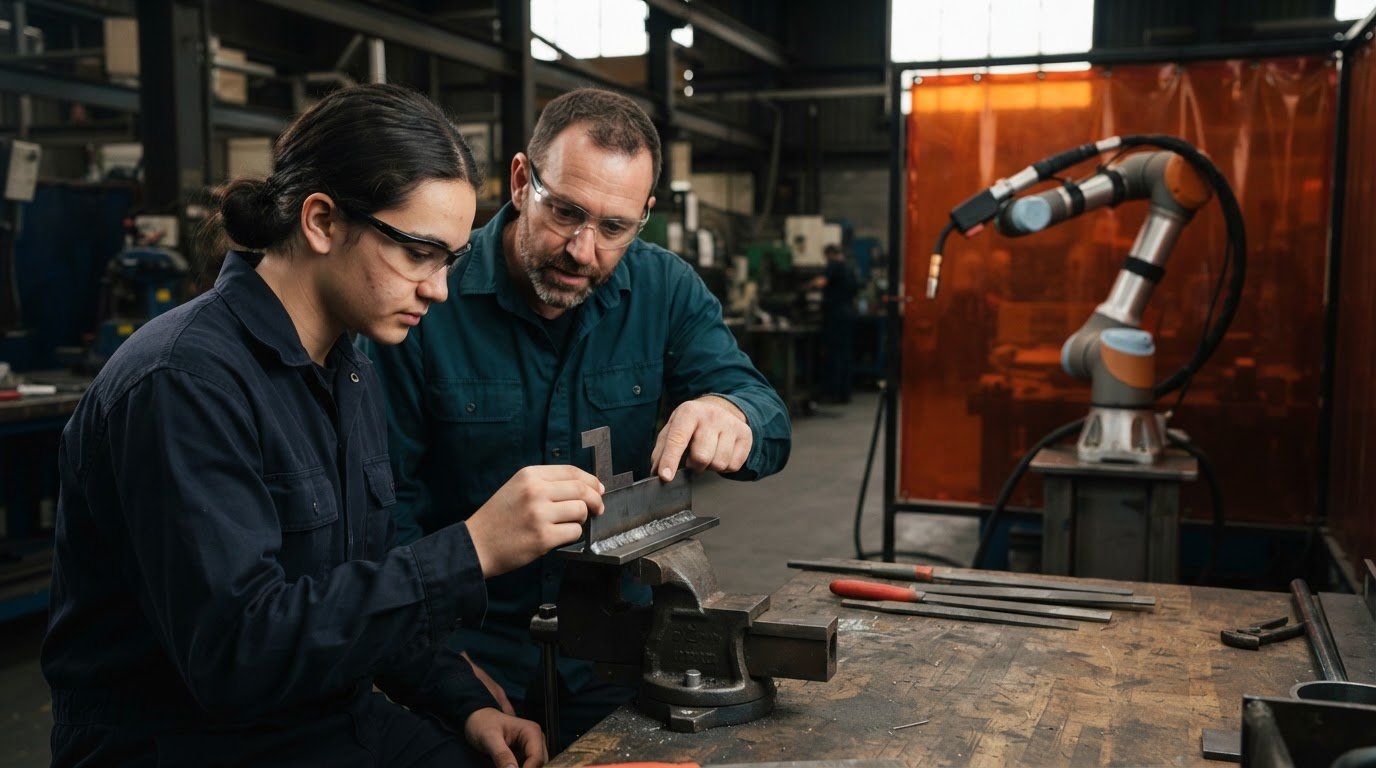
Upskilling welders for robotic welding means building on practical welding knowledge with training in robot operation, weld-path teaching, cell safety and quality checks. Effective learning combines clear explanations with hands-on practice using the equipment, materials and tasks from the workplace. The goal is to help welders set up and adjust automated jobs while keeping their judgement central to quality.
It’s understandable to wonder how automation affects the people who know the work best. Robots can handle repeatable welds, giving skilled welders more time for complex or variable work. Their expertise remains essential to setting up the process and judging weld quality.
This article explains what robotic welding training covers, how welders contribute to setup and troubleshooting, and why quality checks still rely on informed operators. It also looks at how practical onboarding can help a team build confidence with robotic systems at a manageable pace.
Key Takeaways
- Choose a robot teaching method that lets welders make and adjust weld paths without relying on traditional programming.
- Build quality checks around joint preparation, fit-up, material cleanliness and weld settings, alongside safe cell operation.
- Use welders’ process knowledge to set up jobs, spot defects and troubleshoot when a robot’s results need adjustment.
- Start with a clearly defined, repeatable task so the team can build practical confidence before taking on more complex work.
What are robotic welding training programs?
Upskilling welders for robotic welding combines welding knowledge with robot operation, weld-path teaching, safety and quality checks. Training is most useful when it centres on a real production task, such as repeating a consistent weld on a well-fixtured assembly.
Choosing robot programming methods
Robot programming methods range from teach-pendant instructions to software that builds paths from 3D models. A teach pendant lets a programmer set points and adjust parameters at the cell; offline programming uses a computer model to prepare and test a job away from production equipment. The best fit depends on task complexity, available models and how the team learns.
Automatic programming software can reduce manual path entry, but operators still need to understand and review the proposed weld path. One reported comparison puts the Human Teach Device method at an average of 131 seconds per task, against 468 seconds for traditional teaching programming. These are method-specific figures, not a guarantee for every system.
Operator and programmer training
Operator training focuses on running the cell, loading parts, selecting a job and recognising when a process needs attention. Programmer training adds creating or adjusting paths, setting reference frames, changing weld schedules and troubleshooting. This distinction helps allocate learning to each role.
A practical upskilling plan for robotic welding starts with a real weld task and supervised practice. Welders can build on their process knowledge by learning how to operate the cell, teach a path and identify when a result needs attention.
Australian qualifications and certifications
Relevant foundations include qualifications or certificates in welding, metals fabrication or machining, followed by practical training on the robotic welding system used at work. Trade knowledge helps learners understand the process; robot-specific learning builds cell operation and programming skills.
There isn’t one qualification covering every robot and workplace task. Training can include the relevant process, such as GMAW (MIG), GTAW (TIG) or spot welding, alongside hands-on practice.
Training costs and incentives in Australia
Training costs vary with the delivery approach, equipment access and the skills being developed. Employers can focus learning on the selected production task, including cell operation, path teaching and quality checks.
Government support depends on the relevant scheme and its eligibility criteria. The time it takes an experienced welder to build new skills varies with their background, the robot interface and the complexity of the task.
Human judgment in weld quality and safety
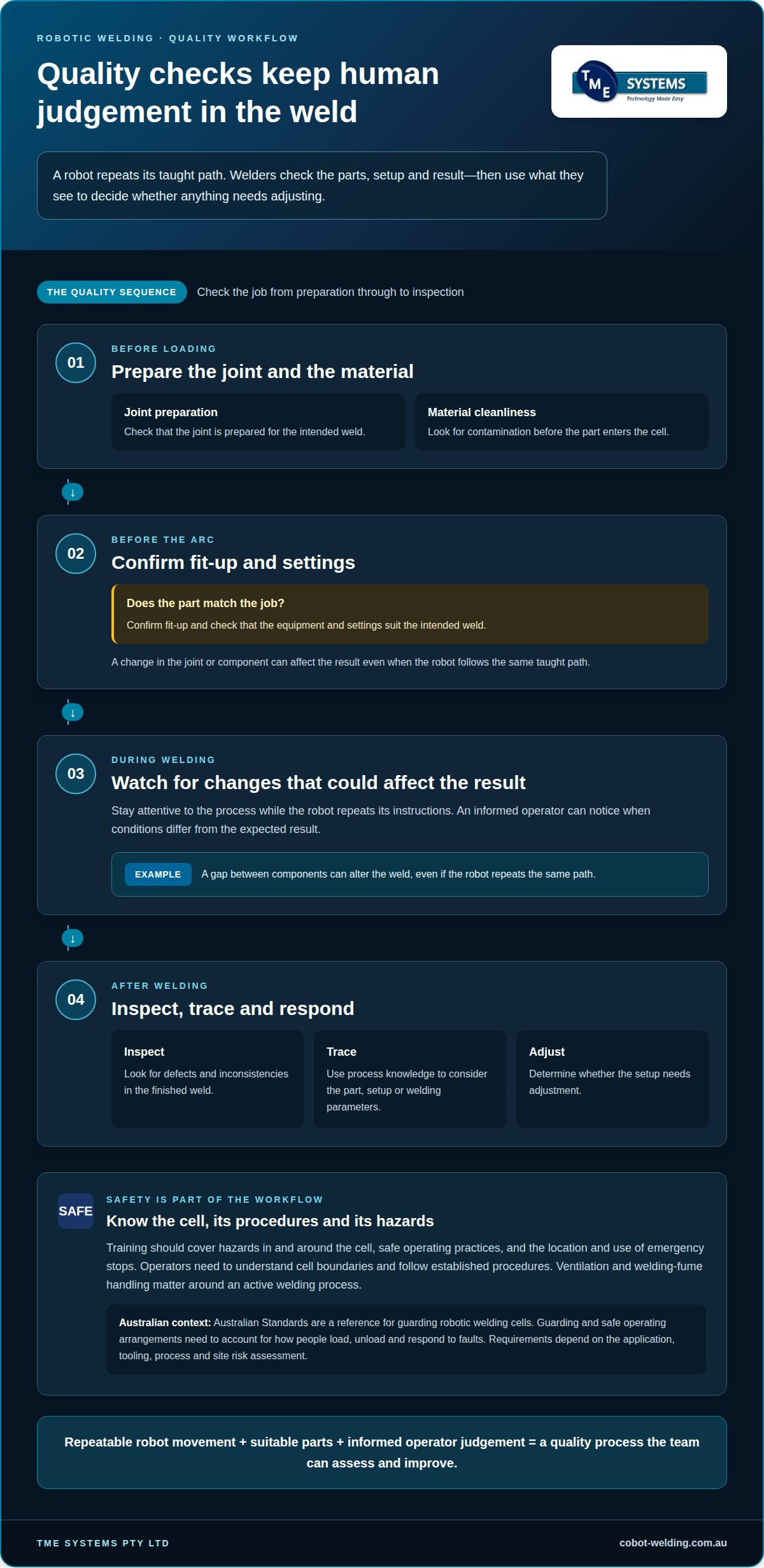
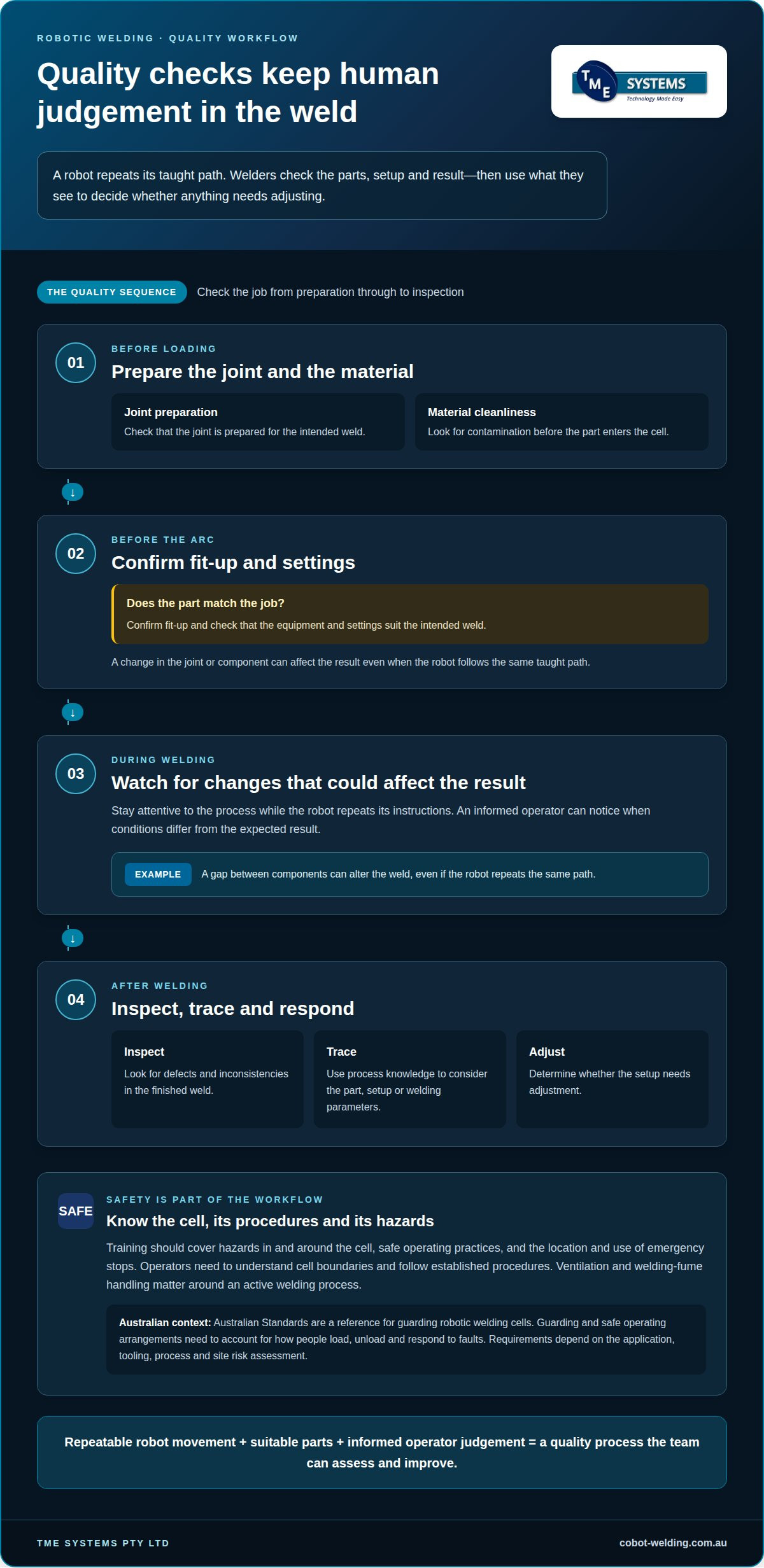
A robot repeats its taught path, but it cannot judge every change in a joint or component. Welders use their process knowledge to spot poor fit-up, contamination or a bead that differs from the expected result. Their judgement helps the team trace a fault to the part, setup or welding parameters.
Quality checks begin before the arc starts. The operator checks joint preparation, material cleanliness and fit-up, then confirms that the equipment and settings suit the task. During welding, they watch for changes that could affect the result. A gap between components, for example, can alter the weld even when the robot repeats the same path. After welding, inspection helps identify defects and determine whether the setup needs adjustment.
- Check joint preparation and material cleanliness before loading the part.
- Confirm fit-up and settings match the intended weld.
- Observe the process and inspect results for defects or inconsistencies.
These checks are technical work, not a replacement for programming. They connect welding practice with the robot’s repeatable movements, helping the team understand why a successful result depends on both a sound setup and suitable parts.
Safety training should cover hazards in and around the robotic cell, safe operating practices, and the location and use of emergency stops. Operators need to understand the cell’s boundaries and follow established procedures rather than assume the robot will recognise every unsafe condition. Ventilation and welding-fume handling also matter while working around an active welding process. Safety requirements depend on the application, tooling, process and site risk assessment.
In Australia, Australian Standards are a reference for guarding robotic welding cells. Guarding and safe operating arrangements need to account for how people interact with the equipment during production, including loading, unloading and responding to a fault. Regular practice with the cell’s procedures helps operators recognise hazards before they become incidents. To consider how the operator and robot work together, explore collaborative robot welding cells as part of the production setup.
Welder roles in robotic system setup and troubleshooting
Robotic welding still relies on welders to turn process knowledge into reliable production. Their tasks may include preparing fixtures, loading the correct job, confirming the torch path and checking the finished weld. Because the robot repeats its instructions, a misplaced part or changed joint can affect each cycle. Understanding this helps teams trace faults to the component, fixture, taught path or welding process.
To operate and program industrial robotic welding systems, welders need sound process knowledge, safe cell practices and an understanding of programming logic. Programming work also calls for adjusting weld parameters, using sensors and understanding how programmable logic controllers (PLCs) coordinate equipment. The depth of training depends on whether the role runs existing jobs or creates and troubleshoots programs.
A welding cell may combine a collaborative robot, torch, welding power source, fixture, positioner and safety controls. Each element affects the job: a fixture holds the work consistently, while a positioner can present a joint at a suitable angle. Before production, welders help confirm that the component is secure and the weld points are within the robot’s working reach.
System options suit different work. A collaborative robot cell may suit a clearly defined task, while an industrial robot with a positioner can support more complex part movement. ABB and Yaskawa are examples of robot systems technicians may encounter. Familiarity with one system can help, but operators still need training on the controls, equipment and procedures in their own cell.
When a weld changes, a trained welder can help isolate the cause before anyone adjusts the taught path or settings. They can inspect the part and fixture, review the welding parameters, check relevant equipment responses and assess the weld for defects. The team can then make a controlled adjustment and inspect the result. Testing the path and setup before production also helps uncover reach or access problems.
Robot welding as a response to the skilled-welder shortage
Robotic welding can help Australian workshops direct skilled welding expertise where it is most needed. A robot can handle repeatable welds on consistently fixtured parts, while experienced welders focus on complex joints, repairs or custom work. This is a practical division of work, not a claim that automation can replace every welding role.
The benefit depends on choosing suitable work. Repeatable welds on stable components are generally stronger candidates than variable field welding, where access, fit-up and conditions can change. Assigning suitable routine welds to a robot can give skilled welders more time to resolve difficult joints, make quality decisions or share process knowledge with apprentices. The work still depends on people who understand the weld and the equipment.
Problems can arise when a workshop automates a poor-fit task or relies on a taught path without sound process knowledge. A changed fixture, inconsistent component or unsuitable welding parameter can affect results across a production run. Training should therefore cover the task, cell safety, path teaching where relevant and checks for weld defects. This helps workers respond to problems instead of assuming that a repeated path guarantees a sound weld.
A measured approach can build capability while preserving the value of trade experience. Start with a well-defined, repeatable weld and train the people responsible for loading parts, monitoring the cycle and responding to faults. As their skills develop, operators can take on more path teaching and setup work. Apprentices can also learn how welding principles apply to automated production with guidance from experienced tradespeople.
For workshops weighing up where automation fits, explore collaborative robot welding options and consider how they could support a defined, repeatable task.
Robotic welding is designed to assist skilled welders, not make their expertise irrelevant. Training should build process understanding and practical confidence alongside hands-on cell skills, with learning focused on the selected task. When welders and automation staff share what they know, the team can connect welding judgement with path teaching and process adjustments.
TME Systems: Collaborative Robot Welding Cells
TME Systems helps Australian workshops develop collaborative robot welding capability through its No-Code Teaching Software, integration services and operator onboarding. Operators can use the software to teach weld paths and adjust them without traditional robot programming, bringing practical welding knowledge into the cell setup.
This approach may suit a workshop with repeatable welds that wants to develop operators alongside automation. TME Systems’ Mobile Demo System brings a portable welding cell to a customer’s site for hands-on evaluation, while integration connects the system with existing welding equipment, fixtures and production processes. The right next step depends on the work, parts and skills the team wants to develop.
Contact TME Systems to discuss collaborative robot welding, operator training and the Mobile Demo System for your workshop.
Make the next welding task your starting point
Choose a repeatable job that could suit automation, then map the practical skills your team needs to manage it. This gives training a clear purpose and shows how experienced welders’ judgement can guide the transition. A focused plan for upskilling welders for robotic welding can identify where operators need support, from teaching a path to recognising when a weld needs attention.
TME Systems offers No-Code Teaching Software, Collaborative Robot Welding Cells and a Mobile Demo System to help Australian workshops explore collaborative welding. Consider how these options could fit your production tasks and the capabilities you want to build.
Talk with TME Systems about your robotic welding plans and take a practical step towards building your team’s confidence.
Frequently Asked Questions
What training courses for robotic welding are available in Australia?
Australian learning pathways can combine a welding, metals fabrication or machining qualification with workplace training on a robotic cell. Apprenticeships can also provide a foundation for developing automation skills. TME Systems provides operator onboarding and training with its no-code teaching software, helping welders learn to teach weld paths and adjust them through the operator interface without writing robot code.
How can welders learn robot setup, teach-pendant programming, and troubleshooting?
Welders can develop these skills through supervised practice with the equipment and process used at work. Start by learning how to prepare the cell for a job, then practise teaching or adjusting paths and recognising when results need attention. TME Systems’ no-code teaching software supports operator-led path teaching, and its Mobile Demo System brings a portable welding cell to a customer’s site for hands-on evaluation.
How long does it take to upskill an experienced welder for robotic welding?
Training an experienced welder can take between 2 and 8 months, depending on their background, the robot interface and task complexity.