
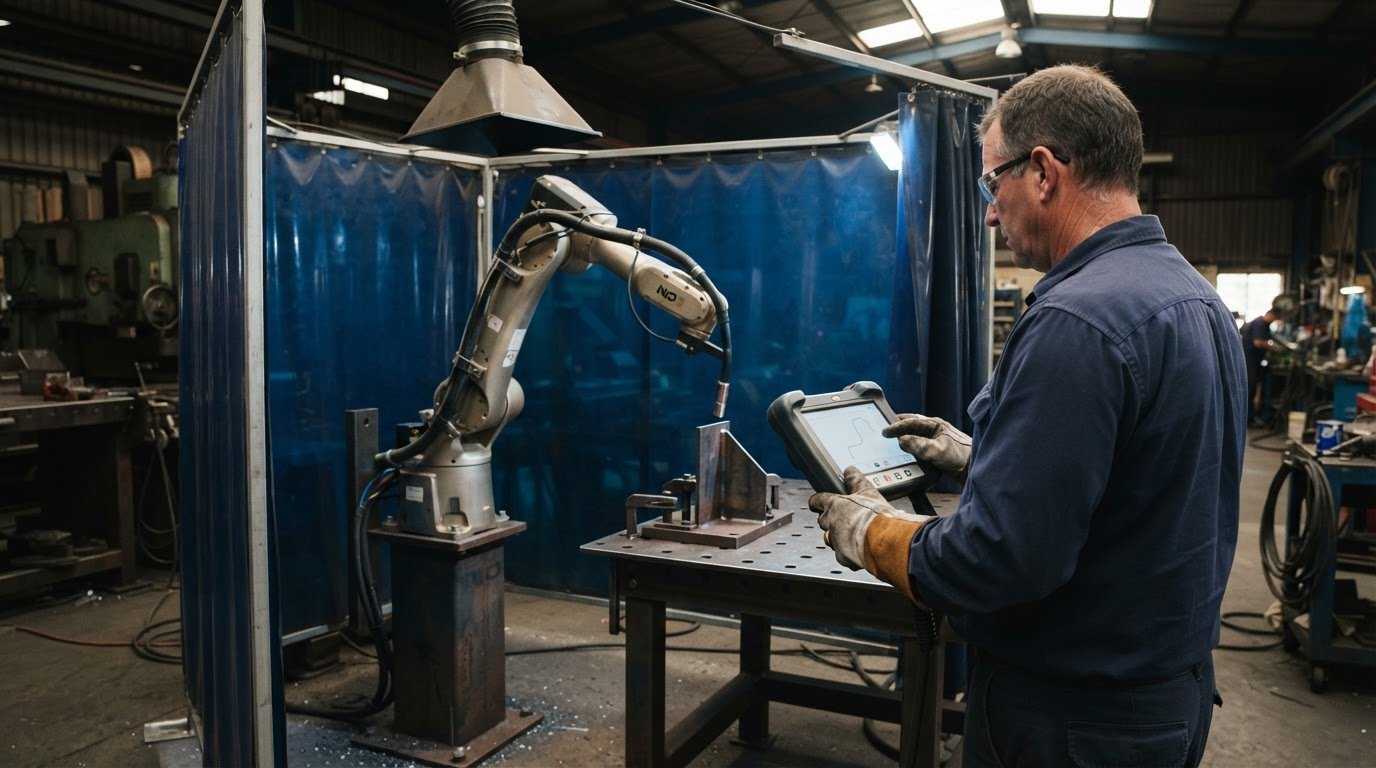
Automation works best when it gives welders a stronger role, not a smaller one. To understand how to get welders to embrace automation, show how a collaborative robot can repeat suitable weld paths while experienced people teach the system, monitor quality and handle work that calls for judgement. This matters when manufacturers need consistent output and skilled labour is difficult to secure.
It’s reasonable for welders to question a change that affects how their craft is practised. Adoption is more practical when teams are involved early, can learn the controls hands-on and can see how automation supports their expertise rather than replacing it. This article explains where welding automation can improve production and help address labour shortages, how welders’ responsibilities are shifting towards operating and overseeing systems, and what can make the transition easier to accept. The right fit depends on the task, product mix and level of repetition. It also considers where human skill remains central, from preparing joints and assessing weld quality to solving unusual problems on the workshop floor.
Key Takeaways
- Set clear measures for automation, such as weld quality, rework and time spent on repeatable tasks, so progress is visible to the team.
- Build on welders’ process knowledge by developing their skills in setting weld paths, adjusting parameters and troubleshooting systems.
- Match automation to suitable production tasks to add capacity when skilled labour is hard to secure, while keeping craft-led work in experienced hands.
- No-Code Teaching Software and Collaborative Robot Welding Cells can help make robotic welding more accessible to operators.
Why is welding automation important?
Welding automation can improve output and repeatability while keeping skilled people involved in setup and quality checks. Its value depends on choosing tasks where consistent paths and parameters address a real production constraint.
Productivity and efficiency gains
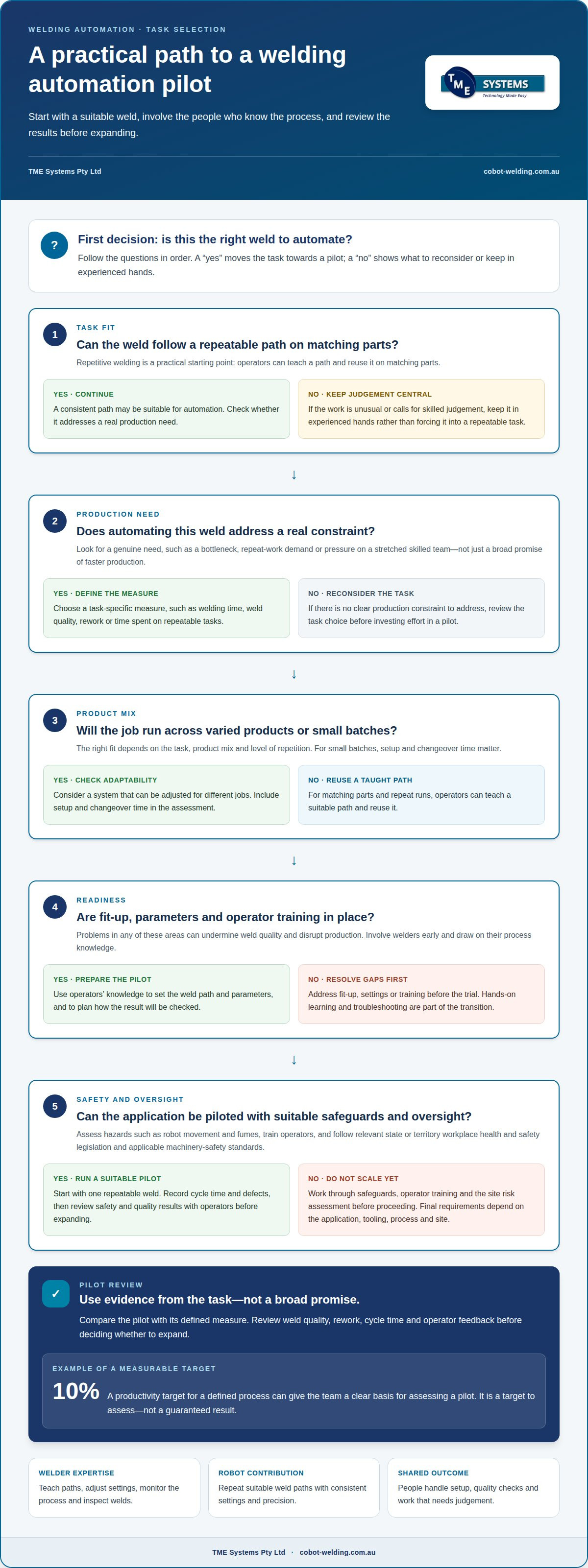
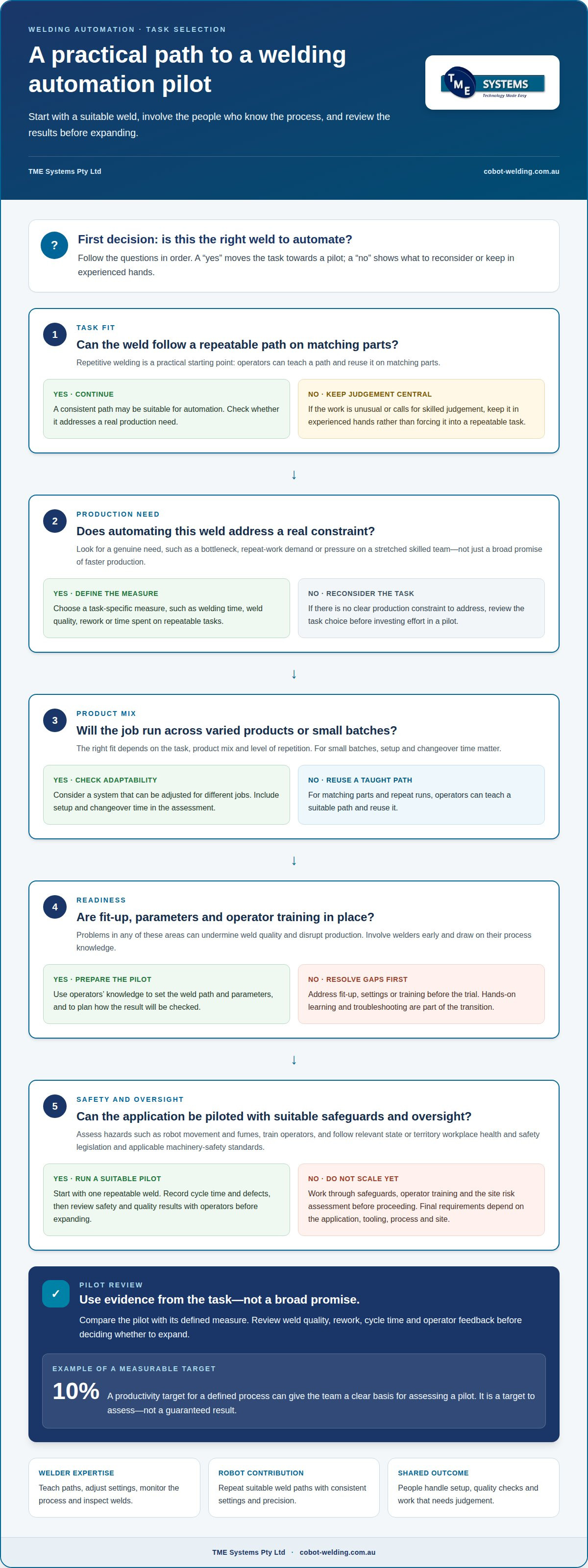
Automation uses programmed paths and settings to repeat suitable welds with consistent precision. That can reduce variation, defects and rework, while helping production maintain a steadier pace. The World Bank identifies technology as a way to increase productivity. For a workshop, a useful measure might be welding time for a particular task, rather than a broad promise of faster production. A productivity target, such as 10% for a defined process, gives the team a clear basis for assessing a pilot.
Automation for repetitive and small-batch work
Repetitive welding is a practical starting point: operators can teach a robot a path and reuse it on matching parts. For small batches, consider setup and changeover time. A system that can be adjusted for different jobs may suit varied production better than one tied to a single long run. Start with one repeatable weld, record cycle time and defects, then review the results with operators before expanding. Check fit-up, parameters and training early, since problems in any of these areas can undermine quality and disrupt production.
Cobots and welding labour shortages
Collaborative robots, or cobots, can handle repetitive welding while welders oversee the process and focus on complex work. This can help a stretched team manage more operations, but it doesn’t remove the need for skilled judgement. Involve welders before selecting a task: ask which welds cause bottlenecks and draw on their knowledge of joint preparation and quality. A cobot can be a practical first step, complementing existing processes rather than requiring every operation to change at once.
Safety, quality and rework
Automated welding can reduce workers’ direct exposure to fumes, heat and intense light by moving repetitive welding into a controlled cell. Consistent paths and parameters can support weld quality, but equipment still needs appropriate safeguards and oversight. In Australia, follow the workplace health and safety legislation relevant to the state or territory, alongside applicable machinery-safety standards. Before scaling up, pilot a suitable weld, assess hazards such as robot movement and fumes, train operators, and review safety and quality results. Final safety requirements depend on the application, tooling, process and site risk assessment.
Welders’ changing roles as technicians and robot operators
Automation shifts some work from manual welding towards teaching weld paths, monitoring the process and checking quality. Welders’ process knowledge remains essential when setting up a task and responding to changing production conditions.
From manual welding to process oversight
In automated fabrication, welders may teach paths, adjust settings through software and inspect finished welds. They can also troubleshoot when fit-up or material behaviour affects the result. The work changes, but welding knowledge remains vital: understanding joint preparation and quality helps operators recognise when a robot’s output needs attention. Teams can combine hands-on experience with digital controls and process oversight.
Virtual reality for cell planning
Virtual reality lets teams programme welding robots and test cell configurations before setting up physical equipment. A welder can practise a sequence or visualise a complex weld path in a simulated environment, then apply that learning on the workshop floor. This can make early training more practical by letting workers explore robot operations without interrupting a live production run. Virtual and augmented reality can also support rehearsal of unfamiliar paths.
Training welders as robotic programmers
Training existing welders builds on their understanding of the welding process while developing skills in robot controls, programming and troubleshooting. Experience with gas metal arc welding or gas tungsten arc welding is useful, alongside basic logic and problem-solving. Training can combine instructor demonstrations, hands-on practice and trial runs. For example, an operator might teach a path, review the weld, then adjust settings with guidance before running the task independently.
Simplified robot teaching and collaboration
Rapid-Line demonstrated a simplified teaching approach: after watching an instructor, six welders each created a simple robot weld programme in 15 minutes or less. The example shows how practical instruction can help experienced welders start using robot controls. Collaborative robots can also take on repetitive welds while welders manage setup and quality. To explore how collaborative robot welding fits this kind of shared workflow, consider the tasks operators want to automate first.
Automation adoption and skilled labour shortages
For Australian manufacturers, automation can help manage welding capacity when skilled workers are difficult to recruit or retain. It shifts where welders apply their expertise rather than removing the need for their judgement.
Workforce shortages and changing demographics
When experienced welders leave a business, practical knowledge of materials, fit-up and weld quality can leave with them. A workshop that relies on one person for a recurring job may struggle to maintain output when that worker is unavailable. Automation can help make suitable processes repeatable, while people remain responsible for setup, monitoring and exceptions.
Plan workforce development alongside equipment adoption. Identify which applications rely on specialist judgement and which follow a stable sequence. Pair experienced welders with colleagues learning robot operation so process knowledge can be shared. If managers are considering how to get welders to embrace automation, include welders in decisions about which tasks to automate and how skills will develop. This makes their practical experience part of the transition from the start.
Automation as a response to welder shortages
Automation can help address a skilled-welder shortage by allowing experienced workers to oversee repeatable operations and focus on work requiring greater judgement. For example, a cobot could handle a recurring weld while a welder attends to complex joints, inspection or process adjustments. Automation doesn’t create skilled workers, but it can help a team direct existing expertise where it matters most. Suitability depends on repeatability, part consistency and time spent on the task.
A practical approach to how to get welders to embrace automation is to connect the change to a defined production need. Set a measurable target, such as reducing welding time on a specific task, then assess the result in a controlled trial. Involve welders in choosing the application and reviewing the outcome. Their feedback can reveal setup issues, while hands-on learning helps them see how the system supports production and how their responsibilities may develop.
Make the next step a shared decision
Build a workplace where automation skills develop alongside production. Treat each application as a chance to refine how people and equipment work together, then use those lessons to guide future decisions. Welders can shape that progress by sharing what they observe on the floor and identifying where their judgement adds the most value.
A practical approach to how to get welders to embrace automation is to give the team a meaningful role in deciding what comes next. Discuss the production challenges to address, the work the team wants to retain and the capabilities it wants to build. This gives the transition a clear purpose beyond introducing new equipment.
If you’re ready to explore a suitable next step for your workshop, contact TME Systems Pty Ltd to discuss welding automation. A considered start can help your team move forward with confidence.
TME Systems
TME Systems Pty Ltd helps Australian manufacturers explore collaborative robot welding in a way that fits their production needs and workforce. Its no-code teaching software, Mobile Demo System and integration services support operator-led adoption. Teams can see the system in practice and consider how it may fit their work.
For businesses weighing where to start, focus an initial discussion on production pressures, operators’ roles and how new technology could fit existing workflows. This keeps attention on practical applications and the people using the system. Contact TME Systems to discuss collaborative robot welding and a hands-on demonstration for your workshop.
Make the next step a shared decision
Build a workplace where automation skills develop alongside production. Treat each application as a chance to refine how people and equipment work together, then use those lessons to guide future decisions. Welders can shape that progress by sharing what they observe on the floor and identifying where their judgement adds the most value.
A practical approach to how to get welders to embrace automation is to give the team a meaningful role in deciding what comes next. Discuss the production challenges to address, the work the team wants to retain and the capabilities it wants to build. This gives the transition a clear purpose beyond introducing new equipment.
If you’re ready to explore a suitable next step for your workshop, contact TME Systems to discuss welding automation. A considered start can help your team move forward with confidence.
Frequently Asked Questions
What benefits can welding automation offer welders and Australian fabrication businesses?
Welding automation can provide more consistent output and help welders spend less time on repetitive operations. A robot can repeat a taught weld path while an experienced worker checks the finished joint and manages exceptions. This can help reduce variation and rework. Depending on the task and workcell setup, automation may also reduce direct exposure to welding fumes, heat and intense light.
What training do welders need to operate and program welding robots or cobots?
Operators need practical instruction in teaching weld paths, adjusting settings, starting and stopping a cell, and recognising when a weld needs review. No coding experience is required to use TME Systems’ no-code teaching software. Training should also cover the specific robot, welding equipment and site procedures. A useful exercise is to teach a path on a representative part, then inspect the result with an experienced welder.
What welding tasks are best suited to automation, and which are not?
Automation suits repeat work with consistent fit-up, accessible joints and stable fixturing. High-mix, low-volume work can also suit automation when the right part families are chosen and their weld paths share useful similarities. A one-off component with changing geometry, awkward torch access or frequent fit-up variation may be harder to automate. Skilled welders remain valuable for custom work that calls for adaptation, craftsmanship or judgement as conditions change.
What concerns do welders have about automation, and how can employers address job-loss fears?
Welders may worry that automation will reduce job opportunities, undervalue their experience or push them into unfamiliar technical work. Employers can address these concerns by involving workers before choosing an application and explaining how responsibilities may change. Experienced welders, for example, can help define quality checks and learn to oversee the cell. Be clear about intended workforce changes, and make time for hands-on learning and questions.
How do manual welding, robotic welding and cobot welding compare in cost and productivity?
Manual welding avoids the cost of a robot cell and gives welders flexibility across varied work, but output depends on the available skilled labour and the task. Robotic welding can suit stable, repeat production, though investment and integration affect its economics. Collaborative robot welding offers an operator-led approach for suitable tasks. Compare options by considering task volume, setup time, changeovers, quality needs, labour availability and training requirements.