
Robotic welding can reduce workers’ exposure to fumes, burns and repetitive physical strain by moving hazardous tasks behind safety barriers and into controlled cells. Reducing workplace injuries with welding automation still depends on suitable fume extraction, safe work procedures, training and personal protective equipment. The stakes are clear: 16 manufacturing workers died from workplace injuries in Australia in 2022.
It’s understandable to ask whether automation can make a workshop safer without taking skilled people out of the picture. Robots can handle repetitive welding movements, while workers remain responsible for setup, inspection and maintenance. Automation can support safety, but it does not replace good work practices or remove every hazard.
This article explains how robotic welding can reduce exposure and physical strain, what barriers and fume extraction do, and where worker responsibilities still matter. You’ll also learn how collaborative welding cells and no-code teaching can fit into Australian manufacturing when a business is considering its next steps.
Key Takeaways
- Assess which welding tasks are repetitive or hazardous to understand where automation could fit your production line.
- Consider how barriers, sensors and local exhaust ventilation work together in a robotic cell.
- Keep operators involved in teaching weld paths, inspecting equipment and responding to machine feedback.
- Learn how no-code teaching can help operators adjust weld paths and parameters without traditional programming.
Robotic welding in Australian manufacturing
In Australian manufacturing, robotic welding can shift repetitive welding movements from a person to a machine. It can also reduce time spent in awkward postures and near welding fumes, while workers remain responsible for setup and oversight.
Robotic and collaborative welding systems
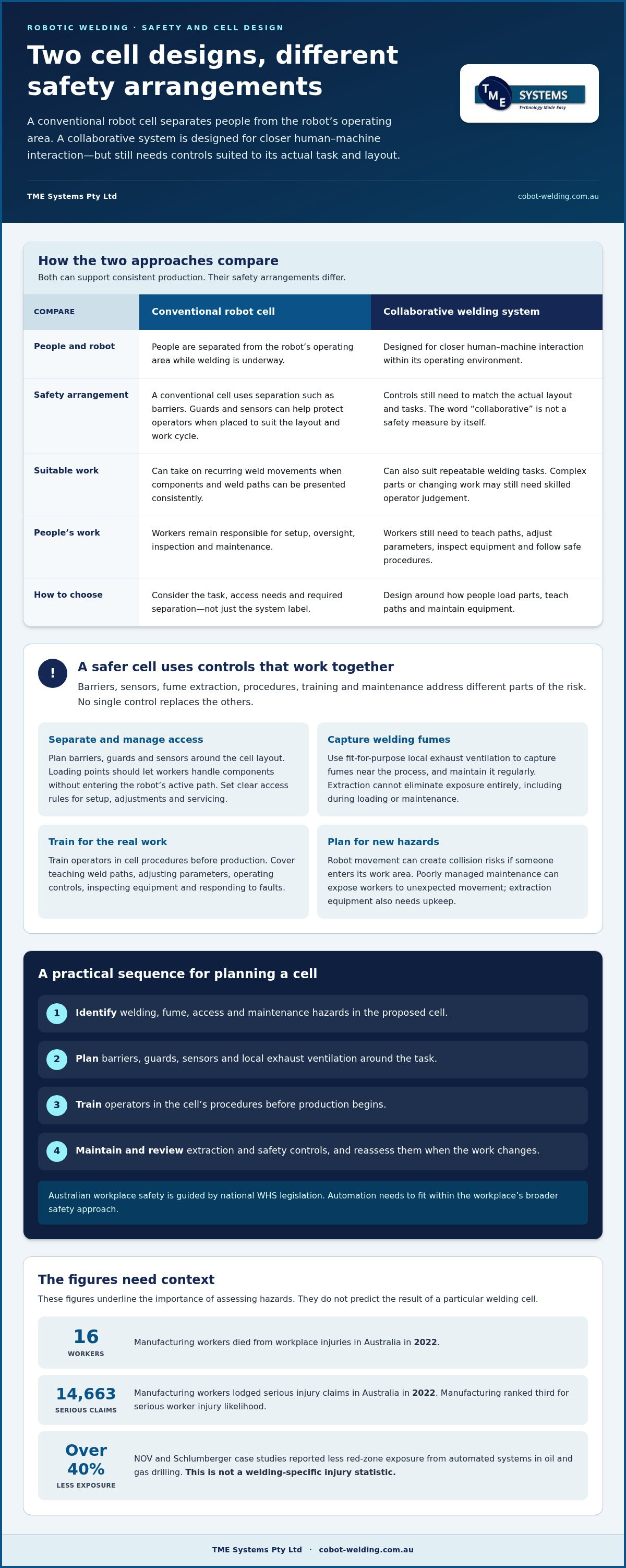
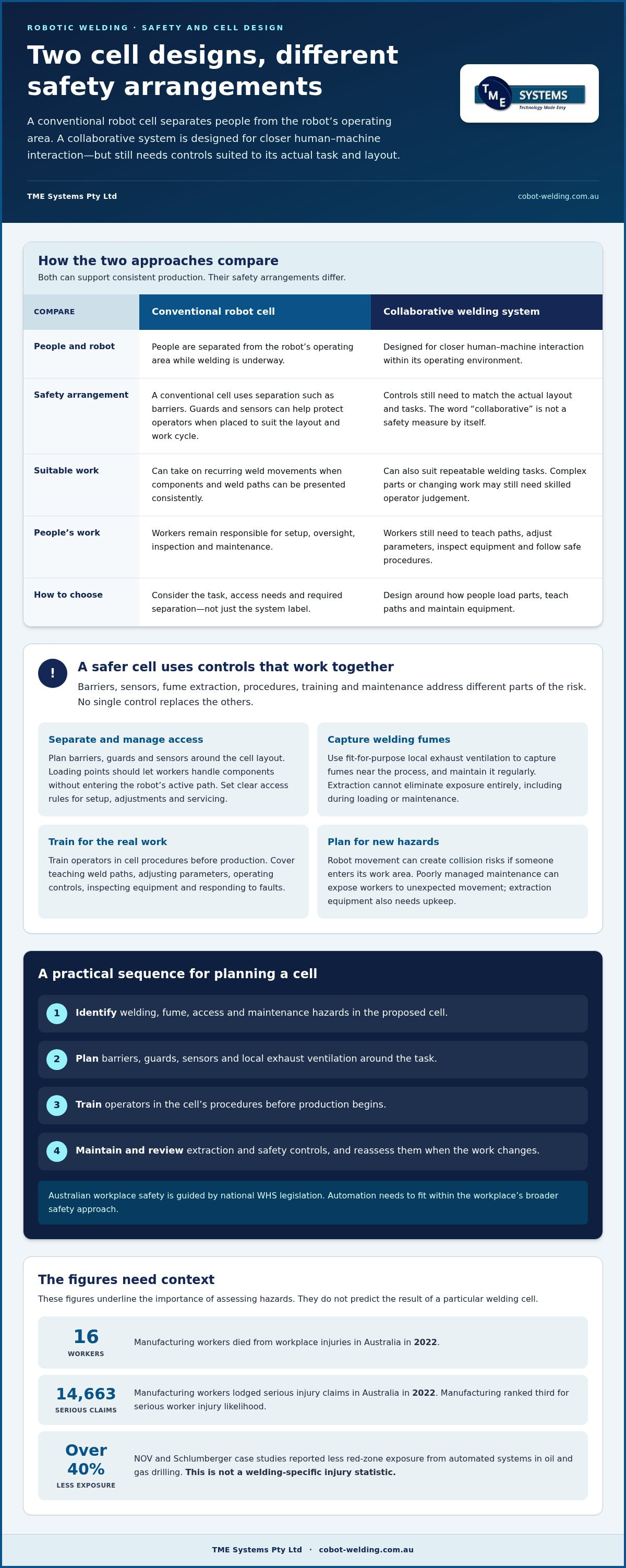
Robotic welding uses programmed machinery to repeat weld paths; collaborative systems are designed for closer human-machine interaction. Both can support consistent production, but their safety arrangements differ. A conventional robot cell separates people with barriers, while a collaborative system is designed for interaction within its operating environment. Choose based on the task, access needs and required separation, not the system label alone. Productivity depends on the process and how it fits the production line.
Automatable welding tasks
Robots and collaborative systems suit repeatable welding tasks where components and weld paths can be presented consistently. A programmed unit can take on recurring weld movements, reducing the time a worker spends in a fixed, uncomfortable position. Automated feeding and stacking can also reduce manual handling in welding and roll-forming systems. The practical starting point is to identify repetitive tasks, material movement and points where workers face welding hazards. Complex parts or changing work may still need skilled operator judgement.
Reported injury reduction statistics
Published figures should be read in context: exposure reductions are not the same as injury-rate reductions. NOV and Schlumberger case studies reported over 40 percent less red-zone exposure from automated systems in oil and gas drilling. That result is not a welding-specific injury statistic. In Australia, manufacturing workers lodged 14,663 serious injury claims in 2022, and manufacturing ranked third for serious worker injury likelihood. Those figures underline the value of assessing hazards, but they do not predict the result of a particular cell.
There is no single cost for welding automation: the price depends on the robot and cell configuration, welding equipment, guarding, extraction and integration, and is given after a quote request. Funding support depends on current Australian, state and territory program criteria. Build a project case around the hazards addressed, affected tasks and planned safety controls. Australian workplace safety is guided by national WHS legislation, so automation needs to sit within the workplace’s broader safety approach.
Safety barriers and fume-extraction cells
Australian workplace safety is guided by national WHS legislation. Automated welding controls need to account for robot movement, welding fumes, operator access and maintenance tasks.
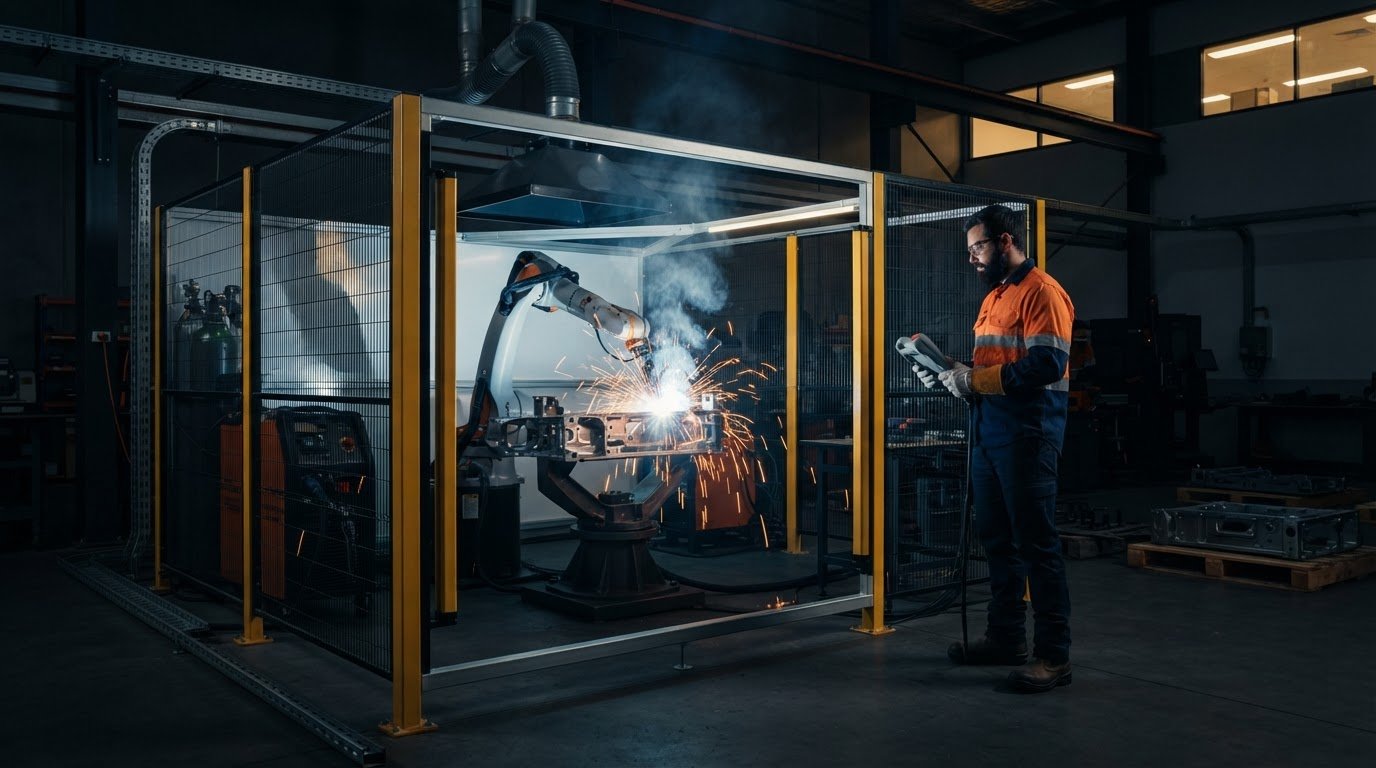
A safety barrier separates workers from the robot’s operating area while welding is underway. Automatic guards and sensors can help protect operators, but their placement must suit the cell’s layout and work cycle. For example, a loading point needs to let workers handle components without entering the robot’s active path. Clear access rules also matter during setup, adjustments and servicing.
Fume-extraction cells combine physical separation with controls that capture welding fumes near the process. Fit-for-purpose local exhaust ventilation should be installed and regularly maintained. Extraction systems can’t eliminate exposure entirely, particularly in confined spaces or large production facilities. Cell design should therefore consider where fumes are generated, how air is drawn away, and whether workers could still encounter fumes during loading or maintenance.
Automation can introduce hazards as well as reduce exposure to existing ones. A moving robot can create collision risks if someone enters its work area, while poorly managed maintenance can expose workers to unexpected movement. Extraction equipment also needs upkeep to work as intended. Barriers, sensors, clear procedures and maintenance planning address different parts of the risk; no single control replaces the others.
For safer implementation, Australian businesses can follow a practical sequence:
- Identify welding, fume, access and maintenance hazards in the proposed cell.
- Plan barriers, guards, sensors and local exhaust ventilation around the task.
- Train operators in the cell’s procedures before production begins.
- Maintain extraction and safety controls, and review them when the work changes.
A collaborative robot welding cell still needs controls suited to its actual layout and tasks. Design the cell around how people load parts, teach paths and maintain equipment, rather than relying on the word “collaborative” as a safety measure.
For a project involving cell layout and safeguards, explore collaborative robot welding cells as one way to bring robotic welding into a production process.
Australian automated welding cells are guided by national WHS legislation, with controls tailored to robot movement, welding fumes, operator access and maintenance. The described safeguards include barriers, guards and sensors, local exhaust ventilation, clear procedures, training and ongoing maintenance.
Worker roles in programming, inspection and maintenance
Workers using automated welding systems need task-specific training, documented safe work procedures and clear responsibilities. Training should cover teaching weld paths, adjusting parameters, operating controls, inspecting equipment and responding to faults.
Training for automated welding systems
Training prepares operators to use the system safely and make controlled production adjustments. For example, an operator teaching a new weld path needs to understand how the robot moves, how to adjust parameters and how to stay clear of its operating area. Practical onboarding should cover loading parts, starting and stopping the cycle, recognising faults and knowing when to seek support. Training should match each worker’s role.
Safe work procedures
Safe work procedures describe how operators set up, run and maintain a welding cell. They should explain how workers load components, use controls, respond to alarms and keep access points clear during operation. Maintenance procedures should define how equipment is made safe before inspection or repair, and who may perform each task. Clear instructions help prevent informal workarounds when a production issue interrupts the normal cycle.
Workers remain responsible for teaching the robot the required weld path, checking that components are positioned correctly and adjusting parameters when a job changes. A trial run can reveal issues such as unexpected movement or a poor torch approach before routine production begins.
Inspection also relies on workers noticing changes the machine may not interpret as a safety problem. Operators can examine weld quality, confirm fixtures hold parts securely and watch for damaged cables or unusual machine behaviour. Automated systems can provide continuous feedback on machine performance, which supports proactive maintenance. Workers can use that feedback to flag developing issues before they disrupt the production cycle.
Maintenance staff need clear handovers with operators. A reported fault, replaced component or changed weld path can affect how the cell behaves. Recording changes gives the next shift useful context. Regular attention to equipment condition, extraction performance and safety controls helps keep the system aligned with the task. Human judgement remains central: operators identify changes, report hazards and follow agreed procedures rather than bypassing controls to keep production moving.
Common manual welding injuries and hazards in Australia
Manual welding exposes workers to distinct hazards, including burns, electric shock, eye or hand damage and cuts. The Occupational Safety and Health Administration identifies these as common welding-related injuries. In Australia, workplace safety is guided by national WHS legislation, but the immediate risks are practical: sparks can burn skin, sharp metal edges can cut hands, and electrical faults can cause shock.
Fumes require attention beyond the welding task itself. They can contain metal oxides, silicates and fluorides, some of which are toxic or carcinogenic. Research published in the Australian and New Zealand Journal of Public Health in August 2024 identified prolonged exposure to welding fumes as a serious health risk for welders. The International Agency for Research on Cancer classed welding fumes as carcinogenic to humans in early 2017.
Clothing can add a hazard if workers assume ordinary workwear is protective. Cotton drill garments are not flame-resistant unless treated, and can ignite and burn. Welders should wear outer garments with a fire-resistant rating or welders’ leathers. A welding helmet and suitable respiratory protection also help address exposure to light, sparks and fumes during the task.
Electrical safety and equipment condition matter at the workstation. Check that welding equipment is dry and well maintained, and use shutdown mechanisms such as fuses and low-voltage safety switches. Voltage reduction devices can reduce electric-shock risks. These controls complement safe work procedures and personal protective equipment; they do not replace them.
For a recent example of burn severity, a welder in an incident described by Weld Australia required two skin grafts. Mapping where sparks, fumes, sharp edges and electrical equipment intersect helps identify which manual tasks may benefit from automation. Consider how automating repetitive welding tasks could reduce workers’ direct exposure while keeping safe work practices in place.
TME Systems: No-Code Teaching Software
TME Systems Pty Ltd’s No-Code Teaching Software lets operators teach weld paths and adjust parameters without writing code or needing robot-programming experience. It can help manufacturers assess whether repeatable welding tasks are ready for automation, while keeping experienced workers involved in setup and refinement.
TME Systems Pty Ltd’s Collaborative Robot Welding Cells and Welding Automation Integration bring together the robot, welding process and production requirements in a working cell. The Mobile Demo System brings a welding cell to your site so your team can evaluate the approach in its own production environment. Discuss the task, operator roles and safety needs together, rather than treating the robot as a stand-alone purchase.
Contact TME Systems Pty Ltd to discuss how no-code teaching or a collaborative welding cell could fit your manufacturing process.
Make your next automation decision a practical one
Start with a production task that involves repetitive movement or places workers near welding hazards. Map how components are handled, where operators need access and what skills they’ll need to run the process. This gives your team a practical basis for assessing whether reducing workplace injuries with welding automation fits the work, rather than treating automation as a stand-alone equipment decision.
TME Systems offers No-Code Teaching Software for teaching weld paths and adjusting parameters, Collaborative Robot Welding Cells, and a Mobile Demo System that brings a welding cell to your site for evaluation. These options can help you explore how automation might fit your production process while keeping operators involved. Start with your task, workflow and safety priorities.
Contact TME Systems about welding automation to discuss a practical next step for your workshop. A thoughtful assessment can help your team move forward with confidence.
Frequently Asked Questions
How does welding automation reduce workplace injuries?
Welding automation can reduce injury exposure by assigning repeatable weld movements to a robot, limiting workers’ time near arcs, fumes, sparks and hot metal. Reducing workplace injuries with welding automation also means considering material handling: automated feeding or stacking can reduce manual lifting. For example, a robot can repeat a weld path while an operator handles parts from a designated position. Barriers, extraction, training and protective equipment remain important.
What risk assessment and machine guarding are required for welding robots in Australia?
Australian workplace safety is guided by national WHS legislation, while controls for a welding robot depend on its application, tooling, process and site risk assessment. Assess robot movement and operator access during loading, fixture changes, teaching and maintenance. Then determine suitable barriers, guards and sensors for the cell’s layout and tasks. Include fume extraction and safe procedures for testing and servicing, and review the controls when the process or workspace changes.