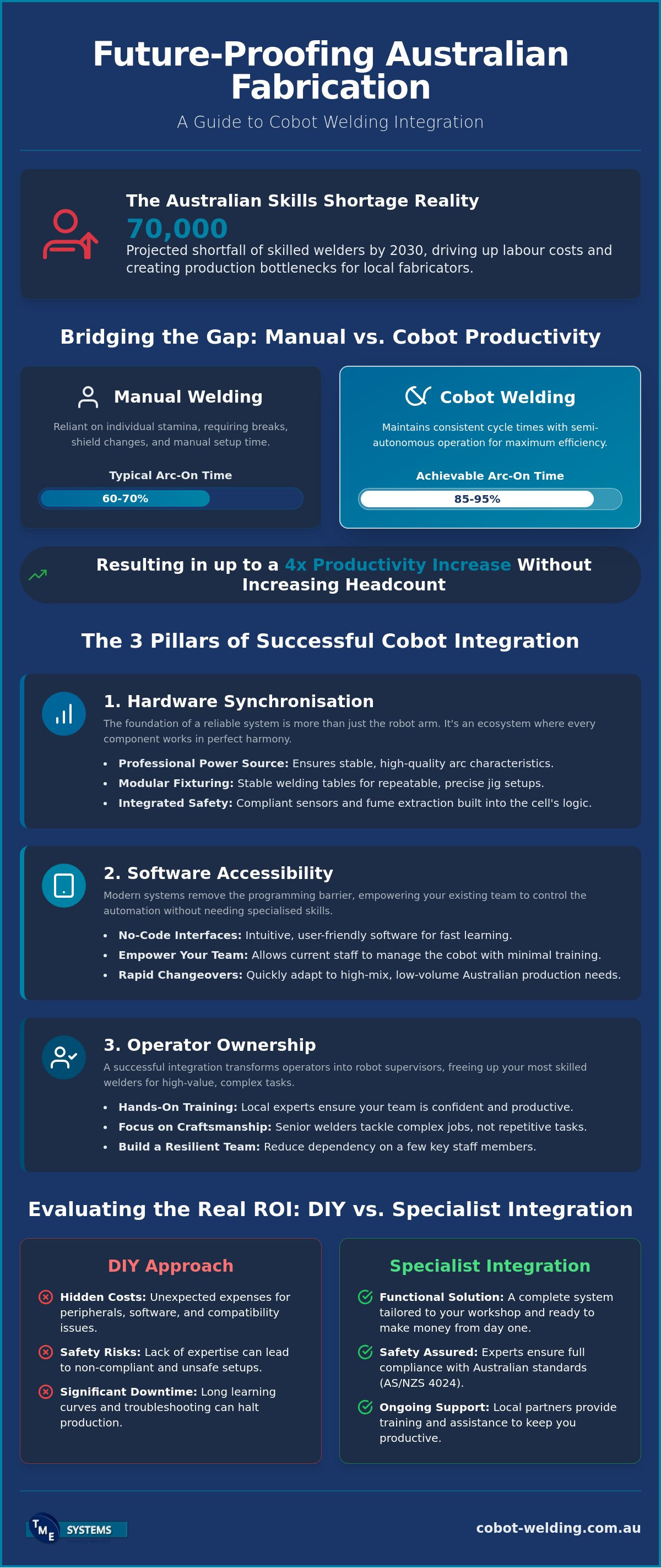

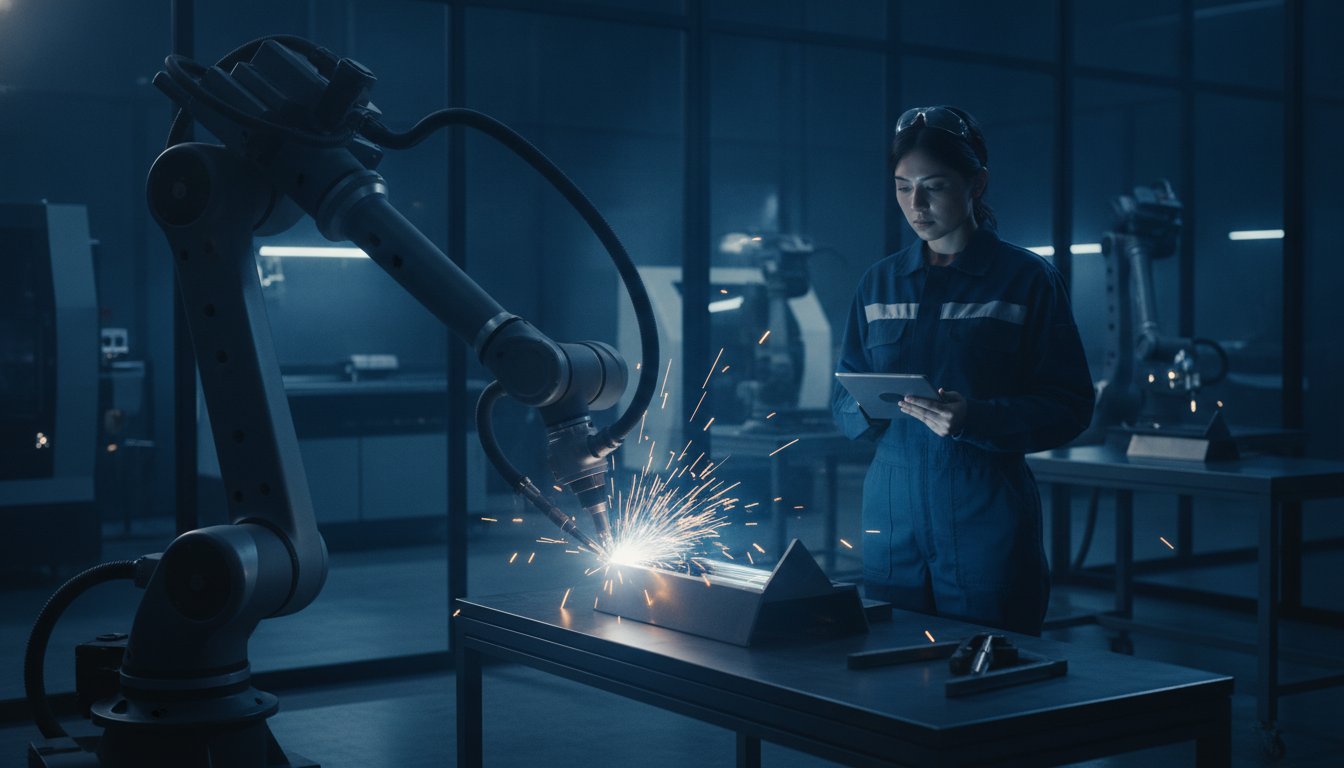
Did you know that Australia is projected to face a shortfall of 70,000 skilled welders by 2030? For many local fabricators, this isn't just a distant statistic; it's a daily reality felt through rising labour costs and the constant struggle to find staff for repetitive tasks. You might feel that advanced automation is only for the big players with massive production runs, but that's a common misconception. Practical cobot welding integration is now within reach for workshops of all sizes, designed to support your team rather than replace them.
We understand the pressure to maintain quality while increasing throughput. This guide will show you how welding system integration specialists bridge the gap between traditional craftsmanship and automated efficiency to future-proof your workshop. You'll discover how easy-to-use, no-code systems allow your existing staff to achieve consistent weld quality without needing complex programming skills. We will walk through the practical steps of bringing a collaborative partner onto your shop floor to help you get more done with the talent you already have.
Key Takeaways
- Discover why successful automation involves more than just hardware and how specialists help your workshop navigate the chronic shortage of skilled labour.
- Understand the core pillars of cobot welding integration, from synchronising power sources to implementing no-code software that your team can master quickly.
- Evaluate the real-world ROI of specialist-led setups compared to the hidden costs and safety risks often associated with DIY automation attempts.
- Learn the practical steps for preparing your workshop, including how to audit your current processes to identify the most "cobot-friendly" tasks.
- Explore the benefits of working with local experts who provide hands-on training and ongoing support to ensure your new system stays productive.
The Role of Welding System Integration Specialists in Modern Fabrication
Many Australian fabricators think that adding automation simply means buying a robot arm and hoping for the best. In reality, bolting a machine to the floor is only half the battle. True welding system integration is about ensuring that the technology actually fits into your specific production flow without causing more headaches than it solves. It's the difference between owning a tool and having a functional solution that actually makes you money from day one.
A robot supplier will sell you a piece of equipment and leave you with a manual. An integration partner, however, looks at your floor space, your power supply, and your staff's current skill levels. They customise the setup so you can handle high-mix, low-volume work profitably. This is the "Australian reality" where flexibility is just as important as speed. Instead of focusing on massive production runs, specialists help you refine your workshop to handle diverse jobs with minimal downtime between setups.
Addressing the Australian Skills Shortage
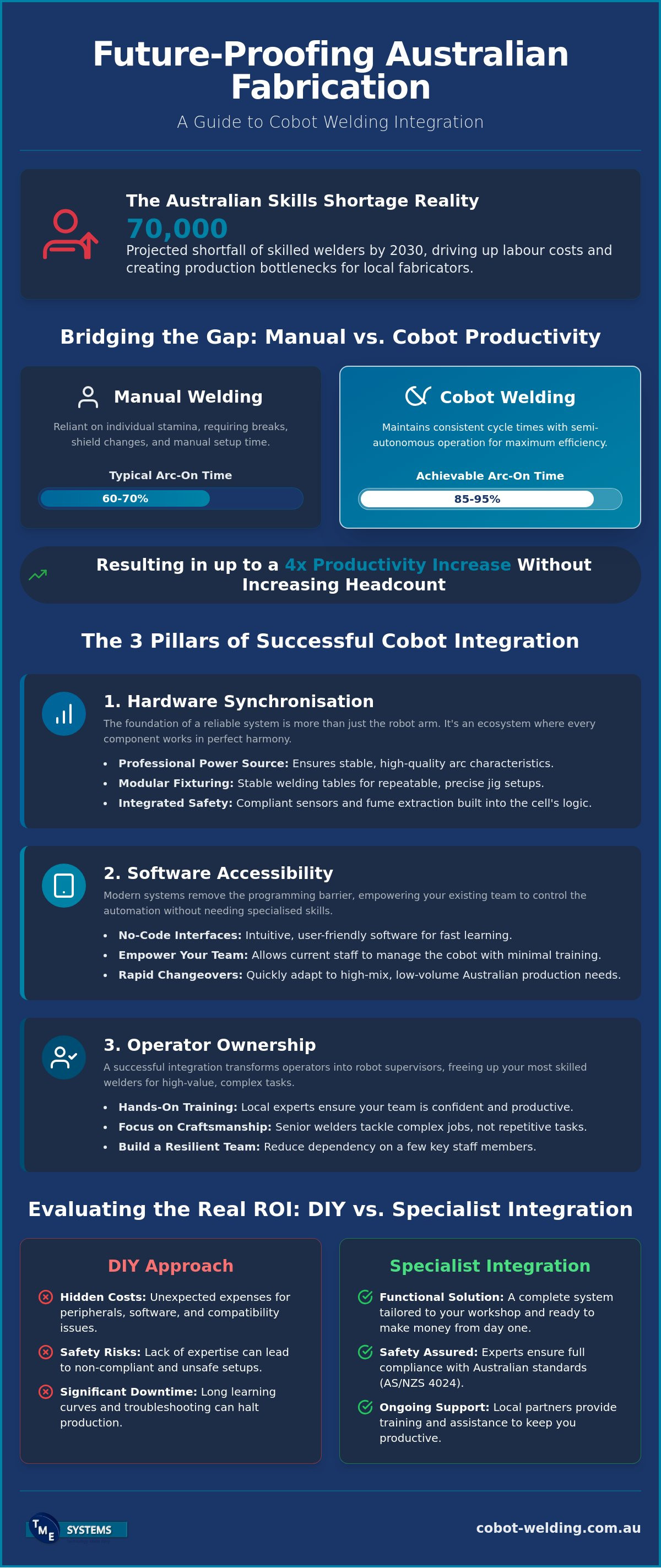
The industry is currently facing a shortfall of 70,000 skilled welders by 2030. This makes cobot welding integration a practical necessity rather than a luxury. Senior tradespeople shouldn't spend their days on repetitive grunt work like simple brackets or straight seams. By handing these tasks off to a machine, you allow your most experienced staff to focus on complex joins that require true craftsmanship. To understand the potential, it helps to first clarify what a collaborative robot (cobot) is and how it differs from traditional industrial robots that require heavy safety caging. Welding integration is the process of synchronising hardware, software, and human workflow. This approach also reduces the barrier to entry for junior staff. With intuitive systems, a less experienced operator can manage the machine, helping you build a more resilient team while keeping your senior welders engaged in high-value work.
Boosting Throughput without Increasing Headcount
Consistent cycle times are the holy grail of workshop management. When you know exactly how long a part takes to weld, your quoting becomes more accurate and your scheduling more reliable. Integrated cells allow for semi-autonomous operation, where a single operator can manage multiple stations or prepare the next jig while the robot is under the hood. Local manufacturers in 2026 are seeing significant results from this shift. Some report a 4x productivity increase, largely because a machine can maintain an 85-95% arc-on time. Compare that to the typical 60-70% arc-on time of a manual welder who needs breaks, shield changes, and setup time. You aren't just welding faster; you're welding more often without adding a single person to the payroll.
Three Pillars of Successful Cobot Welding Integration
Successful automation isn't about finding the flashiest robot on the market. It's about building a reliable system where every component talks to the next. For an Australian workshop, this means looking past the robot arm itself to consider the entire ecosystem of the cell. If your power source, software, and staff aren't in sync, the machine will likely sit idle. A complete cobot welding integration strategy relies on three fundamental pillars: hardware synchronisation, software accessibility, and operator ownership.
Hardware: Beyond the Robot Arm
The robot arm is merely the hand; you still need a high-quality "brain" and "lungs" for the system to function. This starts with matching a professional-grade power source to the cobot arm to ensure stable arc characteristics during automated runs. You also need to consider the physical environment. A stable, modular welding table is essential for creating repeatable jigs, allowing you to swap between different jobs without losing precision. Safety is another non-negotiable factor. While cobots are designed to work alongside humans, you must still meet specific robot systems and system integration safety requirements to stay compliant with local standards like AS/NZS 4024. This often involves integrating sensors and fume extraction directly into the cell logic so the system protects your team while it works.
Software: The Interface of Efficiency
The biggest hurdle for most fabricators is the fear of complex programming. Traditional industrial robots often require expensive external contractors just to change a weld path. Modern no-code robot welding software has changed this dynamic entirely. Instead of typing lines of code into a pendant, your welders can use visual path teaching. This involves physically moving the arm to the start and end points, effectively "showing" the machine where to weld. It allows your team to adjust parameters like volts and travel speed on the fly. If you want to see how this looks in a real workshop, our mobile demo system shows exactly how intuitive these interfaces have become.
Operator Onboarding and Ownership
The final pillar is your people. Integration only succeeds when your welders feel like the cobot is a sophisticated power tool rather than a replacement. Onboarding should focus on empowering your staff to take ownership of the cell. When a senior welder realises they can "teach" the cobot to handle the boring, repetitive runs, they can spend their time on the high-value, complex projects that actually require their expertise. This shift in mindset turns a technical upgrade into a long-term cultural win for your workshop.
DIY vs. Specialist Integration: Evaluating the Real ROI
The temptation to "have a go" at setting up your own automation is strong in many Australian workshops. It seems like a cost-effective way to modernise, but the gap between a robot in a box and a productive welding cell is often wider than it looks. While the upfront price of a standalone arm is lower, cobot welding integration performed by specialists focuses on the total cost of ownership. A DIY approach often leads to "shelf-ware", where a robot sits idle because the team hit a technical snag they couldn't solve. Specialists reduce the "Time to First Weld" from months to days, ensuring your investment starts paying for itself immediately.
Calculating your return on investment requires looking beyond the initial invoice. You have to factor in the reduction of rework and the improved life of your consumables. When a machine handles the torch, the travel speed and distance are perfectly consistent, which significantly reduces the wear on tips and nozzles. More importantly, it eliminates the human error that leads to grinding and re-welding. If you are aiming for high precision cobot welding in a low-volume shop, the precision of a professionally integrated system ensures every part is right the first time.
The Risk of the "Shelf-Ware" Robot
Many DIY projects stall when complex programming or hardware synchronisation challenges arise. Without a turnkey solution, you might find yourself troubleshooting software bugs instead of shipping finished products. A specialist ensures the cell is ready to work from day one, with all essential safety features in cobots properly configured and tested. This professional setup prevents the machine from becoming an expensive doorstop and keeps your production line moving.
Professional Support and Training
The true cost of integration includes the price of downtime during the learning curve. If your team is left to figure things out on their own, productivity will drop while they struggle with the new tech. Local integration partners provide hands-on operator training that builds confidence and reduces staff resistance. This ongoing support is vital for maintaining uptime; when a question arises, you need a partner who understands the Australian manufacturing environment and can provide a quick answer. This collaborative relationship ensures that your staff feels supported, which naturally leads to lower turnover and a more efficient workshop floor.
How to Prepare Your Workshop for Seamless Integration
Preparation is the bridge between buying a piece of technology and actually making it work for your business. You don't need to overhaul your entire facility to get started, but a few strategic adjustments will ensure your cobot welding integration is smooth from day one. It starts with a clear-eyed look at what's currently happening on your workshop floor. By following a structured approach, you can avoid the common pitfalls that stall automation projects and start seeing results within the first week of installation.
- Step 1: Audit your processes. Look for the jobs that are repetitive, boring, or prone to human fatigue. These are your "cobot-friendly" tasks.
- Step 2: Check your infrastructure. Most collaborative robot welding cells have a compact footprint, but you still need to ensure you have the right power supply and floor space for a mobile unit to move between stations.
- Step 3: Organise your fixturing. A robot is only as good as the jig it works on. Repeatability is essential, so invest time in modular tables and clamps that hold parts in the exact same position every time. Industry experts often suggest budgeting 10 to 25 per cent of your system cost for high-quality fixturing to get the best results.
- Step 4: Pick your champion. Identify an operator who is keen to learn and give them the lead. This person will become your internal expert, helping others get comfortable with the new system.
- Step 5: Test your parts. Before you commit, it's worth seeing how the tech handles your specific materials and joins. You can book a mobile welding robot demonstration to see the system in action on your own turf.
Identifying the Right Parts for Automation
Not every job is a candidate for automation. High-frequency small batches are usually the sweet spot for cobots. Aluminium and stainless steel are particularly good candidates because the precision of a machine can significantly reduce the cleaning and finishing time required for these sensitive materials. You should also evaluate joint access; if a human welder struggles to reach a spot, the robot torch might too. Focus on parts with consistent fit-up to ensure the machine can maintain a high arc-on time without constant manual intervention.
Floor Layout and Workflow Optimisation
The goal is to enhance your workflow, not create a new bottleneck. Think about where materials enter the cell and where finished parts exit. You need enough room for an operator to load a second jig while the robot is welding the first. Safety zones are also vital. Even though these machines are designed for collaboration, you must manage pedestrian traffic and ensure that flash protection and fume extraction don't interfere with other workshop activities. A well-placed cell should feel like a natural extension of your existing production line.
If you're ready to see how this fits into your shop, the best next step is to book a mobile demonstration and test your most common parts under real conditions.
Partnering with Australian Integration Experts for Success
Choosing a partner for cobot welding integration shouldn't feel like a one-off transaction; it's a fundamental shift in how your workshop operates. TME Systems Pty Ltd focuses on providing no-code software because we understand the reality of the Australian market. Most local fabricators don't have the luxury of dedicated robotics engineers on staff. They need a system that their best welders can pick up in an afternoon. By prioritising accessible technology, we ensure that your investment remains a productive tool rather than a complicated burden as your product range evolves.
Even for our national clients, we advocate for a cobot welding sydney style implementation approach. This means providing localised, hands-on support that mirrors the responsiveness you'd expect from a workshop next door. It's about moving beyond the hardware to provide end-to-end service, from the initial feasibility study to ongoing operator onboarding. This ensures that as your business grows, your automated cells grow with you, allowing you to take on more complex work without the stress of finding additional skilled labour.
The TME Systems Pty Ltd Advantage
We specialise in "no-expert-required" technology. Our goal is to make innovation feel attainable for every Australian workshop, regardless of their previous experience with automation. We provide a bridge between traditional craftsmanship and modern efficiency through several key focus areas:
- National reach with local insight: We understand the specific standards and hurdles faced by Australian manufacturers.
- Long-term partnership: We stay involved well after the initial sale to help you refine your processes and adjust to new production demands.
- Accessible innovation: Our systems are designed specifically for the high-mix, low-volume production that defines our local industry.
Next Steps: From Interest to Implementation
The path to a more efficient workshop starts with a simple feasibility study. We look at your specific weldments to determine which jobs will provide the quickest return and the most consistent quality. From there, we bring the technology to you. During a mobile demo on your workshop floor, your team can see exactly how the no-code interface handles your parts. It's the most practical way to demystify the transition and build confidence across your staff before you make a final decision. You'll see firsthand how the technology adapts to your workers, not the other way around. Ready to see the results for yourself? Book a mobile demonstration today.
Future-Proofing Your Workshop with Practical Automation
Transitioning to automated fabrication doesn't have to be a leap into the unknown. By focusing on the right pillars, hardware synchronisation, no-code software, and operator training, you can bridge the gap between traditional craftsmanship and modern efficiency. Successful cobot welding integration is about empowering your existing team to handle more work with less stress, ensuring your workshop remains competitive as the industry evolves. You don't need to be a robotics expert to see these results; you just need a partner who understands the unique pressures of the Australian manufacturing floor.
We are specialists in high-mix, low-volume fabrication and our Australian-owned support team is here to help you every step of the way. Our no-code teaching software is designed for rapid job changes, making it the ideal tool for shops that handle diverse projects. If you're ready to see how this technology handles your specific parts, Book a Mobile Cobot Welding Demonstration at Your Workshop today. Taking this first step is the most practical way to ensure your business stays resilient and productive for years to come.
Frequently Asked Questions
What exactly does a welding system integration specialist do?
A specialist synchronises your hardware, software, and human workflow to ensure the system actually makes you money. They don't just drop off a machine; they look at your floor space, power supply, and specific weldments to create a turnkey solution. This process ensures that the machine fits your production cycle perfectly, rather than forcing your team to adapt to a rigid, out-of-the-box setup.
Is my workshop too small for professional cobot integration?
No workshop is too small for professional cobot welding integration, as these systems are built for flexibility. Unlike traditional industrial robots that require massive safety cages and fixed positions, cobots have a compact footprint and can be mounted on mobile bases. This makes them ideal for small to medium enterprises (SMEs) that need to move the machine between different workstations to handle diverse, low-volume jobs.
Do I need to hire a programmer for my new welding robot?
You don't need a programmer because modern systems use intuitive, no-code teaching software. Your existing welders can program the machine by physically moving the arm to the start and end points of a join. This visual path teaching means your team maintains control over the weld quality without ever having to write a single line of code or hire an expensive external consultant.
Can a cobot handle both MIG and TIG welding processes?
Yes, cobot systems are highly versatile and can be configured for both MIG and TIG processes. While MIG is often chosen for its speed in general fabrication, TIG integration is becoming increasingly popular for high-precision work on aluminium and stainless steel. A specialist will help you select the right torch and power source combination to match the specific materials and quality standards your customers expect.
How long does the integration process usually take?
Professional integration typically takes just a few days from the moment the equipment arrives at your facility. Because specialists handle the initial configuration and safety testing, your team can start their first production welds almost immediately. This is a significant advantage over DIY attempts, which can often stall for months as staff struggle with technical bugs or complex hardware synchronisation issues.
What are the safety requirements for cobot welding in Australia?
In Australia, you must meet the AS/NZS 4024 safety of machinery standards along with the ISO 15066 collaborative robot specifications. A specialist ensures your cell includes necessary safety sensors, adequate fume extraction, and flash protection. They also help you conduct a mandatory risk assessment to ensure the system is safe for your operators to work alongside without traditional physical guarding.
Can I integrate a cobot with my existing welding power source?
It depends on the age and digital interface of your current equipment. While some modern power sources can be linked to a robot controller, many fabricators find that a fully synchronised, purpose-built power source provides better arc stability and easier parameter control. An integration specialist will audit your existing gear to determine if it is robot-ready or if an upgrade is necessary for reliable performance.
What is the typical ROI period for an integrated welding cell?
Most local workshops achieve a full return on investment within 12 to 24 months. This payback period is driven by a potential 4x increase in productivity and a significant reduction in rework. For operations running multiple shifts, the ROI can be even faster, as the machine maintains a consistent 85-95% arc-on time that a manual welder simply can't match over a long day.