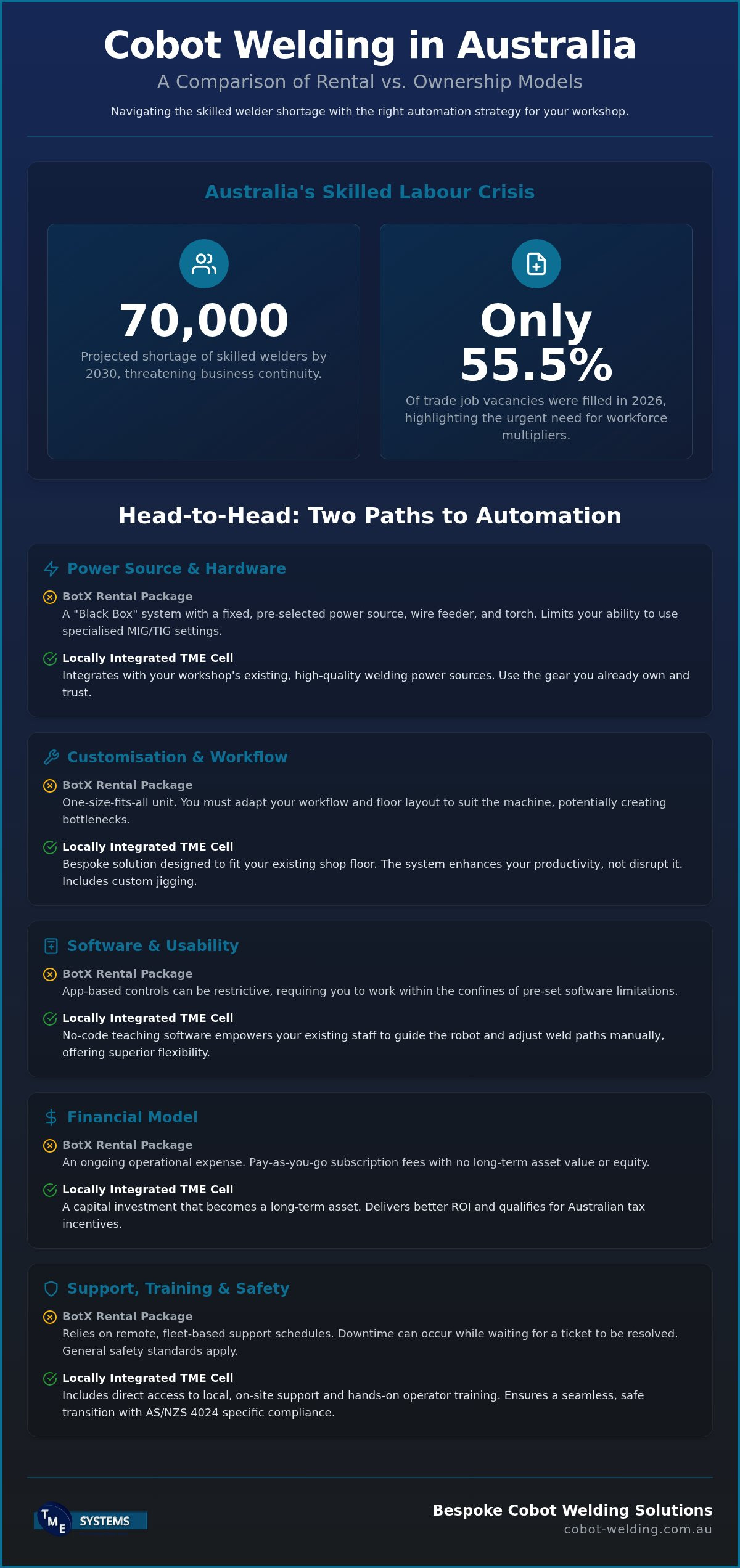

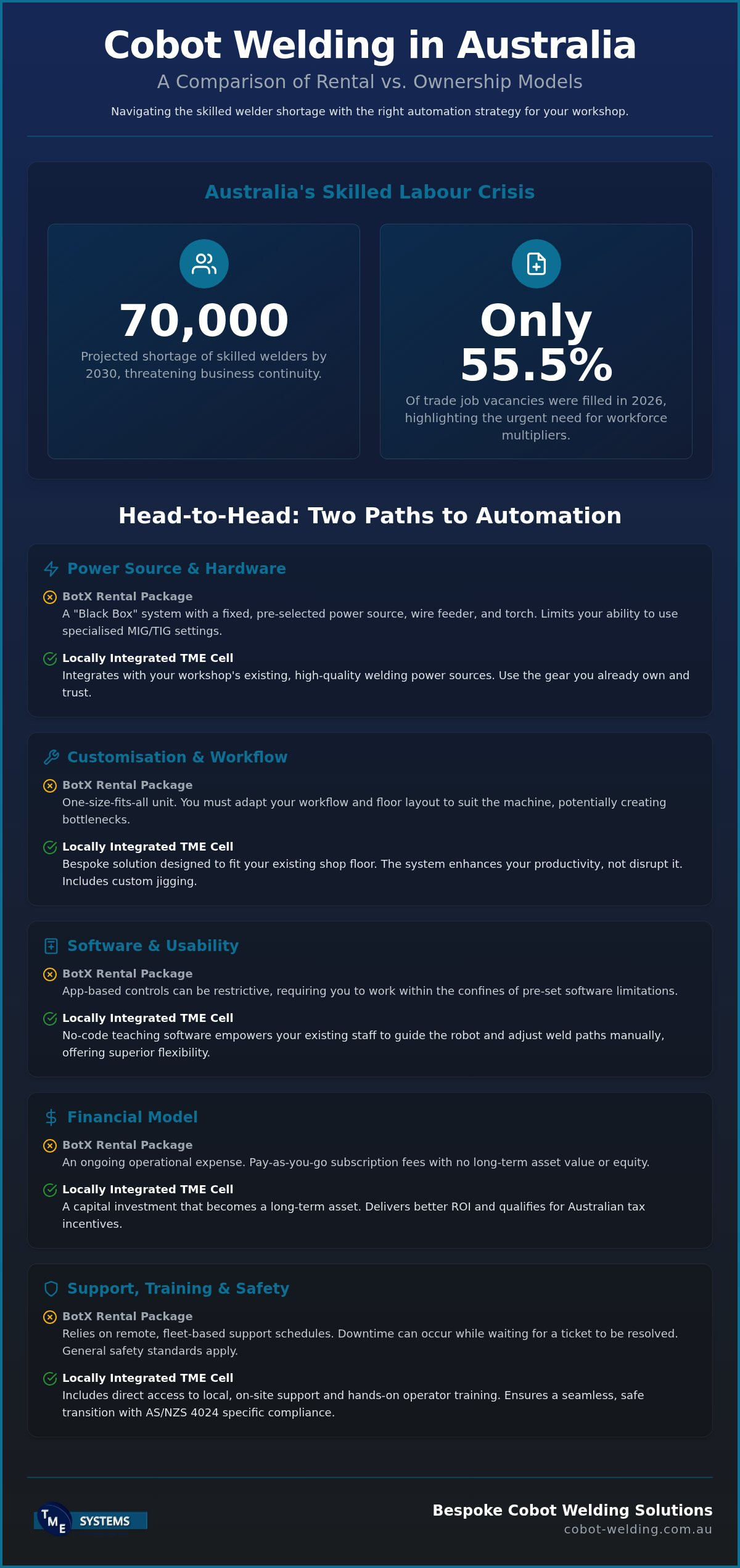
With Australia facing a projected deficit of 70,000 skilled welders by 2030, the pressure to automate your workshop floor is no longer just about growth; it's about basic business continuity. You've likely felt the pinch of unfilled trade vacancies and the frustration of high rework rates on small batches, leading you to look for a botx welding robot comparison to see if a rental model or a permanent local integration fits your workflow best. It's a significant decision, and it's natural to feel uncertain about which path actually secures your shop's future.
We understand that you need a system your existing staff can operate confidently without learning complex programming languages. This guide explores whether the low-entry BotX rental path or a custom, locally integrated cobot cell offers the best ROI for your specific production mix. We'll examine the practical trade-offs between flexible hiring and the long-term productivity of owning a turnkey system. Our goal is to help you reduce reliance on hard-to-find trades while maintaining the high standards of Australian safety compliance and the consistent weld quality your clients expect.
Key Takeaways
- Understand the performance gap between fixed rental hardware and bespoke cells that integrate with your preferred MIG or TIG equipment.
- Learn why no-code teaching software offers more flexibility than app-based controls by allowing your team to adjust weld paths manually.
- Evaluate the long-term financial impact of asset ownership, including Australian tax incentives, versus the ongoing subscription costs of a rental.
- Use our botx welding robot comparison to determine if a pay-as-you-go model suits your current workload or if ownership provides better scaling potential.
- Recognise the critical role of local, on-site support and operator training in ensuring your workshop transition is seamless and safe.
The BotX Rental Model in the Australian Context
BotX is a subscription-based automation system that bundles a collaborative robot arm with a pre-selected, fixed power source. For many Australian workshops, it's the first option that appears when starting a botx welding robot comparison. The core appeal is the "pay-as-you-go" structure, which allows businesses to treat automation like an operational expense rather than a capital investment. This model is particularly attractive for shops with fluctuating workloads or those hesitant to commit to a permanent asset during uncertain economic shifts.
The primary driver for this rental path is the critical shortage of skilled labour. In 2026, only 55.5% of trade job vacancies in Australia are being filled. Fabricators are turning to rentals as a way to "hire" a workforce multiplier without the long-term commitment of a purchase. Robotic welding has become a go-to solution for managing high rework rates on small batches, but the rental path involves a significant trade-off: you gain ease of entry at the expense of customisation and long-term asset value.
Packaged Solutions vs Local Flexibility
Rental systems are typically packaged as "one-size-fits-all" units. While this makes setup straightforward, it often limits your ability to adapt the hardware to specific tasks. If your workshop handles a diverse range of MIG and TIG projects, a fixed rental package may not offer the precision or power settings you'd get from a bespoke integration. We've found that many fabricators prefer a mobile demo system to see a proof of concept on their own floor before deciding. This allows you to test the technology without the "forever" subscription fees associated with a rental model.
The Reality of On-Demand Scaling
Scaling with a rental model isn't always as instant as the marketing suggests. You're still subject to shipping lead times and the availability of rental fleet stock. If a unit requires maintenance or a software update, you're often reliant on the rental provider's remote support schedule. This can lead to unexpected downtime if a technical glitch occurs in the middle of a tight production run. In contrast, owning your system means you control the maintenance schedule and have direct access to local support, ensuring your existing staff can keep the arc on without waiting for a third-party technician to clear a ticket.
Performance and Customisation: Packaged Units vs Bespoke Integration
When conducting a botx welding robot comparison, the most immediate difference you'll notice is the hardware philosophy. Rental models generally arrive as a "Black Box" package. This means the power source, wire feeder, and torch are pre-selected and fixed. While this simplifies the initial choice, it can become a bottleneck if your workshop relies on specific MIG or TIG settings that the rental unit wasn't designed to handle. According to the World Robotics report, the global trend in manufacturing is moving toward high-mix, low-volume flexibility, yet rigid rental packages often struggle to adapt to non-standard jobs or unique material thicknesses.
| Feature | BotX Rental Package | Locally Integrated TME Cell |
|---|---|---|
| Power Source | Fixed / Pre-selected | Integration with your preferred MIG/TIG gear |
| Customisation | Limited to package specs | Bespoke jigging and floor layout |
| Software | App-based controls | No-code teaching software |
| Safety | General fleet standards | AS/NZS 4024 specific compliance |
| Support | Remote / Fleet-based | On-site local integration and training |
The "Black Box" problem extends to your floor layout. A packaged unit requires you to change your workflow to suit the machine. In contrast, a locally integrated cell is designed to fit your existing shop floor, ensuring that the robot enhances your productivity rather than getting in the way of your team. If you're unsure how a robot fits into your current setup, exploring a mobile demo system can provide the clarity you need before committing to a specific hardware path.
Integrating Existing Workshop Infrastructure
Local integration allows you to reuse high-quality welding power sources you already own and trust. This not only saves on unnecessary equipment costs but also ensures your operators are working with familiar arc characteristics. By adding custom jigging and tooling, you can optimise the workspace for your specific parts. This bespoke approach allows for collaborative safety without the need for bulky, floor-consuming guarding, keeping your workshop agile and efficient.
Meeting Australian Safety Standards (AS/NZS 4024)
Safety compliance is a significant hurdle for many Australian fabricators. An "out of the box" system might claim general safety, but it doesn't automatically ensure compliance with AS/NZS 4024.1:2014 within your specific environment. A local integration process includes a thorough risk assessment of your actual workshop floor. This ensures that your staff are protected according to national industrial regulations, giving you the confidence that your new technology meets every local legal requirement from day one.
Software and Usability: Comparing App-Based Controls to No-Code Teaching
When you're evaluating a botx welding robot comparison, the user interface is where your team will spend most of their time. Many rental systems rely on app-based controls that feel familiar because they look like a tablet or smartphone. While these apps are marketed as "easy," they can often be restrictive when you're dealing with complex geometries or non-standard weld paths. If the software doesn't allow for fine-tuned adjustments, your operators might find themselves fighting the machine rather than working with it.
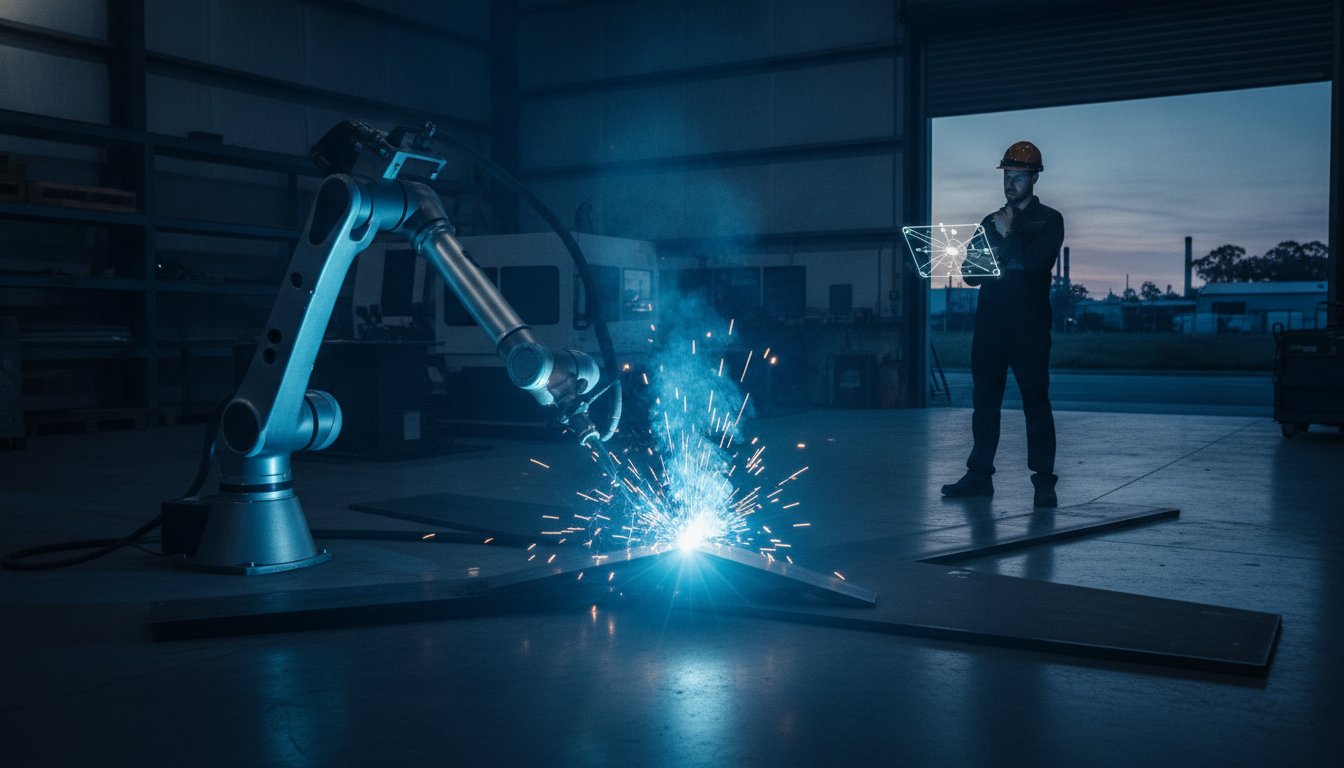
The primary reason for adopting this technology is the welding skills shortage in Australia, which means you need a system that doesn't require a university degree in robotics. True no-code teaching software takes a different approach by removing the screen as the primary interface for path creation. Instead of tapping icons to move an arm, your welders use their hands to guide the robot exactly where it needs to go. This intuitive process demystifies the transition to automation and ensures that your existing staff feel like masters of the tool, not servants to the code.
The Power of Intuitive Teaching
Hand-guiding a robot is a natural extension of a fabricator's existing trade skills. Because the operator physically moves the torch to set the start and end points, they can account for tight corners or awkward angles that a screen-based app might struggle to define. This hands-on method significantly reduces setup time for small batches and one-off custom jobs, making automation viable even for shops that don't do high-volume production. No-code software is the digital bridge that translates the refined physical skills of a master welder into the precise, repeatable movements of a collaborative robot.
Future-Proofing Your Software Skills
Owning your software licence provides a level of certainty that a rental subscription cannot match. When you own the system, you aren't at risk of losing access to your programmed parts if a rental agreement ends or fees increase. Regular firmware updates also ensure your hardware keeps pace with new welding techniques and safety refinements. By investing in a permanent solution, you empower your current workforce to become "robot leads" who can manage the cell independently. This builds internal capability and ensures your workshop remains competitive as the Australian manufacturing landscape continues to evolve.
The Financial Reality: Rental Fees vs Ownership ROI in Australia
When you run a botx welding robot comparison, the monthly rental figure often looks manageable on paper. However, Australian SMEs are increasingly looking past the initial "pay-as-you-go" hook toward the long-term strength of their balance sheets. For a local workshop, the decision between operational expenditure (OpEx) and capital expenditure (CapEx) involves more than just cash flow; it's about building an asset that works for you for the next decade. Small businesses make up approximately 97.2% of all actively trading businesses in Australia, and for these shops, owning the technology is a proven way to secure production future.
Rental models often carry hidden costs that don't appear in the headline rate. Delivery fees, mandatory insurance, and the reality of a "forever" subscription can quickly erode the perceived savings. When you own an integrated cobot cell, your costs stabilise after the initial investment. With business equipment finance rates in 2026 ranging from 7% to 20% depending on your profile, the cost of borrowing to own is often more predictable than the rising fees of a long-term rental agreement.
Australian Tax Incentives and Asset Write-Offs
In 2026, the Australian government continues to support local manufacturing through targeted tax incentives. While rental payments are generally tax-deductible as an operating expense, they don't provide the same balance sheet benefits as owning a depreciated asset. Purchasing a system allows you to take advantage of current asset write-off provisions, which can significantly lower your taxable income in the year of purchase. This strengthens your position for future growth and makes the workshop more attractive to lenders or potential partners.
Long-Term Productivity Gains
The true ROI of a permanent robot cell is found in the reduction of rework and the optimisation of your existing staff. With the average welder salary in Australia now reaching $80,000 to $85,000, every hour spent fixing a bad weld is a heavy hit to your margin. A permanent asset allows you to refine your cost-per-part over a three-to-five-year horizon, something a temporary rental cannot guarantee. You can find more detail on Calculating Robotic Welding ROI for Fabricators to see how these numbers stack up for your specific floor.
If you're ready to see how an integrated system compares to a rental on your own workshop floor, our mobile demo system can provide a practical proof of concept.
Scaling Your Workshop: Why Local Support Wins the Long Game
When you finish your botx welding robot comparison, the deciding factor often isn't just the machine; it's the person standing next to it. Automation is a journey, not a one-time transaction. While a rental system might arrive in a crate with a manual, a locally integrated cell comes with a partnership. For Australian fabricators, this means having access to experts who understand the specific pressures of our regional industry, from the scarcity of tradespeople to the strict requirements of local safety standards. Building a relationship with integration specialists ensures that your investment continues to evolve as your production needs grow.
Transitioning from a single cobot cell to a fully automated workflow requires a steady, methodical approach. A local partner acts as a practical mentor, helping you identify which parts of your process are ready for the robot and which still require the nuanced touch of a master welder. This collaborative approach ensures that technology empowers your workers rather than replacing them, allowing your team to focus on high-value tasks while the robot handles the repetitive runs. It's about securing your shop's future through sustainable, supported growth.
On-the-Ground Integration and Support
There's a significant difference between calling a remote helpdesk and having a technician stand on your workshop floor. When a complex jigging issue arises or a specific weld path needs refining, on-site support is invaluable. Local integration allows for a customised onboarding program that respects your team's existing skills. Instead of a generic tutorial, your staff receive training tailored to your specific MIG or TIG equipment and your unique part geometries. If you're looking for a partner to guide this transition, it's vital to know what to look for in Australian Robotic Welding Experts.
Making the Choice for 2026
Deciding between a rental and a permanent cell comes down to your long-term goals. To help you decide, consider this simple checklist:
- Choose a rental if: Your project is a one-off lasting less than six months and you have no desire to build long-term asset value.
- Choose local integration if: You want to customise the system to your existing power sources, take advantage of 2026 tax incentives, and ensure your staff are trained to manage the cell independently.
The best way to demystify the process is to see the technology in action. You can organise a mobile welding robot demonstration for your workshop to test the no-code interface and arc quality on your own parts. This hands-on proof of concept allows you to make an informed decision based on the reality of your own production floor, ensuring you choose the path that offers the best ROI for your business.
Securing the Future of Your Australian Workshop
Choosing between a rental model and a permanent cell is a pivotal decision for any fabricator looking to outpace the skilled labour shortage. This botx welding robot comparison highlights that while packaged rentals offer a low-risk entry point, they often lack the customisation and long-term financial benefits of ownership. By opting for a locally integrated system, you gain the freedom to use your preferred power sources and the ability to leverage 2026 tax incentives that strengthen your balance sheet.
Success on the workshop floor ultimately depends on how well your team adapts to new technology. Our turnkey integration and no-code software expertise ensure that your existing staff can operate the system with confidence from day one. As an Australian-owned and operated partner, we're here to provide on-the-ground support that keeps your production lines moving. It's time to stop worrying about trade vacancies and start focusing on the consistent, high-quality output your clients expect.
Ready to see the difference for yourself? Book a Mobile Welding Robot Demonstration for Your Workshop to experience a hands-on proof of concept on your own floor. We're here to help you make the transition to automation practical, profitable, and permanent.
Frequently Asked Questions
Is a BotX rental cheaper than buying a cobot welding cell in Australia?
Rental payments are a short-term solution for cash flow, but they can become more expensive over several years when compared to asset ownership. While the initial outlay is lower, you miss out on depreciation benefits and the security of owning a permanent asset. When performing a botx welding robot comparison, many fabricators find that the long-term ROI of an integrated cell outweighs the simplicity of a subscription model.
Do I need a robot programmer to run an integrated welding cobot?
You definitely don't need a specialised programmer to operate our collaborative systems. Our no-code teaching software allows your existing welders to guide the robot arm by hand to set weld paths. This intuitive approach means your team uses their trade skills to refine the arc rather than typing lines of code. It's designed specifically so that fabricators can take full control of the automation process without any prior robotics experience.
Can I use my existing MIG welder with a locally integrated cobot system?
Yes, one of the primary advantages of local integration is the ability to use your preferred MIG or TIG power sources. Unlike packaged rental units that come with fixed hardware, our integration services ensure your existing workshop gear works seamlessly with the cobot. This reuse of trusted equipment reduces your initial capital requirements and ensures your operators are working with arc characteristics they already understand and trust.
How long does it take to train an experienced welder to use a cobot?
Most experienced fabricators can become proficient with a cobot system within a single shift. Because the interface is based on physical movement rather than complex programming, the learning curve is very shallow. Our operator training and onboarding programs focus on practical application, ensuring your staff can set up new jobs and adjust parameters independently. This rapid transition helps your workshop maintain productivity while adopting new technology.
Are collaborative welding robots safe to use without safety cages in Australia?
Collaborative robots are designed to work alongside humans without traditional bulky guarding, but they must still comply with AS/NZS 4024.1:2014. Safety is determined by a thorough risk assessment of your specific workshop floor and the application itself. Professional integration ensures that force-limiting settings and safety scanners are correctly configured, allowing your team to work confidently in a shared space while meeting all Australian industrial regulations.
What happens if our production needs change after we've bought a system?
Integrated systems are built for flexibility, allowing you to redeploy the robot as your production mix evolves. Because the software is no-code, your team can program new parts or adjust existing paths in minutes. You aren't locked into a specific package; you can swap out jigs, update your power source, or refine your workflow. This adaptability makes a permanent cell a versatile tool that grows with your business.
Does the no-code software work for both aluminium and stainless steel?
The no-code software is completely material-agnostic and handles aluminium, stainless steel, and mild steel with equal precision. The software manages the movement and pathing of the robot, while your integrated power source handles the specific arc parameters required for different alloys. This makes the system ideal for high-mix job shops that need to switch between different materials and thicknesses throughout a standard production week.
How do I calculate the ROI for a welding robot in a small job shop?
To calculate ROI, you should compare your current cost-per-part against the projected output of an automated cell. Factor in the reduction of rework, the ability to run existing staff on multiple machines, and 2026 tax incentives for equipment ownership. A thorough botx welding robot comparison often reveals that the consistency of a permanent asset significantly lowers operational costs over a three-to-five-year horizon, especially for shops struggling with the skilled welder shortage.