
What if the biggest factor in your cobot welding cost australia isn't the price of the robotic arm, but the hidden hours spent programming it? If you're managing a busy workshop, you're already familiar with the frustration of a dwindling pool of ticketed welders and the rising labour costs that come with repetitive production runs. It's a common challenge to see your most skilled staff tied up with basic tasks when they should be focused on high-value projects that actually grow your bottom line.
We understand that automation can feel like a daunting leap, especially if you don't have a robotics engineer on the payroll. This guide is designed to strip away the technical jargon and provide a clear, grounded look at the total investment required for collaborative welding in 2026. You'll learn how to distinguish between initial hardware costs and long-term integration, why no-code software is a game-changer for ROI, and exactly how to calculate when your new system will start paying for itself on the workshop floor.
Key Takeaways
- Get a transparent breakdown of the total cobot welding cost australia for 2026, looking past the initial hardware price to include essential integration and safety requirements.
- Discover how no-code teaching software allows your current team to 'teach' the robot, preserving their craftsmanship while eliminating the need for an expensive robotics programmer.
- Learn to calculate a realistic ROI based on local labour rates and increased arc-on time, typically resulting in a payback period of 6 to 18 months.
- Understand why professional onboarding and workshop integration are critical to avoiding costly downtime and ensuring your system is production-ready from day one.
- Identify the practical steps for budgeting, including the value of an on-site mobile demonstration to verify the technology works for your specific parts.
Understanding the Investment: Cobot Welding Costs in Australia for 2026
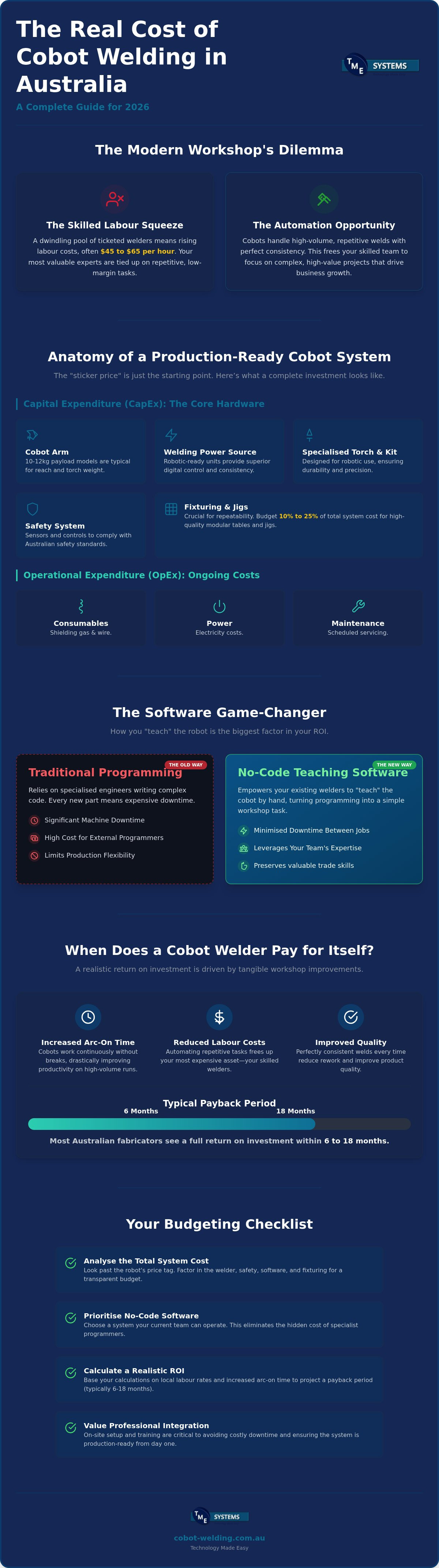
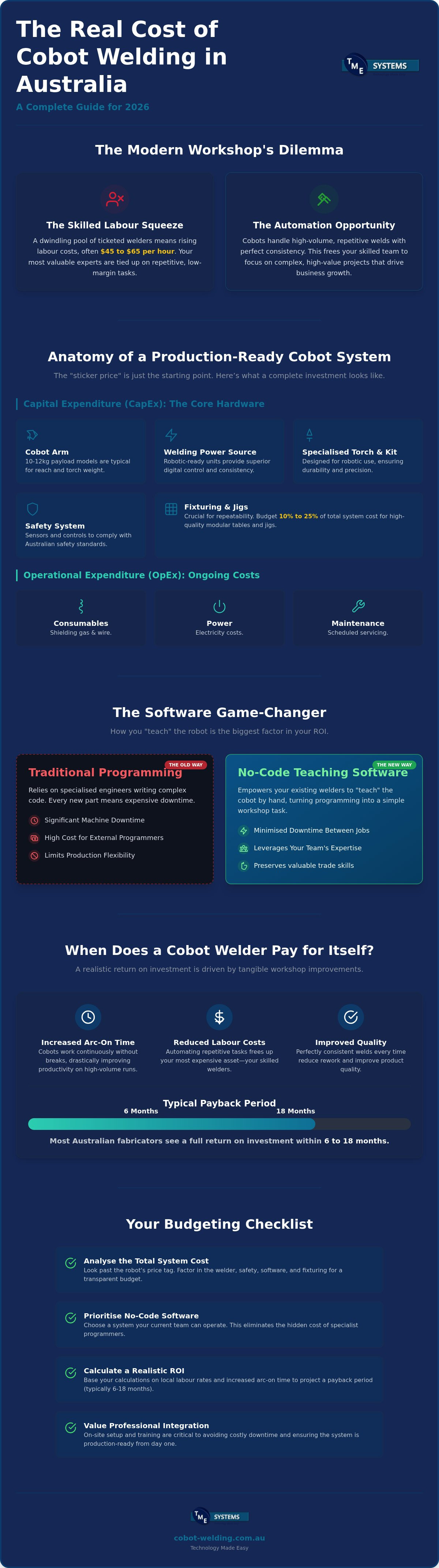
Many Australian fabricators start their automation journey by looking at the price tag of a robotic arm. While the cobot welding cost australia has become more accessible in 2026, the "sticker price" of the hardware is only one piece of the puzzle. A truly production-ready system involves a combination of the arm, a high-quality welding power source, safety sensors, and the software that ties it all together. If you only budget for the robot, you'll likely find yourself stalled halfway through the integration process.
The shift toward a collaborative robot (cobot) represents a fundamental change in how workshops operate. Unlike traditional industrial robots that require expensive safety cages and specialised programmers, cobots are designed to work alongside your team. This significantly lowers the total cost of ownership by reducing the physical footprint required in your shop and eliminating the need for a dedicated robotics engineer on the payroll. For local fabricators, this means the technology is no longer reserved for Tier 1 automotive plants; it's a practical tool for the average workshop floor.
Capital Expenditure (CapEx) vs. Operational Expenditure (OpEx)
When you look at the financials, it's helpful to split the investment into two buckets. Your CapEx includes the physical assets like the cobot arm, the welding torch, and the power source. These are the one-off costs that get the machine through the door. In contrast, your OpEx covers the day-to-day running costs such as shielding gas, welding wire, and electricity. In the past, programming was a massive ongoing OpEx because you needed external experts every time you changed a part. Today, no-code teaching software has shifted this task back to your existing tradespeople. It turns programming into a standard workshop task, similar to setting up a new jig, which keeps your operational costs predictable and low.
Why Australian Fabricators are Investing in 2026
The primary driver for investment this year remains the acute shortage of ticketed welders. With labour rates for skilled tradespeople often sitting between $45 and $65 per hour, using a human welder for repetitive, low-value runs is becoming a financial drain. Automation allows your best people to focus on complex, high-margin work while the cobot handles the high-volume tasks. Additionally, various government incentives aimed at modernising Australian manufacturing can often offset a portion of the initial investment. It's worth checking current industry grants or accelerated depreciation schemes that apply to industrial automation to see how they might improve your bottom line.
The Price Breakdown: Hardware, Software, and Hidden Costs
Building a functional welding cell is about more than just purchasing a robotic arm. To get an accurate picture of the cobot welding cost australia, you need to look at the entire ecosystem. A professional setup typically includes the cobot arm, a compatible welding power source, a specialised torch, and a suite of safety sensors to ensure the system complies with local standards. While it's tempting to focus solely on the robot, the integration of these components determines whether the machine becomes a productive member of your team or a source of constant calibration headaches.
Hardware Components: The Building Blocks
The choice of cobot arm usually depends on the reach and payload required for your specific parts. While a 5kg arm might handle light tasks, most Australian fabricators opt for 10kg or 12kg models to accommodate heavier torches and the forces involved in high-speed movement. You also face a choice regarding your power source. Some shops choose to integrate their existing manual welders to save on initial costs, but investing in a dedicated robotic-ready unit often pays off through better digital communication and more consistent arc control. Don't forget to budget for high-quality fixturing. Industry data suggests that budgeting between 10% and 25% of your total system cost for modular welding tables and precision jigs is essential for repeatable, high-quality results.
The Software Advantage: No-Code vs. Traditional
The most significant "hidden" cost in traditional automation isn't the hardware; it's the downtime associated with programming. If your system requires a specialist to write lines of code every time you switch from a gate frame to a bracket, your machine will sit idle for hours or even days. This is where no-code teaching software changes the financial equation. By allowing a standard welder to physically lead the arm through a weld path, you can set up a new batch in minutes. This agility is vital for the "high-mix, low-volume" work common in Australian shops. Instead of paying for a robotics engineer, you're empowering your existing staff to use their trade knowledge to "teach" the robot.
When weighing up these different factors, it often helps to see the equipment in your own environment. Arranging a mobile demonstration can clarify how these components fit onto your workshop floor and help you identify which hardware configuration best suits your current production flow. Whether you're looking at MIG, TIG, or plasma cutting, the goal is to find a balance where the hardware capability matches the simplicity of the software interface.
Calculating ROI: When Does a Cobot Welder Pay for Itself?
Determining the cobot welding cost australia is only half the battle; the real question for most business owners is how quickly that investment returns to the bank account. In a typical Australian workshop, ticketed welders command rates between $45 and $65 per hour. When you factor in superannuation, insurance, and overheads, the cost of manual labour for repetitive tasks becomes a significant burden. A cobot doesn't just replace an hourly rate; it changes the fundamental capacity of your floor by maintaining consistent output without the fatigue that naturally limits human performance.
The financial impact is most visible when you look at a double-shift scenario. While a manual welder might maintain an arc-on time of 60% to 70% during a standard shift, a cobot can consistently hit 85% to 95%. Over two shifts, this gap widens into a massive productivity lead. You aren't just saving on wages; you're increasing the total number of parts out the door without adding to your headcount. This allows you to stop turning away smaller, repetitive jobs that were previously too labour-intensive to be profitable.
Labour Savings and Productivity Gains
One of the most practical ways to see an immediate return is through operator multi-tasking. Because the system is collaborative and safe, a single operator can often manage two cobot cells simultaneously or prepare the next jig while the robot is under the hood. This effectively doubles your output per staff member. For a high-mix job shop in 2026, implementing a collaborative system can increase welding throughput by 50% to 150%, meaning the equipment often pays for itself through sheer volume alone. This shift from manual labour to supervised automation is a key step in improving welding productivity with cobots.
Quality Control and Reduced Rework
Rework is a silent profit killer in many fabrication shops. Industry data shows that manual rework rates often sit between 5% and 8%, but a cobot can bring that down to under 1%. In sectors like structural steel or pressure vessel fabrication, a single failed weld can cost thousands in lost time and materials. By ensuring every bead is laid with the same travel speed and torch angle, you eliminate the "Friday afternoon" human error factor. You also save on the back end; more consistent travel speeds can reduce wire consumption by 15% to 25% and significantly lower the time spent grinding away spatter. These incremental savings in consumables and cleaning time often shave months off the total payback period, which typically ranges from 6 to 18 months for most Australian fabricators.
Integration and Training: Ensuring Your Investment Works
Successful automation is as much about people as it is about machines. When calculating your total cobot welding cost australia, the investment in integration and training is what ensures the cell actually produces parts rather than gathering dust in a corner. While it might be tempting to skip professional onboarding to save on initial costs, the price of "figuring it out yourself" usually comes in the form of weeks of lost production and frustrated staff. A structured integration plan turns a complex technical transition into a predictable workshop upgrade.
The Integration Roadmap for Australian Shops
A professional integration usually follows a three-step process designed to minimise disruption to your current orders. First, an on-site assessment identifies exactly where the cell will sit and how parts will flow to and from the operator. Second, the physical installation must account for Australian safety standards, specifically ISO 10218-1/2 and the relevant risk assessments. Even though cobots are built for collaboration, ensuring the entire cell meets local safety requirements is a legal necessity. Finally, we customise the weld parameters for your specific materials. Whether you're working with thin-gauge aluminium or heavy mild steel, having these settings refined from day one prevents the "trial and error" waste that often plagues unassisted setups.
Staff Onboarding and Training Costs
Training your existing team is significantly more cost-effective than trying to recruit specialized robotics staff in a tight labour market. There is also a vital psychological element to this process. When you frame the cobot as a sophisticated tool designed to handle the "grunt work," your tradespeople see it as an asset to their craft rather than a threat to their job. This approach preserves the welding knowledge already present in your workshop while adding a new layer of technical skill to your team. You can read more about on-site cobot welder training to see how we help operators become proficient in days, not months.
The long-term success of your investment also relies on local technical support and the availability of spare parts. If a torch is damaged or a cable fails, you can't afford to wait weeks for an overseas shipment. Partnering with a local provider ensures that your downtime is measured in hours, not days. If you're looking to build a reliable automation strategy, starting with a professional welding system integration plan is the most effective way to protect your bottom line and ensure the equipment performs as promised.
Next Steps: How to Budget for Your First Cobot Cell
Moving from the research phase to a physical installation requires a structured approach to your finances. While previous sections have outlined the broad cobot welding cost australia, your specific workshop budget for 2026 needs to account for your unique production mix. A generic quote rarely survives the reality of a busy workshop floor. To ensure your investment is sound, you should prepare a checklist that covers the entire lifecycle of the equipment, from the initial purchase to the first day of full production.
Your 2026 budgeting checklist should include:
- Primary Hardware: The cobot arm, welding power source, and torch assembly.
- Software Licensing: No-code teaching software that allows your existing team to manage the system.
- Fixturing and Tooling: High-quality modular welding tables and custom jigs, which often represent 10% to 25% of the total system value.
- Safety Compliance: Costs for a formal risk assessment and any necessary physical guarding to meet Australian standards.
- Onboarding: Dedicated time for your staff to learn the system without the pressure of a live production deadline.
For many Australian SMEs, the decision between an outright purchase and a leasing arrangement is a critical financial step. Buying the equipment outright can simplify your balance sheet and allow for immediate depreciation benefits. Alternatively, leasing options can preserve your cash flow for raw materials and other operational expenses. It's always best to speak with your financial advisor about which path suits your current growth strategy.
Booking a Mobile Demonstration
The most effective way to de-risk your investment is to see the technology work on your own parts. A mobile demonstration reduces the risk of buying the wrong tool by proving the cobot can handle your specific weld joints and material thicknesses. When preparing for a demo, have your most repetitive parts ready and involve your best welder in the process. Their trade knowledge is essential for evaluating the weld quality and the ease of the software interface. You can book a mobile welding robot demonstration to get a hands-on feel for how the system adapts to your workshop environment.
Customised Quotes and Integration Planning
Generic online prices can be misleading because they often omit the integration work required for a seamless setup. Every workshop has different requirements for reach, power, and safety. A tailored integration plan ensures that the system you buy today is capable of handling your production volume for years to come. TME Systems Pty Ltd specialises in providing these turnkey solutions, focusing on no-code software that keeps the power of automation in the hands of your tradespeople. If you're ready to move beyond estimates, you can contact TME Systems Pty Ltd for a tailored cobot welding cost breakdown that reflects your specific operational goals.
Securing Your Workshop's Future with Practical Automation
Investing in automation is no longer a matter of 'if' but 'when' for competitive Australian fabricators. Understanding the true cobot welding cost australia involves looking beyond the initial hardware to the long-term gains in productivity and quality. By choosing a system powered by no-code teaching software, you ensure that your existing team remains at the heart of your production, using their trade expertise to drive the technology rather than being sidelined by complex programming requirements.
As an Australian-owned and operated partner, TME Systems Pty Ltd is dedicated to helping local manufacturers achieve a proven ROI through seamless workshop integration. We specialise in making technical transitions feel attainable, providing the training and ongoing support needed to keep your arc-on time at its peak. Ready to see how these figures apply to your specific production runs? Request a custom cost breakdown for your workshop and take the first step toward a more efficient, high-output floor. With a pragmatic plan in place, your first cobot cell will be more than just a purchase; it'll be a reliable partner in your long-term success.
Frequently Asked Questions
How much does a basic cobot welding setup cost in Australia in 2026?
A basic setup typically includes the robotic arm, a welding power source, and the interface software, with prices varying based on the required reach and payload. While entry-level arms are more accessible than ever, a production-ready cell involves additional investment in safety sensors and specialised integration. Your total cobot welding cost australia depends heavily on whether you're purchasing a standalone arm or a complete turnkey system designed for immediate workshop use.
Do I need to hire a programmer to run a no-code welding robot?
You don't need a robotics engineer or a computer programmer to operate a system equipped with no-code software. This technology allows your ticketed welders to physically move the arm and 'teach' it the required path. It's a much more practical approach for local shops because it keeps the control in the hands of the tradespeople who actually understand the weld pool and joint requirements.
What is the typical ROI timeframe for a cobot welder in a small Australian workshop?
Most Australian fabricators see a full return on their investment within 6 to 18 months. This timeframe is driven by a significant increase in arc-on time and a reduction in the rework that typically plagues manual production runs. In a double-shift scenario, the payback period often accelerates because the machine doesn't suffer from the fatigue or inconsistency that naturally limits human output over long hours.
Can a cobot welder handle both MIG and TIG applications?
Yes, collaborative systems are versatile enough to handle MIG, TIG, and even plasma cutting tasks. The hardware is essentially a platform; you simply swap the torch and integrate the appropriate power source to suit your material. While MIG is common for high-volume steel work, TIG configurations are increasingly popular for precision tasks in aluminium and stainless steel where consistent travel speed is critical for quality.
What are the hidden costs of robotic welding integration?
The most common hidden costs involve precision fixturing and the mandatory safety risk assessments required by Australian law. You should budget for high-quality modular tables and clamps to ensure your parts are positioned identically every time. Without proper jigs, the robot's repeatability is wasted. Other factors include the electricity and shielding gas consumption, though these are often offset by the reduction in wasted welding wire and spatter.
Is it safe to use a welding cobot without a safety cage in Australia?
It's possible to operate without a full cage, but only if a formal risk assessment confirms the setup is safe for your specific environment. Australian standards like AS/NZS 4024 require you to consider the 'sharp' end of the application, such as the hot welding torch and arc glare. In many cases, simple light curtains or area scanners are used instead of physical fences to maintain the collaborative nature of the workshop.
Does the cost of a cobot include training for my existing staff?
Training is often a separate component of the integration process, though many turnkey packages include initial onboarding for your operators. Investing in professional training ensures your team feels confident using the no-code interface from day one. This proactive approach prevents the downtime that occurs when staff try to 'figure it out' on their own, making it a vital part of the overall cobot welding cost australia for any serious business.
Are there any Australian government grants for welding automation in 2026?
Several federal and state-based grants are available in 2026 to support the modernisation of Australian manufacturing. These programs often target small-to-medium enterprises looking to improve their global competitiveness through automation. It's worth checking with bodies like the Department of Industry or local manufacturing hubs to see which current schemes, such as technology tax write-offs or energy efficiency grants, could help offset your capital expenditure.