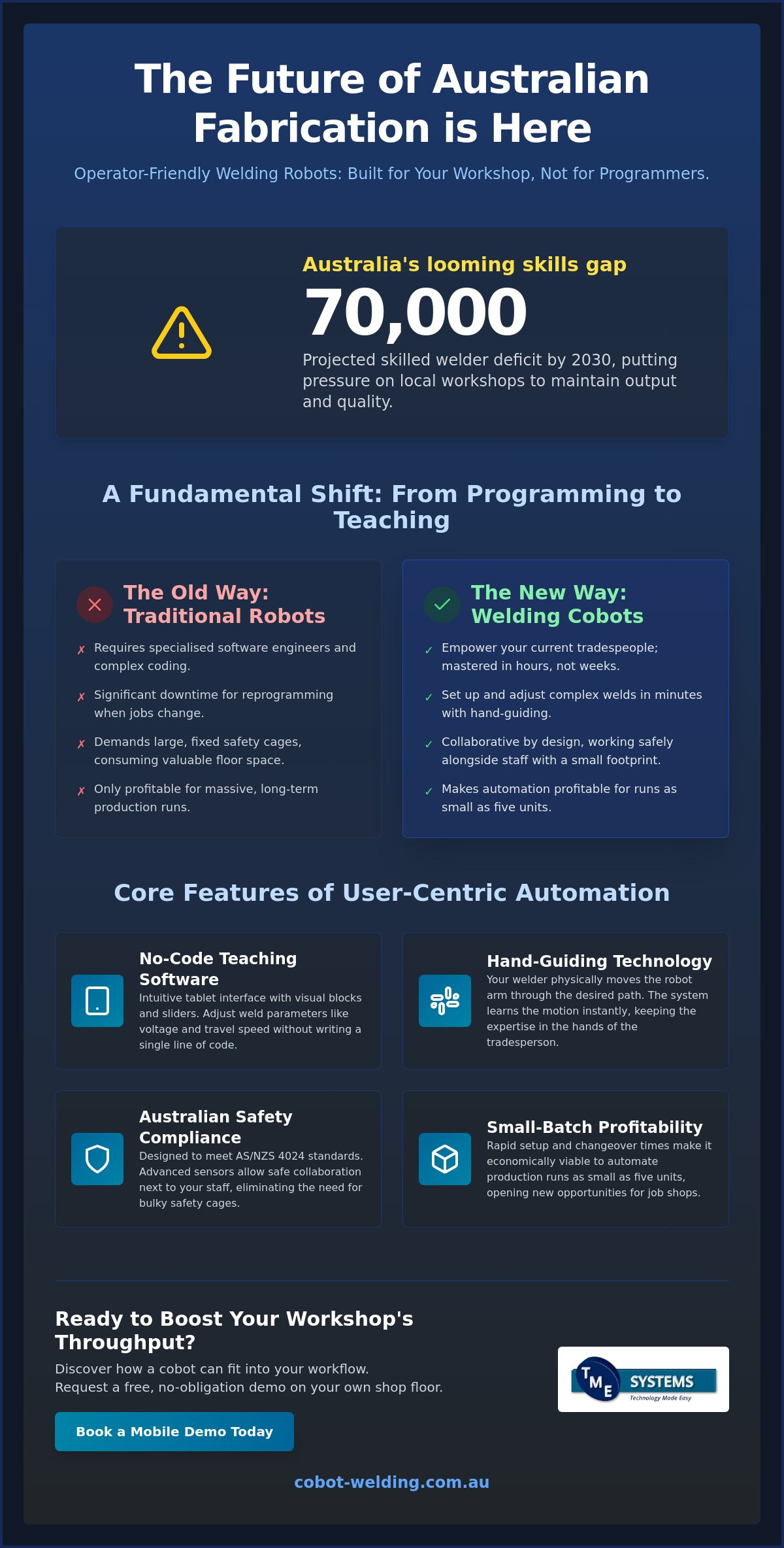

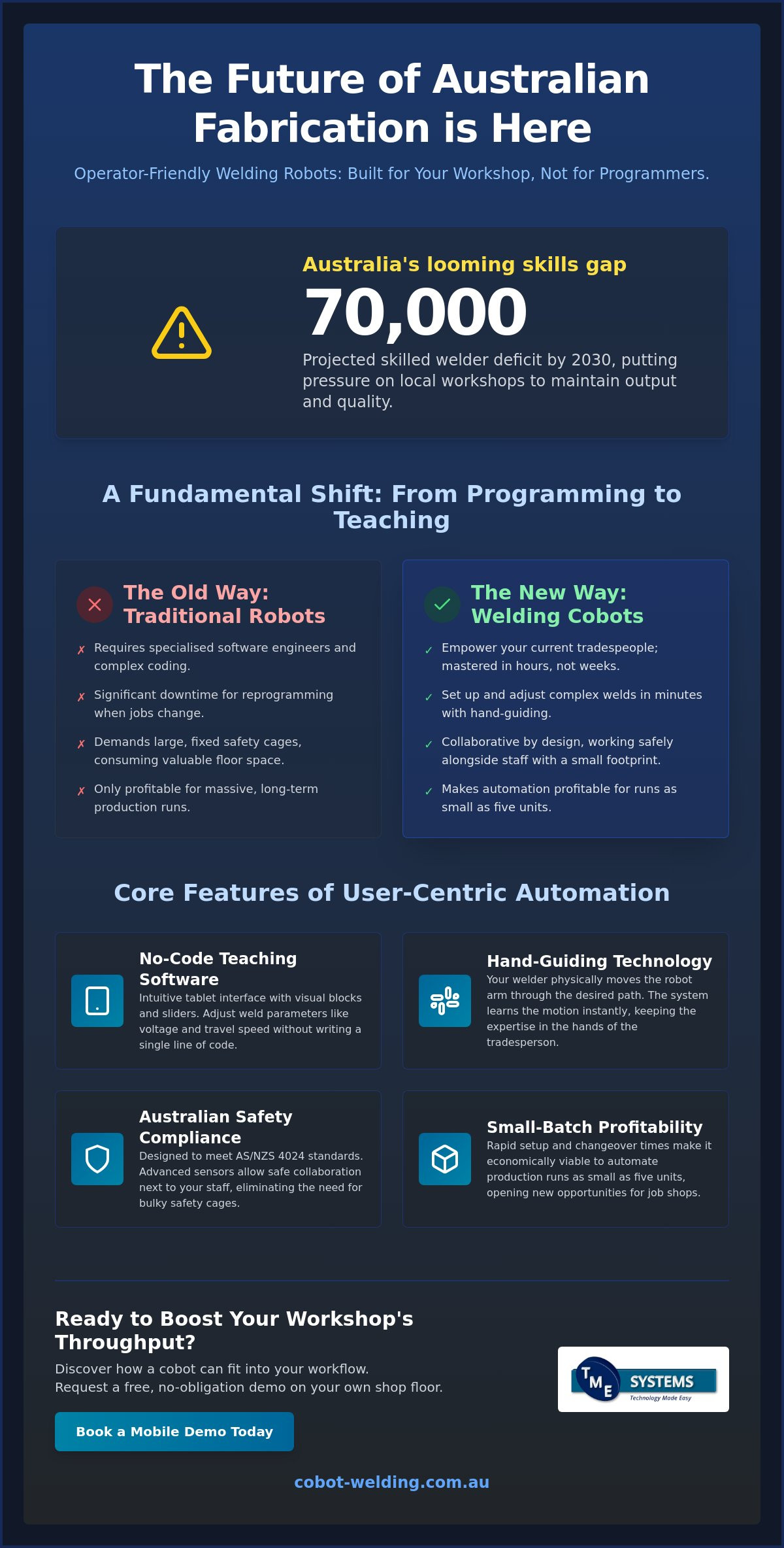
Australia is currently staring down a projected deficit of 70,000 skilled welders by 2030, a statistic that highlights the growing pressure on local workshops to maintain output. You've likely felt the frustration of a mounting backlog or the sting of high rework costs on manual welds, all while wondering how to scale without finding more specialists in a tight market. It's easy to assume that operator friendly welding robots are a bridge too far, reserved only for massive factories with dedicated programming departments and seven-figure budgets.
We understand that the biggest hurdle isn't the cost of the hardware, but the fear of complexity. The good news is that modern no-code cobots have evolved into practical tools that your current team can master in hours, not weeks. By shifting to these intuitive systems, you can empower your tradespeople to automate repetitive production runs without needing to write a single line of code. This article explores how these tools are helping Australian fabricators increase throughput and achieve consistent quality, ensuring your workshop remains competitive as industry standards and labour market realities continue to shift.
Key Takeaways
- Learn how operator friendly welding robots are built for your current tradespeople, eliminating the need for specialised software engineers in your workshop.
- Understand the power of no-code teaching software to help your team set up and adjust complex welds in minutes rather than hours.
- See why small-batch production is now viable with automation, making runs as small as five units profitable for local fabricators.
- Get the facts on Australian safety compliance, specifically AS/NZS 4024, to keep your staff safe and your business protected.
- Discover how to de-risk your investment through turnkey integration and the benefits of seeing a mobile demo on your own shop floor.
What are Operator-Friendly Welding Robots? Beyond the Hype
For a long time, the word "robot" in a workshop suggested something inaccessible. It meant expensive technicians, complex code, and massive safety cages that ate up half the floor. Operator friendly welding robots have changed that narrative. These systems are designed specifically for the tradespeople already on your team. Instead of requiring a computer science degree, they rely on the welding expertise your staff already possess. They are tools built to enhance a welder's output, not replace their fundamental skills.
While a traditional Robot welding overview might highlight high-volume automotive production, the latest technology in 2026 focuses on versatility for smaller job shops. With Australia facing a projected deficit of 70,000 welders by 2030, we simply can't afford to keep automation locked behind a "tech barrier". The goal is to turn your best welders into automation experts. This allows them to produce more without the physical strain of repetitive manual tasks, ensuring your workshop stays productive even when recruitment is difficult.
The Shift from Programming to Teaching
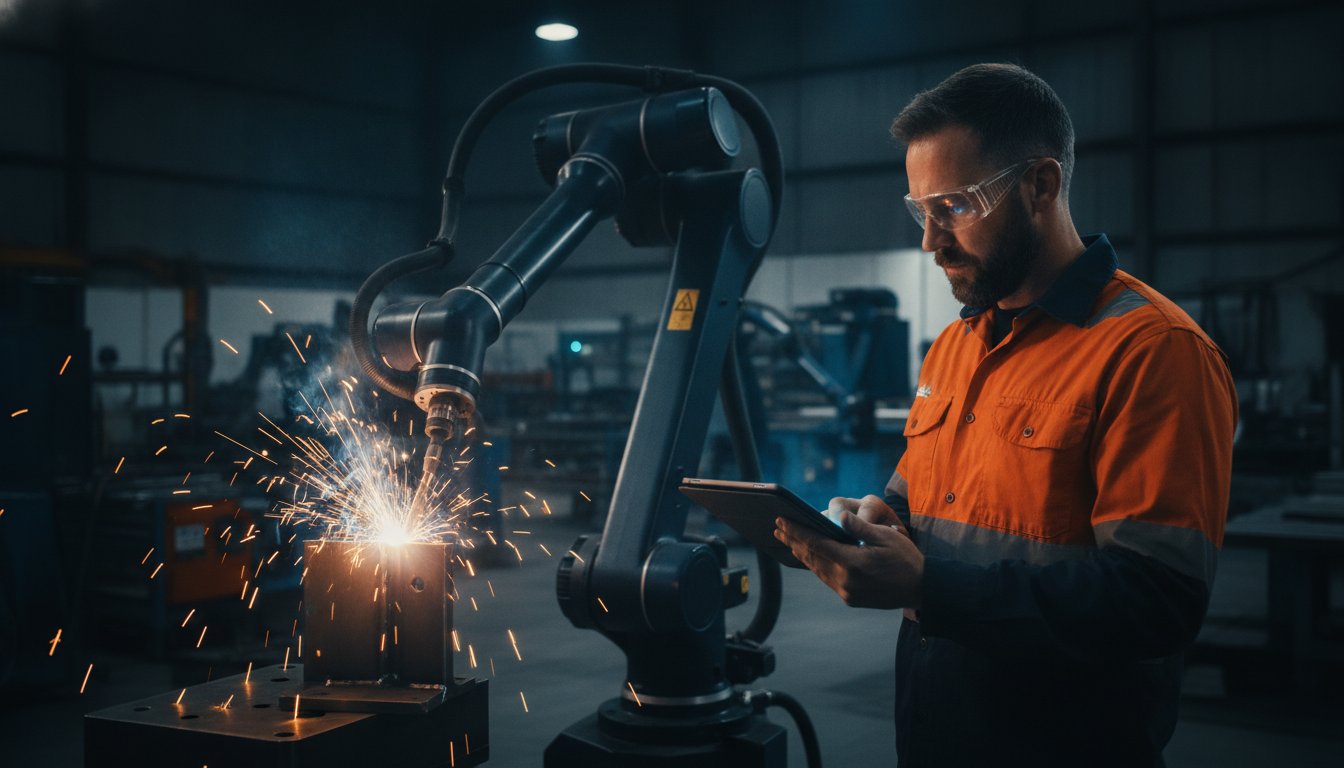
Traditional industrial robots are often "black boxes" that require lines of code or complex pendant navigation to move even an inch. This creates a massive bottleneck for local job shops. If the part changes, the production stops until a specialist arrives to reprogram the system. Modern operator friendly welding robots use hand-guiding technology to bypass this issue. Your welder simply grabs the robot arm and moves it through the required weld path physically. The software "learns" the movement instantly. This approach keeps the "welding soul" and technical expertise in the hands of the tradesperson, making the transition to automation feel natural rather than intimidating.
Why "Collaborative" Matters on the Workshop Floor
The term "collaborative" refers to robots, or cobots, that are designed to work alongside humans safely. Unlike old-school robots that needed light curtains and steel fences, cobots use advanced sensors to stop instantly if they sense an obstruction. This is a significant advantage for the typical Australian workshop where floor space is often at a premium. Because there is no need for massive safety cages, these units have a much smaller footprint and can be integrated into your existing layout with minimal fuss. This proximity also offers a psychological benefit. Operators quickly start to see the robot as a helpful assistant, much like a high-end positioner or a new MIG plant, rather than a distant machine that operates in isolation.
The Core Features of User-Centric Welding Automation
Designing a system for a welder means speaking the language of the workshop floor, not the server room. The primary difference between a standard industrial arm and operator friendly welding robots lies in the interface. A "robotics-first" system forces the user to think in Cartesian coordinates and complex syntax. In contrast, a "welding-first" system prioritises the parameters that actually matter to a tradesperson: travel speed, wire feed, and torch angle. By using mobile tablet controls with familiar touch gestures, these systems feel more like a modern smartphone than a piece of heavy machinery.
The Australian market for welding robots is expanding because local shops need tools that work immediately. These user-centric systems combine high-end hardware, like precision sensors and collaborative arms, with software that removes the technical "middleman". This setup allows a senior welder to oversee multiple cells at once, ensuring that the quality of the output matches their years of manual experience.
No-Code Teaching Software: The Game Changer
The introduction of no-code robot welding software has effectively removed the need for specialised programmers. No-code is a visual interface that translates human intent into machine logic without text-based syntax. Instead of typing commands, operators use visual blocks and intuitive sliders to set their weld parameters. If a weld needs more penetration, the operator simply adjusts a slider on the tablet for voltage or wire speed. This visual approach makes it easy to see the logic of the weld sequence at a glance, allowing for rapid troubleshooting and refinement without stopping production for long periods.
Touch-and-Teach Path Generation
Setting up a new part used to be the most time-consuming aspect of automation. With operator friendly welding robots, this process is simplified through "touch-and-teach" path generation. The operator defines the start and end points of a weld by simply clicking buttons on the torch or tablet. The software then calculates the most efficient path between those points. This technology allows for:
- Rapid duplication of paths for multi-run heavy plates.
- Instant generation of circular patterns for pipe and flange work.
- The ability to "nudge" paths by millimetres to account for slight fit-up variations.
Myth-Busting: "Robots are Only for Large-Scale Production"
A common myth persists in Aussie workshops that robots only make sense if you're pumping out thousands of identical widgets. This "all or nothing" mentality stems from the old days of rigid industrial automation. Back then, the cost and time required to program a robot for a new part meant you needed massive volumes just to break even. Today, operator friendly welding robots have flipped that logic. If a setup takes ten minutes instead of ten hours, a batch of five parts becomes just as viable as a run of five hundred.
Australian manufacturing has always thrived on being "high-mix, low-volume". We specialise in custom solutions and short, agile production runs. The recently released National Robotics Strategy acknowledges this reality, pushing for technologies that allow local businesses to pivot quickly. By using quick-change jigging and modular tables, you can swap between a trailer chassis and a batch of brackets in the time it takes to have a smoko. This flexibility is what allows a small job shop to compete with larger offshore operations without sacrificing their niche.
High-Mix, Low-Volume: The New Reality
Automation on the fly is no longer a pipe dream. When you don't need a software engineer to re-code the line, your lead times drop significantly. You can take on bespoke jobs that were previously too labour-intensive to be profitable. This speed doesn't just come from the robot's movement; it comes from the lack of downtime between different jobs. It turns the robot into a versatile tool that stays busy all shift, rather than a specialised machine that sits idle waiting for a massive order.
Calculating ROI Beyond Just "Speed"
True return on investment (ROI) looks at the entire production cycle. While operator friendly welding robots might weld faster than a human, the real savings often show up in the finishing bay. Consistent, high-quality beads mean a massive reduction in rework and grinding time. If you can save thirty minutes of cleanup on every part, the machine pays for itself far quicker than a simple "arc-on" time comparison suggests.
There's also the human factor to consider. Using automation for repetitive, dull tasks allows your senior staff to focus on complex, high-value fabrication that requires their unique expertise. These cobot welding benefits for welders include reduced physical strain and a lower risk of arc-eye. By removing the grunt work, you're not just improving the bottom line; you're creating a safer, more engaging environment that helps you keep your best people on the tools for longer.
Implementation: Training and Safety in the Australian Context
The transition to automation often fails when the technology is too far removed from the people using it. Implementation shouldn't feel like a university degree; it should feel like adding a high-end tool to your kit. Because operator friendly welding robots are built for tradespeople, the training happens on your workshop floor using your actual production parts. This practical approach ensures that your team doesn't just learn how to press buttons, but how to apply their existing welding knowledge to a new, more efficient process.
Success depends on having a clear path from the delivery crate to the first production weld. This isn't about weeks of downtime. It's about a structured, logical onboarding that respects the value of your staff's time. Having access to local robotic welding technical support is also vital. Knowing that a partner understands the specific hurdles of the Australian fabrication industry provides the confidence needed to make the leap into automation.
The 4-Hour Onboarding: From Crate to Weld
A typical setup for a modern cobot cell is surprisingly fast. The process generally follows four key stages:
- Step 1: Physical Setup: The cell is positioned and powered on. There's no need for complex facility integration or massive rewiring.
- Step 2: Interface Navigation: Operators familiarise themselves with the tablet control and configure basic safety zones to suit the immediate environment.
- Step 3: Path Teaching: Using the hand-guiding techniques discussed earlier, the welder moves the arm through the desired path, setting trigger points for the arc.
- Step 4: Production Run: Parameters are refined on the fly, and the first production arc is struck.
Safety Standards Without the Stress
Safety is the first question every workshop manager asks. Modern cobots are designed with force-sensing technology and speed limits that allow them to stop instantly if they encounter an obstruction. However, a pragmatic Australian approach still requires a proper risk assessment of the entire application, including the welding torch and the workpiece itself. You might still use light curtains or scanners in high-speed environments, but the footprint is always smaller than traditional industrial cells. AS/NZS 4024 compliance is the baseline for safe human-robot interaction in Australian workshops. For a deeper look at your obligations, read our guide on welding cobot safety australia. If you're ready to see these systems in action, you can request a mobile demonstration to see how safety and productivity work together on your own floor.
Choosing the Right Partner for Your Automation Journey
Selecting a partner is just as critical as selecting the hardware itself. For many Australian fabricators, the temptation to "DIY" a robotic cell can lead to unforeseen integration hurdles and prolonged downtime. TME Systems Pty Ltd provides a turnkey solution that offers a clear, fixed path to productivity. It ensures that the robot, the power source, and the software arrive as a single, cohesive unit. This approach removes the risk of technical friction between different vendors. By choosing a partner who understands the local landscape, you gain access to a support network that values the long-term success of your production line rather than just a one-off sale.
The value of this relationship shows up in the months and years following the initial setup. Technology moves fast, and having a partner that provides ongoing training and regular software updates ensures your investment doesn't become obsolete. It's about building a workshop that can adapt to changing contracts and market demands without needing a complete equipment overhaul every time a new job comes through the door.
The TME Systems Pty Ltd Difference: Pragmatic Automation
Our approach is rooted in a "no-code" philosophy that prioritises the person on the tools. We don't believe you should have to hire new staff or specialised engineers just to run a machine. Instead, we focus on empowering your existing workforce with operator friendly welding robots that feel like a natural extension of their craft. TME Systems Pty Ltd provides integration services designed to be seamless, ensuring the robot talks to your existing welding power sources. This avoids the need for a complete overhaul of your current plant and allows for a much faster return on investment.
We also recognise that seeing is believing, especially when it comes to automation. Our mobile demo system is a unique offering that brings the technology directly to your workshop, anywhere in Australia. This allows your team to interact with the system in their own environment, removing the abstraction of a showroom and replacing it with the reality of your own floor. It's a hands-on way to demystify the tech and get your welders on board from day one.
Next Steps: Booking Your Demonstration
When you book a demonstration, we encourage you to bring your most "difficult" small-batch parts to the table. We want to show you exactly how the system handles the real-world challenges you face every day. TME Systems Pty Ltd includes a local site assessment to ensure your workshop is ready for integration, covering everything from power requirements to floor layout and safety positioning. We're here to ensure there are no surprises when the system arrives.
Ready to see it in action? You can book a mobile welding robot demonstration today and see how operator friendly welding robots can transform your production capacity. Let's work together to make automation a practical, profitable reality for your workshop.
Future-Proof Your Workshop with Accessible Automation
The "tech barrier" that once kept automation out of local job shops has been dismantled. We've seen how no-code software and intuitive hand-guiding allow your current team to master operator friendly welding robots without any previous programming experience. This shift makes small production runs profitable and lets your senior welders focus on the high-value, complex tasks that define your business.
Transitioning to automation is a practical step toward long-term stability and consistent quality. With Australian-owned support and systems compliant with AS/NZS 4024 safety standards, you can integrate these tools with total confidence. The most effective way to understand the impact on your workflow is to see the equipment in action on your own workshop floor.
Book a Mobile Welding Robot Demonstration for Your Workshop to see the technology handle your actual production parts. It's a straightforward way to empower your staff and ensure your business remains competitive for years to come. We're here to help you make that transition as smooth as possible.
Frequently Asked Questions
How long does it take for a welder to learn how to operate a cobot?
A welder can generally learn to operate the system in less than four hours. Since the software is designed for tradespeople, the onboarding focuses on applying existing welding knowledge to the interface rather than learning computer science. By the end of the first shift, most operators are comfortable setting up new paths and striking an arc on production parts.
Do I need to know how to code to use these welding robots?
You don't need to know a single line of code to use operator friendly welding robots. These systems use a visual, no-code interface that replaces text-based syntax with intuitive blocks and sliders. If you can use a smartphone or a tablet, you already have the technical skills required to teach the robot a new weld path.
Can these robots handle both MIG and TIG welding applications?
Yes, these systems are highly versatile and can handle both MIG and TIG applications with ease. The robot acts as a precise positioning tool for the torch, while the software allows you to adjust parameters specific to each process. This flexibility makes them suitable for everything from heavy structural steel to fine-gauge stainless steel fabrication.
Is it safe to have a robot welding right next to my staff without a cage?
It is safe to work alongside a cobot because they feature advanced force-sensing technology that stops the arm instantly upon contact. However, you must still conduct a risk assessment for the entire application, including the heat and light from the arc. Ensuring your setup is compliant with AS/NZS 4024 standards is the essential baseline for safe human-robot interaction.
How much floor space does an operator-friendly welding cell actually need?
A typical collaborative welding cell fits within the footprint of a standard 2.4-metre welding bay. Because you don't need massive safety cages or bulky light curtains in every scenario, you can integrate these units into your existing workshop layout. This compact design is ideal for smaller Australian workshops where floor space is often at a premium.
What happens if the robot breaks down; do I need a specialist from overseas?
You won't need to wait for an overseas specialist because support is handled by local Australian-owned and operated teams. Modern systems are designed for easy troubleshooting through the tablet interface. If a hardware issue arises, local technicians provide on-site assistance or remote diagnostics to get your production line moving again without lengthy delays.
Can I use my existing welding power source with a new cobot system?
Most modern collaborative systems are designed to integrate seamlessly with your existing high-quality welding power sources. This allows you to leverage your current investment in MIG or TIG plants while adding the precision of automation. During the site assessment, we verify the compatibility of your equipment to ensure a smooth and reliable setup.
How do these robots handle aluminium or stainless steel compared to mild steel?
These robots handle aluminium and stainless steel exceptionally well because they maintain a consistent travel speed and torch angle. This consistency is vital for managing the heat input required for sensitive non-ferrous metals. By removing the hand-shaking and fatigue of manual welding, operator friendly welding robots produce cleaner, more uniform beads on every part.