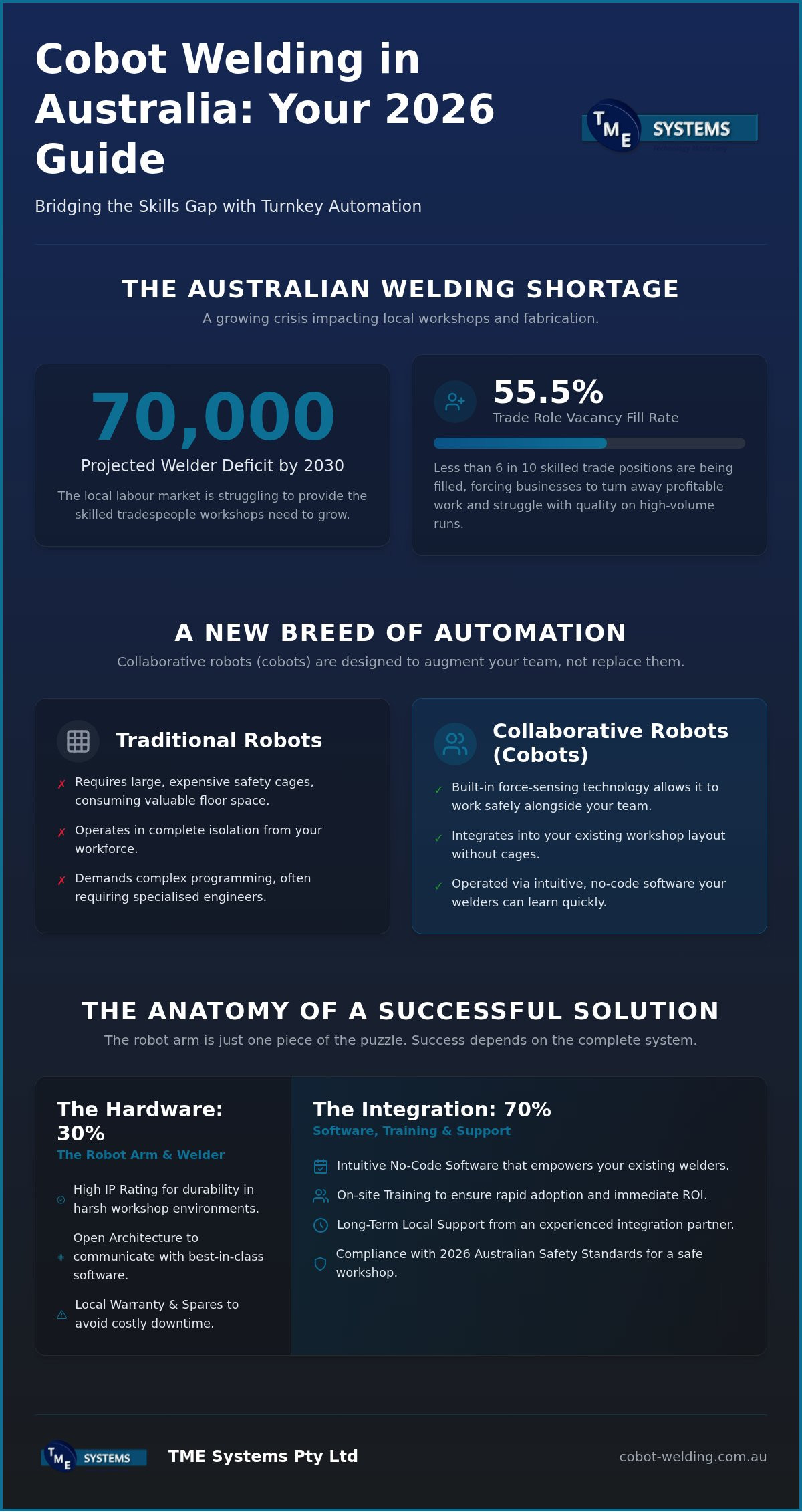

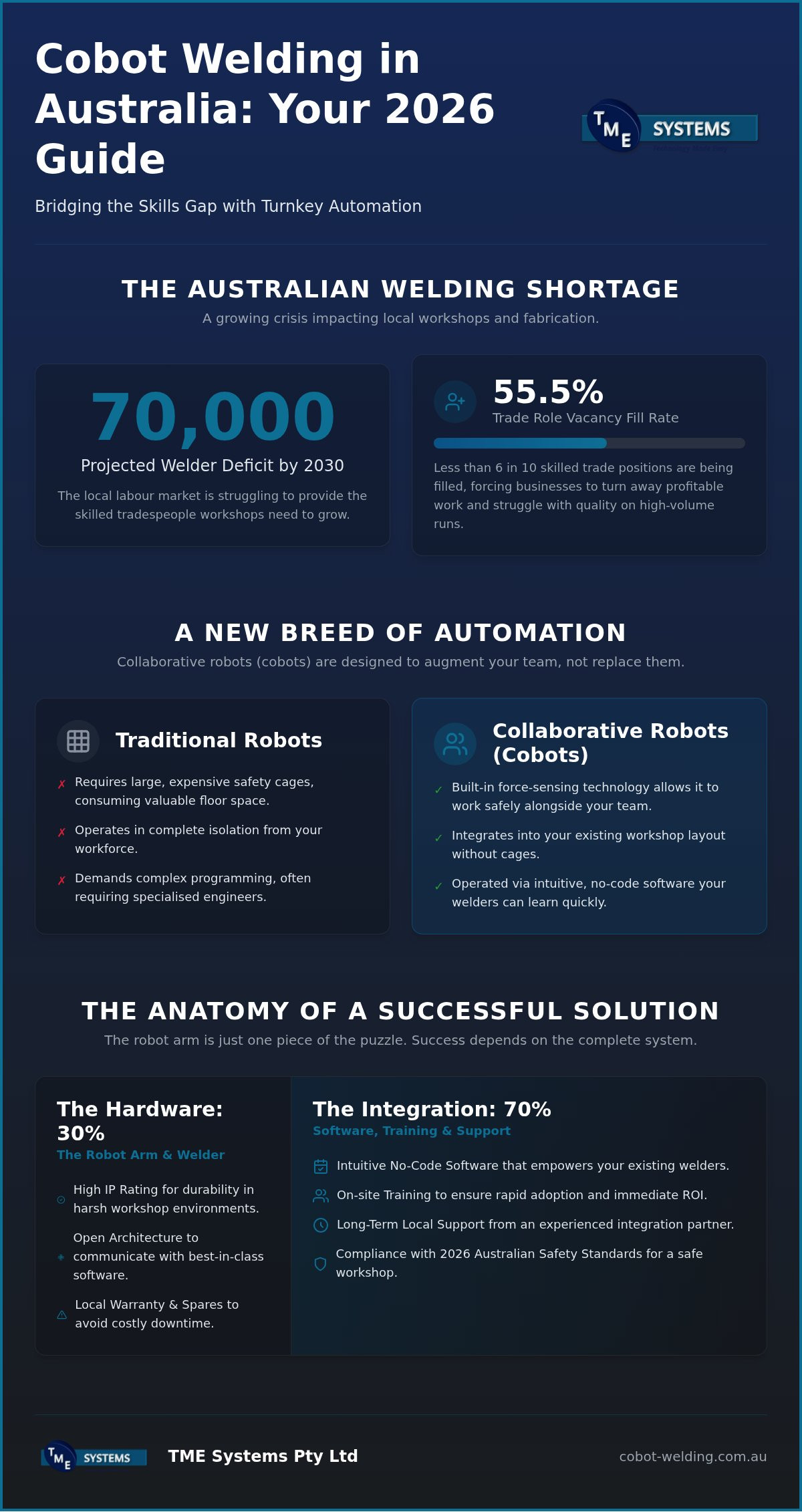
Australia is projected to face a deficit of at least 70,000 welders by 2030, a reality that's already making it difficult for local workshops to keep up with growing demand. You likely know the frustration of turning away profitable work or watching quality fluctuate on high-volume runs because you simply can't find enough skilled tradespeople. The fear for many owners is that investing in automation means buying an expensive "high-tech brick" that sits idle because it's too complex for the team to operate. When you're comparing cobot welding brands australia, the hardware is only one piece of the puzzle.
We understand that technology should support your people, not replace their expertise. This 2026 guide will help you discover the leading collaborative robot brands and the integration partners helping Australian workshops overcome the skills shortage with accessible, turnkey automation. You'll learn how to achieve consistent, high-quality welds and increase throughput without the headache of traditional coding. We'll preview the top systems on the market, explain how no-code teaching software is changing the game, and outline the essential safety standards you need to know to keep your workshop compliant and productive.
Key Takeaways
- Understand why collaborative robots are the most practical tool for bridging the local skills gap and increasing workshop throughput without hiring more staff.
- Evaluate the top cobot welding brands australia relies on, focusing on specific hardware specs like IP ratings and reach for heavy-duty fabrication.
- Learn why intuitive no-code software is the key to making automation accessible for your existing welders, removing the need for complex programming.
- Discover how to vet an integration partner based on their ability to provide on-site training and long-term support rather than just hardware.
- Gain clarity on the 2026 Australian safety standards and how a turnkey cobot cell ensures your workshop remains compliant while boosting weld consistency.
The Landscape of Cobot Welding in Australia for 2026
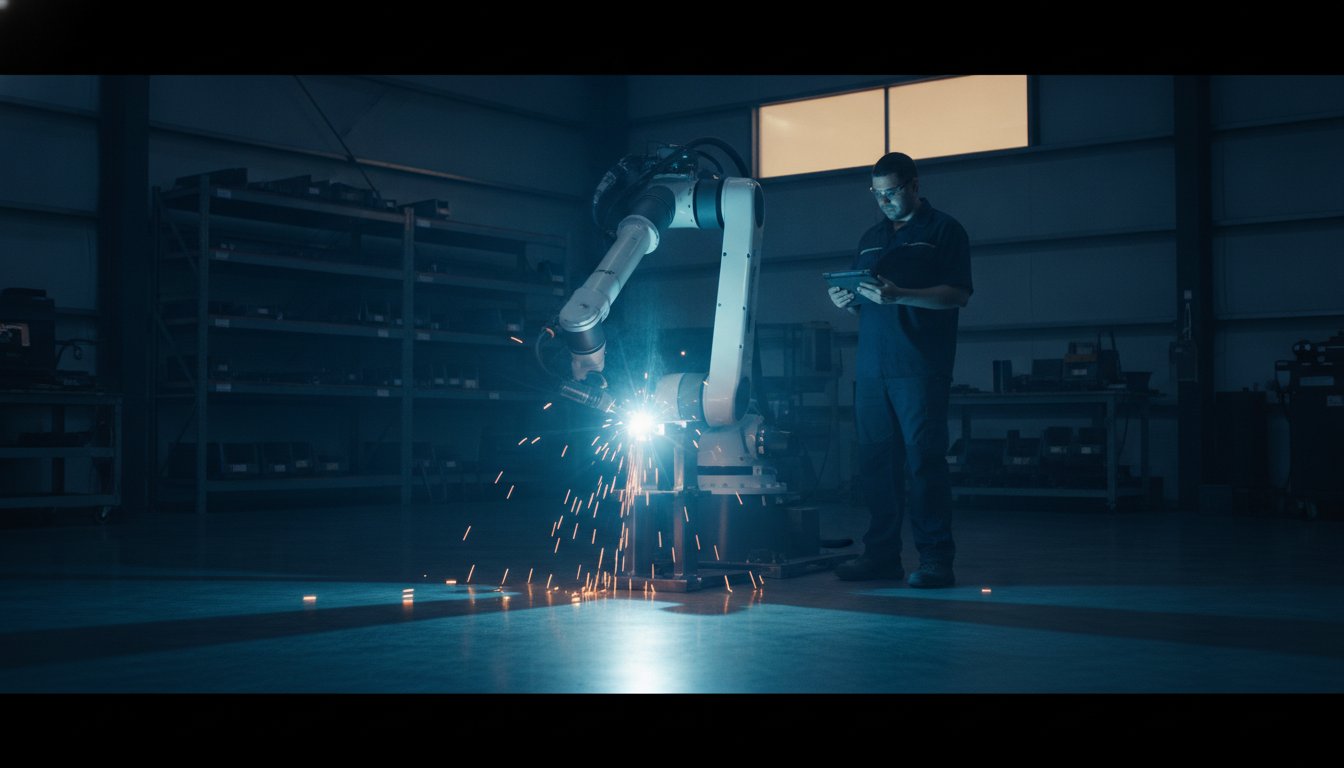
The Australian fabrication sector is undergoing a quiet transformation. For decades, robotics was the domain of massive automotive assembly lines, requiring dedicated floor space and heavy safety cages. Today, the rise of the collaborative robot (cobot) has changed the math for local job shops. Unlike traditional industrial robots that operate in isolation, cobots are designed to work alongside your team, handling the repetitive, high-volume runs while your skilled welders focus on complex, one-off projects.
This shift is driven by a stark reality: Australia is projected to have a deficit of at least 70,000 welders by 2030. Many workshops are already feeling the pinch, with trade role vacancy fill rates sitting at just 55.5% in 2026. When you're looking at cobot welding brands australia offers, you aren't just buying hardware; you're securing a way to maintain throughput without relying on a labour market that simply isn't providing the staff you need. Modern systems allow for flexible, small-batch automation that fits the reality of the local market.
Why 'Collaborative' Matters on the Australian Shop Floor
Safety is the fundamental difference. Traditional robots rely on physical barriers to prevent injury. Cobots, however, use advanced force-sensing technology. If the arm makes contact with an object or person, it stops instantly. This allows you to integrate automation into your existing floor plan without building expensive cages or losing valuable square meterage. It turns the robot into a tool that augments human skill. Instead of replacing a tradesperson, the system takes over the dirty, dull, and dangerous tasks, allowing your best people to apply their craftsmanship where it's actually needed.
The 2026 Market: Why Now is the Time to Automate
The technology has matured significantly. In 2026, the leading cobot welding brands australia fabricators use are rugged enough for the dust and heat of a typical welding shed. With global manufacturing costs rising and local competition intensifying, the ability to produce consistent, high-quality welds every time is no longer a luxury; it's a requirement for survival. Cobot welding is a hybrid of human craftsmanship and robotic precision. It offers a rapid ROI because it fits into your current workflow, requiring minimal changes to your infrastructure while providing the consistency that manual welding often lacks on long shifts.
Leading Global Hardware Brands for Australian Fabricators
Choosing between the various cobot welding brands australia offers involves looking beyond the glossy brochures. While names like Universal Robots (UR), Fanuc, and ABB dominate the global market, their suitability for your shed depends on more than just brand recognition. UR is often praised for its flexibility and massive ecosystem, while traditional giants like Fanuc and ABB bring decades of industrial pedigree to their collaborative models. However, for a welding environment, you need an arm with a high Ingress Protection (IP) rating to withstand the constant presence of spatter, fumes, and grinding dust.
You also need to look for an 'open architecture' system. This ensures the hardware can communicate seamlessly with specialised software, which is what actually turns a robot arm into a precision tool. It's a common mistake to focus solely on the arm, but hardware is only about 30% of the total welding solution for a modern workshop. Without the right integration and software, a robot arm is just an expensive limb. If you want to see how these systems handle real-world tasks, our mobile demo system can provide a practical proof of concept at your site.
Hardware Reliability and Local Spare Parts
Avoid the temptation of 'grey market' imports. They might look cheaper on paper, but they often lack Australian warranty support and local spare parts. If a joint fails on a Tuesday, you don't want to wait three weeks for a replacement from overseas. Reliability also means considering the duty cycle in our local climate. Australian workshops get hot, and you need hardware that can run 8-hour shifts in 40-degree heat without thermal tripping. Recent research on cobot safety highlights that maintaining equipment to local standards is vital for worker protection and long-term uptime. A trusted partner ensures your hardware stays compliant and operational.
Comparing Reach and Payload for Common Welding Tasks
Payload isn't just about the weight of the torch. You have to account for the torch itself, the wire feeder mounting, and the cable management system. While a 5kg arm might suffice for light TIG work, a 10kg or 12kg payload arm is usually the standard for MIG welding to ensure the motors aren't constantly strained. Reach is equally critical. To cover a standard Australian pallet (1165mm x 1165mm), you generally need an arm with a reach of at least 1300mm. This allows the robot to access all corners of the jig without hitting its physical limits. Balancing size and reach is key; a larger robot provides more coverage but can limit floor flexibility in smaller job shops.
Software Brands: Why the Interface is More Critical Than the Arm
While the robot arm provides the movement, the software acts as the brain. For many Australian job shops, the biggest hurdle to automation isn't the cost of the hardware; it's the complexity of the programming. Traditional industrial robots often require a dedicated programmer to write lines of code for every new task. This creates a massive bottleneck when you're dealing with small-batch production or custom fabrication. When evaluating cobot welding brands australia, the interface should be your primary concern. If the system is too hard to program, it'll end up sitting idle in the corner of your shed.
The 'No-Code' revolution has changed this dynamic completely. Instead of typing commands, your team can now interact with the robot through intuitive touchscreens and physical guidance. This shift allows you to move from setup to first weld in minutes rather than hours. It makes automation viable for runs of ten parts, not just ten thousand. This flexibility is essential for staying competitive in a market where lead times are shrinking and customer demands are constantly shifting.
The Power of No-Code Teaching Software
The most effective software allows a welder to 'show' the robot what to do. By hand-guiding the torch along the joint, the operator records the path directly. This method is far more natural for a tradesperson than using a joystick or a pendant. It reduces the 'fear of technology' that can sometimes cause friction when introducing new tools to senior staff. They quickly see that the robot is there to help them, not replace their hard-earned skills. Learn more about no-code robot welding software and how it bridges the gap between traditional craftsmanship and modern efficiency.
Adjusting Parameters on the Fly
A great interface doesn't just record movement; it manages the welding process itself. Operators can adjust voltage, wire feed speed, and travel speed through a simple touch interface. If the weld isn't penetrating correctly, you can make an adjustment on the fly without needing to dive into complex sub-menus. You can also store these settings as 'Weld Recipes'. When a repeat job comes back into the shop, you simply load the recipe and get to work, ensuring 100% consistency every single time. Ultimately, no-code software turns a robot into a power tool for the welder.
How to Evaluate an Australian Integration Partner
Buying a robot arm is only a small part of the journey. The real challenge lies in making that arm work within your specific production flow. In the world of cobot welding brands australia, you'll often encounter "box droppers" who ship the hardware and leave the complex setup to you. This is the biggest risk to your project. Without a partner who understands the local workshop reality and Australian safety standards, such as AS/NZS 4024.1:2019, your investment can quickly become an expensive ornament. You need a partner who stays until your team is confident and the system is producing high-quality welds consistently.
A true integration partner acts as a practical mentor. They don't just provide the tools; they provide the onboarding and training necessary to ensure your welders actually enjoy using the system. This collaborative approach future-proofs your investment by ensuring your staff can refine and adjust the robot's paths as your product range evolves. If you're ready to see how a partner can transform your workshop, you can book a consultation with our integration specialists today.
Turnkey Cells vs DIY Integration
The temptation to save money through DIY integration is often a false economy. When you try to piece together a system yourself, you face hidden costs in cabling, custom torch mounts, and safety sensors. You also take on the full burden of the mandatory risk assessment. Choosing a turnkey solution ensures all these components are designed to work together from the start. The Australian guide to collaborative robot welding cells explains how these integrated systems allow you to start "making welds" on day one, providing a much faster path to ROI than a piecemeal setup.
The 'Mobile Demo' Advantage
Theoretical specs on a website are one thing, but seeing a cobot handle your actual parts in your shed is the ultimate proof of concept. A mobile demonstration system allows you to test the reach and software interface on your most common jobs. This is also the most effective way to get "buy-in" from the blokes on the floor. When they see how easy it is to hand-guide the arm and adjust parameters through a touch interface, the fear of being replaced by a machine disappears. To get the most value, have your jigs and a few challenging test pieces ready so you can see exactly how the system handles your specific material and joint types.
TME Systems: The All-in-One Solution for Australian Job Shops
TME Systems bridges the gap between global hardware and the local workshop floor. While there are several cobot welding brands australia businesses can choose from, we focus on the integration and software that actually makes those arms productive. We don't just drop a box at your door. Our team approaches every project as a practical mentor, drawing on our background in fabrication and integration to ensure the technology fits your existing workflow. We understand that a robot is only useful if it's actually making welds, so we provide turnkey collaborative robot welding cells that are ready to work from day one.
Our onboarding process is designed to be thorough and steady. It starts with our mobile demo system, which provides a real-world proof of concept on your own parts. Once you're confident the system works, we handle the integration and provide on-site operator training and onboarding. This end-to-end support means you're never left trying to figure out complex settings on your own. If a question arises on a Friday afternoon, our local support team is ready to help, ensuring your production line doesn't grind to a halt.
Our No-Code Software Advantage
Australian job shops often need to change jobs five times a day. You don't have time for a dedicated programmer to spend hours refining a single path. Our specialised no-code teaching software is designed specifically for this high-mix, low-volume environment. It allows your best welders to stay in control of the process by hand-guiding the torch to show the robot exactly where to go. By simplifying complex paths without a single line of code, we ensure the technology adapts to the user, not the other way around. This keeps your skilled tradespeople focused on their craft rather than fighting with an interface.
National Support and Training
We believe that a successful automation project relies on the confidence of your team. Our comprehensive operator training programmes are designed to build that confidence through hands-on experience. We stay with you until your staff are comfortable managing the cell independently. As your business grows and your jobs change, we provide ongoing integration support to help you refine your processes and tackle new challenges. Book your mobile welding robot demonstration today to see how we can help you overcome the skills shortage with accessible, reliable automation.
Future-Proof Your Workshop with Accessible Automation
The path to increasing your workshop's throughput doesn't have to involve a desperate search for staff that don't exist. By choosing the right collaborative system, you can empower your current team to produce consistent, high-quality welds on every shift. While comparing the various cobot welding brands australia has available, remember that the most reliable hardware is only as good as the software that controls it. A turnkey cell with no-code software ensures your welders stay in control of the process without needing to learn a single line of code.
At TME Systems, we provide the practical mentorship and Australian-based technical support needed to make automation a reality for local job shops. We believe the best way to evaluate these tools is to see them in action on your own floor with your own parts. If you are ready to see how this technology handles your specific fabrication challenges, you can Book a Mobile Welding Robot Demo for Your Workshop today. We look forward to helping you build a more resilient and productive workshop for the years ahead.
Frequently Asked Questions
Which cobot welding brand is best for small batches in Australia?
The best choice for small batches depends more on the software interface than the hardware brand. For high-mix production, you should look for cobot welding brands australia offers that include no-code teaching software. This allows your team to switch between different jobs several times a day without a programming bottleneck. TME Systems provides turnkey cells specifically designed to handle the flexibility required by local job shops and small-batch fabricators.
Do I need a specialised programmer to run a welding cobot?
You don't need a programmer if your system uses no-code teaching software. This technology allows your experienced welders to hand-guide the robot arm along the joint to "show" it the path. The software records the movement directly, meaning your current team can manage the system themselves. This approach removes the need for complex coding and ensures your staff stay in control of the final weld quality and craftsmanship.
What is the difference between a hardware brand and an integration partner?
A hardware brand like Universal Robots or Fanuc manufactures the robotic arm itself. An integration partner like TME Systems takes that arm and builds it into a complete, working cell with a power source, safety sensors, and specialised software. The partner provides the training and local support necessary to ensure the hardware actually performs in your shed. They bridge the gap between a standalone machine and a functional workshop solution.
How much does a cobot welding system cost for an Australian workshop?
The total investment for a collaborative system varies based on the arm's reach, the welding process, and the level of software integration. While hardware prices are often quoted separately, a complete turnkey cell includes the power source, custom software, and safety equipment. Industry data indicates that complete systems can vary significantly in price. You should focus on the total cost of ownership, including training and support, rather than just the initial hardware tag.
Can a welding cobot handle both MIG and TIG welding?
Yes, a collaborative robot is a flexible platform capable of performing both MIG and TIG welding tasks. The arm can be fitted with different torches and integrated with various power sources to suit your specific needs. While MIG is common for high-volume production, TIG setups are perfect for precision work on thinner materials. The key is using software that allows for easy parameter adjustments, such as travel speed and voltage, for each process.
Is it safe to use a welding cobot without a safety cage?
Cobots are designed to work without cages because they use force-sensing technology to stop if they make contact with a person. However, you must still conduct a thorough risk assessment under AS/NZS 4024.1:2019 standards for every installation. While the robot arm itself is safe, the welding process introduces hazards like arc flash and hot spatter. You may still need light curtains or screens to protect other workers in the shop from these secondary risks.
How long does it take to train a welder to use a cobot?
Most experienced welders can learn the basics of operating a cobot within a few hours. When using no-code teaching software, the learning curve is very shallow because the process is intuitive. It usually takes a day or two of on-site training to make a team fully confident in setting up new jobs and refining weld paths. This rapid onboarding ensures your workshop sees a return on investment quickly without pulling staff away from production.
What kind of maintenance do Australian cobot welding cells require?
Maintenance for these systems is straightforward and similar to your existing manual welding equipment. You'll need to regularly clean spatter from the torch and sensors, check cable management for wear, and perform occasional software updates. The robot arm itself is designed for industrial use and requires minimal mechanical intervention. A local integration partner provides ongoing technical support to ensure your system stays refined and productive as your business grows and your job types change.