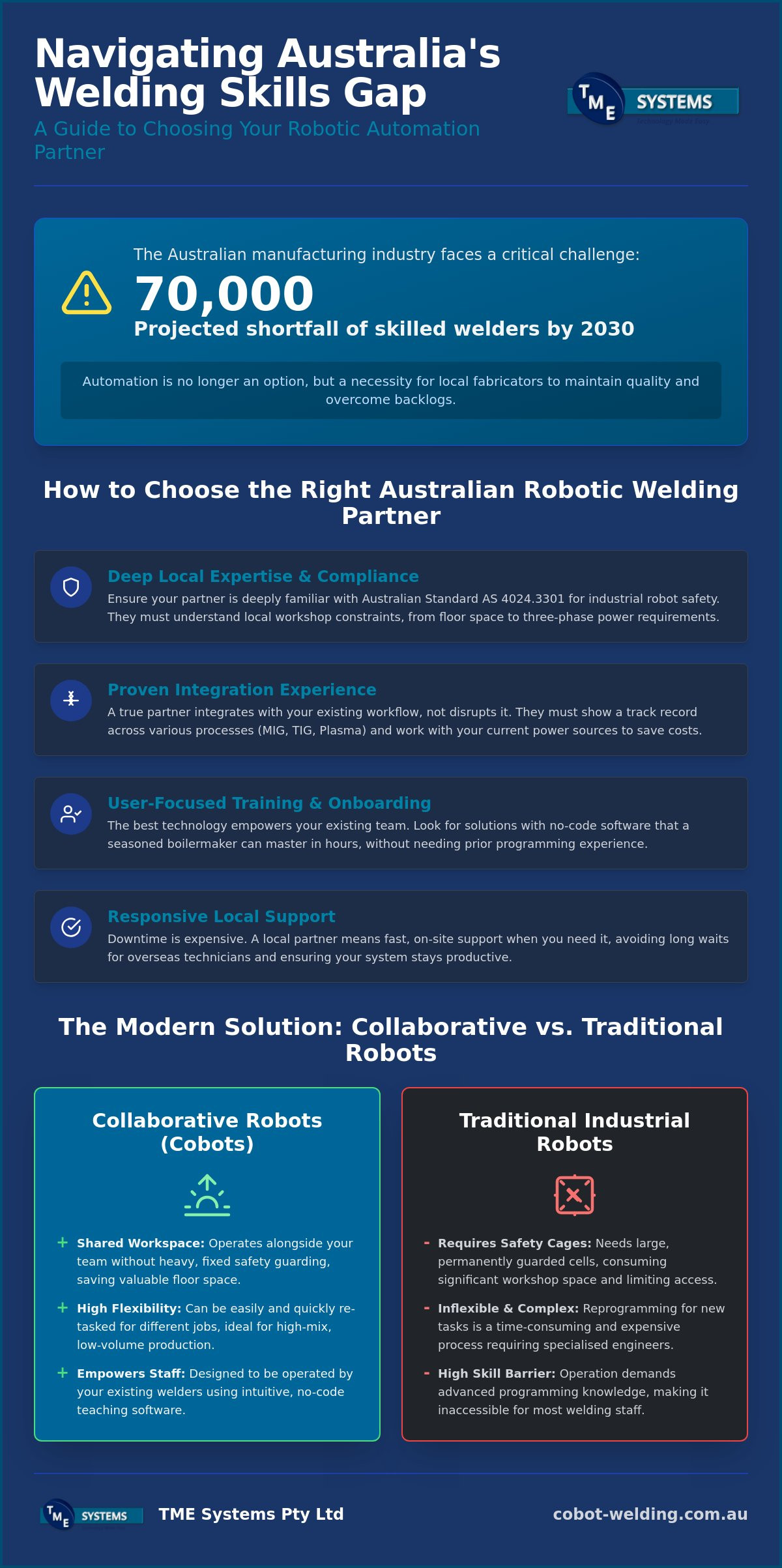

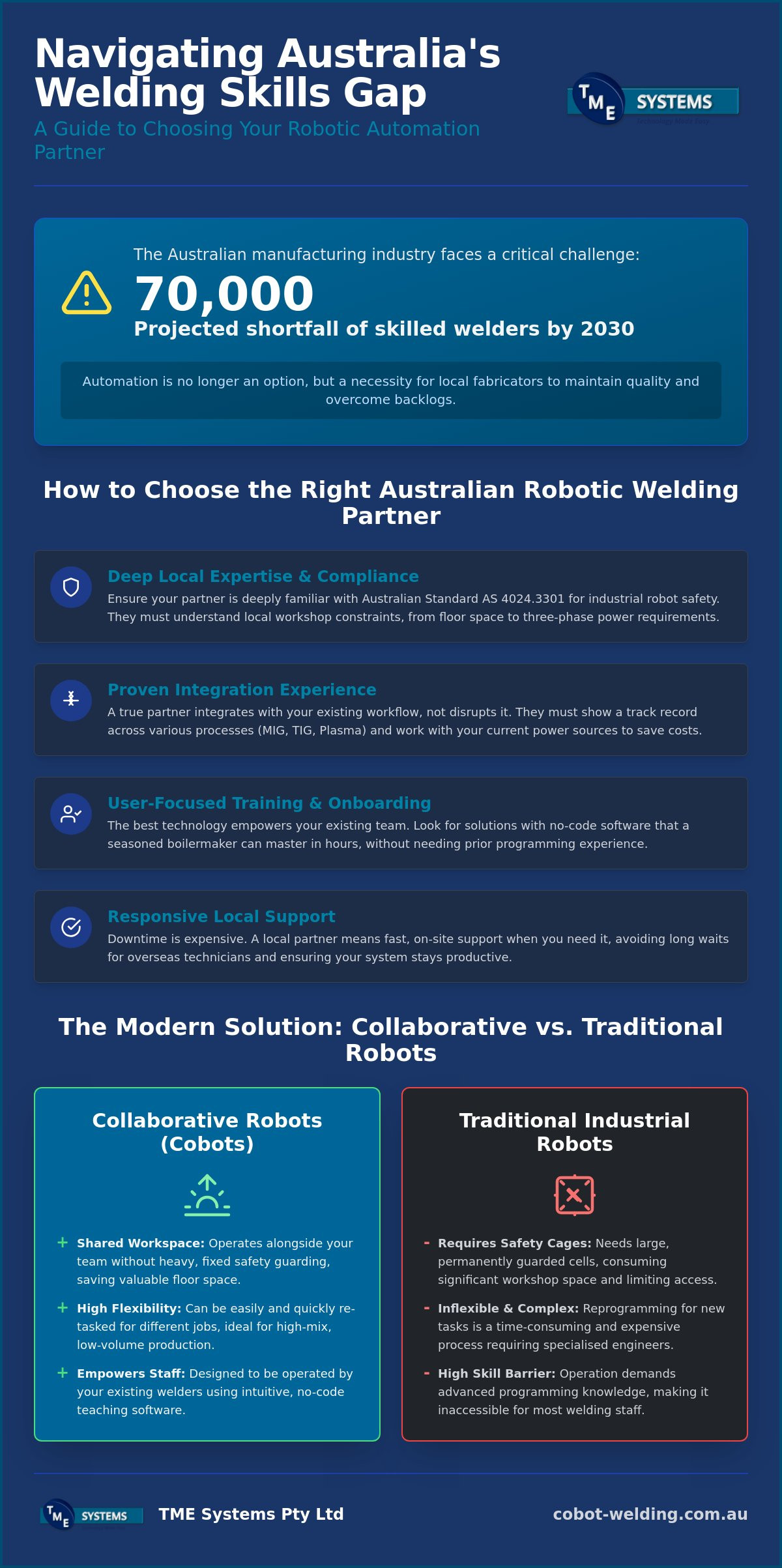
Did you know that Australia is projected to face a shortfall of 70,000 skilled welders by 2030? It's a pressure every local fabricator feels when trying to maintain consistent quality while facing a mounting backlog of work. You've likely looked at automation before but felt put off by the thought of complex programming or the fear that your best workers might feel sidelined by a machine they can't operate. Finding genuine australian robotic welding experts is about more than just hardware; it's about finding a partner who understands the gritty reality of your workshop floor.
We agree that technology should support your team, not replace their hard-earned skills. This guide will show you how to identify experts who specialise in no-code, collaborative solutions that your staff can master quickly. You'll discover how to choose a partner who can help you automate your floor to achieve improved productivity and consistent, high-quality welds through systems your current team can actually use.
Key Takeaways
- Learn why partnering with genuine australian robotic welding experts ensures your system meets local safety standards while addressing the unique challenges of the regional manufacturing landscape.
- Discover the essential criteria for choosing an automation partner, including their ability to integrate multiple welding processes and provide comprehensive operator training.
- Understand the practical advantages of collaborative robots, such as shared workspaces without heavy guarding and the flexibility to re-task the system for different jobs.
- Find out how to conduct a thorough needs analysis to identify the best candidates for automation and set realistic productivity goals for your workshop's first year.
- Explore how no-code teaching software empowers your existing team to operate advanced machinery without needing prior programming experience.
Defining Australian Robotic Welding Expertise for 2026
The Australian manufacturing landscape has changed significantly over the last few years. We've moved away from the era of mass-produced automotive lines and into a period defined by high-mix, low-volume production. Whether you're fabricating components for defence, renewable energy, or local construction, the pressure to deliver precision at scale has never been higher. True australian robotic welding experts understand that 2026 isn't about replacing the human element; it's about augmenting it to meet these new demands.
With Weld Australia projecting a shortfall of 70,000 welders by 2030, the conversation around automation has shifted from "if" to "how." This evolution means Robot welding is no longer reserved for the giants of industry. It's now a practical tool for the local job shop. However, success depends on choosing a partner who understands the nuances of the Australian workshop, from our specific power requirements to the physical grit of a typical fabrication floor.
The Role of Local Knowledge in Automation
Safety isn't just a checkbox; it's a legal and moral obligation. Genuine experts in this field are deeply familiar with Australian Standard AS 4024.3301, which governs industrial robot safety. They don't just drop a crate at your door and leave you to figure out the guarding requirements. They understand that a local workshop might have limited floor space or specific three-phase power constraints. Having a partner nearby means that if a system needs a tweak or a sensor needs adjusting, you aren't waiting for a technician to fly in from overseas. Local support is the difference between a productive afternoon and a week of expensive downtime.
Supporting the Local Fabrication Community
Small and medium enterprises (SMEs) are the backbone of our industry. To compete with international manufacturers, local shops need to be smarter. This is where the "mentor" approach beats the "vendor" approach. You need someone who speaks the language of a boiler maker, not just a software engineer. A hardware vendor will sell you a robot arm; a partner will help you refine your entire welding process. They'll look at your current jigs, your gas flow, and your wire feed to ensure the system delivers consistent, high-quality beads from day one. By focusing on collaborative solutions that your existing staff can master, these experts help you bridge the skills gap while keeping your most experienced tradespeople focused on the complex tasks that robots can't yet handle.
Key Criteria for Selecting a Welding Automation Partner
Selecting a partner is a decision that impacts your workshop's output for years. You aren't just looking for someone who can ship a box; you need australian robotic welding experts who can prove their value on your actual floor. While the hardware is important, the true test of an expert is their ability to solve your specific production hurdles. If a provider cannot explain how their system manages your unique material thicknesses or joint types, they are likely just equipment resellers rather than true integrators. You need a partner who understands the grit of a workshop floor and the precision required for high-quality fabrication.
Proven Integration Experience
Integration is where the value is either created or lost. A generic, one-size-fits-all setup rarely fits the needs of a specialised Australian job shop. When vetting a partner, look for those who excel in welding system integration. They should have a proven track record across various processes, including MIG, TIG, and Plasma. A vital question to ask is whether they can work with your existing power sources. A pragmatic partner won't force you to scrap perfectly good gear if it can be successfully integrated into a new collaborative cell. This customisation ensures the robot fits your workflow, rather than forcing your team to change how they work to suit the machine.
Comprehensive Training and Onboarding
Technology is only as effective as the person operating it. Given the current welding skills shortage, your existing team is your most valuable asset. The right partner provides training that focuses on the welder, not a computer programmer. You want a system that a seasoned boiler maker can pick up in a few hours. This onboarding should be thorough and practical, covering everything from no-code teaching to deep process optimisation. When your staff feel confident with the tech, they'll find ways to make it even more productive.
Seeing the tech in action is the best way to demystify the transition. Don't settle for a glossy brochure or a pre-recorded video. Ask for a mobile demonstration where the equipment is brought directly to your site. This allows your team to touch the machinery and ask technical questions in their own environment. Ongoing support is just as vital. Ensure your partner has a local service team capable of providing quick responses. You can't afford to have a cell sitting idle because a spare part is stuck in a warehouse overseas. If you're ready to see how these systems perform, looking into a collaborative welding solution designed for local conditions is a smart move for any forward-thinking fabricator.
Comparing Collaborative Systems vs Traditional Industrial Robots
Traditional industrial robots are brilliant for high-volume automotive lines where the same weld is repeated for years. But for most local workshops, that isn't the reality of the daily grind. You need a system that can handle a batch of ten brackets in the morning and a custom trailer frame in the afternoon. This is why australian robotic welding experts are increasingly steering fabricators toward collaborative systems. Unlike traditional robots that require extensive safety cages and fixed footprints, cobots are designed to work alongside your team without the need for massive guarding structures.
Space is at a premium in any workshop. High-end industrial setups often take up half a bay just for the safety fencing and light curtains. In contrast, collaborative robot welding cells are compact and often mobile. You can wheel the cell to where the work is, rather than reorganising your entire floor layout. This flexibility is supported by technical advancements seen in University of Wollongong's robotic welding research, which highlights how intelligent fabrication is becoming more accessible and practical for smaller, custom batch runs in Australia.
The No-Code Software Advantage
The biggest barrier to automation used to be the "PhD factor," which was the need for a specialist programmer to write complex lines of code for every new job. Modern no-code robot welding software changes that dynamic entirely. Instead of typing commands, your welder simply moves the robot arm by hand to the start and end points of the weld. It's as intuitive as showing an apprentice how to run a bead. This reduces setup times from hours to mere minutes. When you can switch jobs that quickly, automation becomes cost-effective even for the smallest custom fabrication runs.
Safe, Collaborative Workspaces
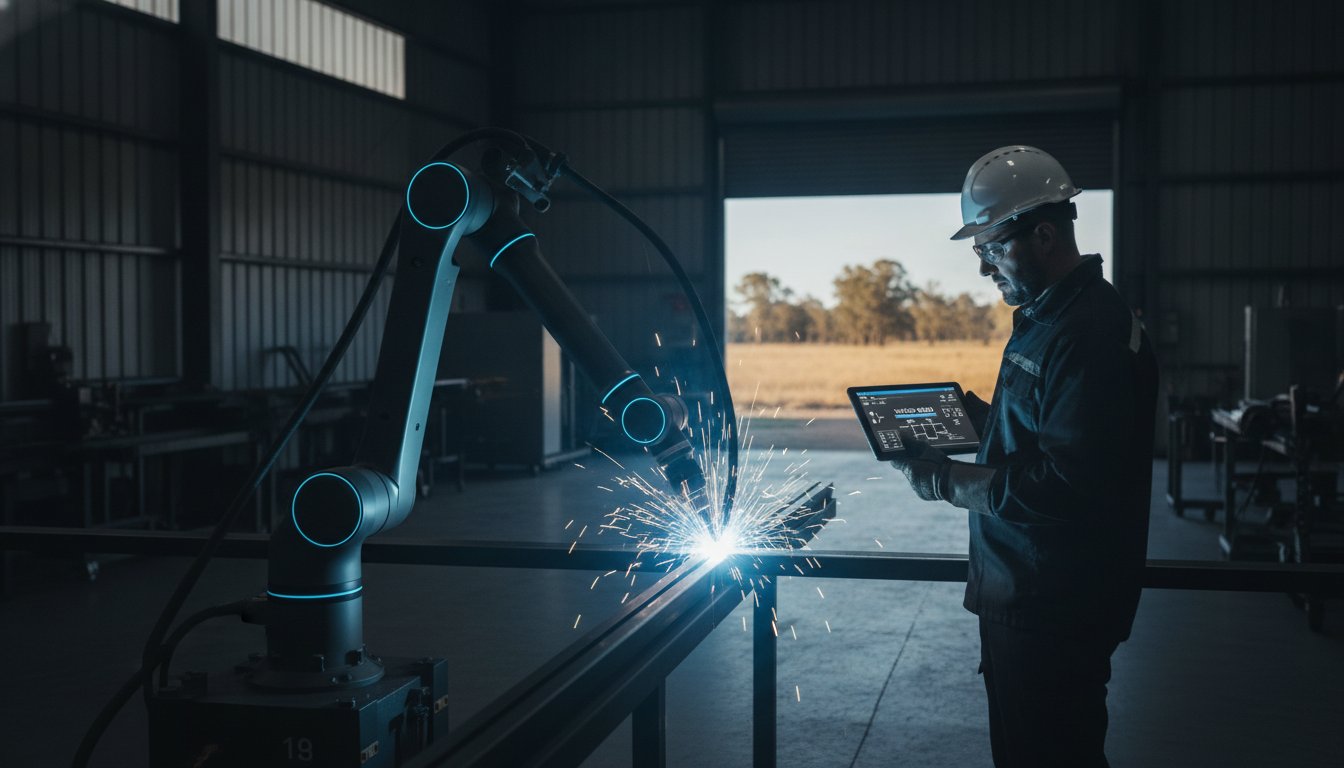
Safety is built into the very joints of a cobot. They use sensitive torque sensors to detect any contact, stopping instantly if they touch an operator or an obstruction. This removes the need for heavy guarding and makes the robot feel like just another tool in the kit rather than a dangerous machine. Australian robotic welding experts focus on this human-centric approach because it addresses the dull, repetitive tasks that cause fatigue and injury. By letting the robot handle the long, straight runs, your skilled welders can focus on the complex joins where their craftsmanship is truly required. It improves workshop ergonomics and helps your team stay fresh and productive throughout the shift.
Planning Your Transition to Automated Welding
Moving into automation is a significant operational shift that requires a clear roadmap. It's not just about the day the equipment arrives; it's about the work you do before it hits the workshop floor. Successful fabricators don't rush the process. Instead, they work with australian robotic welding experts to identify which parts of their production are actually ready for a digital helping hand. A thorough needs analysis helps you avoid the trap of trying to automate every task at once, focusing instead on the areas where you'll see the most immediate impact.
Assessing Your Workshop's Readiness
Not every job in your shop is a candidate for automation. You should focus on parts that are repetitive or have high rejection rates due to human fatigue. These are your "low-hanging fruit." Using a practical transition to robotic welding checklist allows you to evaluate your current parts and determine if a turnkey cell or a custom integration is the better fit. You'll also need to check your physical infrastructure. Does your floor have the right power supply? Is there enough space for the cell and the operator to work safely? Addressing these logistical details early prevents expensive downtime during installation.
Engaging your staff is just as vital as the hardware. Your team needs to understand that the system is a tool designed to support their skills. When you involve your welders in the planning phase, they're more likely to take ownership of the new gear. This culture shift is essential for a smooth transition and long-term success on the tools.
Calculating ROI and Productivity Gains
Many fabricators only look at how fast the robot can run a bead. While speed matters, the real value lies in the consistency of the output. When you implement high precision cobot welding, you're essentially eliminating the human error that leads to grinding and re-welding. This saves on consumables and gas while freeing up your most experienced tradespeople for complex, high-value projects that require a human touch.
Measure your ROI by looking at the first 12 months of operation. Factor in the increased throughput and the improved quality of your finished products. By partnering with australian robotic welding experts, you gain access to the technical support needed to keep your system running at peak performance. If you're ready to start this process, you can book a mobile demonstration to see how a collaborative cell fits into your specific workshop environment.
Leading Australian Cobot Welding Solutions by TME Systems Pty Ltd
TME Systems Pty Ltd has spent decades refining industrial automation specifically for the Australian market. We don't just sell gear; we provide solutions that fit the grit and reality of a local fabrication shop. As australian robotic welding experts, we've seen how the right technology can transform a business when it's implemented with a focus on the operator. Our philosophy is simple. We believe technology should empower your staff, not replace their hard-earned craftsmanship.
The heart of our approach is making automation accessible. We've moved away from the complex, code-heavy systems of the past to focus on intuitive, no-code teaching software. This allows your best welders to program the robot by simply guiding the torch along the desired path. It's a practical tool, not a complex puzzle. When your team sees how easily they can refine a weld path, the fear of automation disappears and productivity takes off.
Turnkey Collaborative Welding Cells
TME Systems Pty Ltd provides pre-configured, collaborative welding cells that are designed to be productive almost immediately upon delivery. These aren't experimental kits. They are robust, high-quality units built with components selected to withstand harsh Australian industrial conditions. Whether your workshop specialises in high-precision TIG or heavy-duty MIG applications, our cells offer the versatility you need. Because these units are compact and require minimal guarding, they fit easily into your existing floor layout without requiring a total workshop overhaul.
Local Support and Mobile Demonstrations
We know that seeing is believing on a workshop floor. That's why TME Systems Pty Ltd offers a mobile demo system that brings the technology directly to you. This isn't a generic sales pitch in a showroom. We prove the concept by running tests on your actual parts and materials in your own environment. This hands-on approach ensures there are no surprises when your own system arrives. Our commitment to your success continues long after the initial setup. We provide:
- Comprehensive operator training and onboarding programmes tailored to your team.
- Ongoing access to Australian-based technical experts who understand your business.
- Support for welding system integration to ensure your new cell works with your existing gear.
- Guidance on process optimisation to help you hit your ROI goals within the first year.
Choosing a partner is about more than just a transaction. It's about finding a mentor who is invested in your long-term growth. At TME Systems Pty Ltd, we prioritise the human operator in every system we integrate. We're here to help you bridge the skills gap and stay competitive in a rapidly changing industry. If you're looking for australian robotic welding experts who speak your language and understand your pressures, we're ready to help you take that next step.
Future-Proof Your Workshop with Practical Automation
The transition to automated welding doesn't have to be a leap into the unknown. By focusing on collaborative systems and no-code software, you can empower your existing team to achieve higher productivity without the stress of complex programming. Genuine australian robotic welding experts act as partners, helping you de-risk the investment through hands-on demonstrations and local training tailored to your specific needs.
Successful automation relies on choosing turnkey cells designed for the realities of Australian SMEs. This approach ensures your system is ready to weld shortly after it arrives, supported by comprehensive local operator training that keeps your team at the centre of the process. When the technology is easy to use, your skilled welders can focus on the high-value, complex tasks that truly require their expertise.
If you're ready to see how this technology handles your specific parts, it's time to take the next step. You can book a mobile welding robot demonstration for your workshop today. It's a pragmatic way to prove the concept on your own floor and see the results for yourself. Your team has the skill; we just provide the tools to help them do more.
Frequently Asked Questions
What makes a company a true expert in Australian robotic welding?
Expertise is defined by a partner's ability to integrate technology into your specific workflow while adhering to local safety standards. True australian robotic welding experts understand the nuances of our regional manufacturing sector and the specific pressures of local job shops. They provide end-to-end support, from initial site assessments to ongoing operator training. It's about ensuring the system works for your team, not the other way around.
How much space do I need for a collaborative welding cell?
You generally need much less space than a traditional industrial setup requires. Most collaborative cells are designed with a compact footprint, often fitting within a standard welding bay. Because they don't require heavy safety fencing or light curtains, you can integrate them into existing lines without major structural changes. Some systems are even mobile, allowing you to move the cell between different workstations as your production needs change.
Do I need to hire a programmer to run a welding cobot?
You don't need a specialised programmer to operate a modern cobot effectively. No-code teaching software allows your current welders to program the robot by hand. They simply guide the arm through the required path, and the software records the coordinates. This approach values the welding knowledge your team already has, making the technology a practical tool they can master in just a few hours.
Can a welding robot handle small batches and custom jobs profitably?
Yes, cobots are specifically designed for the high-mix, low-volume production typical of local workshops. The ability to switch between different jobs in minutes makes them profitable even for runs of ten or twenty parts. By automating the straightforward, repetitive runs, you can keep your production moving while your skilled staff tackle the one-off, complex fabrications that require a human touch.
What is the typical ROI for an Australian fabricator adopting cobots?
ROI is typically realised through improved weld consistency and a dramatic reduction in rework costs. When you partner with australian robotic welding experts, you aren't just looking at speed; you're looking at the total cost of production. By eliminating the need for grinding and re-welding, many fabricators see a full return on their investment within the first 12 to 18 months of operation.
Are collaborative welding robots safe to use without a cage?
Cobots are designed to be safe for shared workspaces, but a thorough risk assessment is still essential. They use sensitive force-limiting sensors to stop the moment they detect contact. However, the safety of the application also depends on the welding arc and the parts being handled. Experts will help you evaluate your specific setup to ensure it meets Australian safety requirements without the need for traditional cages.
What kind of maintenance do robotic welding systems require?
Maintenance for these systems is straightforward and centres on standard welding upkeep. You'll need to manage consumables like tips and liners just as you would with a manual torch. The robot arm itself requires periodic inspections and occasional software updates to ensure peak performance. A reliable partner will provide a clear maintenance schedule and local technical support to keep your cell running smoothly at all times.