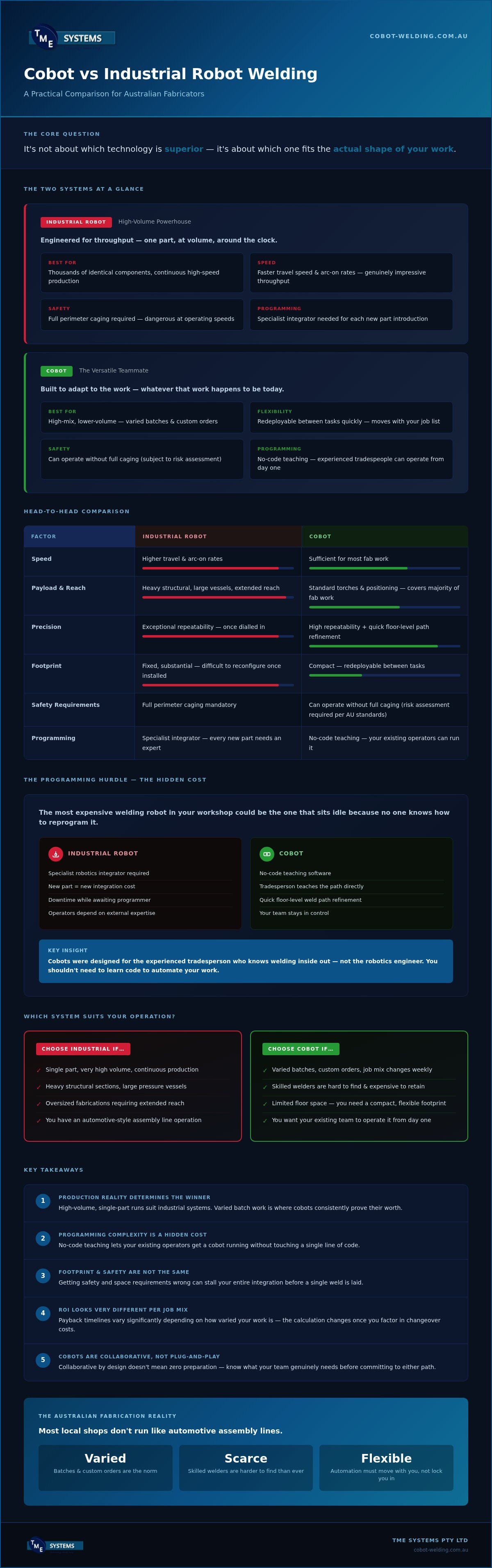

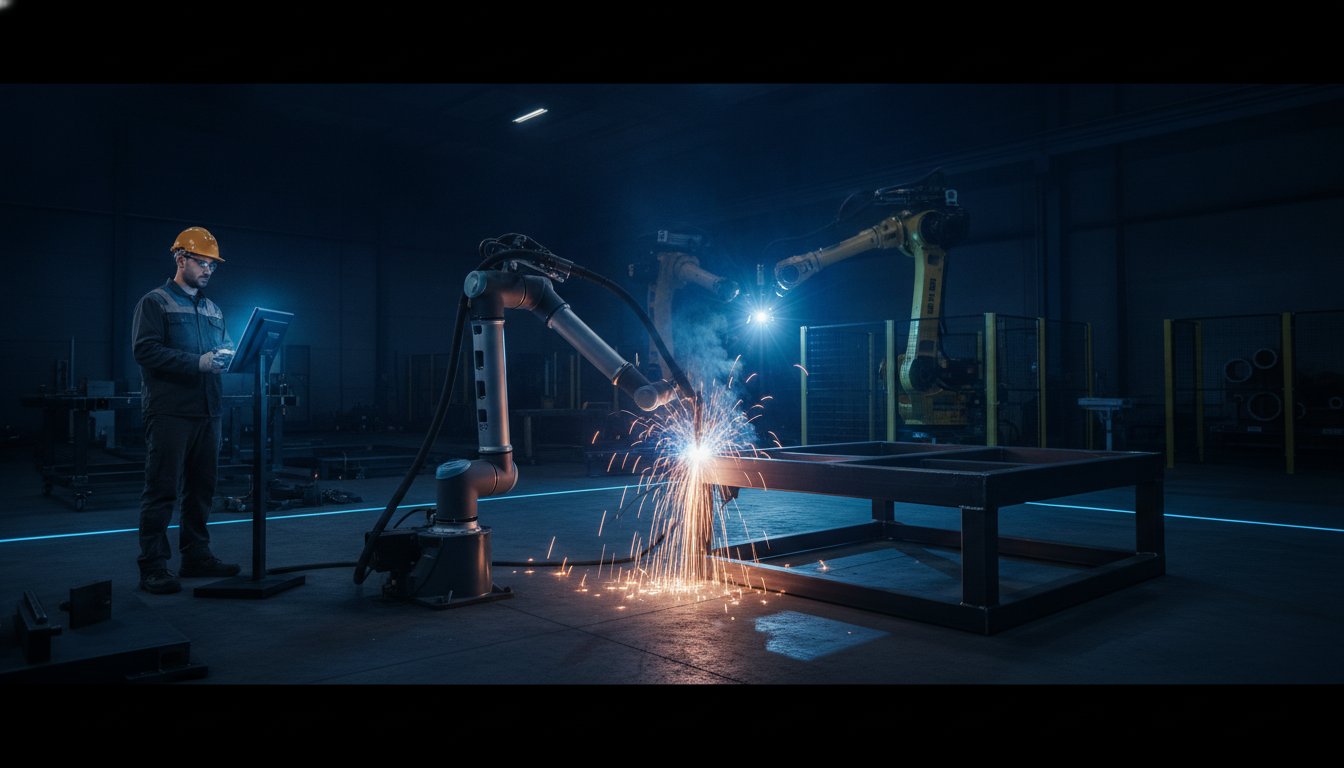
The most expensive welding robot in your workshop could be the one that sits idle because no one knows how to reprogram it. That's the uncomfortable reality facing more Australian fabricators than most would care to admit, and it's exactly why the debate around cobot vs industrial robot welding has moved from factory floors to boardrooms right across the country.
If you're weighing up automation right now, you're probably already sold on the idea that something needs to change. Skilled welders are harder to find and more expensive to retain than ever before. Repetitive jobs are eating into your margins with inconsistent results. And the last thing you need is to spend serious money on a system that becomes a very costly piece of workshop furniture because your team can't operate it confidently.
This guide cuts through the noise and gives you a practical, honest comparison built for the realities of Australian fabrication in 2026. You'll walk away knowing which system suits your batch sizes, whether your existing crew can run it from day one, and what a realistic return on investment actually looks like for a shop like yours.
Key Takeaways
- Understanding the core differences in cobot vs industrial robot welding comes down to your production reality — high-volume, single-part runs suit industrial systems, while varied batch work is where cobots consistently prove their worth.
- Programming complexity is one of the biggest hidden costs in automation — discover how no-code teaching methods let your existing operators get a cobot running without touching a line of code.
- Footprint and safety requirements are not the same for both systems, and getting this wrong can stall your entire integration before a single weld is laid.
- The return on investment calculation looks very different depending on your job mix — this guide breaks down what realistic payback timelines actually look like for Australian fabrication shops.
- Cobots are collaborative by design, but that doesn't mean they're plug-and-play — learn what your team genuinely needs to know before committing to either path.
The Fundamental Shift: Collaborative vs Industrial Welding Robots
Not all welding robots are built for the same workshop. That sounds obvious, but it's a distinction that gets glossed over constantly in sales conversations, and it's the source of a lot of expensive regret. The cobot vs industrial robot welding debate isn't really about which technology is superior. It's about which one fits the actual shape of your work.
At their core, these two systems represent fundamentally different philosophies about how automation should operate on a production floor. One is built around the work coming to the robot, on repeat, at volume. The other is built around the robot adapting to the work, whatever that work happens to be today.
The High-Volume Powerhouse: Industrial Robots
Traditional industrial welding robots are engineered for one thing above all else: throughput. When you're producing thousands of identical components week after week, these systems are genuinely impressive. They operate at speeds that no human welder can sustain, and once a program is dialled in, the consistency is exceptional.
The trade-off is significant, though. Industrial robots require:
- Dedicated safety guarding, typically full perimeter caging, because they operate at speeds and forces that are dangerous in close proximity to people
- A fixed, substantial footprint that's difficult to reconfigure once installed
- Specialist programming knowledge, often requiring a robotics integrator every time a new part is introduced
For a facility running a single part at serious volume, that investment makes sense. For most Australian fabricators juggling a varied job mix, it's a different calculation entirely.
The Versatile Teammate: Collaborative Robots (Cobots)
Collaborative robots (cobots) were designed with a different operator in mind: not the robotics engineer, but the experienced tradesperson who knows welding inside out and shouldn't need to learn code to automate it. These systems are built to work alongside people rather than in isolation from them, which changes everything about how they integrate into a real workshop.
Cobots occupy a smaller footprint, can be redeployed between tasks relatively quickly, and in many configurations can operate without full perimeter guarding, subject to a proper risk assessment under the relevant Australian safety standards. That flexibility is what makes them genuinely useful for high-mix, lower-volume environments where the job list changes week to week.
The shift happening across Australian fabrication right now reflects a broader truth: most local shops don't run like automotive assembly lines. They run varied batches, respond to custom orders, and need automation that moves with them. That's the gap cobots are filling, and it's why the conversation has changed so dramatically in a short period of time.
Performance and Payload: Comparing Speed, Reach, and Precision
Raw speed is the number that gets thrown around most in the cobot vs industrial robot welding conversation, and it's also the most misunderstood. Yes, industrial robots move faster. Their travel speeds and arc-on rates are genuinely impressive, and for a facility running the same component around the clock, that speed translates directly into output. But speed between welds, the time spent moving through air rather than laying a bead, only matters if you're actually running continuously. The moment you factor in changeovers, the maths shifts considerably.
Payload and reach are where industrial systems maintain a clear advantage that no honest comparison should gloss over. If your work regularly involves heavy structural sections, large pressure vessels, or oversized fabrications requiring extended reach, an industrial robot is likely the better fit. Cobots typically operate within a payload range suited to standard welding torches and positioning loads, which is more than adequate for the majority of fabrication work, but there are jobs where the physics simply demand more.
On precision, both systems deliver repeatability that far exceeds manual welding. The meaningful distinction is in fine adjustment. Cobots, particularly those equipped with no-code teaching software, allow operators to refine weld paths quickly on the floor without calling in a specialist. That adaptability is genuinely useful when a part arrives with a slight variation or a customer changes a joint detail at short notice.
Throughput vs Flexibility
Industrial robots win on 24/7 repetitive cycles, full stop. When a program is locked in and the parts are consistent, they'll outperform any alternative on pure volume. But that calculation changes sharply in a job shop environment. Frequent part changes mean frequent reprogramming, and that's where the real cost of an industrial system can quietly accumulate. Australian labour rates make this especially relevant: if your team is spending hours on changeovers rather than welding, the speed advantage evaporates quickly. Cobots, by contrast, are designed for exactly this kind of varied schedule. Redeploying between jobs is faster, and your existing operators can manage it without outside help. Exploring collaborative robot welding cells built around this reality is a practical starting point for job shops weighing up their options.
Duty Cycle and Durability
Industrial robots are engineered for punishing environments and continuous operation. Modern welding cobots, however, have closed the gap considerably. Today's ruggedised cobot systems are built to handle the heat, spatter, and general conditions of a typical Australian workshop floor without constant babysitting. Maintenance is also a different conversation: industrial systems often require specialist service contracts and longer lead times for parts, while cobots generally support more straightforward upkeep that your own team can manage with proper onboarding.
The Programming Hurdle: Traditional Coding vs No-Code Teaching
Ask any fabricator who's been through a traditional industrial robot installation what surprised them most, and the answer is rarely the hardware. It's the programming. The physical robot arrives, gets bolted down, and then the real challenge begins: getting it to actually do what you need it to do, for every new part that comes through the door.
Traditional Robotic Programming
Industrial robots are typically programmed through a teach pendant, a handheld controller loaded with proprietary syntax that varies between manufacturers. Writing a weld path means entering positional coordinates, motion commands, and process parameters through a text-based interface that takes genuine expertise to use correctly. It's not intuitive, and it's not something your best welder can pick up in an afternoon.
The practical consequences of this are significant for smaller Australian fabrication shops:
- Every new part often means calling in an external integrator. Consultant day rates add up quickly, and scheduling delays mean your robot sits idle while you wait for availability.
- When the "robot guy" isn't on shift, the robot doesn't move. If the one person who understands the programming is sick, on leave, or has left the business, you're looking at downtime that can stretch for days.
- The skill gap is real and growing. Finding a qualified robot programmer in regional Australia is considerably harder than finding a skilled welder. Tying your production capability to that single point of failure is a genuine business risk.
This is why the cobot vs industrial robot welding conversation so often comes back to people rather than technology. The machine is only as useful as the team's ability to run it.
The No-Code Advantage
No-code teaching is exactly what it sounds like: the ability to record weld paths by physically guiding the robot arm to each position, rather than writing a single line of text-based syntax. Your operator moves the torch to the start point, confirms it, moves to the next, and the system builds the program from those physical inputs.
The shift this creates in your workshop is immediate. Your most experienced welder, the person who already knows where a bead should run and why, becomes the person who teaches the robot. That knowledge doesn't need to be translated through a programmer. It transfers directly.
Setup times for new weld paths drop from hours to minutes. A part change that previously required an integrator visit can be handled on the floor between jobs. No-code robot welding software fundamentally changes the ROI calculation, because the hidden cost of changeover downtime and specialist dependency disappears from the equation. What remains is a system your own team owns and operates with confidence from day one.

Workshop Integration: Safety, Space, and ROI Considerations
Before a single weld is laid, two practical questions will shape your entire integration: where does this system actually live in your workshop, and what does it genuinely cost to get it running? The cobot vs industrial robot welding comparison looks very different once you factor in floor space, safety infrastructure, and the full picture of what "installation" really means in an Australian fabrication context.
The Footprint Reality
An industrial robot installation isn't just the robot. It's the full perimeter guarding, the interlocked access gates, the dedicated floor area that's effectively written off for any other purpose once the cage goes up. In metropolitan industrial zones where floor space commands a serious premium, that commitment carries a real ongoing cost that rarely appears in the purchase proposal.
Compact cobot welding cells are designed with a fundamentally different spatial logic. They're built to integrate into existing workflows without demanding a permanent, dedicated zone. For a shop already running at capacity, that difference isn't a minor convenience. It's a genuine constraint that determines whether automation is even feasible in your current building.
Safety and Compliance in Australia
Here's where a lot of general advice falls short. Cobots are collaborative by design, but the welding arc itself doesn't care about that distinction. UV radiation, spatter, and fume generation are present regardless of what's holding the torch, and your setup needs to address all of them properly.
Any cobot welding integration in Australia requires a thorough risk assessment under the relevant standards, including ISO 10218, before you reduce or remove traditional guarding. That assessment will look at robot speed, payload, and the proximity of operators during live welding cycles. Fume extraction isn't optional in either system, and flash protection needs to account for both the operator and anyone working in the surrounding area. Getting this process right from the start protects your team and keeps your setup compliant.
Measuring the Return on Investment
The purchase price is the number that appears on the quote. The real ROI calculation includes installation, commissioning, safety infrastructure, and training. Skipping that last item is where many integrations quietly fail.
On-site cobot welder training is one of the most direct ways to protect your investment. When your own operators are trained on your actual parts, in your actual workshop, the system gets used consistently from day one rather than sitting idle while someone waits for outside support.
The productivity gains compound quickly when you factor in rework reduction. Consistent weld parameters mean fewer rejects, less grinding back, and tighter quality outcomes across every batch. Improving welding productivity with cobots is often as much about eliminating rework costs as it is about increasing arc-on time.
Industrial systems offer genuine "lights out" production value for high-volume single-part runs. Cobots offer something different but equally valuable for job shops: an operator-assist model where your skilled tradespeople focus on setup, quality checking, and complex work while the cobot handles the repetitive runs. In a labour market as tight as Australia's, that's a meaningful shift in how your best people spend their time. Talk to the team about integrating a collaborative welding cell that fits your floor, your workflow, and your budget from the ground up.
Making the Call: Why Cobots are the Practical Choice for Australian Fabricators
Every decision in this cobot vs industrial robot welding comparison comes back to one honest question: what does your production actually look like, week in and week out? Not the ideal scenario, not the biggest contract you've ever landed. The everyday reality of your job mix, your floor space, and the people you have running the shop.
The decision matrix is simpler than most sales conversations make it sound. Volume versus variety. That's the line.
When to Choose an Industrial Robot
There are situations where a traditional industrial system is genuinely the right answer, and it's worth being straight about that. If your production looks like this, an industrial robot deserves serious consideration:
- Your part count runs into the tens of thousands per month, with minimal variation between components
- You have a dedicated, permanent floor area that can accommodate full perimeter guarding without disrupting other workflows
- You have in-house PLC or robotics programming expertise on staff, not on call, but genuinely available day to day
If all three of those apply, you're in a minority of Australian fabricators. And that's not a criticism. It's simply an accurate picture of who those systems were built for.
When the Cobot Wins
For the majority of local fabrication shops, the cobot wins. Not because it's newer or shinier, but because it fits the actual shape of the work.
- Your jobs change weekly or daily, and you can't afford to call in an integrator every time a new part arrives
- Your workshop is tight, and committing a large permanent zone to a single automated cell isn't realistic
- Your best asset is your experienced welders, and you want automation that puts them in control rather than sidelining their knowledge
That last point matters more than most automation conversations acknowledge. A cobot doesn't replace your skilled tradespeople. It gives them a tool they can actually operate, teach, and adjust without outside help.
The entry point for this kind of automation doesn't have to be complicated. Collaborative robot welding cells designed as turnkey solutions mean the integration work is done before the system arrives on your floor. Your team isn't left piecing together components from different suppliers or waiting on a commissioning queue.
If you're still weighing it up, the most practical next step isn't another brochure. It's watching the system work on your own parts, in your own workshop. A mobile welding robot demonstration removes the guesswork entirely. You see real weld quality, real changeover times, and real operator interaction before you commit to anything.
That's the kind of evidence that makes a decision straightforward.
Your Next Step Towards Smarter Welding Starts Here
The cobot vs industrial robot welding decision ultimately comes down to one thing: fit. High-volume, single-part production suits an industrial system. For the majority of Australian fabricators running varied batches with a skilled but stretched team, a cobot delivers genuine, practical value from day one.
What makes that value stick is the combination of no-code teaching software that puts your experienced welders in control, turnkey cells built for rapid integration, and Australian-based support that doesn't disappear after commissioning. You're not buying a machine and figuring it out alone. You're bringing in a system your team can own and operate with confidence.
The most straightforward way to cut through the uncertainty is to see it working on your own parts, in your own workshop. No brochures, no guesswork.
Book a mobile welding robot demonstration at your workshop and get the proof of concept you need before committing to anything. The decision gets a lot easier once you've seen it run.
Frequently Asked Questions
Do I need a safety cage for a welding cobot in Australia?
Not necessarily, but it's not a simple yes or no. A cobot's collaborative design means full perimeter caging may not be required, but you still need a thorough risk assessment completed under ISO 10218 before removing traditional guarding. The welding arc itself introduces hazards, including UV radiation, spatter, and fumes, that exist regardless of what's holding the torch. Your specific setup, operator proximity, and work cycle all factor into what the assessment will require.
Flash protection and fume extraction are non-negotiable in any configuration. Getting the risk assessment done properly from the start is the fastest path to a compliant, operational cell. Cutting corners here doesn't save time; it creates delays and potential liability down the track.
Can a cobot weld as fast as an industrial robot?
On a straight, continuous run of identical parts, an industrial robot is faster. That's a straightforward fact. However, in a cobot vs industrial robot welding comparison for job shops, raw travel speed rarely tells the whole story. Once you factor in changeover time, the speed advantage of an industrial system narrows considerably for high-mix environments where parts change frequently.
A cobot running a varied job schedule will often deliver better overall throughput than an industrial robot that spends hours being reprogrammed between runs. The relevant question isn't which system moves faster through air; it's which one keeps the arc on longest across your actual weekly job list.
How long does it take to learn no-code welding software?
Most operators with solid welding experience are recording usable weld paths within their first training session. No-code teaching works by physically guiding the robot arm to each position rather than writing syntax, so the learning curve maps to your welder's existing knowledge rather than demanding entirely new skills. The torch goes where they know it should go, and the software builds the program from those physical inputs.
Confidence with more complex multi-pass sequences or fine parameter adjustments typically develops over the first few weeks of regular use. On-site training on your own parts, in your own workshop, accelerates this considerably compared to off-site classroom instruction.
Is a cobot suitable for heavy structural steel welding?
Cobots handle the majority of structural fabrication work without issue, including fillet welds, lap joints, and multi-pass runs on standard section sizes. Where they reach their limits is with very large, heavy components that require extended reach or significant payload capacity to position the torch correctly. If your work regularly involves oversized structural sections or heavy pressure vessels, it's worth discussing your specific part envelope before committing to any system.
For most Australian fabricators running structural steel at typical section sizes, a well-configured cobot welding cell is more than capable. The honest answer is to bring your actual parts to a demonstration and see the results directly rather than relying on spec sheets alone.
What is the price difference between cobots and industrial robots?
We won't quote specific figures here because the total cost of either system depends heavily on your application, required tooling, safety infrastructure, and integration complexity. What's consistently true is that the purchase price is only part of the picture. Industrial systems typically carry higher installation costs, larger safety infrastructure requirements, and ongoing specialist programming expenses that add up over time.
Cobots generally have a lower total cost of entry for job shops, particularly when you factor in reduced changeover costs and the ability for your own team to manage programming without outside help. The most accurate cost comparison for your situation comes from a detailed conversation about your specific production requirements.
Can I use my existing MIG or TIG welder with a cobot?
In many cases, yes, but compatibility depends on the specific welder model and whether it supports the communication protocols the cobot system requires. Some welding power sources integrate directly with cobot controllers, allowing weld parameters to be managed as part of the program. Others may need an interface module or may not be compatible at all. It's a practical question worth raising early in any integration discussion rather than assuming your existing equipment will carry across.
Bringing your current power source details to a consultation or demonstration session means you'll get a clear answer specific to your setup rather than a general one. Assuming compatibility and discovering otherwise mid-installation is an avoidable problem.
What happens if the cobot hits something or someone?
Cobots are designed with force and torque sensing that triggers an immediate stop when unexpected contact or resistance is detected. This is a core part of what makes them collaborative rather than simply automated. The system responds in milliseconds, and the forces involved at the point of contact are considerably lower than those generated by a traditional industrial robot operating at full speed.
That said, this safety feature addresses incidental contact during non-welding motion. During an active weld cycle, the arc, spatter, and heat remain genuine hazards regardless of the robot's collaborative design. Your risk assessment will define the appropriate boundaries and any guarding required during live welding, which is why that step isn't optional.
How do I calculate the ROI for a welding cobot in a small shop?
Start with the costs your shop carries right now: rework and rejection rates, hours spent on repetitive runs that pull your best welders away from complex work, and any production capacity you're turning away because you can't scale output. A realistic ROI calculation maps those current costs against the system's total acquisition and integration cost, then factors in the productivity gains from increased arc-on time and reduced rework.
Changeover efficiency is often the variable that moves the needle most for smaller shops. If your team can retask the cobot between jobs without calling in outside help, the savings on integrator fees and downtime compound quickly. Running through this calculation with your actual job mix and labour rates gives you a far more useful number than any industry average figure could.