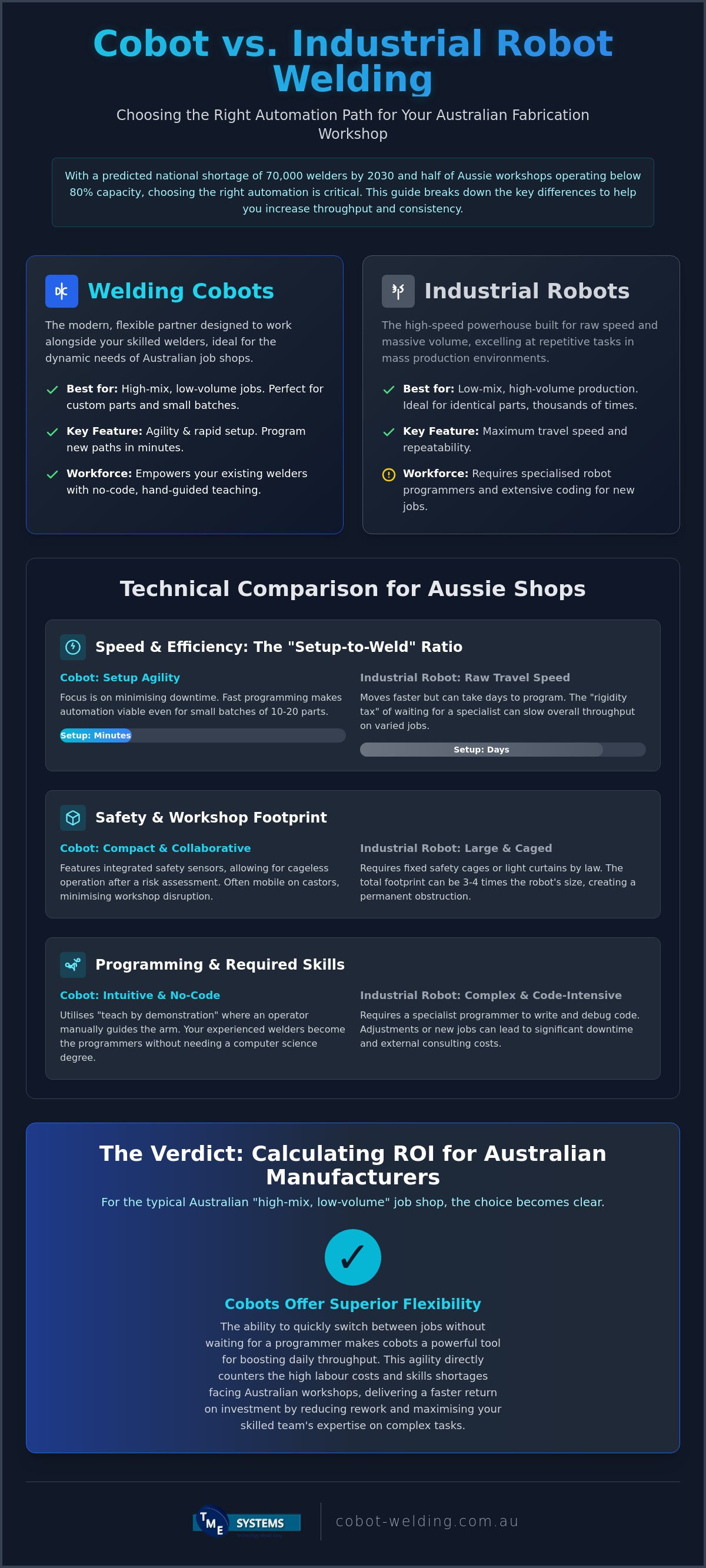

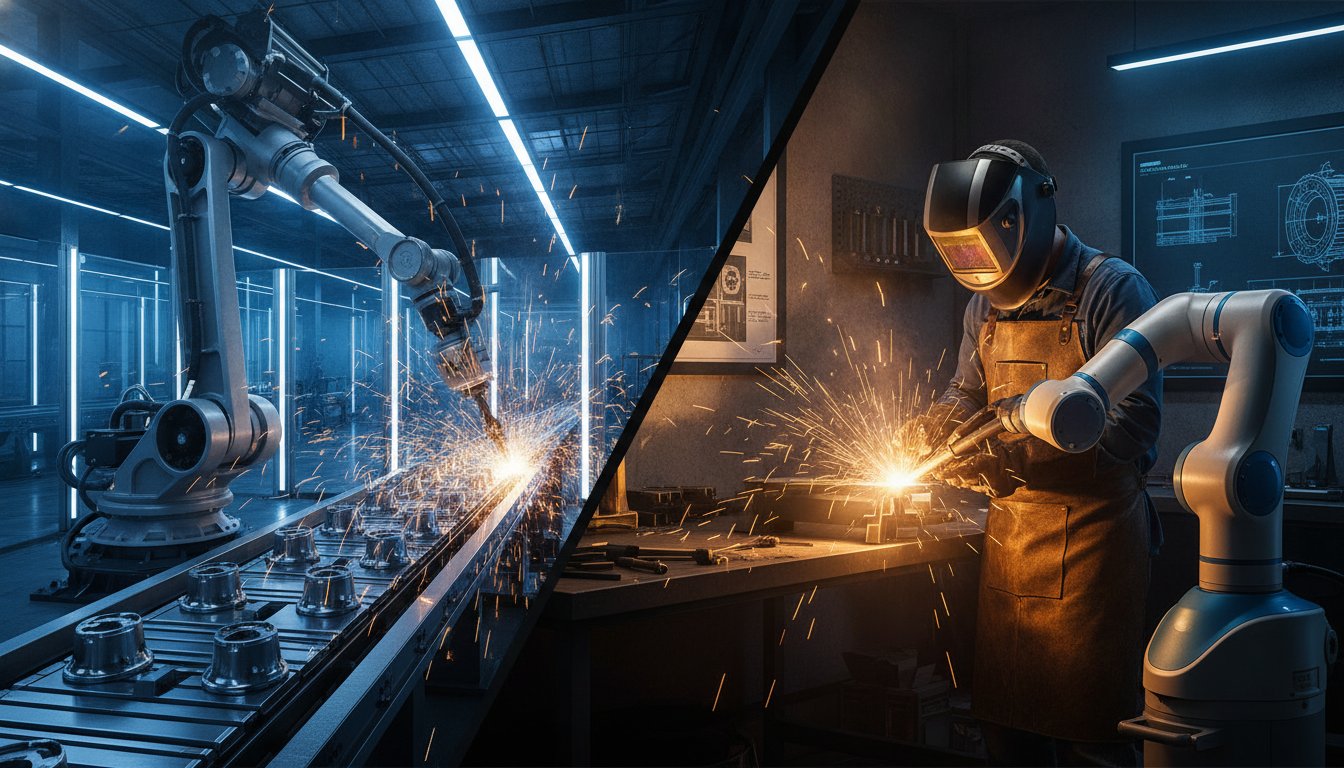
With half of all Australian welding workshops currently operating below 80% capacity, the challenge today isn't just finding new work; it's finding the hands to do it. You have likely considered automation to bridge the gap, but the cobot vs industrial robot welding debate often leaves fabricators stuck between two very different paths. One offers high-speed output behind a safety cage, while the other provides a flexible, hand-guided tool that works alongside your team on the workshop floor.
We know that rising labour costs and the national shortage of 70,000 welders predicted by 2030 make every minute of rework a serious drain on your bottom line. You want to increase daily throughput and improve consistency without the fear of complex programming or losing your best staff. This article will help you discover the critical differences between collaborative and industrial welding robots to choose the right path for your fabrication business. We will break down the practicalities of safety standards, setup times, and how to empower your current team to produce more with less stress.
Key Takeaways
- Learn why industrial robots excel at high-volume mass production while cobots offer the flexibility needed for high-mix, low-volume Aussie job shops.
- Understand the safety and floor space requirements for each system, including how cobots can often operate without the bulky safety cages required for traditional units.
- Evaluate the cobot vs industrial robot welding debate by looking at the "setup-to-weld" ratio rather than just raw travel speed.
- Discover how no-code teaching software allows your current welding staff to program paths quickly without needing any prior coding experience or computer degrees.
- Calculate your potential return on investment by factoring in the Australian labour premium and the long-term benefits of reducing rework in your workshop.
Defining the Contenders: What is Cobot vs Industrial Robot Welding?
For decades, robotic welding was reserved for massive assembly lines and automotive giants. It was a world of "automation for the few" where you needed a team of specialised engineers just to get a single part moving. Today, that barrier has dropped. The cobot vs industrial robot welding debate is now a daily reality for Australian fabricators who need to get more work out the door without adding more stress to their existing team.
The shift we are seeing across the country is moving away from rigid, high-volume production toward flexible automation. Australian workshops often deal with "high-mix, low-volume" jobs; one day you're welding structural beams, the next you're on small brackets. Choosing between a traditional industrial arm and a modern cobot depends entirely on how your workshop flows and how often your production line needs to pivot.
The Industrial Robot: A High-Speed Powerhouse
Industrial robots are built for raw speed and massive volume. These systems are designed to stay in one place and repeat the exact same weld thousands of times with precision. Because they move at such high speeds and with immense force, they must be housed inside fixed safety cages or behind light curtains to protect staff. This requires a significant commitment of floor space that many smaller Aussie workshops simply don't have to spare.
While they are incredibly efficient for mass production, they come with a "rigidity tax." Every new job or slight adjustment to a weld path typically requires a specialist robotic programmer. If your workshop handles the same five parts all year, an industrial robot is a formidable asset. However, if your jobs change weekly, the downtime spent waiting for a programmer can quickly eat into your profits and slow down your throughput.
The Welding Cobot: The Modern Fabricator’s Tool
A collaborative robot (cobot) represents a fundamental change in how we think about automation. Instead of a machine that replaces a person behind a cage, a cobot is a flexible partner designed to work alongside your skilled welders. It is compact, often mobile, and features integrated safety sensors that allow it to operate in shared spaces after a proper risk assessment is conducted according to Australian standards.
The real power of a welding cobot lies in its versatility for the average Aussie job shop. It focuses on ease of use, allowing your experienced welders to lead the process rather than being sidelined by a computer scientist. By using no-code teaching software, an operator can manually guide the arm to define a weld path in minutes. This makes automation viable even for small batches of ten or twenty parts, ensuring your skilled tradespeople stay focused on the complex tasks that actually require their expertise.
Speed, Safety, and Space: Technical Comparisons for Aussie Shops
When comparing cobot vs industrial robot welding, many workshop owners look at raw travel speed first. It's true that an industrial arm can move through the air much faster than a cobot. However, in a busy workshop, "speed" is a deceptive metric. If it takes three days to program an industrial robot for a job that only takes four hours to weld, your overall cycle time is actually quite slow. This is where collaborative robot welding cells shine. They prioritise setup agility, allowing you to switch between different parts in minutes rather than days.
Footprint and Workshop Integration
Floor space is a premium asset in Australian manufacturing. To calculate the "real" cost of an industrial robot, you must factor in the safety cage, light curtains, and clear zones required by law. These footprints are often three to four times the size of the robot arm itself. Once installed, they are usually bolted down, creating a permanent obstruction in your workflow. This can make it difficult to move large workpieces or maintain a flexible floor plan as your business grows.
In contrast, cobot cells are designed for mobility. Many units are built on castors, meaning you can wheel the automation to the work rather than moving the work to the machine. While "cageless" doesn't mean you can ignore guarding entirely, it does mean your team has better access to the table. This flexibility minimises disruption, allowing you to integrate automation into your existing bays without a total workshop redesign. If you're curious about how this looks in practice, you can organise a mobile demo to see a system on your own floor.
Safety and Collaborative Standards
Safety in the Australian context is governed by strict Work Health and Safety (WHS) regulations. While we look to international robot safety standards for guidance, local compliance often centres on AS/NZS 4024.3303:2017. This standard allows for collaborative operation through Power and Force Limiting (PFL) technology.
The role of the operator changes with a cobot. Instead of being locked out by a safety gate, the welder stays close to the process to oversee quality and make adjustments. The system is built with sensitive sensors that monitor every movement. Collaborative robots are designed to stop instantly upon contact to prevent injury. This built-in protection, combined with a documented risk assessment, makes it possible for humans and machines to share the same workspace safely. By removing the physical barriers, you empower your staff to use the robot as just another tool in their kit, much like a high-end welding power source.
Batch Versatility: Why Job Shops are Favouring Cobots
The average Aussie job shop isn't a car plant. You don't have the luxury of six-month production runs where a machine does the same weld ten thousand times. Instead, your team likely handles a "high-mix" of work; small batches of brackets, frames, or custom components that change almost every day. In this environment, the cobot vs industrial robot welding decision comes down to one metric: the "setup-to-weld" ratio. If it takes longer to programme the robot than it does to weld the parts by hand, the automation stays idle. Cobots have changed this math by making it profitable to automate batches as small as ten or twenty units.
We often talk about automation as a way to handle the "donkey work." This means letting a machine take over the repetitive, soul-crushing runs that lead to boredom and mistakes. By offloading these tasks to turnkey robotic welding units, you free up your most experienced staff to focus on the complex, high-value fabrication that actually requires a human touch. It's about working smarter, not replacing the skill that built your business.
High-Volume vs High-Mix Strategies
Industrial robots are the undisputed kings of high-volume manufacturing. Their raw speed justifies a week of complex coding if the machine is going to run the same part for the next three years. However, most Australian fabricators need to switch between jobs in minutes. A typical day might look like this:
- 07:00: Weld a batch of 30 base plates.
- 09:30: Quickly reconfigure for 15 custom gate frames.
- 13:00: Set up a jig for a run of 50 stainless steel brackets.
A cobot allows for this level of agility. Because you can hand-guide the arm to teach a new path, the downtime between different jobs is minimal. This flexibility is why so many local shops are choosing cobots over the rigid structure of traditional industrial units.
Reducing Rework and Improving Consistency
Human welders, no matter how skilled, face "Friday afternoon fatigue." After eight hours of repetitive arcs, consistency naturally slips. This leads to rework, which is a silent killer of profit margins in a high-cost labour market like Australia. A robot doesn't get tired. It maintains the exact same torch angle, travel speed, and wire feed rate on the 500th weld as it did on the first.
This consistency has a massive ripple effect downstream. When every part in a batch is identical, assembly becomes faster and finishing times are slashed. You aren't just saving time in the welding bay; you're refining your entire production flow and ensuring that every product leaving your shop meets a high standard of quality without the need for constant correction.
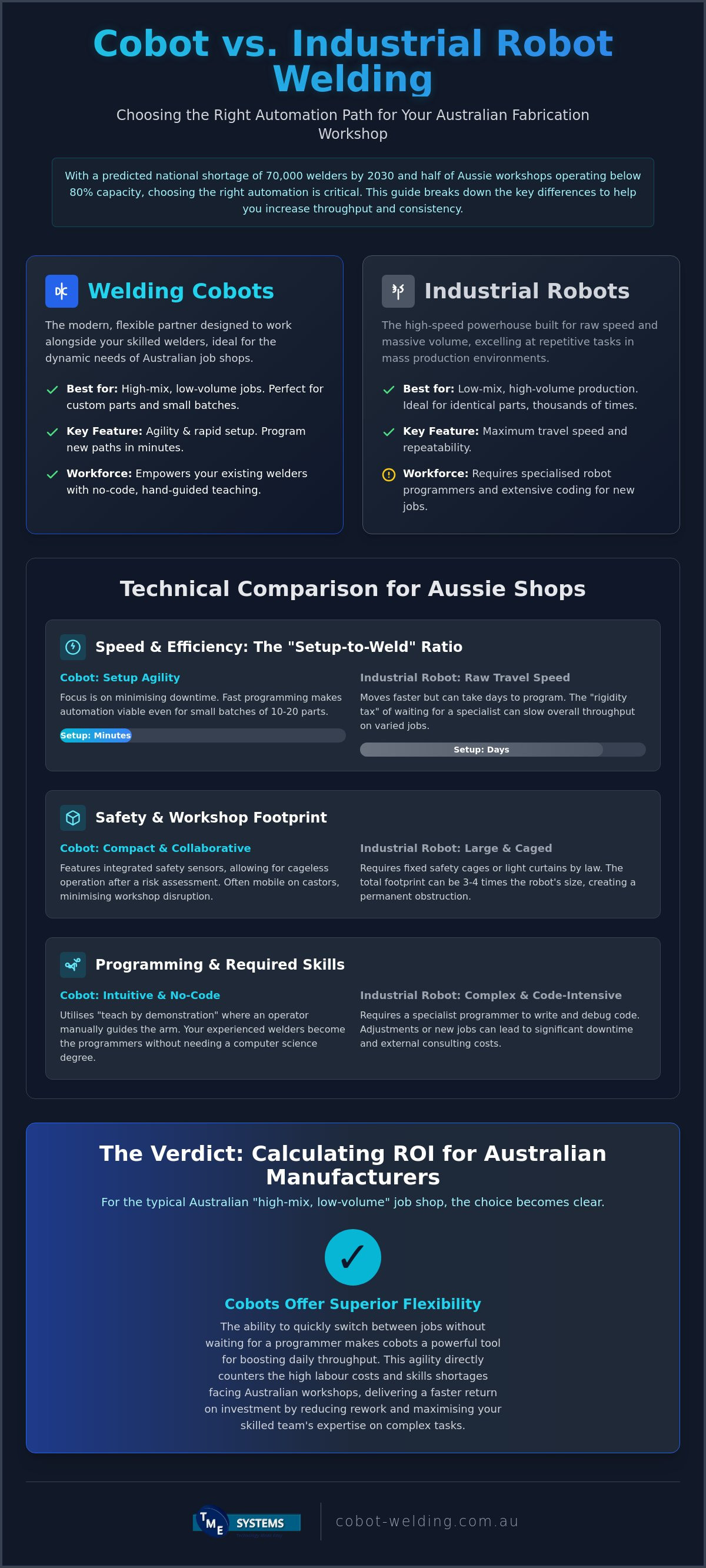
The Programming Hurdle: No-Code Software vs Traditional Coding
The biggest barrier to automation in many Australian workshops isn't the cost of the machine; it's the fear of the screen. For years, the cobot vs industrial robot welding debate was settled by who could afford a full-time robotic programmer. Traditional industrial robots operate on complex, proprietary languages or G-code that feel like a foreign tongue to most fabricators. If you don't have a computer science expert on staff, a traditional robot can quickly become an expensive paperweight the moment a weld path needs a slight adjustment.
In 2026, the "No-Code" revolution has completely changed this dynamic. Modern no-code robot welding software has stripped away the technical jargon and replaced it with intuitive, visual interfaces. This approach keeps the expertise exactly where it belongs: in the hands of your best welders. They understand heat input, torch angles, and travel speeds better than any IT professional ever will. By removing the coding hurdle, you ensure that the machine adapts to your workshop's reality rather than forcing your team to learn a new trade.
The Death of the Teach Pendant
Traditional industrial robots rely on a "teach pendant," a bulky, button-heavy tablet used to manually enter coordinates and commands. This often leads to a bottleneck at the robot. If only one person knows how to use the pendant, production stops the moment they walk away or take a sick day. It is a rigid way of working that doesn't fit the fast-paced nature of a local job shop.
The move toward "lead-through" teaching has made these pendants a thing of the past for many. With a cobot, an operator simply grabs the robot arm and moves it physically through the desired weld path. The software records these points in real-time. No-code software allows a welder to teach a path in minutes, not hours. This makes it possible to set up a new job during a morning smoko break and have the robot running production before lunch.
Empowering Your Existing Team
One of the most significant benefits of no-code automation is how it solves the skills gap. You don't need to go out and find a new hire in a market where welders are already scarce. Instead, you can upskill a manual welder to become a "robot lead" in a single afternoon. Because the software is designed to be supportive and accessible, the learning curve is incredibly shallow.
There is also a psychological benefit to this approach. When a machine is easy to control, staff see it as a high-end tool rather than a replacement for their jobs. It becomes a partner that handles the repetitive runs, allowing the welder to oversee multiple cells or focus on custom work that requires their specific craft. If you want to see how this transition works in a real workshop, you can explore our no-code teaching software and see how it fits your current team's workflow.
The Verdict: Calculating ROI for Australian Manufacturers
Deciding on the right path in the cobot vs industrial robot welding debate requires a hard look at your shop's bottom line. In Australia, we deal with a significant "labour premium" that makes manual welding increasingly expensive. When half of our local workshops are operating below 80% capacity due to staff shortages, the return on investment (ROI) isn't just about the machine's price tag. It's about the cost of the work you are currently turning away. To ensure a fast payback, focusing on on-site cobot welder training is essential. This allows your team to hit the ground running and start producing consistent, high-quality parts from day one.
Hidden Costs of Industrial Automation
The "sticker price" of an industrial robot arm is often just the beginning. You must also budget for safety fencing, light curtains, and professional installation that can involve bolting systems into the slab. If your production requirements change, you might face external programming fees every time a new weld path is needed. These systems are powerful, but they are also rigid. The cost of downtime during a complex software update or a layout change can be substantial for a small business.
Cobots tend to have a more transparent total cost of ownership. Because they are often mobile and require no specialised safety cages, the setup costs are minimal. You also save on the long-term cost of specialised labour; your existing welders become the operators. For many Aussie SMEs, the ability to claim the $20,000 instant asset write-off, which is permanent from 1 July 2026, makes the transition to cobot technology even more accessible.
Next Steps: From Curiosity to the Workshop Floor
If you are still unsure which system fits your floor, start by identifying your first "robot-ready" job. Look for parts with long, repetitive seams or batches that currently cause a bottleneck in your production flow. Seeing the technology in person is often the best way to demystify the process. You can organise a mobile welding robot demonstration to see exactly how a cobot handles your specific parts and materials.
Choosing between these two technologies isn't about finding the "best" robot; it's about finding the best fit for your team. A partnership with a local Australian integrator ensures you have the ongoing support and training needed to scale your automation as your business grows. Use this quick checklist to help guide your final decision:
- Production Volume: Do you have high-volume, low-variation runs (Industrial) or high-mix, small batches (Cobot)?
- Space Constraints: Can you spare room for a permanent safety cage, or do you need a mobile unit that shares the floor?
- Programming Needs: Do you have a dedicated coder on staff, or do you need a no-code system your welders can lead?
Future-Proofing Your Fabrication Workshop
The decision between cobot vs industrial robot welding ultimately comes down to the rhythm of your workshop floor. If your business thrives on high-volume, repetitive production behind safety glass, the industrial route remains a powerhouse. However, for the majority of Australian job shops managing high-mix batches and custom projects, the flexibility of collaborative automation is hard to beat. It allows you to tackle the skilled labour shortage by turning your best welders into high-output operators without needing a single line of code.
We provide turnkey cells ready for immediate production, backed by Australian-owned and operated support you can rely on. Our no-code software is designed to be a tool that welders actually love using, ensuring that technology supports your team rather than replacing them. If you're ready to see how these systems handle your specific parts, it's time to take the next step. Book a mobile welding robot demonstration at your workshop today. Let's work together to make your workshop more productive, more consistent, and more competitive for the long haul.
Frequently Asked Questions
Do I need a special licence to operate a welding cobot in Australia?
No, you don't need a specific robot operator's licence to use a cobot in an Australian workshop. However, the person operating the system should be a competent welder familiar with AS/NZS 1554 standards for structural steel. The business must ensure the entire cell meets local safety requirements through a documented risk assessment as per AS/NZS 4024 standards.
Can a cobot weld as fast as a traditional industrial robot?
While industrial robots have higher raw travel speeds, cobots often deliver faster "setup-to-weld" times for small batches. In the cobot vs industrial robot welding comparison, the cobot wins on agility. You can teach a new path in minutes, whereas an industrial robot might require hours of complex coding before the first arc is struck, making the cobot more efficient for high-mix work.
What happens if the cobot hits something or someone while welding?
Collaborative robots are built with sensitive torque sensors in every joint that detect resistance immediately. If the arm makes contact with an object or a person, it stops instantly to prevent injury. This Power and Force Limiting (PFL) technology is what allows the machine to work safely alongside your team without a traditional safety cage or light curtains.
Is cobot welding suitable for heavy-duty structural steel?
Yes, modern cobots are more than capable of handling heavy-duty structural steel and multi-pass welds. They can manage the payloads of heavy torches and water-cooled leads required for high-amperage work. The software allows for precise weaving and layering, ensuring deep penetration and consistent quality on thick plate sections common in Aussie fabrication.
How much floor space do I actually save by choosing a cobot over an industrial robot?
You can save up to 70% of floor space by choosing a cobot cell over a traditional industrial unit. Because cobots often don't require fixed safety fencing or bulky light curtains, the footprint is usually limited to the welding table itself. This makes them ideal for smaller workshops where every square metre of floor space is a premium asset.
Do I need to hire a programmer to run a no-code welding system?
No, you don't need to hire a specialised programmer to run a no-code system. These interfaces are designed so that your existing welders can "teach" the robot by hand-guiding the arm or using a simple visual menu. It keeps the welding expertise with your tradespeople rather than an IT department, solving the skills gap internally.
Can I use my existing MIG or TIG power source with a new cobot cell?
In many cases, yes, you can integrate your existing high-end MIG or TIG power sources into a new cobot cell. While turnkey systems often come with a pre-configured power source for seamless communication, many integrators can adapt the robot to work with your current fleet. This helps reduce the initial investment while still modernising your production flow.
What is the typical ROI period for an Australian fabricator adopting a cobot?
Most Australian fabricators see a full return on investment within 12 to 18 months, depending on their daily throughput. This calculation factors in the high cost of local labour and the significant reduction in rework and scrap. Additionally, the permanent $20,000 instant asset write-off for small businesses can help accelerate the payback period for eligible workshops.