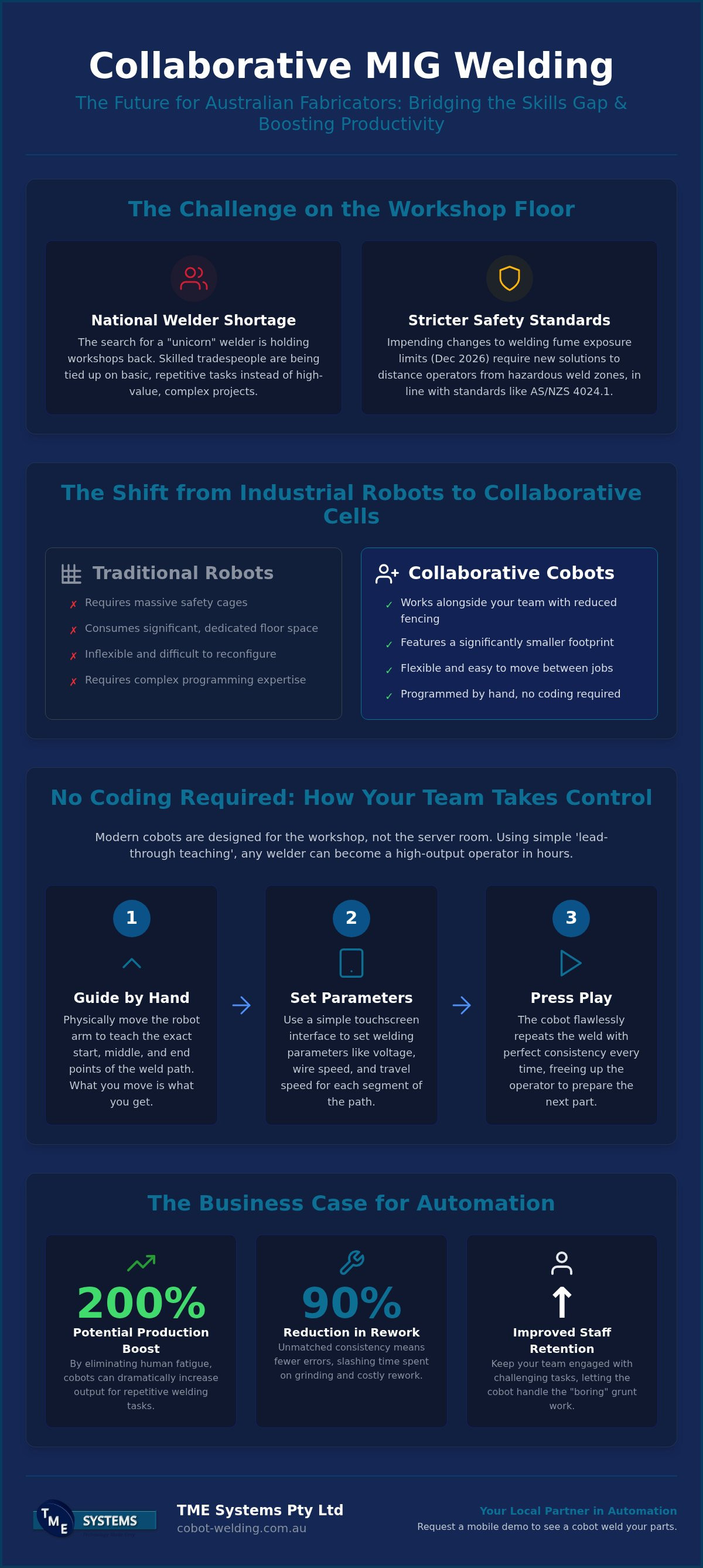

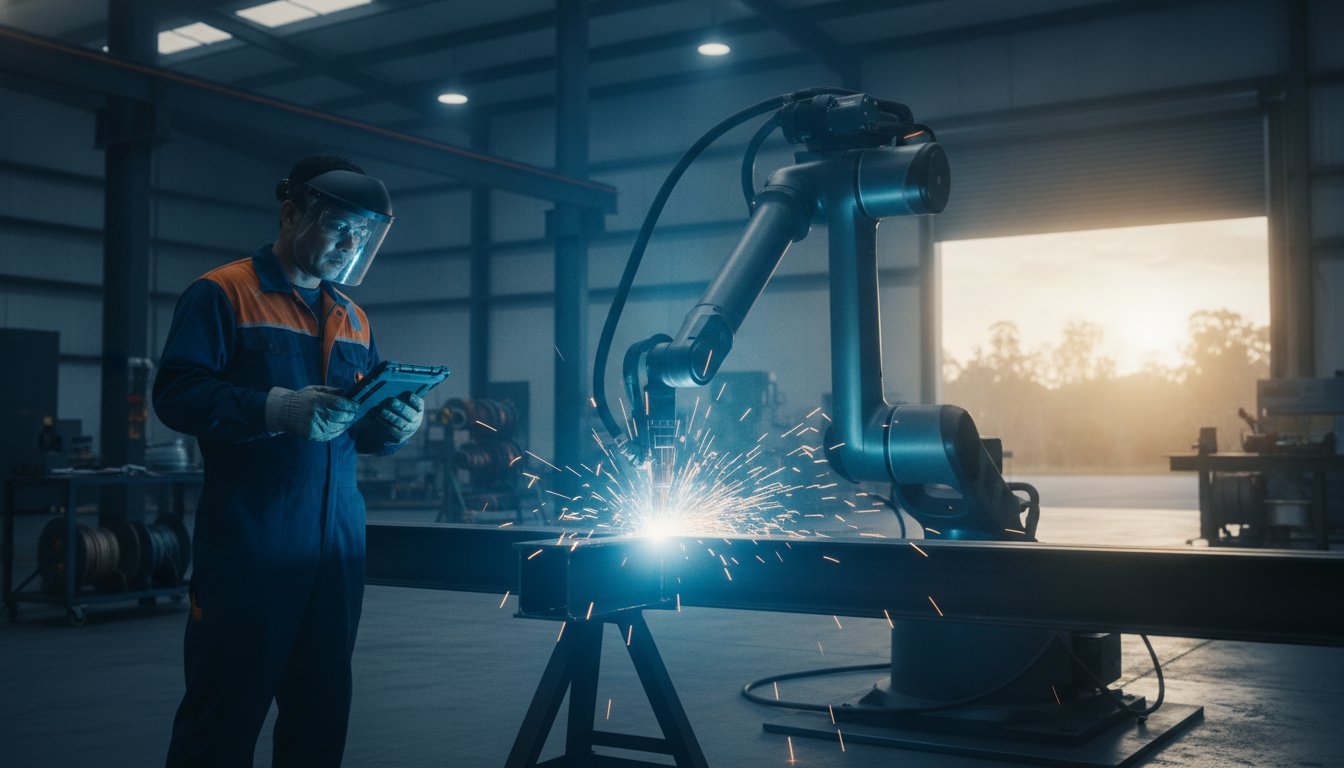
What if the solution to your workshop’s mounting backlog isn't finding a "unicorn" welder who doesn't exist, but rather giving your current team a tool that never gets tired? Most Australian fabricators we talk to are feeling the pinch of the national skills shortage while facing stricter safety regulations, such as the December 2026 changes to welding fume exposure limits. You might worry that bringing in collaborative MIG welding systems means hiring a high-priced IT consultant just to get a clean bead, but that is a common misconception. In reality, modern cobots are designed for the workshop floor, not the server room.
This guide shows you how no-code automation can solve your labour gaps and slash rework costs without requiring a single line of traditional programming. We'll explore how these systems integrate into your existing workflow, meet Australian safety standards like AS/NZS 4024.1, and turn your experienced tradespeople into high-output operators in just a few hours. By the end of this article, you will understand why the most successful shops are treating automation as a practical tool for the trade rather than a complex software project.
Key Takeaways
- Understand why local workshops are turning to automation to bridge the skills gap and manage the stricter 2026 safety standards.
- Learn how collaborative MIG welding systems use lead-through teaching, allowing your existing team to set weld paths by hand without any coding knowledge.
- Identify the essential hardware needed for Australian fab jobs, including how to select the right robotic arm payload and integrate with your current power source.
- Discover how to build a solid business case for automation by measuring improvements in arc-on time and the significant reduction in rework costs.
- Find out why partnering with local specialists and requesting a mobile demo is the most practical way to see a cobot weld your specific parts.
Why Australian Fabricators are Adopting Collaborative MIG Welding Systems
A collaborative MIG welding system is essentially a robotic tool designed to work alongside your team rather than being locked away in a cage. Unlike traditional industrial automation, these systems are built to be approachable for the average fabricator. In the 2026 Australian manufacturing landscape, the pressure to "do more with less" is no longer just a management catchphrase; it's a survival strategy. With the national welder shortage reaching critical levels, shops can't afford to have their best tradespeople stuck on basic, repetitive tasks all day. These systems allow you to redeploy your most skilled staff to high-value, complex projects where their expertise is actually required.
The history of Robot welding shows a steady move toward precision, but the latest collaborative systems take this a step further by focusing on ease of use and worker safety. These "cobots" act as a supportive partner on the shop floor. They handle the heavy lifting of production runs while remaining safe to work around, provided a proper risk assessment is conducted. This shift is particularly relevant given the stricter 2026 regulations regarding welding fume exposure limits, as automation helps distance human operators from the most hazardous areas of the weld zone.
The Shift from Industrial Robots to Collaborative Cells
Traditional industrial robots often require massive safety cages and dedicated floor space that many Aussie workshops simply don't have. Collaborative cells change the game by offering a significantly smaller footprint. Because they are designed to stop or slow down when they detect an obstruction, the need for extensive fencing is often reduced. This creates a flexible automation environment where you can easily move the system between different workstations. It's an ideal setup for high-mix, low-volume production, allowing you to switch from one job to the next without a week of downtime for reconfiguration.
Solving the Repetitive Weld Bottleneck
Every workshop has those "boring" jobs that drain the morale of skilled staff. Whether it's welding hundreds of simple brackets or long, straight seams, these tasks are prone to human error due to fatigue. Collaborative MIG welding systems provide a level of consistency that's impossible to match manually. Every weld looks the same from Monday morning to Friday arvo. This reliability doesn't just improve the look of your product; it slashes the time spent on grinding and rework. By letting the cobot handle the repetitive "grunt work," you keep your team engaged with more challenging tasks, which is a proven way to improve staff retention in a competitive market.
Inside the Cell: Key Components of a Collaborative MIG System
When you look inside a modern setup, the hardware might look familiar, but the way it's put together is what makes the difference. A standard cell for collaborative MIG welding systems usually centres on the robotic arm. For most Australian fabrication jobs, you'll be looking at arms with a 10kg to 20kg payload. This provides enough reach to cover a standard welding table while handling the weight of a heavy-duty water-cooled torch and its cabling. Integrating this arm with an industry-standard MIG power source is crucial. You don't want to replace your entire fleet of machines just to add automation; instead, the system should act as a bridge between your existing gear and the new technology.
Data from the International Federation of Robotics suggests that these setups can boost welding production by up to 200%, largely because they remove the human fatigue factor from the equation. While the arm and power source are the muscles, the interface is the brain. The software is what truly determines success; if it's too hard to use, the system will just sit in the corner gathering dust. High-quality torches and reliable wire feeders are also non-negotiable. If the hardware fails to feed wire consistently, the most advanced software in the world can't fix the weld.
Hardware Designed for the Workshop Floor
A workshop isn't a clean room. It's full of grinding dust, spatter, and fluctuating temperatures. Any system worth its salt needs high-quality seals and protective sleeves to keep the electronics safe. You also need to decide how the system is mounted. A fixed table is great for dedicated production lines, but many Aussie shops prefer mobile carts. This allows you to wheel the cobot to where the work is, rather than moving the work to the robot. If you're curious about how these components handle your specific jobs, a mobile demo system is often the best way to see the hardware in action on your own floor.
Safety Features and Australian Standards
Safety is often the biggest concern for workshop owners. These systems use force and power limiting technology to ensure the robot stops instantly if it "feels" an unexpected obstruction. This allows for compliance with local safety regulations, such as AS/NZS 4024.1, without the need for massive, intrusive guarding. It's about creating a workspace where the operator can set a part, start the cycle, and then prepare the next jig right next to the machine. Emergency stop integration and operator protection protocols are built directly into the control system, ensuring that human safety remains the top priority throughout the shift.
Eliminating the Code: How No-Code Software Empowers Your Welders
One of the biggest hurdles for Australian workshop owners is the lingering fear that automation requires a degree in computer science. There is a persistent myth that you need a dedicated "robot programmer" on the payroll to make these machines work. In reality, the most effective operator for collaborative MIG welding systems isn't an IT expert; it's your best welder. Your experienced tradespeople already understand the nuances of weld pools, heat management, and torch angles. No-code software simply gives them a way to record that expertise without typing a single line of script.
This transition is made possible through "Lead-Through" teaching. Instead of inputting complex coordinates, the operator physically moves the robotic arm to the desired positions. It is as intuitive as showing an apprentice how to move through a joint. By holding the torch and guiding it along the seam, the welder "teaches" the system the exact path required for a perfect bead. Parameters like voltage, wire feed speed, and travel speed are then adjusted via a simple touch-screen interface that feels more like a smartphone app than a piece of industrial machinery.
The ability to save and load jobs is where the real efficiency gains happen. Once a specific part is programmed, the data is stored in the system's memory. When that same job returns to the floor weeks later, the operator can switch over in minutes. This level of accessibility is backed by an International Federation of Robotics case study, which shows that removing the programming barrier is a primary driver for rapid ROI in small-to-medium enterprises.
The Step-by-Step Teaching Workflow
Teaching a new part follows a logical, hands-on sequence that builds operator confidence quickly. First, you physically move the torch to the start and end points of the weld. Second, you select the specific weld type on the tablet, such as a continuous bead or a weave pattern for wider gaps. Third, you perform a "dry run" where the robot follows the path without the arc on to ensure there is no interference with jigs or clamps. Finally, you execute the weld, refining the parameters in real-time to get the penetration and finish exactly right.
Why 'No-Code' Changes the ROI Calculation
Traditional automation often failed in Aussie job shops because the setup time for small batches was too high. If it takes two days to program a robot for a two-hour job, the maths doesn't work. No-code software slashes this setup time, making it profitable to automate batches as small as five or ten units. You no longer need to call in expensive external consultants every time you win a new contract. This independence turns the cobot into a versatile power tool that your team actually wants to use, rather than a complex system they are afraid to touch.
ROI and Integration: Making the Business Case for Automation
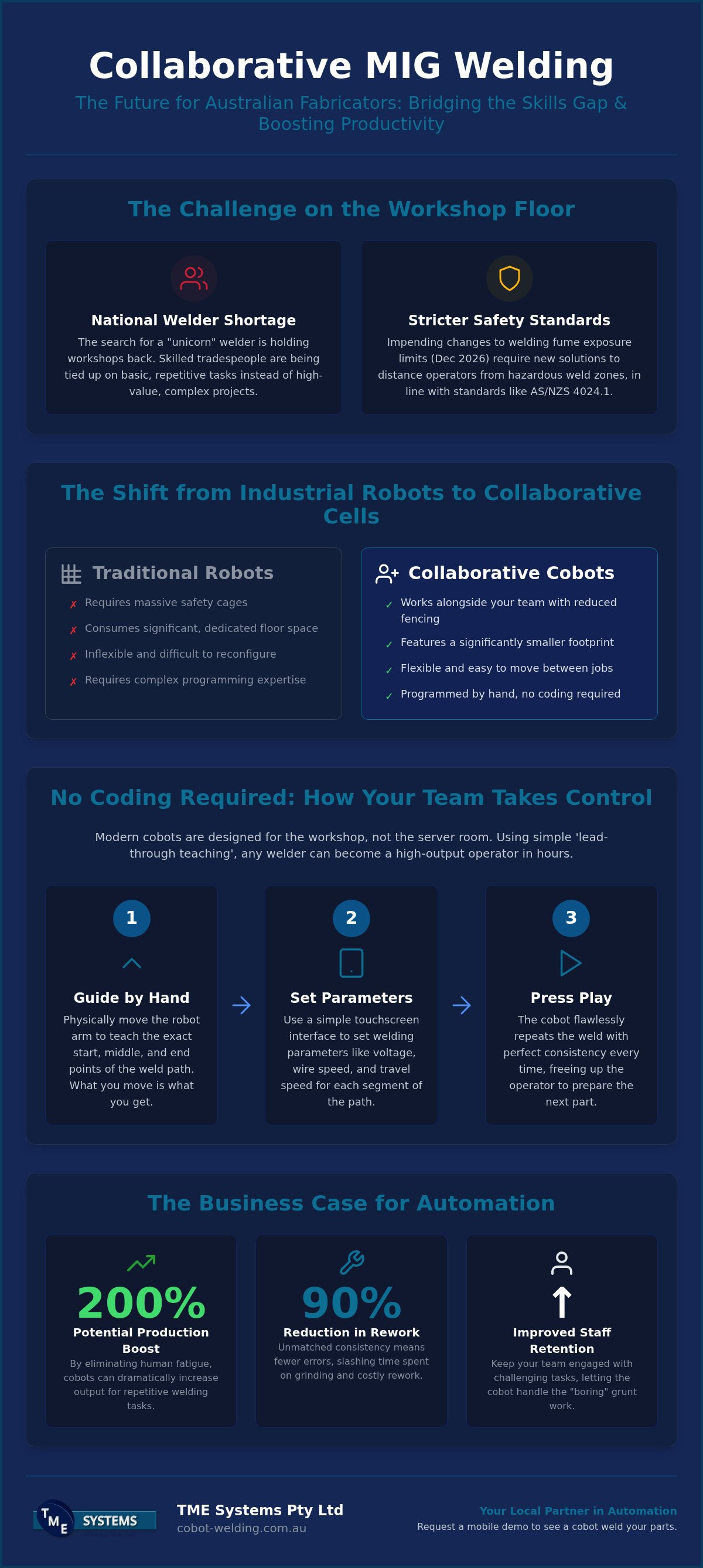
Building a business case for collaborative MIG welding systems starts with a cold look at your current manual production costs. It isn't just about the hourly rate you pay a welder. You have to account for superannuation, workers' comp, and the staggering cost of recruitment in a market where qualified tradespeople are scarce. When you factor in the consistency of robotic output, the maths changes quickly. A cobot doesn't take lunch breaks or get distracted on a Friday arvo, which means your arc-on time increases dramatically while shielding gas and wire waste decrease.
Integration into your workshop doesn't have to mean a total shutdown. Most shops find that the first 30 days are about operator onboarding and building trust in the machine. This is a phase of refinement where your team learns to trust the robotic consistency. By the end of the first month, the system should feel like just another piece of essential workshop gear, seamlessly integrated into your daily production schedule. It's about making the technology work for your people, not the other way around.
The Australian ROI Framework
In the local market, the payback period for a collaborative robot welding cell is often shorter than expected. This is largely due to increased throughput. One operator can effectively manage two cells simultaneously, loading parts into one while the other is under the arc. This doubles your output without increasing your headcount. When you consider the reduction in rework and grinding time, many Aussie fabricators see the system paying for itself within 12 to 18 months, depending on their volume.
Planning Your Integration Strategy
Success depends on choosing the right starting point. We always recommend picking a simple, repetitive job for the first rollout. It builds immediate momentum and proves the value of the tech to the whole team. You'll also need to ensure your jigs and fixtures are designed for robotic repeatability; the robot will hit the exact same spot every time, so your parts need to be there too. Partnering with welding system integration specialists can help you avoid common pitfalls during this setup. If you're ready to see how this fits your specific floor plan, you can book an on-site demo to get started.
Future-Proofing with Local Support and Proof of Concept
Investing in high-tech gear is a big move for any workshop. The real test of that investment happens six months down the track when you're pushing to meet a massive order and need everything to run like clockwork. This is where having a local partner becomes your biggest asset. You need more than just a box delivered to your door; you need a team that can jump on a call or visit your site when you have a technical question. Choosing collaborative MIG welding systems from a provider with a local presence ensures your cell stays operational and profitable for years to come.
Success in automation isn't about buying the most expensive machine. It's about finding a system that fits your specific workflow and having the support to back it up. A local partner acts as a practical mentor, helping you refine your processes and troubleshoot issues in real-time. This ongoing relationship turns a one-off purchase into a long-term strategy for growth, allowing you to scale your production without the usual growing pains associated with new technology.
The Mobile Demo Advantage
One of the best ways to eliminate risk is through a mobile demonstration. It's one thing to watch a video online, but it's another thing entirely to see a cobot weld your actual parts on your own workshop floor. This "proof of concept" phase allows you to verify that the system can handle your specific material thicknesses and joint types before you commit any capital. It's also the perfect time to get buy-in from your team. Letting your best welders get hands-on with the no-code robot welding software demystifies the tech. They'll quickly see that it's a tool designed to make their lives easier, not a threat to their trade.
Long-Term Partnership and Support
A successful automation journey doesn't end with the first weld. As your business evolves, your system needs to keep pace. Local support means you have access to spare parts without waiting weeks for international shipping. It also means you get regular software updates and new feature rollouts that keep your teaching interface at the cutting edge. Beyond the technical side, bringing in this technology helps you build a culture of innovation. In a market where it's hard to find young talent, showing that your shop uses modern, accessible automation can be a major drawcard for the next generation of tradespeople. Once you've mastered your first cell, scaling up to a fully automated workshop becomes a logical, low-risk progression.
Equipping Your Workshop for the Road Ahead
The 2026 manufacturing landscape in Australia demands a smarter approach to traditional fabrication. By adopting collaborative MIG welding systems, you aren't just buying a machine; you're equipping your best tradespeople with a tool that amplifies their skills and protects your business from the labour shortage. We've explored how no-code software removes the programming barrier, allowing your team to focus on quality rather than complex scripts.
Seeing is believing when it comes to workshop floor innovation. As a 100% Australian-owned partner, we provide the integration and support needed to ensure your cell delivers a rapid return on investment. If you're ready to see how this technology handles your specific parts, Book a Mobile Welding Robot Demonstration for your workshop today. Our mobile demo system brings the proof directly to your door, showing you exactly how zero-programming automation can transform your production. It's time to take the guesswork out of automation and start building a more resilient, productive future for your shop.
Frequently Asked Questions
Is a collaborative MIG welding system safe to use without a cage?
Yes, these systems are designed to operate without bulky safety cages, provided you've conducted a thorough risk assessment. Under Australian standard AS/NZS 4024.1, the owner is responsible for ensuring the entire cell is safe. Because cobots use built-in sensors to detect obstructions and stop instantly upon contact, the need for physical fencing is often reduced. You'll still need to consider protection from arc flash and the 2026 welding fume exposure limits, which might require screens or extraction units.
How long does it take to learn how to program a welding cobot?
Most experienced welders can learn to operate a system in just a few hours. Because we use no-code teaching software, there's no need to write or understand computer scripts. Your team simply moves the robotic arm by hand to set the weld path and uses a tablet interface to adjust the settings. It's designed to be as intuitive as using a modern smartphone, which helps your crew feel confident with the tech almost immediately.
Can a cobot handle TIG welding as well as MIG?
Yes, collaborative robots are highly versatile and can be configured for TIG welding applications. While this guide focuses on collaborative MIG welding systems, the same robotic arm can be fitted with a TIG torch and integrated with a suitable power source. This makes the system a flexible asset for Aussie shops that work with a variety of materials and require high-precision finishes on thin-gauge projects.
What is the typical ROI for an Australian small business adopting a cobot?
While every workshop is different, many local fabricators see a full return on investment within 12 to 18 months. This payback is driven by a massive increase in arc-on time and a significant reduction in rework costs. By allowing one operator to manage multiple cells, you effectively double your output without needing to hire additional skilled tradespeople in a market where they're hard to find.
Do I need to buy a new welding machine to use a cobot cell?
No, you don't necessarily need to replace your current gear. These systems are designed to integrate with many industry-standard welding machines already found on Australian workshop floors. During the integration process, we check your existing power source to ensure it can communicate effectively with the robot's control system. This allows you to leverage your existing investments while adding the benefits of modern automation.
What happens if the robot hits an operator during a weld?
The robot will stop immediately due to its force and power limiting safety features. These sensors are designed to detect even slight resistance, halting all movement before any injury occurs. It's a fundamental difference between cobots and traditional industrial robots. Once the obstruction is cleared, the operator can safely reset the system and continue the job without a complex or time-consuming reboot process.
How do I book a mobile demonstration for my workshop?
You can book a session through our website to have our mobile demo system visit your site. This is the most practical way to see the technology in action because we weld your specific parts using your own materials. It's a zero-risk way to prove the concept to your management team and get your welders comfortable with the interface before you make a final decision.
Can collaborative robots weld aluminium or stainless steel?
Yes, these systems are perfectly capable of welding aluminium and stainless steel. Success depends on having the right peripheral equipment, such as a push-pull gun for aluminium wire or the correct shielding gas mix. The precision of the robotic path ensures consistent penetration and a high-quality finish on these sensitive materials, which often require more control than standard mild steel jobs.