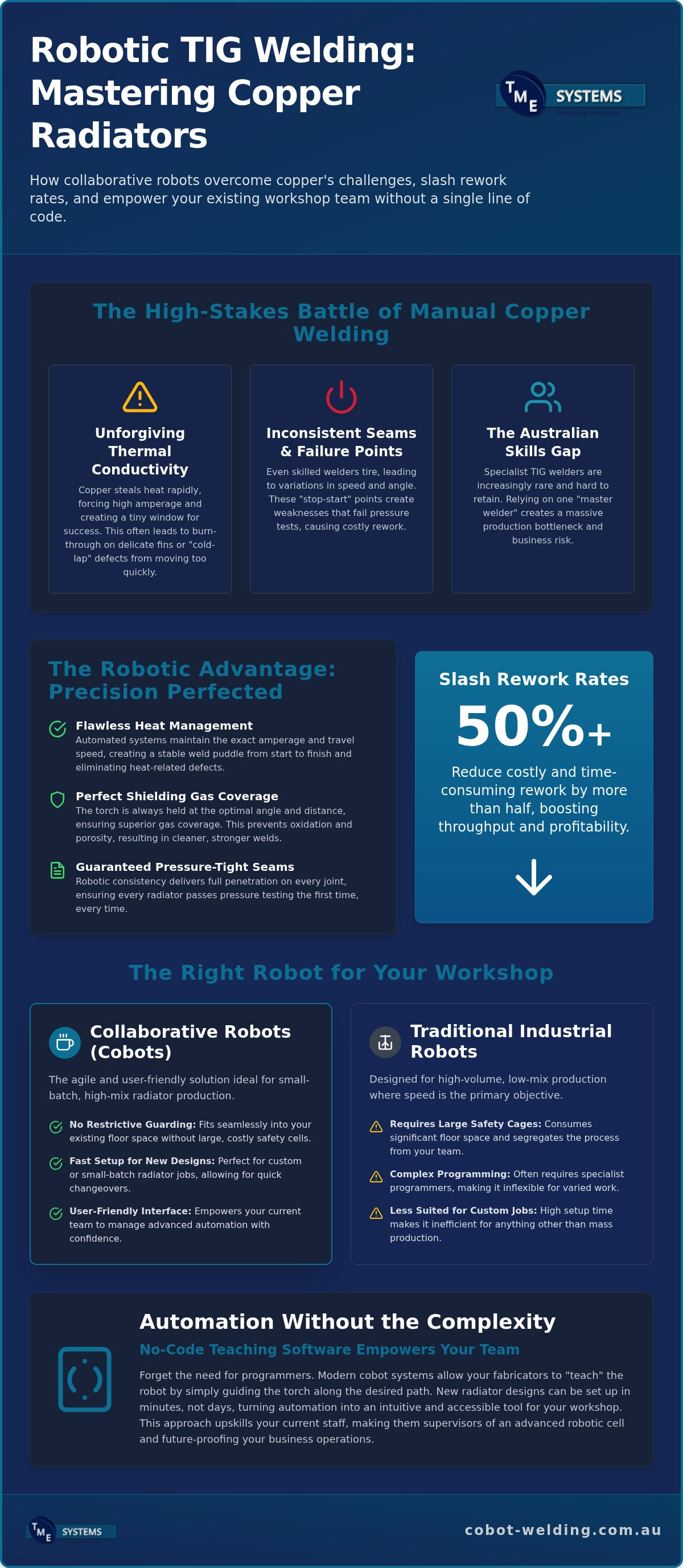

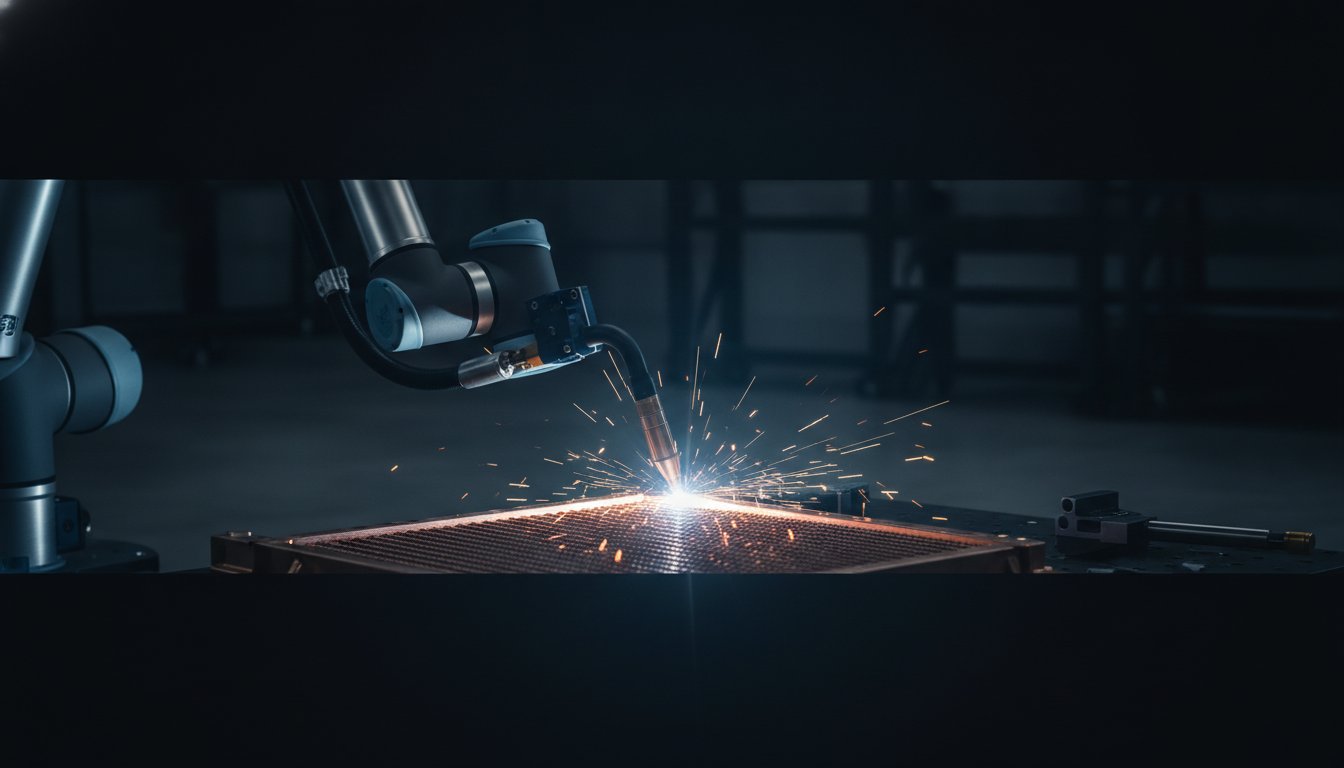
What if the biggest obstacle to your workshop’s growth isn't a lack of orders, but the constant battle against copper’s unforgiving thermal conductivity? You likely know the frustration of seeing a seasoned fabricator spend hours on a custom radiator, only for the unit to fail a pressure test because of one inconsistent seam. It’s a common headache in Australian manufacturing, especially as the pool of specialist TIG welders continues to shrink while rework rates climb.
This guide explores how copper radiator robotic tig welding is being redefined by collaborative robots that don't require a single line of code. You’ll discover how no-code teaching software allows your existing team to set up precision paths for small-batch designs in minutes rather than days. We will look at how to reduce welding rework by 50% or more, achieve aesthetic, leak-proof seams on every unit, and upskill your current staff to manage advanced robotic cells with confidence. By the end, you'll see that automation isn't about replacing your people; it's about giving them a better tool to get the job done right the first time.
Key Takeaways
- Master copper’s difficult thermal conductivity by using automated heat control to slash rework rates and ensure every unit passes pressure testing.
- Explore how copper radiator robotic tig welding delivers the consistent travel speeds and precise arc lengths required for high-quality, aesthetic seams.
- Compare the benefits of collaborative robots against traditional industrial systems to find a solution that fits your floor space without restrictive safety guarding.
- Learn how no-code teaching software allows your current team to set up new radiator designs quickly, turning automation into a user-friendly tool for the workshop.
- Discover the path to future-proofing your business through on-site demonstrations and operator onboarding tailored to the Australian manufacturing landscape.
The Challenges of Manual Copper Radiator TIG Welding
Manual welding on copper radiators is a high-stakes task that tests the patience of even the most experienced fabricators. Unlike working with mild steel or aluminium, copper behaves differently under the torch. It's a constant battle against the material's physical properties. When using Gas Tungsten Arc Welding (GTAW), the operator must manage precise heat input while navigating thin-walled components that are prone to warping or melting away in an instant.
The core issue is consistency. Maintaining a perfectly even travel speed over a long radiator seam is physically demanding. A human hand naturally tires, leading to slight variations in torch angle or arc length. In the world of pressurised heat exchangers, these tiny inconsistencies often result in "stop-start" points. These junctions are notorious for being potential failure points, as the cooling and reheating of the metal can trap impurities or create microscopic cracks that only reveal themselves during a final pressure test.
Thermal Conductivity: The Welder's Enemy
Copper is a thief. It steals heat from the arc faster than almost any other industrial metal, forcing the operator to ramp up the amperage just to maintain a puddle. This creates a narrow window for success. If you move too slowly, the high heat levels lead to "burn-through" on the delicate fins. If you move too quickly, the metal doesn't fuse properly, resulting in "cold-lap" defects. This is why copper radiator robotic tig welding is becoming a necessity; a robot doesn't struggle with heat dissipation. It maintains the exact travel speed and amperage required to keep the puddle stable from the first millimetre to the last.
The Australian Skills Gap in Precision TIG
Finding TIG specialists in the Australian market is getting harder every year. Most highly skilled welders prefer the variety of heavy structural work or custom fabrication over the repetitive, painstaking nature of radiator production. When your workshop relies on a single "master welder" to handle every leak-critical seam, that person becomes a massive bottleneck. If they're away or move on, production grinds to a halt. Transitioning to a model where your team supervises a robotic cell allows you to scale up without hunting for rare specialist labour. It turns the welding process into a repeatable system rather than a fragile, person-dependent craft.
Why Robotic TIG is the Gold Standard for Heat Exchange Components
TIG welding has long been the preferred choice for premium radiator production because it offers the cleanest, most aesthetic results. However, when dealing with copper’s high thermal conductivity, the technical demands on a manual operator are extreme. Copper radiator robotic tig welding solves this by introducing a level of control that manual torches can't match. A robotic system manages micro-adjustments in wire feed and arc length with sub-millimetre precision. This allows for full penetration across the entire joint without the risk of warping the delicate radiator core or fins.
The robotic torch maintains a constant angle and distance, which is nearly impossible for a human to sustain over a full shift. This level of mechanical discipline ensures that the heat input remains within a very narrow window. By keeping the arc stable, the system prevents the overheating that typically leads to distorted reservoir tanks or melted cooling tubes. It turns a high-risk manual process into a predictable, high-yield production step.
Precision Shielding and Gas Flow
Maintaining perfect shielding gas coverage is vital when working with copper to prevent oxidation and porosity. In many Australian workshops, fabricators use specialised Argon and Helium mixes to achieve deeper penetration on thicker reservoir tanks. A robotic arm ensures the gas lens is always held at the optimal distance, which is difficult for a human to maintain over a complex, curved seam. This superior gas management doesn't just improve weld quality; it also significantly reduces the time spent on post-weld cleanup. As detailed in research regarding Robotics and Manufacturing Automation, these automated efficiencies are what allow local manufacturers to remain competitive against high-volume overseas imports.
Consistency in Pressure-Critical Seams
Every radiator you produce must pass a pressure test, meaning there is no room for "good enough" welds. Repetitive tasks, such as welding saddle joints or reservoir tanks, are where human fatigue often leads to pinhole leaks. Robotic cells eliminate this variable by delivering the exact same weld profile on every single unit. Beyond the physical weld, these systems provide a digital footprint of the process. You can track parameters like voltage, travel speed, and gas flow for every radiator that leaves your floor. This data logging creates a built-in quality assurance system that protects your brand's reputation for reliability. If you’re looking to see how these systems handle your specific designs, you might consider how automated welding for local manufacturers can be integrated into your existing floor plan.
Cobots vs Industrial Robots for Radiator Production
Most Australian job shops aren't designed like high-volume automotive factories. Space is at a premium; every square metre needs to earn its keep. Traditional industrial robots often fail this test for small-to-medium fabricators because they require massive safety cages and dedicated floor space that effectively cuts off a large portion of the workshop. If you're considering copper radiator robotic tig welding, the choice between a heavy industrial arm and a collaborative robot (cobot) will define your return on investment.
Industrial robots are built for high-speed, repetitive tasks where humans aren't allowed to enter the work zone. While they offer speed, the cost of integration, safety guarding, and the specialized programming required can be prohibitive. Cobots, on the other hand, are designed to work alongside your team. They feature built-in sensors that stop the arm instantly if they detect an obstruction, allowing them to operate in open environments without restrictive fencing. For a radiator shop, this means you can keep your fabricators close to the action to manage assembly while the robot handles the precision seams.
Space-Saving Workshop Integration
The footprint of collaborative robot welding cells is significantly smaller than their industrial counterparts. Because they don't need light curtains or physical barriers, they fit into existing fabrication bays without a total workshop redesign. This flexibility is a game-changer for radiator production. You can move a mobile cobot cell between different assembly stations depending on your weekly schedule. It reduces the "dead space" that usually sits idle in automated shops, ensuring your floor remains productive and accessible.
Programming vs Teaching
The most significant hurdle with industrial robots is the complexity of G-code or pendant programming. You shouldn't need a computer science degree to weld a reservoir tank. Cobots utilize "no-code" or lead-through teaching. Your best welder simply moves the robot arm by hand to the start and end points of the seam, recording the path with the press of a button. This intuitive approach is backed by research; an IFR case study on automated TIG welding highlights how fabricators have achieved massive productivity gains by simplifying the interface between person and machine.
This "teaching" method allows you to switch between different radiator models in minutes. In a single shift, you might move from a small oil cooler to a large custom radiator without calling in a programmer. It puts the power of automation back into the hands of the tradesperson, making the technology a tool for the welder rather than a replacement for their expertise.
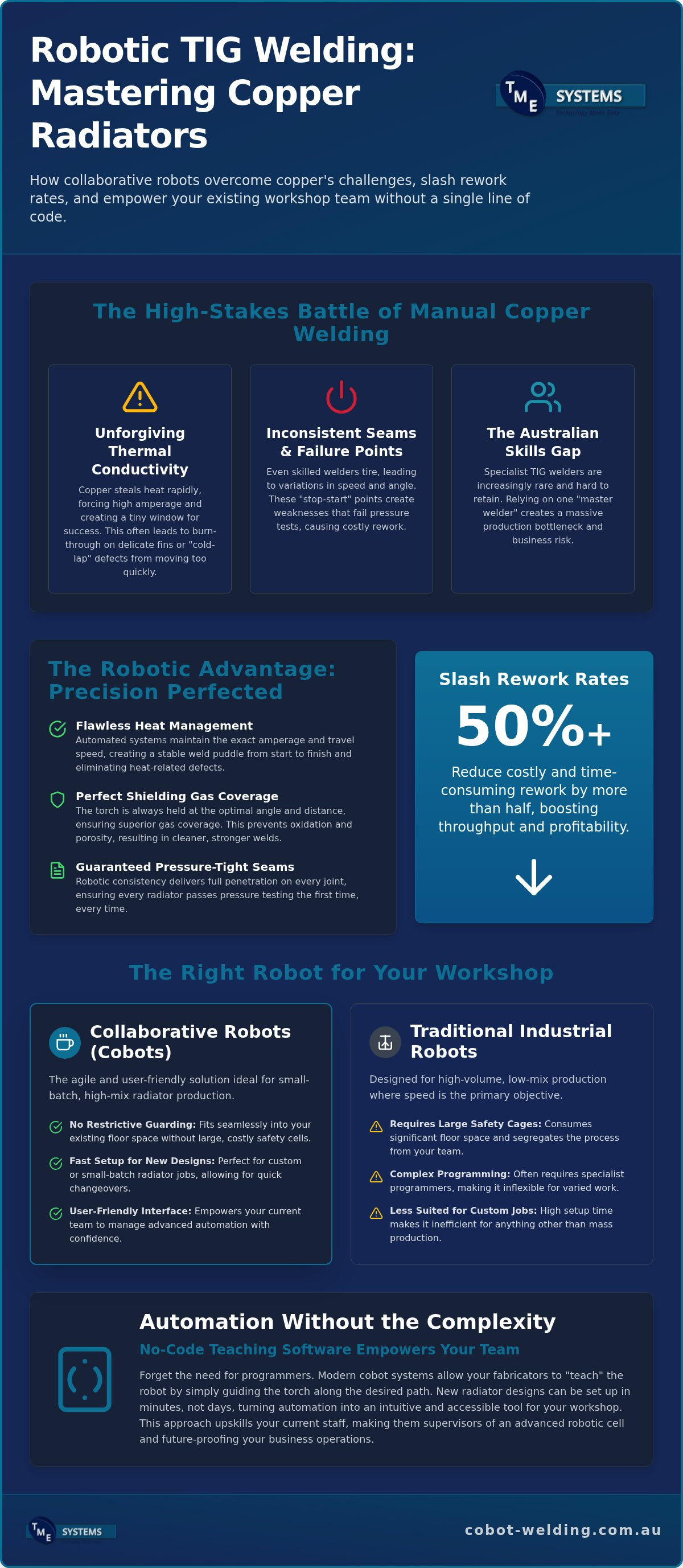
Implementing Automation: From Fixturing to No-Code Teaching
Transitioning to copper radiator robotic tig welding isn't just about unboxing a new piece of hardware. It's a logical, four-step process that starts with how you hold the work and ends with a team that's confident in managing a robotic cell. By breaking the transition down into manageable stages, you can ensure that the technology supports your existing workflow rather than disrupting it.
The Art of Robotic Fixturing
A robot is only as good as the jig that holds the workpiece. Because copper radiators are thin and prone to slight movement under heat, you need a fixture that ensures 100% repeatability. If your radiator sits even two millimetres out of alignment, the arc will miss the joint, leading to a failed unit and wasted material. Many Australian shops use modular welding tables to build custom jigs that lock the radiator into the exact same position every time. Consistency isn't just about the position; it's about the electrical path too. To avoid issues with robotic TIG, you should consider the following:
- Clean Earth Points: Ensure your earthing is consistent to avoid arc blow, which can ruin a TIG seam in seconds.
- Heat Sinking: Use your fixture to help manage heat dissipation in critical areas of the copper core.
- Modular Flexibility: Design your jigs so they can be quickly adjusted for different radiator sizes.
No-Code Path Teaching in Action
Once the radiator is secured, you define the weld path using no-code robot welding software. This is the stage where the cobot truly shines as a tool for the tradesperson. Your welder physically moves the robot arm to the start, middle, and end points of the seam, recording the path with the press of a button. There's no need to type lines of code or navigate complex sub-menus. Using a simple tablet interface, the operator can set "torch on" and "torch off" commands, and even fine-tune the weave pattern for wider joints. It turns a complex programming task into a hands-on teaching session that any experienced fabricator can master in a few hours.
Step 3 involves setting the "Golden Run" for your copper radiator robotic tig welding setup. This is your pilot run where you monitor the first unit and adjust parameters like travel speed and wire feed to account for copper's heat sink effect. Once you're happy with the result, these settings are locked in for the rest of the batch. Finally, Step 4 focuses on operator training and safety onboarding. This includes understanding the collaborative environment and ensuring the cell meets Australian safety standards, such as AS 4024.3301:2017. The goal is to upskill your existing staff so they can manage the robotic cell as comfortably as they handle a manual torch.
If you're ready to see how this process works on your own shop floor, explore our collaborative robot welding cells today.
Future-Proofing Your Workshop with TME Systems
Investing in automation is a significant step for any Australian fabricator. It's not just about the hardware; it's about ensuring your workshop remains competitive as the industry evolves. TME Systems focuses on making this transition as smooth as possible by acting as a practical partner rather than just a supplier. We understand that copper radiator robotic tig welding requires a specific set of parameters and a deep understanding of heat management, which is why our support extends far beyond the initial delivery.
Our approach is grounded in the reality of the local manufacturing floor. We've seen how automated welding for local manufacturers can transform a business from a struggling job shop into a high-precision production facility. By removing the technical barriers to entry, we allow your team to focus on what they do best: producing high-quality Australian-made radiators.
The TME Integration Advantage
Choosing the right robot is only half the battle. Successful cobot welding integration involves customising the turnkey cell to suit your specific radiator designs and material thicknesses. TME Systems specialises in this "end-to-end" relationship. We help you refine your fixtures and adjust your weld paths to ensure the robot handles your unique components with the same care as a master welder. Because we are based locally, you have direct access to technical support and spare parts. This eliminates the long wait times often associated with imported industrial systems, ensuring your radiator line stays productive.
As your production volume grows, scaling your automation is straightforward. The no-code interface remains consistent across all cells, meaning an operator trained on one station can easily manage a second or third. This modular growth strategy allows you to add capacity as your orders increase, without the need for a massive workshop overhaul.
Book a Proof of Concept
We believe that seeing is believing, especially when dealing with a material as temperamental as copper. Our mobile welding robot demonstration brings the technology directly to your floor. This isn't a generic sales pitch; it's a chance to see the no-code software in action using your own radiator components. During the demo, we can help you calculate the expected ROI based on your specific cycle times and current rework rates. It's the most pragmatic way to verify that copper radiator robotic tig welding is the right fit for your business goals. Book your on-site mobile demonstration today to take the first step toward a more efficient, future-proof workshop.
Modernise Your Fabrication Floor
Copper’s unforgiving nature doesn't have to be a bottleneck for your workshop's growth. By adopting copper radiator robotic tig welding, you’re choosing a path that prioritises consistent heat control and pressure-critical reliability. You’ve seen how collaborative robots fit into your existing bays without safety cages, and how no-code software allows your best welders to lead the transition. It’s about giving your team the tools to eliminate rework and focus on high-value fabrication.
TME Systems provides Australian-based technical support and turnkey cells designed specifically for local manufacturing standards. Our proven no-code software ensures rapid deployment, so your team can start producing high-quality seams without a steep learning curve. The most practical way to understand the impact on your specific radiator designs is to see the technology in action on your own floor.
Book a Mobile Welding Robot Demo for Your Workshop and let’s discuss how to refine your production line. Taking the first step toward automation is a smart move for any forward-thinking fabricator, and we’re ready to support you every step of the way.
Frequently Asked Questions
Can a cobot really handle the high heat required for copper TIG welding?
Cobots are built to handle the rigorous duty cycles of TIG welding on copper. While copper requires high amperage to overcome its thermal conductivity, the robotic arm maintains a consistent torch distance and travel speed without the physical strain a human faces. This allows for stable heat management across the entire radiator seam. The mechanical components are shielded and rated for industrial environments, ensuring the system remains reliable during long production runs.
Do I need to hire a programmer to run a robotic radiator welding cell?
You don't need to hire a specialist programmer to operate our cells. The no-code teaching software allows your existing fabricators to define weld paths by physically moving the robot arm to the required points. This lead-through teaching method replaces complex G-code with a simple tablet interface. It empowers your best welders to manage the technology themselves, keeping the expertise on the workshop floor rather than in an office.
How long does it take to switch the robot between different radiator designs?
Switching between different radiator designs typically takes less than 15 minutes. Once a Golden Run is established and saved in the software, an operator simply recalls the program and swaps the fixture. For new custom designs, the no-code interface allows for rapid path teaching. This flexibility makes copper radiator robotic tig welding viable for small-batch production and bespoke radiator units that would otherwise be too slow to automate.
Is robotic TIG welding faster than manual welding for radiators?
Robotic TIG is significantly more productive than manual welding due to its consistency and reduced defect rates. While a master welder can match a robot’s travel speed in short bursts, the robot maintains that pace for the entire shift without fatigue. Industry data shows that robotic systems can achieve a defect rate as low as 0.1% compared to 3-5% for manual welding. This reduces time spent on pressure testing and rework.
What safety standards apply to collaborative welding robots in Australia?
Collaborative robots in Australia must comply with AS 4024.3301:2017, which specifies safety requirements for industrial robots. This standard ensures the cobot can safely work alongside humans by using power and force limiting sensors. Additionally, workshops should follow AS/NZS ISO 3834 for quality assurance in fusion welding. TME Systems provides full safety onboarding to ensure your cell meets these local standards while maintaining a productive, cage-free environment.
Can I use my existing TIG power source with a cobot system?
It is often possible to integrate your existing TIG power source with a collaborative robot system. TME Systems specialise in welding system integration to ensure your current equipment communicates effectively with the robotic arm. This approach can lower the initial investment cost while upgrading your workshop's capabilities. We assess your current hardware during the demo phase to ensure compatibility with the no-code control interface and robotic torch.
What happens if the radiator fit-up isn't perfect?
Repeatable radiator fit-up is essential because the robot follows a precise taught path. If your components aren't aligned correctly in the jig, the weld may miss the joint. We focus heavily on Step 1 of the implementation process: designing robust fixtures and jigs. Using modular welding tables ensures that every radiator is positioned identically, allowing the copper radiator robotic tig welding process to deliver leak-proof results on every single unit produced.
How much floor space does a typical cobot welding cell require?
A typical cobot welding cell requires very little floor space, often fitting within a standard 2-metre by 2-metre welding bay. Because cobots don't require the bulky safety cages or light curtains used by traditional industrial robots, they have a much smaller footprint. This compact design allows you to integrate automation into your existing workshop layout without moving walls or sacrificing valuable assembly space for other fabrication tasks.