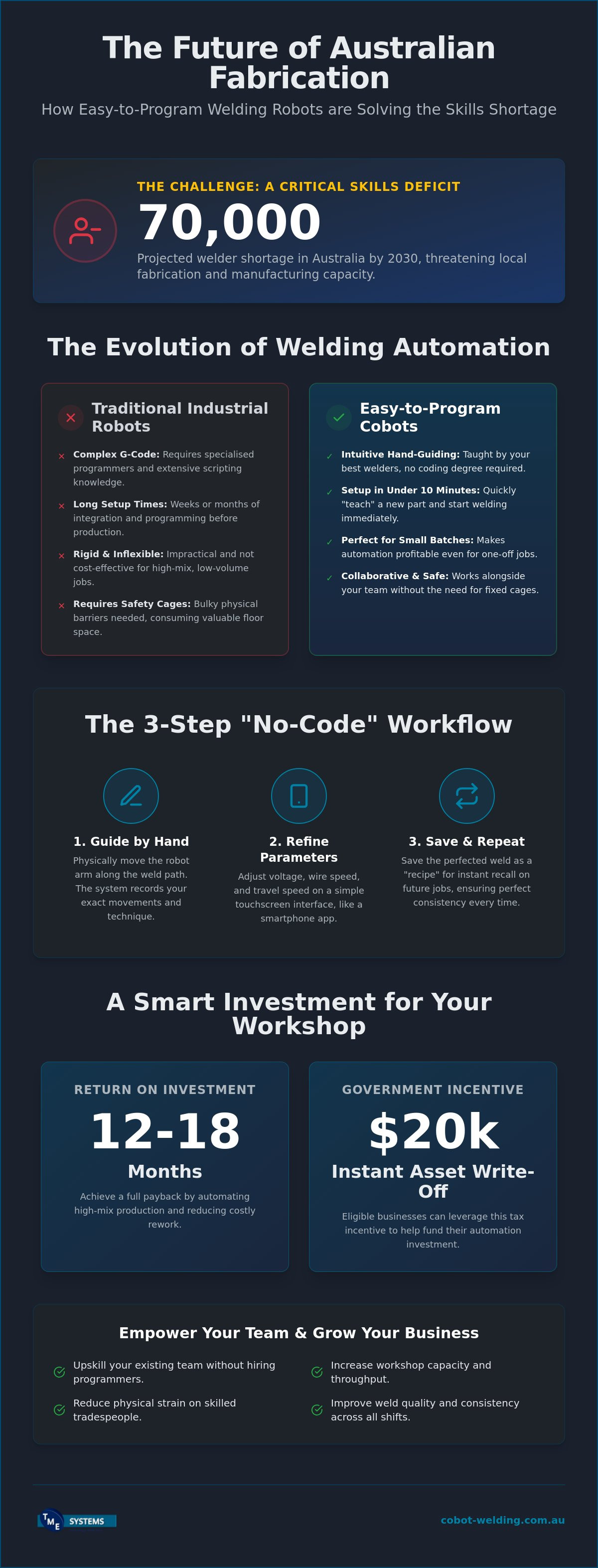

With Australia projected to face a deficit of 70,000 welders by 2030, how's your workshop supposed to keep the torches burning? You've likely felt the pressure of the skills shortage, or perhaps you've looked at automation before and been put off by the thought of hiring a specialised programmer just to set up a simple fillet weld. It's a common frustration to have a full order book but not enough skilled hands to finish the jobs on the floor. We know that for most local fabricators, the real barrier to adopting easy to program welding robots hasn't been the hardware; it's been the complexity of the software.
This guide explains how no-code technology is finally making automation accessible for high-mix, low-volume production. You'll discover how these systems allow your current team to take control of the torch without writing a single line of code. By upskilling the staff you already have, you can reduce rework and see a full return on investment in as little as 12 to 18 months. We'll walk you through the latest cobot trends for 2026, practical setup steps, and the financial incentives, such as the $20,000 instant asset write-off, available to help your business grow.
Key Takeaways
- Learn how the shift from complex G-code to intuitive hand-guiding allows your team to "teach" rather than "program" a weld path.
- Discover why easy to program welding robots are becoming the workshop standard for high-mix production by removing the need for specialised software engineers.
- Understand the practical differences between traditional industrial setups and modern cobots that fit into your existing workshop without the need for bulky safety cages.
- Identify the essential software features that allow a non-technical operator to set up and adjust a new welding task in under 10 minutes.
- Explore how modern human-machine interfaces keep your skilled tradespeople in control of the process, ensuring technology supports their craftsmanship.
Why 'Easy to Program' is the New Standard for Australian Welding Shops
For years, the word "automation" sparked a bit of dread in Australian workshops. It usually meant expensive specialists, months of setup, and a steep learning curve that left the actual welding team on the sidelines. In 2026, that's changed. The new industry standard is built around easy to program welding robots that replace dense G-code and complex scripting with intuitive, visual interfaces. We've moved away from "programming" in the traditional sense. Today, it’s about "teaching."
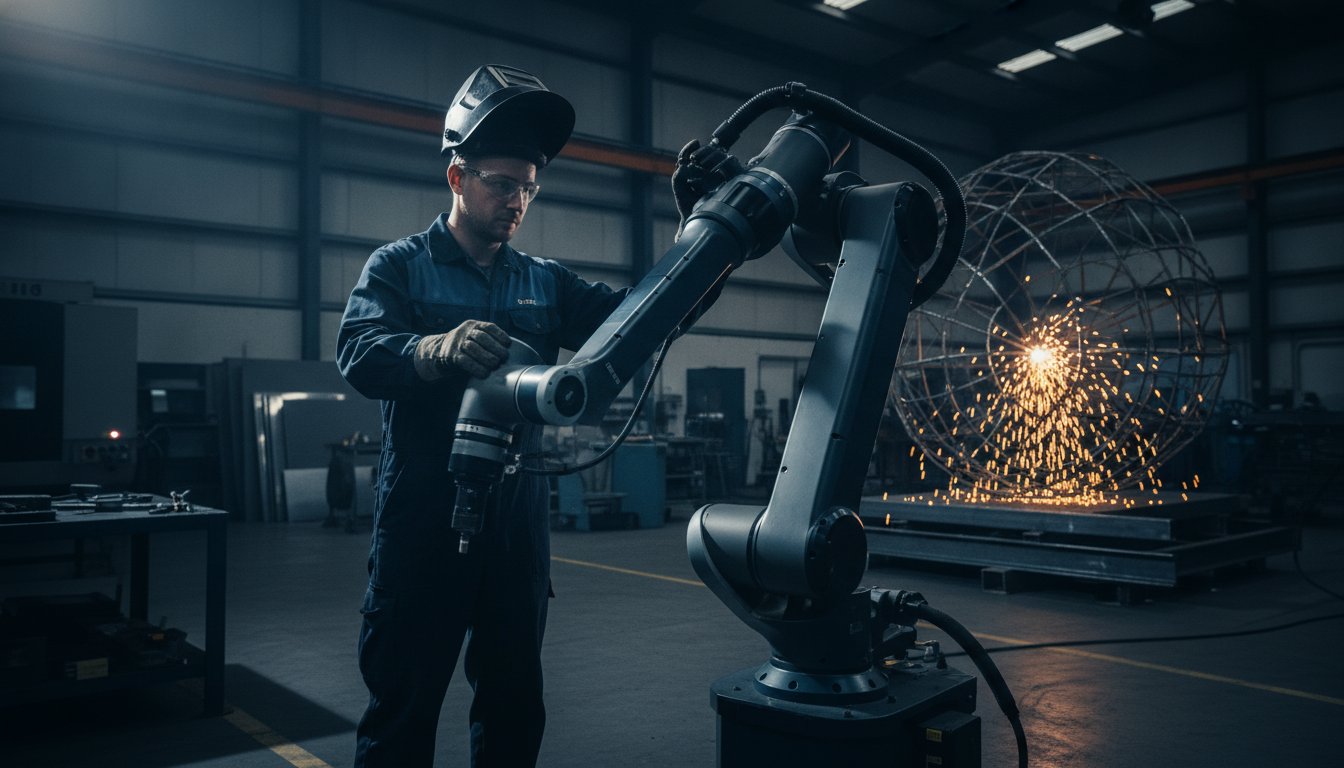
Instead of typing lines of code, a welder simply moves the collaborative robot (cobot) arm by hand to the start and end points of a seam. The software records these points and handles the heavy lifting of calculating the path. This shift is the tipping point for local manufacturing. It allows shops to automate even small-batch runs that were previously too time-consuming to bother with. When you can set up a new part in minutes, the return on investment for high-mix production becomes a reality rather than a pipe dream. Many local shops now report a full return on investment within 12 to 18 months by focusing on these accessible systems.
Breaking the Myth: You Don't Need a Degree in Robotics
Many workshop owners still think they need to hire a university graduate to run a robotic cell. That's a myth we need to put to rest. Modern no-code software looks and feels like a smartphone app. It uses visual icons and drag-and-drop workflows that make sense to someone who knows a good weld from a bad one. In fact, your best welder is usually your best robot teacher. They already understand torch angles, travel speeds, and gas flow. The robot is just a tool that follows their lead.
The Impact on the Australian Skills Shortage
With a projected deficit of 70,000 welders by 2030, we can't afford to have our most experienced tradespeople stuck on repetitive, mind-numbing runs. Easy to program welding robots allow junior staff to produce high-quality production welds under the supervision of a senior welder. This doesn't replace the craftsman; it empowers the whole team. By automating the grunt work, you reduce physical strain on your staff and increase your workshop's capacity. It’s a practical way to keep fabrication jobs on Australian shores while keeping your team healthy and productive.
The Mechanics of No-Code: How Modern Cobots Learn Weld Paths
The core of this technology is "lead-through" teaching. Instead of typing coordinates into a terminal, you physically grab the robot arm and guide it along the seam. It’s a hands-on process that feels natural to anyone who has spent years behind a mask. As you move the torch, the system records the path in real-time. This eliminates the guesswork and the need for a keyboard on the workshop floor. It’s about using the welder's existing muscle memory to set the standard for the machine.
Behind the scenes, a sophisticated software layer translates your physical movements into precise robotic coordinates. While the user experience is simple, the technology is grounded in advanced automated offline programming research, which has paved the way for these intuitive interfaces. This software doesn't just record the path; it allows you to refine the weld parameters like voltage, wire feed speed, and travel speed on the fly. If you notice the pool is getting too hot or the penetration isn't quite right, you can adjust the settings directly through the interface without stopping the program.
Once a job is perfected, you can save the entire sequence as a "recipe." For a local fabricator handling a mix of recurring small batches, this is where the real value lies. You might spend ten minutes teaching a new bracket today, but when that same order returns next month, setup takes seconds. This ability to recall proven settings is why easy to program welding robots are now essential for maintaining consistency across different shifts and operators. You no longer have to worry about whether the Monday morning weld looks the same as the Friday afternoon one.
Teaching vs. Coding: A Practical Comparison
Teaching is the physical act of guiding a robot through a weld path to record its movements. Traditional industrial coding often requires weeks of specialised training and a deep understanding of proprietary languages. In contrast, no-code teaching usually involves just a few hours of onboarding. This shift is how no-code robot welding software bridges the gap for SMEs that can't justify the cost of a full-time programmer. If you're curious about how this looks in practice, you can book a session with a mobile demo system to see the software in action on your own floor.
Intuitive Software Features to Look For
When you're evaluating different systems, the software interface is just as important as the robot arm. Look for features like visual path previews and "dry run" modes. These allow you to watch the robot follow the path at a safe speed without the arc struck, ensuring there are no collisions with fixtures. Smart "weld-to-point" functions are also vital; they automatically calculate the best way for the robot to approach and retract from a weld. This saves you from having to manually teach every transition move, making the process even faster. Most modern systems are compatible with various power sources, whether you're running MIG, TIG, or pulse setups, giving you the flexibility to use the gear you already trust.
Comparing Traditional Industrial Robots vs. Easy-to-Program Cobots
Choosing between traditional automation and collaborative systems often comes down to the layout of your workshop and the variety of parts you handle. Traditional industrial robots are high-speed powerhouses, but they require significant safety infrastructure like light curtains and physical cages to protect your team. Cobots, on the other hand, feature built-in force-sensing technology. This allows them to work safely alongside your staff, often without the need for bulky guarding. For a shop where floor space is at a premium, this difference is massive.
Beyond safety, the footprint of a collaborative cell is much smaller. You don't need to renovate your entire layout or pour new concrete pads to accommodate one. These units are often mobile, meaning you can wheel the robot to where the work is rather than bringing the work to a fixed station. This flexibility is a key reason why easy to program welding robots are winning over Australian fabricators who need to stay agile. You can move the system from a MIG station to a TIG bench in minutes, keeping your production flow steady.
Then there's the hidden cost of programming downtime. With a traditional robot, every time you change a part design, you might need to call in a third-party integrator to rewrite the code. That's money out of your pocket and machines sitting idle. Understanding the fundamentals of robotic welding helps highlight that while industrial robots are faster on paper, the time saved in setup makes cobots faster in the real world of small-batch fabrication. If you're swapping jobs three times a day, the speed of the software matters more than the speed of the arm.
When to Choose a Collaborative Cell
Collaborative systems are the ideal choice for high-mix, low-volume (HMLV) production environments. They're best for shops where the welder needs to stay close to the arc for frequent quality checks or adjustments. If your work involves complex assemblies that require human oversight, check out our collaborative robot welding cells guide for deeper hardware specs and integration tips.
The Total Cost of Ownership (TCO) Difference
Budgeting for automation isn't just about the sticker price. You have to look at the Total Cost of Ownership. Traditional robots often carry high integration fees and require expensive software updates. For a collaborative setup, annual servicing costs in Australia typically range between A$1,000 and A$3,000, making it a predictable expense. When you focus on teaching a cobot to weld in-house, you're investing in your own team's skills rather than paying for external expertise every time a new job comes through the door. This long-term saving is what drives that 12 to 18 month ROI many local shops are achieving.
Checklist: Evaluating Ease of Use Before Investing in Automation
Buying automation is a big step for any workshop. You need to be sure the "ease of use" promised by a salesperson isn't just a marketing slogan. When you're looking at easy to program welding robots, you should put the software through its paces before signing any contracts. Start with a practical question: does the software allow for automated welding path adjustment without having to scrap the program and start from scratch? If a small change in part geometry requires a full reset, it isn't truly accessible for a high-mix environment.
Use this checklist to evaluate any system you're considering:
- Can a non-technical operator "teach" a basic fillet weld in under 10 minutes?
- Is the interface available on a ruggedised tablet that can survive the dust and drops of a workshop floor?
- How many days of training are actually required before your team welds their first production part? (Ideally, this should be one or two days).
- Is there a local mobile demonstration available so you can test the system on your own parts?
The '10-Minute' Test
Ask for a live demonstration of path teaching. Don't settle for a pre-recorded video or a slick presentation. A true test of easy to program welding robots is watching someone set up a path from scratch right in front of you. Look at the user interface logic. Is it intuitive, or is it cluttered with technical jargon that only an engineer would understand? You should also test the ease of adjusting weld parameters like amps, volts, or wire speed mid-program. If you have to dig through five sub-menus just to tweak the heat, it will frustrate your operators and slow down your production runs.
Integration with Existing Gear
Your new robot shouldn't force you to throw away your current equipment. The software must "talk" to your existing welding power source seamlessly. This is why welding system integration is so critical for a successful rollout. A smooth integration ensures that the robot, the software, and the power source work as a single, reliable unit. Think about scalability too. As your business grows, you'll want software that can handle more complex jigs and fixtures without becoming overly complicated. If you want to see how this works on your own shop floor, you can request a visit from our mobile demo system to put the 10-minute test to the proof.
Future-Proofing Your Workshop with TME Systems’ Collaborative Solutions
At TME Systems, we believe that the most advanced technology is useless if your team can't use it. That's why we prioritise the Human-Machine Interface above all else. Our focus is on providing easy to program welding robots that feel like a natural extension of a welder's toolkit. We know the pressure local fabricators face with the current skills shortage, and our goal is to help you do more with the talent you already have on your floor.
We take a "Practical Mentor" approach to every project. This means we don't just deliver a robot and a manual; we integrate a complete solution tailored to your specific production needs. By choosing easy to program welding robots, you're investing in a system that your team will actually want to use. From the first conversation to the final operator sign-off, we're there to ensure the transition is smooth. Our operator training and onboarding programs are designed to get your staff comfortable and productive in a matter of days, not weeks.
Mobile Demonstrations: See it in Action on Your Floor
Reading about a robot is one thing, but seeing it handle your specific parts is another. We bring our mobile demo system directly to your workshop so you can test the "ease of use" in your actual production environment. This is the best time to let your most experienced welder get hands-on with the teaching interface. When they see how simple it is to guide the arm and set a path, the mystery of automation disappears.
You can see the technology in your own space and ask the tough questions about fixtures, torch angles, and cycle times. It's a risk-free way to verify that the system fits your workflow before making a commitment. Book your site visit today to see why we are considered the Australian robotic welding experts.
Your Partner in Accessible Automation
Our relationship doesn't end when the arc is struck. We stay involved through every step, including site assessments and customising the no-code software to suit your specific material types and joint geometries. Whether you're working with thin-gauge aluminium or heavy structural steel, we help refine the "recipes" that keep your quality consistent. We understand that a high-quality collaborative robot has an operational lifespan of about 10 years, and we're committed to supporting yours for the long haul. TME Systems serves as the bridge between traditional craftsmanship and modern robotic efficiency.
Taking the Next Step Toward Smarter Fabrication
Transitioning to automation doesn't have to be a headache for your team. By choosing easy to program welding robots, you're giving your workshop a tool that enhances existing skills rather than trying to replace them. We've explored how hand-guiding technology and no-code software can slash setup times for small batches, allowing you to focus on high-quality production. This shift ensures your business remains resilient and productive as the industry evolves.
As Australian-owned and operated integration specialists, we're here to help you bridge the gap between traditional craftsmanship and modern efficiency. Our software is built specifically for tradespeople, not coders, and we back every installation with comprehensive on-site training and support. Ready to see the technology in action on your own floor? Book a Mobile Demo to see our easy-to-program robots in your own workshop and discover how accessible automation can support your growth. You've already got the expertise; we're just here to help you apply it more effectively.
Frequently Asked Questions
Is it really possible to program a welding robot without coding?
Yes, it's absolutely possible to operate these systems without writing a single line of code. You use a method called "lead-through" teaching, where you physically guide the robot arm along the desired path. The software records these movements and converts them into coordinates automatically. This allows your tradespeople to focus on the quality of the weld rather than the mechanics of a computer language.
How long does it take to learn how to use a no-code welding robot?
Most operators can learn the fundamental controls in just a few hours. While traditional industrial robots often require weeks of off-site training, these intuitive systems are designed for rapid onboarding. Your team will typically be welding production parts within one or two days. This fast learning curve is essential for local workshops that need to see immediate improvements in their daily output.
Can easy-to-program robots handle complex TIG welding on aluminium?
Yes, these robots are more than capable of handling complex TIG tasks on aluminium. The software allows for precise control over advanced parameters like AC balance and pulse settings. You can achieve the same high-quality finish as a manual weld while benefiting from the consistency of a robotic arm. It's a practical solution for shops looking to automate their more technical fabrication jobs.
What happens if the weld path needs a slight adjustment due to part variation?
You can make slight adjustments in seconds through the touch-screen interface. There's no need to scrap the program or start from scratch if a part varies slightly. Many easy to program welding robots also include smart features that allow the operator to nudge specific points in the path. This flexibility ensures that minor variations in your fixtures don't bring your entire production line to a halt.
Do I need to hire a new staff member to manage the robotic welding cell?
No, you don't need to hire a specialised programmer or a new staff member. The beauty of no-code technology is that it empowers the staff you already have. Your experienced welders already understand torch angles and heat settings; they just need to learn how to "teach" those skills to the robot. This approach helps you fill the gap caused by the skills shortage without increasing your headcount.
How much floor space does an easy-to-program cobot welder actually require?
A collaborative welding cell typically takes up no more room than a standard manual welding station. Because these robots have built-in safety sensors, they often don't require the large, fenced-off areas needed by industrial machines. Many systems are built on mobile bases. This means you can wheel the robot into a tight corner or move it between different work bays as your floor plan evolves.
Can these robots be programmed offline using CAD data as well?
Yes, many systems offer the option to program offline using CAD data. While hand-guiding is great for simple jobs, importing a 3D model is often faster for complex assemblies with dozens of weld points. You can plan the entire sequence on a computer and then upload it to the robot. This hybrid approach gives you the best of both worlds for different types of fabrication work.
Is the software updated regularly to include new welding features?
Yes, the software is updated regularly to introduce new features and improve the user interface. These updates often include new welding "recipes" for specific materials or joint types, ensuring your system stays compatible with the latest power sources. It's a steady process of refinement that helps your workshop stay competitive. Regular updates mean your easy to program welding robots actually get more capable over time.