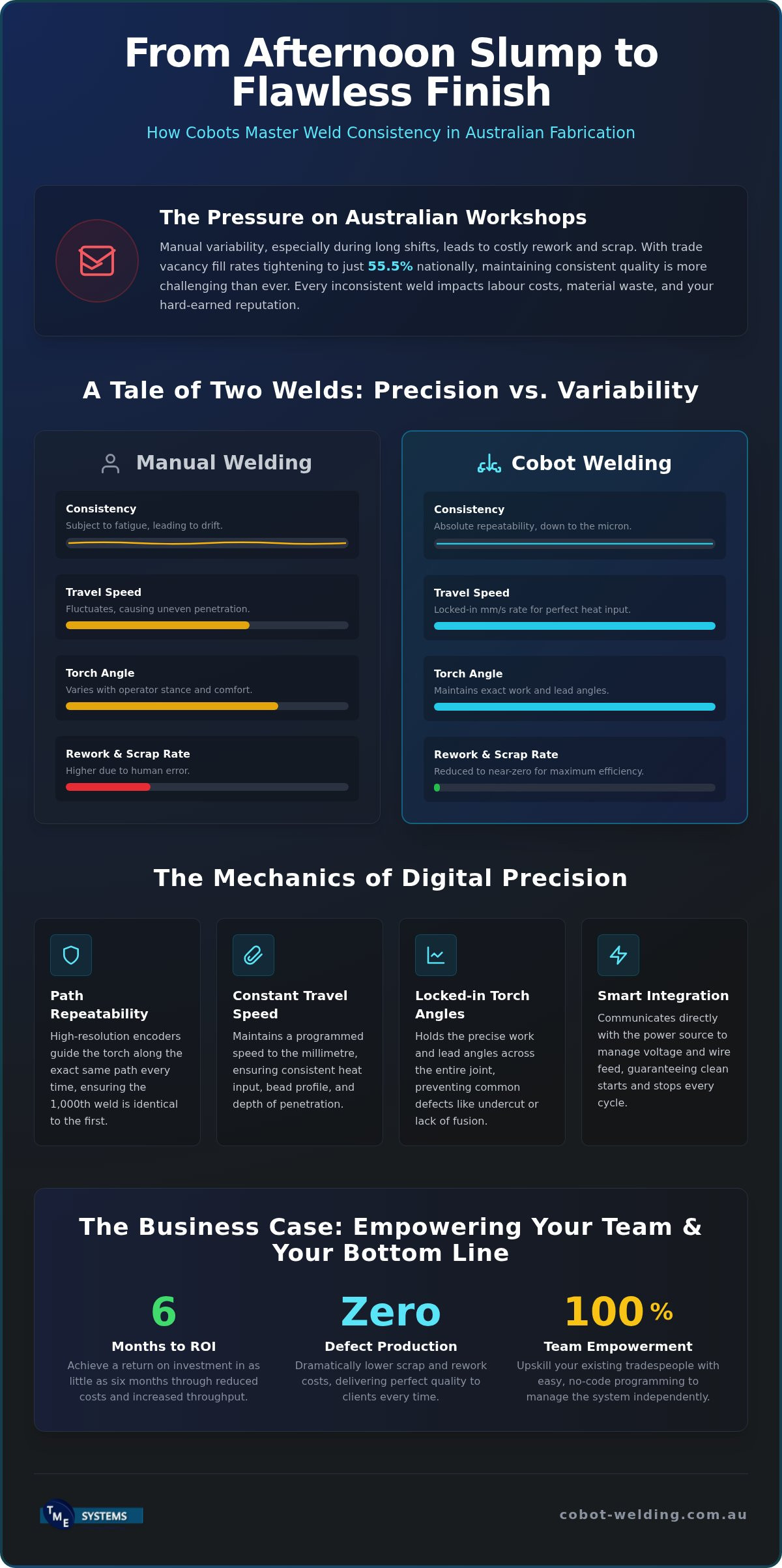

Imagine it's 3:30 PM on a Friday afternoon in a sweltering workshop. Your lead welder is exhausted, the heat is rising, and the precision on the final batch of frames starts to drift just enough to cause a massive headache in quality control. It's a story we hear often from Australian fabricators, where the difference between a Monday morning shift and a Friday afternoon run is often measured in the high cost of rework and scrap. You aren't alone in feeling the pressure of manual variability, especially when trade vacancy fill rates across the country have tightened to just 55.5% this year.
We believe that maintaining a high standard shouldn't feel like a gamble. This guide explains how cobots improve weld consistency by acting as a digital partner for your skilled tradespeople, allowing them to lock in a perfect weld path that the machine replicates with total precision every single time. You'll discover how to achieve zero-defect production runs and lower your operational costs while empowering your existing team with modern, no-code tools. We will also look at the practicalities of workshop integration, from meeting the updated ISO 10218-2:2025 safety standards to achieving a return on investment in as little as six months.
Key Takeaways
- Identify the root causes of weld variability and why manual fatigue often leads to inconsistent penetration and bead geometry.
- Explore the technical mechanics of how cobots improve weld consistency by locking in stable torch angles and constant travel speeds across every joint.
- See how no-code teaching software empowers your tradespeople to record their best paths directly, bridging the gap between traditional craftsmanship and modern automation.
- Assess the operational ROI of reducing scrap and rework, helping your workshop achieve faster throughput and more reliable delivery schedules.
- Learn why choosing a turnkey welding cell and investing in operator training ensures your team can manage and refine the system independently from day one.
What is Weld Consistency and Why is it Hard to Maintain Manually?
In the world of Australian fabrication, consistency is the difference between a profitable week and one spent staring at the scrap heap. When we talk about weld consistency, we aren't just talking about a bead that looks "neat" on a trailer frame or a structural beam. True consistency is the exact repeatability of bead geometry, depth of penetration, and overall structural integrity across every single joint in a batch. It's about ensuring that the thousandth weld is an identical twin to the first.
Achieving this level of precision manually is an uphill battle. A collaborative robot (or cobot) is often introduced to workshops because even the most talented tradespeople are subject to the "afternoon slump." After six hours on the tools in a hot shed, physical fatigue sets in. Torch angles begin to drift by a few degrees, and travel speeds fluctuate by just a few millimetres per second. These tiny variations might seem minor, but they directly compromise the quality of the finished product. Understanding how cobots improve weld consistency starts with acknowledging that while humans are great at problem-solving, machines are better at the monotonous, high-precision repetition that modern manufacturing demands.
The Hidden Costs of Inconsistent Welds
Every inconsistent weld carries a price tag that goes far beyond the initial labour. If a weld fails a visual or ultrasonic test, the rework expenses pile up quickly. You're paying for additional labour hours to grind out the defect and re-weld the joint, all while burning through expensive consumables like shielding gas and wire. In an environment where material costs are rising, wasting a structural section because of a botched seam is a luxury most Australian shops can't afford. There is also the invisible cost of brand reputation; one failure in the field can undo years of hard work.
Human Variability vs. Mechanical Precision
Maintaining a constant arc length over a long seam requires incredible focus and a steady hand. Even a minute tremor can alter the Heat Affected Zone (HAZ), potentially making the metal brittle or causing warping in thin-gauge materials. While a master welder can produce a flawless result, doing it with 100% repeatability for eight hours straight is physically impossible. This is where the partnership between man and machine becomes vital. By offloading the repetitive paths to automation, you ensure that the technical variables are locked in, leaving your skilled staff to focus on complex setups and quality oversight.
The Mechanics of Consistency: How Cobots Control Every Variable
Consistency in a workshop isn't a matter of luck. It's a matter of control. While a human operator relies on their eyes and muscle memory, a cobot relies on high-resolution encoders and digital feedback loops. This is fundamentally controlling essential weld variables with mathematical precision. By removing the guesswork, you're ensuring that the arc remains stable from the first trigger pull to the final stop.
One of the biggest factors in how cobots improve weld consistency is travel speed. Even a slight fluctuation in how fast the torch moves can lead to uneven penetration or an oversized bead. A cobot maintains a constant millimetre-per-second rate, ensuring the heat is distributed perfectly. It also locks in the work and lead angles. This stability prevents the common issues of undercut or lack of fusion that often occur when a manual operator's arm begins to sag or shift during a long run.
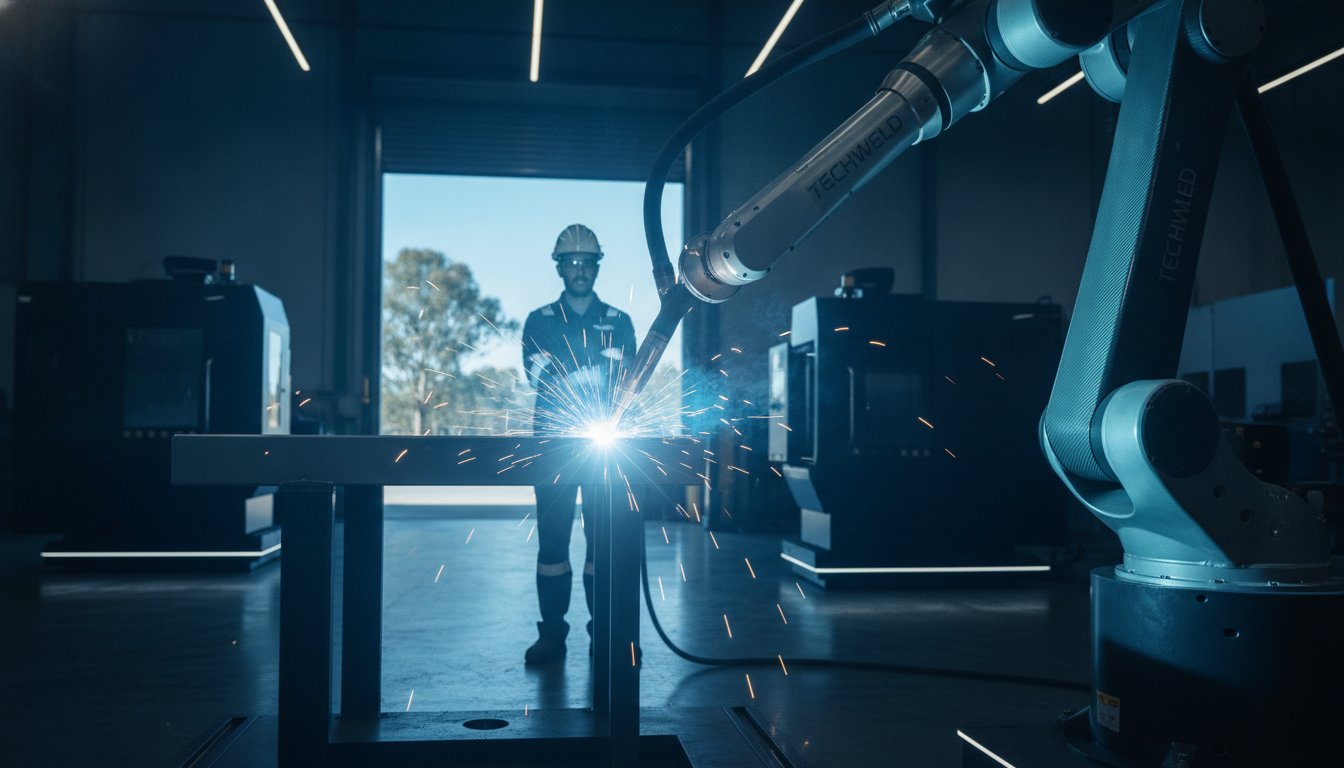
The cobot doesn't work in isolation. It communicates directly with the welding power source to synchronise wire feed speeds and voltage. This level of integration allows for flawless starts and stops, reducing the need for grinding or touch-ups at the end of a seam. By managing heat input so precisely, you can weld thinner materials without the risk of warping. If you're curious about how this looks in practice, you can explore a Collaborative Robot Welding Cell to see the hardware in action.
Digital Control of the Welding Path
Modern cobots use high-resolution encoders to stay within microns of their programmed path. This spatial awareness is critical for maintaining a consistent contact-tip-to-work distance (CTWD). If the distance between the tip and the metal varies, the arc characteristics shift, leading to spatters or weak spots. The cobot eliminates this variable entirely, keeping the torch exactly where it needs to be, regardless of how many times it repeats the cycle.
Eliminating the 'First Weld vs. Last Weld' Gap
We've all seen the difference between a Monday morning weld and a Friday afternoon one. A cobot doesn't suffer from sore shoulders or wandering focus. Because it is a machine, the 100th weld of the day is a carbon copy of the first. In a robotic context, repeatability refers to the system's ability to return to the exact same programmed coordinate within a 0.1mm tolerance, ensuring that every part in the batch meets your quality standards without the need for constant post-weld inspections.
No-Code Teaching: Making 'Perfect' Repeatable for Any Operator
For a long time, the biggest barrier to workshop automation wasn't the cost of the hardware; it was the complexity of the software. Traditional industrial robots required specialist programmers who understood G-code or proprietary languages. If you wanted to change a weld path, you had to wait for a technician or spend hours typing in coordinates. This approach simply doesn't work for the typical Australian fabrication shop, where you might be doing a run of fifty gates in the morning and a dozen custom brackets in the afternoon.
The shift to no-code teaching has changed the game. This technology is a primary reason how cobots improve weld consistency across high-mix, low-volume production. Instead of writing lines of code, a master welder can simply "teach" the cobot by showing it what to do. You're effectively digitising the decades of experience held by your best tradespeople and turning their manual skill into a permanent workshop asset. This ensures that even for a small 5-unit job, the time spent on setup is minimal, making automation viable for almost every task on your floor.
The Power of Hand-Guiding
Hand-guiding allows an operator to physically move the cobot arm along the desired weld path. By pressing a button on the torch head, the welder saves specific points in space. The No-code robot welding software then calculates the smooth trajectory between those points. It captures the exact "feel" of a successful weld, including the travel speed and torch angle, and locks them into the system. This process feels natural to a welder because it uses their existing trade skills rather than forcing them to become IT experts. It's about using the machine as a tool to amplify their craftsmanship.
Job Saving and Instant Recall
Once a perfect path is recorded, it's saved into a digital library. This is where the real value for your business lies. When a recurring job comes back into the shed three months later, any operator can load the pre-set programme and achieve the exact same results as the master welder who first taught the path. This level of improved weld quality translates to less rework and ensures your output remains steady even when your lead staff are off-site or on leave. By creating these digital blueprints, you're guaranteeing that how cobots improve weld consistency is a permanent feature of your production line, regardless of who is standing at the workbench that day.
The Business Case: Rework Reduction and Operational ROI
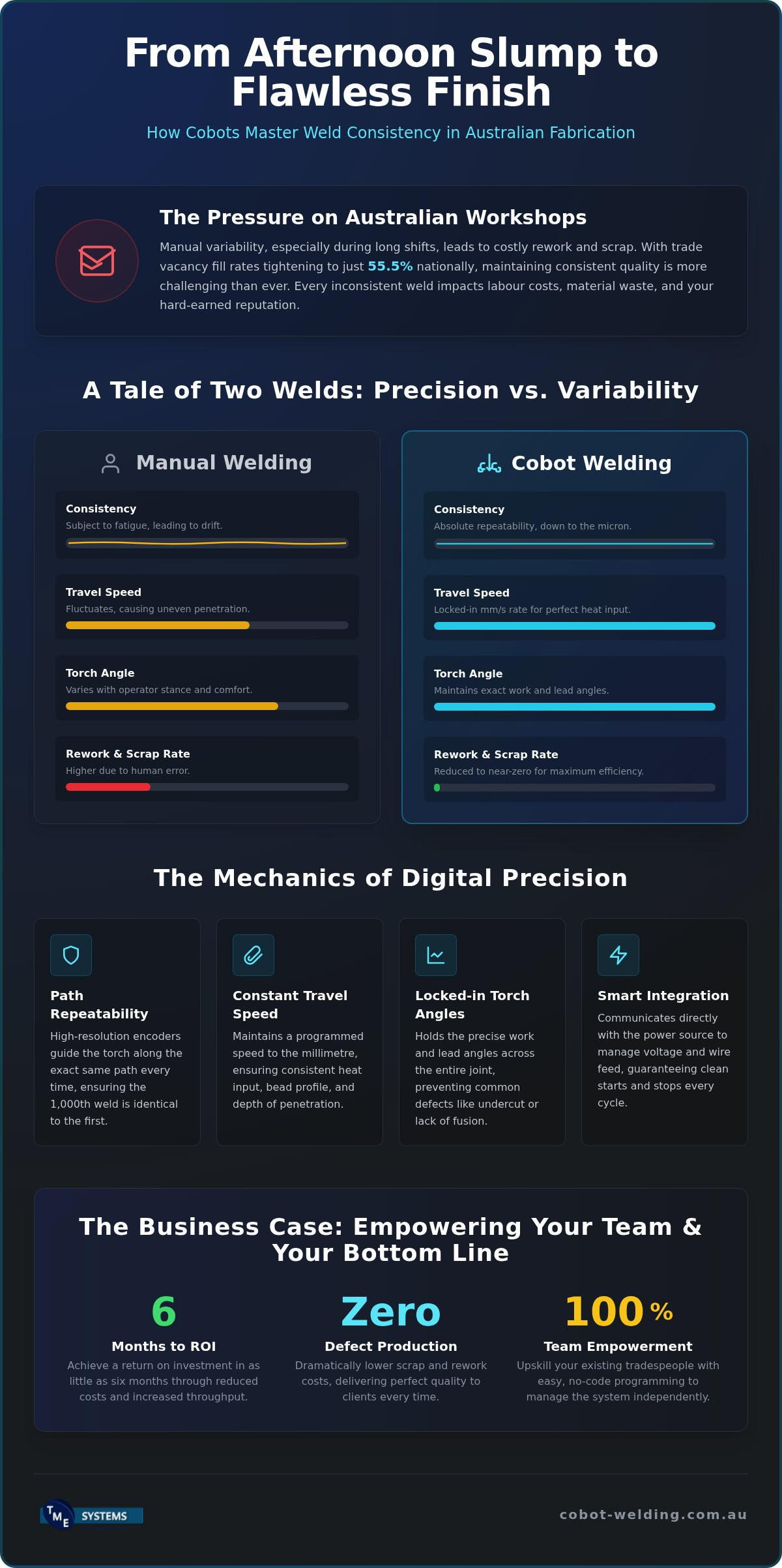
Profitability in an Australian workshop is often won or lost in the finishing bay. If your team spends half their day grinding back messy beads or fixing undercut, your margin is disappearing into the dust extractor. Understanding how cobots improve weld consistency is the first step toward reclaiming those lost hours. By delivering a clean, repeatable weld every time, you virtually eliminate the need for post-weld finishing. This shift alone can significantly shorten your lead times and allow you to take on more projects without increasing your headcount.
The financial argument for automation has never been stronger for local fabricators. Many businesses see a return on investment within 6 to 18 months, primarily because the system addresses the high cost of scrap and rework. When you improve welding productivity with cobots, you're also optimising your use of consumables. A cobot doesn't over-weld or leave the gas running longer than necessary. It uses exactly what is needed for the programmed path, ensuring that your wire and gas costs are as predictable as your weld quality.
Throughput Gains from Reliability
Reliability allows you to move from a "batch and check" mindset to a continuous flow production model. Instead of waiting for a quality control inspector to sign off on a pallet of parts before moving to the next stage, you can trust that every unit meets the standard. This reliability is essential for ISO-certified environments where rejection rates must be kept to an absolute minimum. Because a cobot can maintain an 85% to 95% arc-on time, compared to the 60% to 70% typically achieved manually, your throughput increases without sacrificing precision.
Empowering Your Existing Workforce
With trade vacancy fill rates in Australia dropping to 55.5% in 2026, finding senior welders is harder than ever. Cobots help bridge this skills gap by allowing junior staff to produce senior-level results on repetitive runs. This doesn't replace your master welders; it frees them up. Your most experienced staff can focus on complex, custom jobs that require human problem-solving, while the cobot handles the high-volume work. This approach reduces the physical strain on your team, improving staff retention and making your workshop a more modern, supportive place to work.
To see how these systems fit into your specific workflow, you can book a mobile demo to test the technology on your own workshop floor.
Implementing Cobots in Your Australian Workshop
Transitioning from manual welding to automation shouldn't feel like a leap into the unknown. For most Australian workshops, the goal is to improve output without causing weeks of downtime. This is why choosing a turnkey solution is vital. A turnkey cell arrives ready to weld, meaning you don't have to spend time sourcing separate power sources or building custom safety enclosures. It's about getting the system onto the floor and seeing how cobots improve weld consistency on your very first production run.
Integration is a methodical process. You start by identifying the parts that are most repetitive or prone to human error. By introducing Collaborative robot welding cells into these specific workflows, you create a "consistency loop" that supports your manual welders. The system fits into your existing floor plan, often requiring no more space than a standard manual welding bench. To ensure a smooth transition, follow these practical steps:
- Identify high-volume or repetitive parts suitable for robotic paths.
- Review your current jigging to ensure parts are held in a repeatable position.
- Schedule a site assessment to confirm power and space requirements.
- Involve your welding team early to show them how the software simplifies their day.
On-Site Proof of Concept
Every workshop has that one job, the difficult joint or the awkward geometry that causes constant headaches in quality control. Before you commit to a purchase, you need to know the technology can handle your specific shop floor reality. A Mobile welding robot demonstration allows you to test the cobot on your own parts, using your own jigs. This on-site proof of concept removes the guesswork. It shows exactly how cobots improve weld consistency on the very items you sell to your customers every day, providing a clear benchmark for your expected ROI.
Ongoing Support and Training
Success with automation isn't just about the hardware; it's about the people using it. While no-code software makes the initial setup easy, On-site cobot welder training ensures your team remains confident as your product mix changes. Integration specialists help fine-tune those first batches, setting the parameters that guarantee long-term stability. This partnership ensures that your staff feel empowered by the new tools, turning a technical upgrade into a cultural win for your workshop. By investing in this initial training, you're securing the future of your production line and ensuring that every weld, for years to come, is as perfect as the first one taught to the machine.
Future-Proof Your Fabrication Shop
Maintaining a competitive edge in the Australian market requires a shift from manual variability to repeatable precision. We've explored how cobots improve weld consistency by digitising the skill of your best tradespeople, ensuring that every batch meets the same high standard regardless of shift time or fatigue. By adopting specialised no-code teaching software and complete turnkey welding cells, you can eliminate the costly cycle of grinding and re-welding that eats into your margins.
Innovation doesn't have to be intimidating or disruptive. With national integration and training support, your team can master these tools quickly and stay focused on the high-value custom work they do best. The most effective way to understand the impact on your specific production line is to see the technology in person, using your own jigs and parts.
Book a Mobile Demonstration to see cobot consistency on your workshop floor and take the first step toward a zero-defect future. We're here to help you refine your process and support your workshop's growth through every stage of the journey.
Frequently Asked Questions
Can a cobot really weld as well as a human with 20 years of experience?
A cobot performs as well as the person who teaches it. By using no-code software, your most experienced welder can record a perfect path that the machine then replicates with total precision. While the machine doesn't have the intuition of a veteran tradesperson, it excels at repeating that high-level skill without the physical fatigue that eventually impacts even the best manual operators.
How much does weld consistency actually impact the bottom line of a small shop?
Consistency is often the difference between profit and loss on a high-volume run. In a typical Australian workshop, rework and grinding can consume a massive portion of your labour hours. By delivering repeatable results, you slash the time spent in the finishing bay and reduce the waste of expensive consumables. This reliability allows you to quote jobs more accurately and increase your total throughput.
Is it hard to adjust the weld path if the consistency starts to drift?
Adjusting the path is a straightforward process that takes only a few minutes. Because the system uses hand-guiding technology, an operator can simply move the arm to a new position and save the point. You don't need to wait for a technician or write a single line of code to make refinements. This flexibility ensures you can keep production moving even if your jigs or parts change slightly.
What happens to consistency if the parts aren't perfectly uniform?
Robotic precision depends on the repeatability of your part fit-up and jigging. If your parts vary significantly, the cobot will still follow its programmed path, which may lead to gaps or poor fusion. This is a key part of how cobots improve weld consistency; they encourage a more disciplined approach to upstream processes like cutting and jigging, which improves the overall quality of everything leaving your shop.
Do I need a robot programmer on staff to keep my welds consistent?
You don't need any specialised IT or programming staff to run a collaborative welding cell. The systems are designed for tradespeople to use on the workshop floor. With the operator training provided during integration, your existing welders will have all the skills needed to set up new jobs and maintain the consistency of your production runs independently.
How does a cobot handle different materials like aluminium or stainless steel?
Cobots handle various materials by maintaining the exact travel speeds and arc voltages required for each metal's specific properties. For aluminium, the steady speed is vital to prevent burn-through; for stainless steel, the precise heat input helps maintain corrosion resistance. The system integrates directly with the power source, allowing you to switch between material-specific programmes at the touch of a button.
Will a cobot improve the structural integrity of the weld or just the appearance?
A cobot improves both the structural integrity and the visual finish of the joint. By maintaining a constant torch angle and arc length, the system ensures uniform penetration and a stable Heat Affected Zone (HAZ). This level of control reduces common manual defects like porosity or lack of fusion, ensuring your work meets strict Australian standards while also looking exceptionally clean for the client.
What is the typical ROI for a cobot based solely on rework reduction?
Many Australian fabricators see a full return on investment within 6 to 18 months. While this includes gains in throughput, the reduction in rework is a primary driver. When you eliminate the need for grinding, re-welding, and scrap, the savings on labour and materials add up quickly. Getting the job right the first time is the most effective way to pay off the equipment cost.