
What if the solution to your skilled labour shortage isn't finding another ticketed welder, but empowering your current team with a tool that never gets tired? Many Australian fabricators are asking: is a universal robot good for welding? It's a fair question, especially when you're feeling the pinch of high rework costs on manual jobs and the constant pressure of inconsistent small to medium batch runs. You've likely seen the headlines about automation, but the fear of a complex system breaking your existing workflow is enough to make any workshop manager hesitate.
We understand that a production floor is only as good as its output. You need solutions that actually work in the real world, not just in a sales brochure. This guide will help you discover why Universal Robots are transforming Australian welding shops and how to determine if they are the right fit for your specific production needs. We'll walk through the benefits of no-code teaching software, the reality of fast setup times for diverse jobs, and how these collaborative tools can create a safer, more modern environment without requiring a PhD to operate.
Key Takeaways
- Learn how to evaluate if a universal robot is good for welding by assessing its precision, footprint, and how easily it integrates into your existing workshop floor.
- Explore how 6-axis freedom and +/- 0.03mm repeatability deliver consistent, high-quality results that significantly reduce rework and material waste.
- See how no-code teaching software empowers your existing team to lead the automation process by demonstrating weld paths by hand.
- Understand how to weigh the investment of a collaborative robot welding cell against the rising costs of scarce specialist labour and production downtime.
- Discover the benefits of starting with a mobile demonstration to prove the technology on your own parts before committing to a full integration.
Is a Universal Robot Good for Welding? Evaluating Performance for Australian Shops
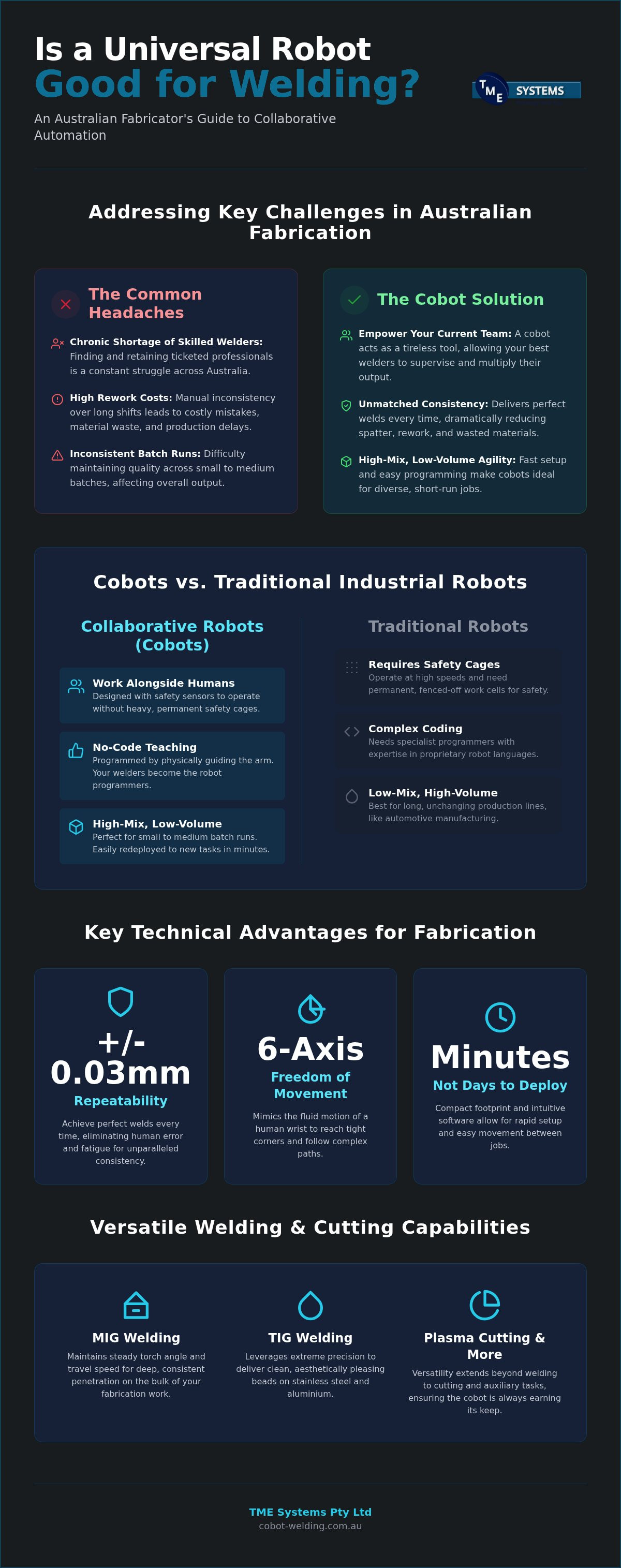
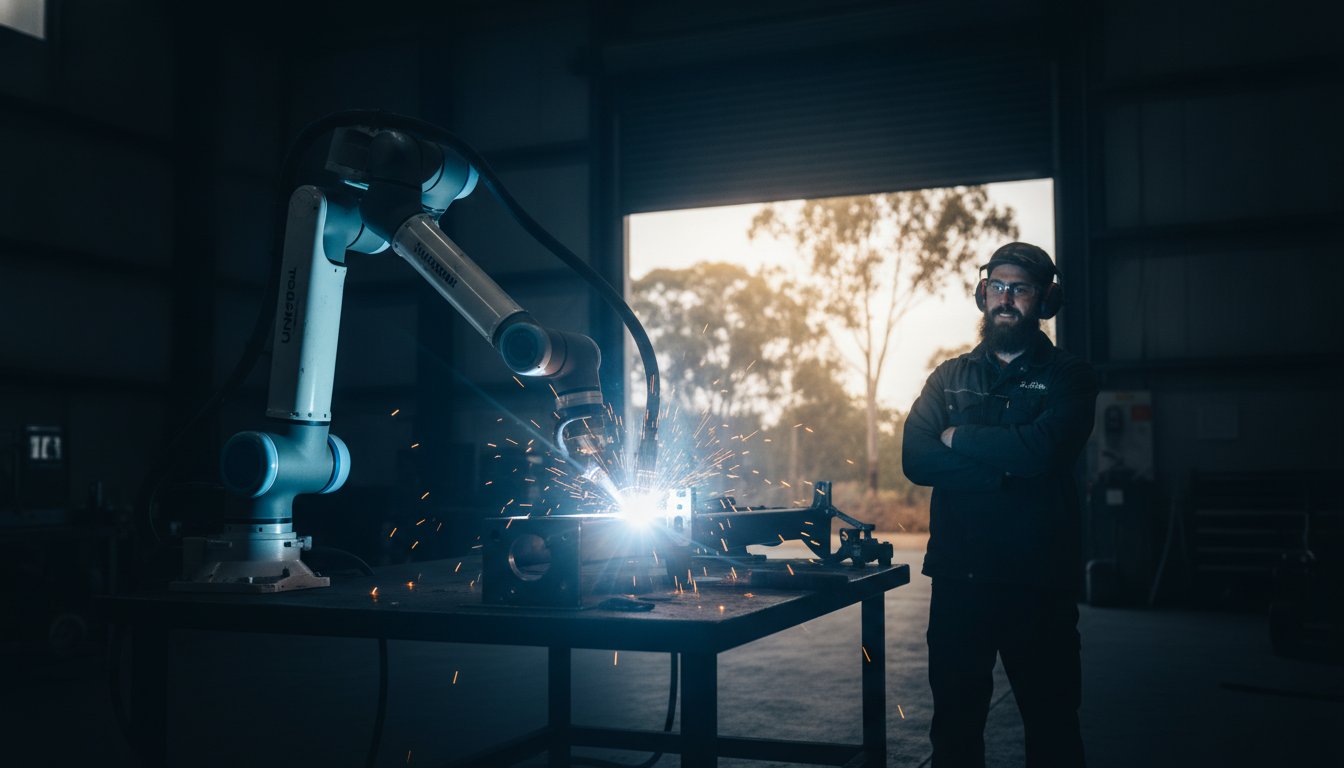
Universal Robots (UR) aren't your typical industrial behemoths. They are collaborative robots, or "cobots," designed to work alongside your team rather than behind a heavy safety fence. For many local fabricators, the burning question is: is a universal robot good for welding when the jobs change every week? The answer lies in their precision and compact footprint. Unlike traditional automation, these arms fit into your existing workshop layout without requiring a massive floor space overhaul. They act more like a sophisticated power tool than a replacement for your staff.
Robot welding was once the exclusive domain of car manufacturers, but that's changing rapidly. In Australia, the robotics market is expanding at a compound annual growth rate of over 15 per cent as we head toward 2034. Welding is the fastest-growing application because it addresses the two biggest headaches for SMEs: the chronic shortage of ticketed welders and the high cost of rework. For an Australian shop, the appeal isn't just about speed. It's about achieving a level of repeatability that manual welding simply can't match over a long shift.
The Difference Between Cobots and Traditional Welding Robots
Traditional industrial robots are fast, but they're often rigid. They require permanent safety cages and specialist programmers who speak complex code. UR cobots take a different path. They're built for high-mix, low-volume production. This means you can move the robot between different welding benches as your schedule shifts. You don't need a dedicated programming department. Instead, your best welders can manage the machine. It's about flexibility. If a job finishes early, you can redeploy the arm to a new task in minutes, not days.
Key Welding Processes Supported by UR Systems
Most Australian sheds rely on MIG welding for the bulk of their fabrication. UR systems handle this with ease, maintaining a steady torch angle and travel speed that ensures deep, consistent penetration. If your work requires the aesthetic finish of TIG welding, the cobot's repeatability of +/- 0.03mm ensures clean, precise beads every time. Many owners ask is a universal robot good for welding aluminium or thin-gauge stainless steel. The answer is yes, provided the system is integrated correctly. Beyond the arc, these arms are versatile. Many shops now use them for plasma cutting or auxiliary tasks like part cleaning, ensuring the robot is always earning its keep on the floor.
Technical Advantages: Why UR Cobots Excel in Fabrication
The technical build of a Universal Robot is exactly what makes it a powerhouse in a local fabrication shed. With 6-axis freedom, the arm can mimic the fluid motion of a human wrist, reaching into tight corners or following complex circular paths that traditional 3-axis machines can't touch. When you ask is a universal robot good for welding, the technical answer lies in its repeatability of +/- 0.03mm. This level of precision means that once you've dialled in the perfect settings for a joint, the robot will replicate that exact weld every single time, whether it's the first part of the morning or the last part of a double shift.
These systems also feature built-in force-torque sensing. This isn't just a safety feature; it allows the robot to detect if it has bumped into a fixture and stop immediately. Beyond safety, it helps with path adjustment, ensuring the torch stays exactly where it needs to be. For Australian shops, the ability to integrate these cobots with existing power sources is a major win. You don't need to scrap your current setup. These cells are designed to talk to the leading welding brands already sitting on your floor, making the transition to automation feel like a natural upgrade rather than a total rebuild.
Precision and Consistency in Every Bead
Human fatigue is the silent killer of workshop productivity. Even the best welder finds their consistency slipping after eight hours of hooded work. By taking over the repetitive, long-run jobs, a cobot eliminates this variable. You'll see a marked reduction in spatter and rework because the travel speed and wire feed remain perfectly constant. Path consistency is the primary driver of robotic ROI. This reliability is especially critical given the current welding skills shortage facing the local industry. If you want to see how this precision looks on your own workpieces, you might consider booking a mobile welding robot demonstration to see the results firsthand.
Safety Standards and Collaborative Operation
Safety is often the first hurdle for owners looking at automation. UR robots are built to meet ISO 10218-1 and the relevant Australian safety standards, specifically AS 4024.3303:2017. This standard governs collaborative robot applications in Australia, ensuring that the machine can safely operate in the same space as your workers. While you still need a proper risk assessment for your specific setup, the lack of bulky safety cages means you can keep your workshop floor open and accessible. You're getting the benefits of high-end automation without sacrificing the valuable square metreage of your shed.
The No-Code Revolution: Making Automation Accessible
Historically, the biggest roadblock to automation in an Australian shed was the sheer complexity of the software. You would buy a robot, then realise you needed a dedicated programmer just to make it run a straight bead. This is where the narrative shifts. When owners ask is a universal robot good for welding, they are often really asking if their team can actually use it without a computer science degree. The rise of no-code robot welding software has flipped the script. Instead of typing lines of code, you teach the robot by demonstration. You simply move the arm by hand to the start and end points of the weld, and the software handles the underlying geometry.
This "hand-guiding" method reduces setup times from hours of technical work to just a few minutes of physical movement. It makes automation viable for small, diverse batches that were previously too expensive to automate. You can switch from welding a simple bracket to a complex frame in the time it takes to have a quick smoko. Because the interface is intuitive, the barrier to entry for your workshop has never been lower.
Empowering Your Existing Tradespeople
This technology turns your skilled welders into robot supervisors rather than replacing them. They use their years of experience to set the torch angle and travel speed, while the robot provides the mechanical consistency. It is a practical way to solve the skills gap. An apprentice who is comfortable with a smartphone can often learn to manage a robotic cell's basic operations in a single afternoon. There is a massive psychological benefit here. When the tech is easy to use, it isn't intimidating. It becomes just another reliable tool on the floor, like a bandsaw or a press brake.
Adjusting Weld Paths on the Fly
Production doesn't stop for a software update. With modern visual interfaces, you can adjust parameters like wire feed speed or voltage on the fly. These screens look like modern tablet apps, not 1990s green-screen terminals. If you notice the heat input is slightly off due to a variation in the material, you can refine the settings mid-job. This ensures your team stays in total control of the weld quality at every step. You aren't locked into a rigid programme; you have the freedom to adjust and support the process as the job requires.
Calculating the Value: Is the Investment Right for You?
Deciding whether to invest in automation often comes down to a simple comparison of costs. Many workshop managers ask: is a universal robot good for welding when I could just hire another person? In the current Australian market, finding a ticketed welder is a significant hurdle. When you compare the capital investment of a collaborative robot welding cell against the total cost of a new full-time hire, the numbers start to make sense. A robot doesn't require superannuation, sick leave, or holiday pay. It also helps you improve welding productivity with cobots by maximising your "arc-on" time. While a human operator needs breaks, a cobot keeps the torch moving with mechanical precision.
Rework and scrap are silent profit killers in any fabrication business. If a manual weld fails inspection, you've lost the material, the gas, and the labour hours. The repeatability of a UR arm virtually eliminates these errors. This consistency protects your bottom line and ensures your shop keeps its reputation for high-quality output. You are also gaining the flexibility to move the robot between different jobs throughout the year, ensuring the asset is always earning its keep.
Small Batch Profitability
Australian manufacturing thrives on high-mix, low-volume work. In this environment, "setup-to-weld" time is the most critical metric for small shops. Traditional robots often fail here because they take too long to programme for short runs. Because UR systems use no-code software, that setup time drops to minutes. This makes even a run of ten or twenty parts profitable to automate. You aren't just saving on labour; you're increasing the overall throughput of your shed.
Long-Term Reliability and Maintenance
Workshop floors are harsh environments. They are dusty, hot, and full of grinding grit. UR robots are designed to be durable in these conditions. Having local technical support and parts available within Australia is a massive advantage. It means you aren't waiting weeks for a component to arrive from the other side of the world. Future-proofing your business against labour market fluctuations is a smart play. You're building a resilient operation that can scale up when the work flows in. To see how these systems handle your specific parts, you can explore our collaborative robot welding solutions to find the right fit for your floor.
Implementing Your First Cobot Welding Solution
Moving from theory to the workshop floor requires a practical, step-by-step plan. The most effective way to begin is with a mobile welding robot demonstration. This isn't just a generic sales pitch; it's an on-site proof-of-concept where you can see the technology running on your own workpieces. It helps you answer the question is a universal robot good for welding for your specific production mix. Once you've seen the results, the best strategy is to identify the simplest, most repetitive job to automate first. Start small. By focusing on high-volume, low-complexity parts, you build immediate confidence in the system and see a faster return on your time.
Staff buy-in is the engine of any successful automation project. You aren't just installing a machine; you're introducing a new way of working that supports your team. Focus on on-site cobot welder training to ensure your tradespeople feel in control of the technology. When your ticketed welders see the cobot as a tool that handles the monotonous runs, they can focus their specialist skills on more complex, custom fabrication. Partnering with an integrator who understands the Australian manufacturing landscape ensures your setup meets local safety standards and operational realities.
The Integration Process
The first step in a successful rollout is assessing your current equipment. Most modern MIG and TIG power sources are compatible with collaborative cells, meaning you often don't need to replace your entire welding setup. We look at your existing workspace to design a layout that maximises efficiency without blocking the flow of the shed. A successful transition doesn't happen overnight, but with the right support, the timeline from receiving your cell to laying the first robotic bead is often shorter than traditional industrial automation.
Ongoing Support and Scaling
Accessing local technical support is non-negotiable for a busy Australian shop. You need a partner who can provide quick software updates and hardware support to keep your production line moving. As you see the benefits of reduced rework and increased throughput, you'll likely start planning for your second or third cobot. Many fabricators find that once the first cell is running smoothly, identifying the next application becomes obvious. You're joining a growing community of Australian shops that are using this technology to stay competitive. Ultimately, if you want to know is a universal robot good for welding in the long run, look at how easily it scales alongside your business growth.
Future-Proofing Your Workshop with Collaborative Precision
The transition to automation doesn't have to be a leap into the unknown. We've seen how no-code software and high-precision hardware turn complex robotics into a practical power tool for your best tradespeople. By integrating these systems, you can reduce rework, manage small-batch runs profitably, and finally address the persistent labour shortages that hold your production back. If you're still wondering is a universal robot good for welding, the answer lies in its ability to mirror human skill with robotic consistency on your own shop floor.
As an Australian-owned and operated partner, we focus on making this transition seamless through specialised no-code software solutions and expert on-site operator training. We don't just drop off a machine; we stay until your team is confident and the beads are perfect. Ready to see the results for yourself? Book a Mobile Welding Robot Demonstration for your workshop today and find out how collaborative tech can support your business growth. Your workshop's future is built on the skills you already have, enhanced by the tools of tomorrow.
Frequently Asked Questions
Can a Universal Robot perform TIG welding as well as MIG?
Yes, Universal Robots are highly capable of both MIG and TIG welding processes. MIG is the most common application in Australian sheds for its speed, but TIG welding benefits significantly from the cobot's +/- 0.03mm repeatability. This precision allows for the aesthetic, high-quality finishes required on stainless steel or thin-gauge materials without the hand-shaking or fatigue that affects manual operators during long shifts.
Do I need a specialised programmer to run a UR welding cobot?
You don't need a specialised computer programmer to operate these systems. Modern no-code software allows your existing ticketed welders to teach the robot by physically moving the arm along the desired weld path. This approach empowers your current team to manage the technology, ensuring that the person with the most welding experience remains in control of the final quality and output.
Is it safe to use a welding robot without a safety cage in Australia?
It is possible to operate a UR welding cobot without a traditional safety cage in Australia, provided you comply with the AS 4024.3303:2017 standard. This requires a thorough risk assessment of your specific application, including the welding torch and the parts being handled. Because the robot is designed to stop upon contact, it can often work in open environments where traditional industrial robots cannot.
How much floor space does a collaborative welding cell actually take up?
A typical collaborative welding cell takes up about the same amount of space as a standard manual welding bench. Most systems are designed with a compact footprint that allows them to be integrated into existing production lines without moving heavy machinery. Some configurations are even mounted on mobile carts, allowing you to wheel the robot to different areas of the workshop as your production schedule changes.
Can I use my existing MIG welder with a Universal Robot?
Many Australian fabricators successfully integrate their existing MIG power sources with a Universal Robot. Compatibility depends on the specific model and its interface capabilities, but most modern digital welders can be linked to the cobot. This flexibility means you can often upgrade to automation without the immediate cost of replacing your entire fleet of welding machines, making the transition more affordable.
What is the typical ROI for an Australian fabrication shop?
The typical ROI for an Australian fabrication shop is often driven by the reduction in rework and the ability to increase arc-on time. While every business is different, shops that handle repetitive small-to-medium batches see the fastest returns. When asking is a universal robot good for welding, consider the savings from reduced material waste and the ability to take on more work without needing to find scarce specialist labour.
How does the robot handle different material thicknesses like aluminium?
These robots handle a wide range of material thicknesses, including challenging materials like aluminium, by maintaining a perfectly consistent travel speed and torch angle. The software allows you to fine-tune parameters like wire feed and voltage to prevent burn-through on thin sheets. This level of control is difficult to maintain manually over long production runs but is a standard feature of robotic systems.
What happens if the robot hits an obstacle or a person?
Universal Robots are equipped with built-in force-torque sensors that detect any resistance or contact with an obstacle. If the robot hits a person or a fixture, it stops immediately to prevent injury or damage. This safety mechanism is a core reason why they are classified as collaborative, allowing them to work safely alongside your team in a modern manufacturing environment without the need for bulky physical barriers.