
What if the answer to your workshop's production crunch isn't hunting down another labour-hire welder, but stopping the search altogether? If you run an Australian fabrication business, you already know the frustration of relying on agency staff. Exorbitant hourly rates and placement fees eat away at project margins, yet the quality rarely matches your internal standards. Inconsistent penetration and constant rework slow jobs down, while unpredictable labour costs turn quoting into a gamble. For fabricators looking to protect their bottom line, reducing reliance on contract welders has become an operational necessity rather than just a future ambition.
This guide outlines how to systematically phase out expensive labour hire and build self-sufficient fabrication capacity using collaborative automation. You will discover how augmenting your existing boilermakers and apprentices keeps critical fabrication knowledge inside your business, stabilises overheads, and empowers your team to deliver repeatable, high-standard welds on demand. Here is a practical roadmap to taking back control of your capacity, output, and project margins.
Key Takeaways
- Explore how rising agency markups, constant rework, and contractor turnover silently erode fabrication job margins and project delivery timelines.
- Discover why reducing reliance on contract welders starts with augmenting your existing team using collaborative automation rather than hiring more temporary staff.
- Evaluate capacity strategies across labour hire, traditional industrial robotics, and flexible cobot cells to determine the best fit for your shop floor.
- Follow a practical 5-step roadmap to audit repetitive weld seams, calculate your baseline arc-on time, and systematically phase out external labour.
- Understand how turnkey collaborative welding cells and intuitive no-code software allow apprentices and tradespeople to deliver consistent welds from day one.
The Hidden Financial and Operational Toll of Relying on Contract Welders
Bringing in labour-hire welders feels like a straightforward fix when delivery dates loom. In practice, it often triggers a compounding cycle of margin erosion, scheduling bottlenecks, and administrative drag. Getting a clear view of these true workshop costs makes reducing reliance on contract welders an urgent priority for any workshop focused on commercial resilience.
Direct Invoice Rates versus True Workshop Floor Friction
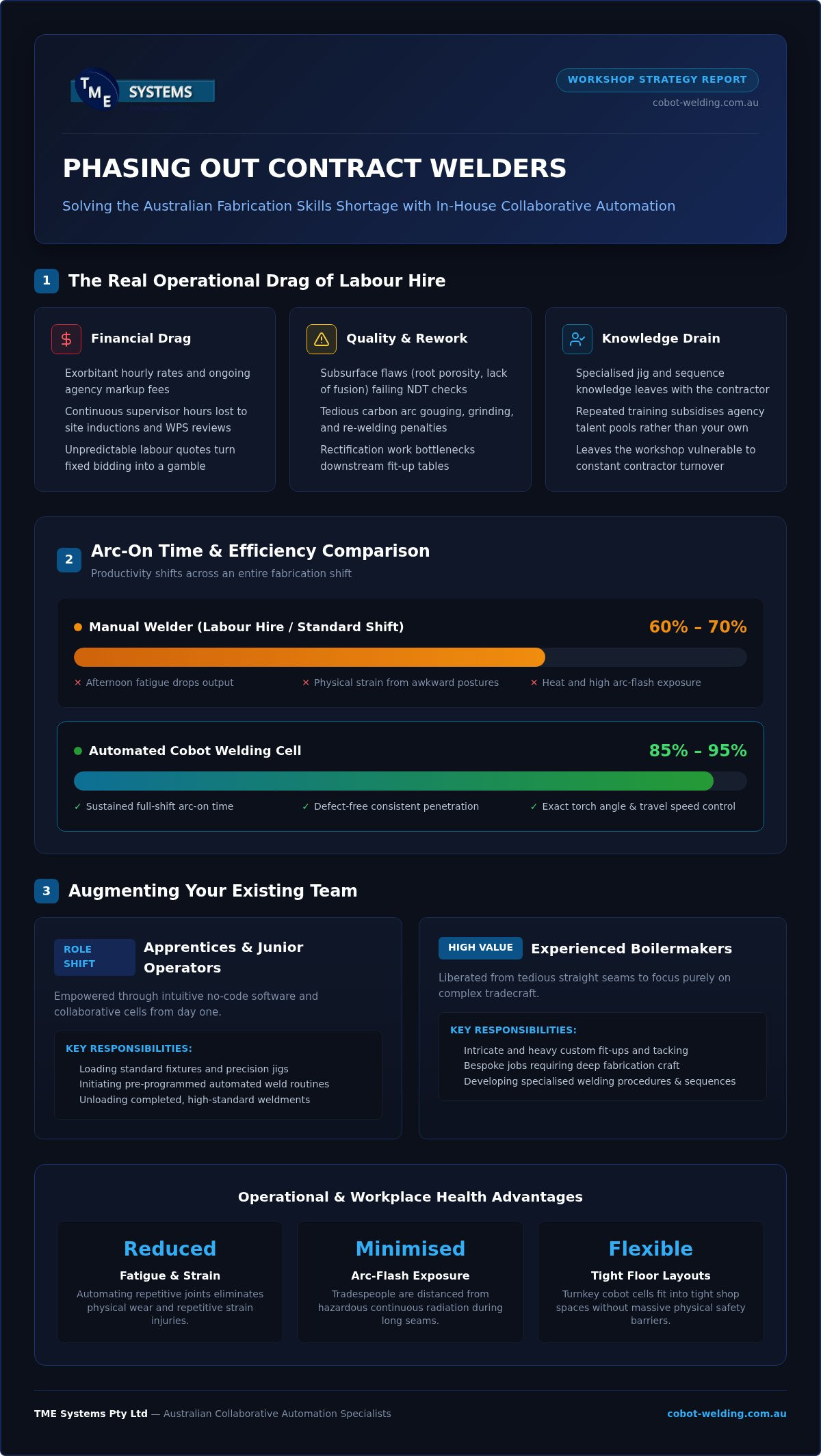
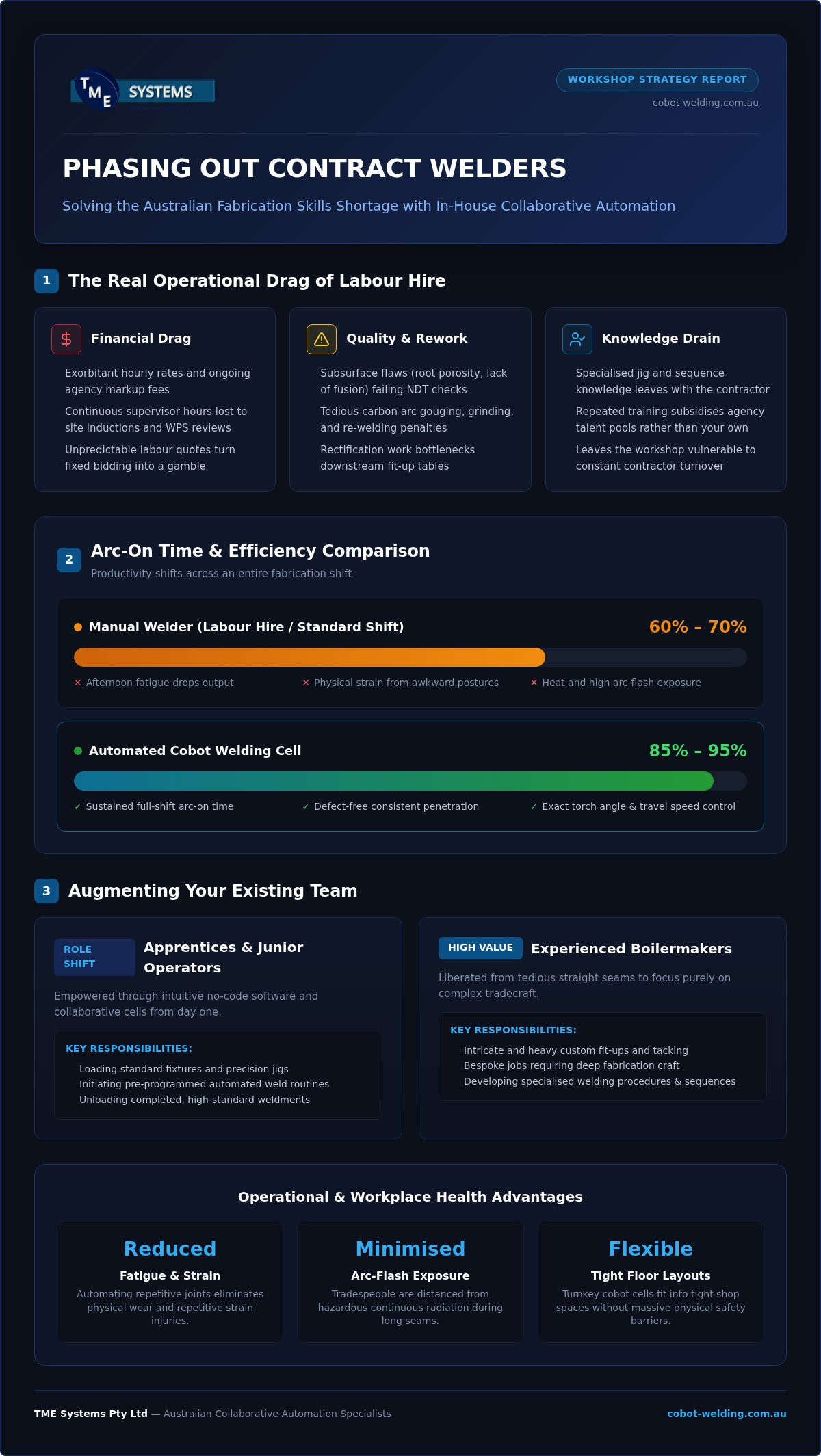
Agency markup rates are only the tip of the iceberg. The moment an external tradesperson steps onto the floor, productive output drops. Workshop supervisors lose valuable production hours walking temporary staff through site inductions, reviewing weld procedure specifications (WPS), and monitoring work habits. Every time a placement ends and a new contractor arrives, that overhead repeats. While investments in robotic welding create predictable, repeatable operating costs, relying on short-term labour traps your workshop in continuous onboarding downtime and safety admin fees.
Weld Quality Discrepancies and Escalating Rework Penalties
Temporary fabricators don't know your internal standards or finish expectations. Slight variations in torch angle, travel speed, or heat input inevitably show up during visual inspections or non-destructive testing (NDT):
- Subsurface flaws: Lack of fusion or root porosity requires tedious carbon arc gouging, grinding, and re-welding.
- Downstream delays: Rectification work ties up fit-up tables, delaying the next scheduled job on the board.
- Client friction: Inconsistent bead aesthetics and late dispatch dates put hard-won client relationships at risk.
A single batch of failed structural joints can swallow the net profit of an entire tender.
Institutional Knowledge Drain and Operational Fragility
Every fabrication run teaches a workshop something new, whether it is how a proprietary jig handles thermal distortion or the neatest sequence for balancing heat. When contract staff finish up, that technical know-how leaves with them. Training external personnel repeatedly on your specialised tooling builds zero equity for your team; it simply subsidises an agency's candidate database. Reducing reliance on contract welders protects your business against talent poaching and locks critical fabrication intelligence permanently inside your own factory walls.
How Collaborative Automation Solves the Australian Fabrication Skills Gap
Most fabrication managers assume solving a capacity crunch means either hiring scarce tradespeople or spending fortunes on massive robotic lines. Collaborative automation bridges this gap cleanly. By handling monotonous, repetitive joins, cobots allow Australian workshops to dramatically expand throughput without adding headcount.
Augmenting Existing Personnel Instead of Chasing Ghost Labour
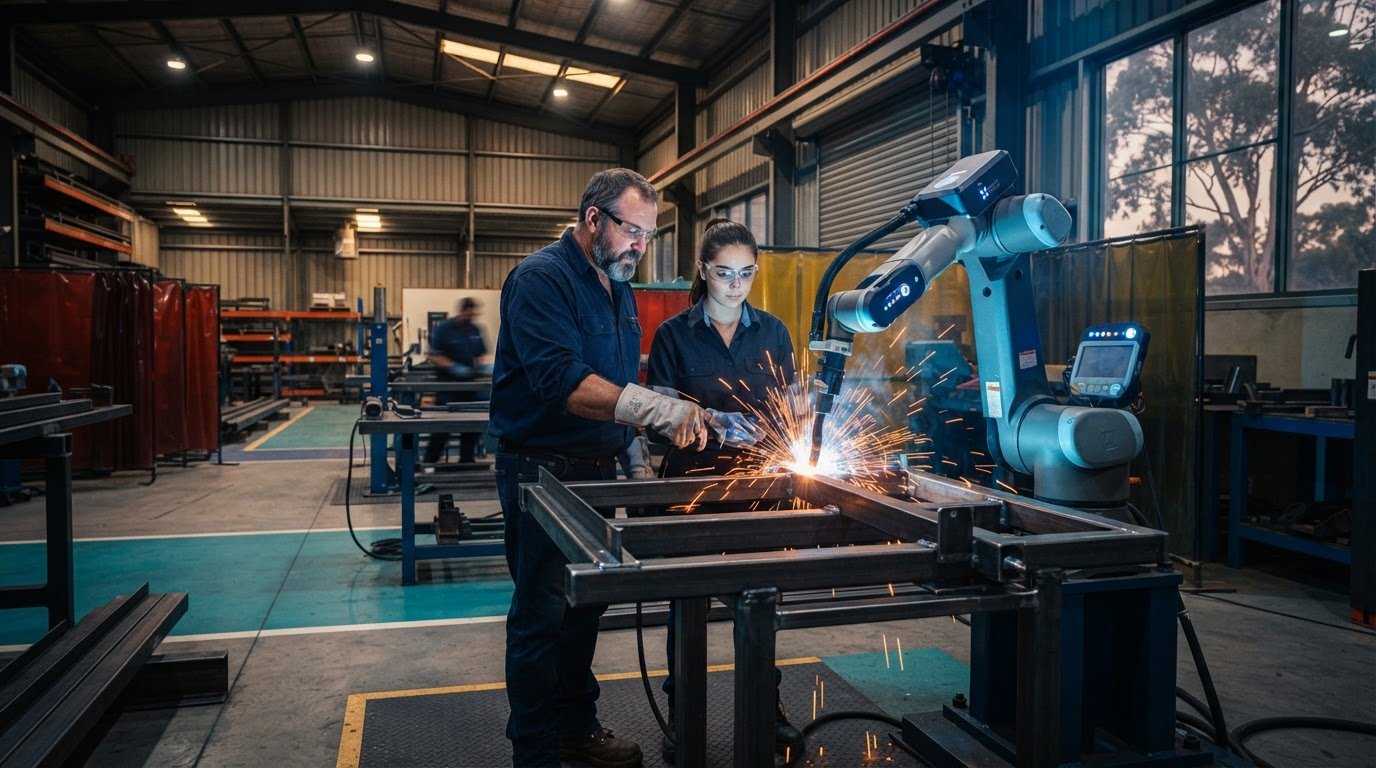
The smartest way to tackle the skills shortage is by multiplying the capability of your current crew. A collaborative robot does not replace your team; it acts as a force multiplier. An apprentice or junior operator can load jigs, initiate automated weld routines, and unload completed assemblies. This shift frees experienced boilermakers to focus on intricate fit-ups, tacking, and bespoke jobs that demand genuine trade craft.
Workplace conditions improve immediately as well. Shifting repetitive straight seams and multi-pass joints to automation reduces fatigue, repetitive strain, and arc-flash exposure for your workforce. Exploring modern collaborative robot welding cells shows how easily these systems fit into tight production layouts without requiring massive physical safety barriers.
Achieving Predictable Cycle Times and Consistent Quality Standards
Manual welding shifts naturally see productivity drop off towards the afternoon. Heat, fatigue, and awkward postures mean a manual welder typically achieves an arc-on time between 60% and 70%. In contrast, an automated cobot cell consistently sustains 85% to 95% arc-on time across the entire shift.
- Defect-free consistency: Precise control over travel speed, wire feed rate, and torch angles ensures consistent penetration and bead profile across every run.
- Confident quoting: Standardised cycle times remove the guesswork from job costing, allowing you to price tenders accurately without factoring in contractor risk premiums.
- Structural compliance: Repeatable machine parameters simplify quality documentation and compliance against strict national standards.
This stability is central to systematically reducing reliance on contract welders while protecting gross margins on high-volume runs.
Accessible Technology Geared for High-Mix Low-Volume Production
Traditional industrial robots demanded complex scripting languages and dedicated robotic technicians, making them unsuitable for typical Australian job shops handling mixed orders. Today's collaborative systems use intuitive, no-code interfaces. Operators simply teach the robot by guiding the torch by hand or using touch-screen graphics, setting up new part geometries in minutes rather than days.
Teaming modular welding tables with fast programming makes high-mix, low-volume fabrication practical and profitable. To see how other workshops manage this balance, learn how to improve welding productivity with cobots across variable production runs. If you want to see how these automated tools adapt to your workshop's specific parts, booking a trial through cobot-welding.com.au provides practical proof on your own floor.
Comparing Capacity Strategies: Labour Hire vs Industrial Robots vs Cobot Cells
When customer demand outstrips your workshop's manual capacity, you face three distinct paths forward. You can contract temporary labour, commission a heavy industrial robot cell, or integrate collaborative robot systems. Weighing these options against floor space, programming overhead, and balance-sheet impact shows why reducing reliance on contract welders via cobots is becoming the standard for modern fabricators.
Capital Allocation versus Endless Operational Expense
Labour hire represents a purely operational drain. Every dollar spent on agency markups vanishes once the shift ends, leaving behind zero equity. Conversely, bringing collaborative cells into your workshop transforms volatile labour expenses into a tangible balance-sheet asset. Instead of remaining vulnerable to shifting wage rates and penalty loadings, you secure a predictable cost per component. Payback timelines shorten as high torch uptime reduces scrap and virtually eliminates downstream weld rectification.
Footprint, Safety Guarding, and Workshop Integration Demands
Floor space often rules out traditional industrial automation for small to medium fabrication shops. Traditional robotic cells demand:
- Extensive floor footprints: Perimeter steel fences, interlocking light curtains, and physical barriers consume several bays of floor space.
- Restricted layouts: Fixed cells disrupt existing material flows, creating transport bottlenecks for forklifts and overhead cranes.
- High utility overhauls: Substantial mechanical guarding complicates local extraction hoods and workshop ventilation.
Collaborative systems, by contrast, drop neatly into an existing standard welding bay. Integrated safety sensors monitor physical force and proximity, allowing the arm to operate safely alongside tradespeople without walling off valuable production space.
Programming Complexity and Lead Time to Production
The greatest barrier to traditional robotics has always been software complexity. Legacy machines rely on proprietary programming pendants and complex code, forcing workshops to hire expensive third-party automation consultants or dedicated robotic technicians every time part drawings change.
Modern collaborative systems remove this hurdle entirely. Using no-code robot welding software, existing boilermakers can teach new weld paths in minutes. The operator simply moves the arm by hand to define start points, weave patterns, and weld terminations, confirming parameters on a simple graphical interface. This rapid changeover allows your workshop to run small batches profitably during the morning, re-tool the table before lunch, and weld an entirely different job that afternoon.
By keeping control on the shop floor, reducing reliance on contract welders becomes a realistic, everyday strategy rather than an ongoing staffing compromise.
5-Step Roadmap: Contract Welders to In-House Automation
Phasing out external labour hire does not happen overnight. It requires a deliberate, practical methodology that balances workshop output with team confidence. Following this structured pathway allows your workshop to reclaim production control while keeping jobs moving out the door on schedule.
Steps 1 and 2: Auditing Fabrication Workflows and Labour Expenditure
Begin by analysing current shop-floor throughput to pinpoint exactly where contractor hours go:
- Step 1: Audit high-repetition weld assemblies. Review current jobs to isolate components with predictable geometry, such as structural cleats, base plates, pipe spools, and box frames. Group these by seam length and weld size. Identifying parts that tie up manual labour on simple runs gives you your automation candidates.
- Step 2: Quantify true contractor expenditure. Review the last six months of labour-hire invoices. Factor in overtime rates, agency recruitment margins, consumables, and internal rework hours. Pinpoint your baseline arc-on time for these jobs. This financial baseline reveals the ongoing cash bleed that automation will eliminate.
Steps 3 and 4: Standardising Fit-Up and Involving Workshop Staff
Success depends equally on part repeatability and crew buy-in:
- Step 3: Standardise upstream fit-up and part clamping. Automated welding torches follow exact paths, meaning joint gaps must be consistent. Work with your laser-cutting and brake-press operators to maintain tight prep tolerances. Mount modular fixture plates on your welding tables to ensure rapid, repeatable part positioning between cycles.
- Step 4: Engage your tradespeople early with hands-on trials. Culture makes or breaks technology adoption. Involve your boilermakers and apprentices from day one. Frame the cobot as a power tool designed to take over uncomfortable, back-straining runs. Letting operators teach joints using point-and-shoot software quickly dissolves initial apprehension.
Step 5: Phased Commissioning and Reallocating Core Craftsmen
The final step connects the system into daily production:
- Step 5: Commission the cell and taper agency contracts. Set up a dual-station routine where an operator loads one side while the cobot welds the other. As batch throughput climbs, systematically scale back external labour hire. Reassign your experienced boilermakers to bespoke fabrications, complex sub-assemblies, and job fit-up where their craftsmanship adds true commercial value.
Following this structured sequence makes reducing reliance on contract welders a smooth, manageable transition for both your team and your cash flow. If you want to see this process evaluated on your workshop floor with your own parts, request an on-site demonstration today.
Building Workshop Independence with Turnkey Cobot Integration and Training
Adopting automation shouldn't mean wrestling with complex software or dealing with disconnected suppliers. Achieving true shop-floor independence depends on choosing complete, ready-to-weld systems backed by hands-on training. This practical focus ensures reducing reliance on contract welders delivers lasting workshop capability from day one.
Seamless Integration with Existing Workshop Infrastructure
A major advantage of modern collaborative setups is their adaptability. Full welding system integration means you don't need to replace your trusted equipment. Modern cobot cells interface directly with your existing MIG and TIG power supplies, production benches, and gas delivery networks. Specialised integration connects wire feed controls, shielding gas solenoids, and trigger circuits cleanly into the robotic controller. This approach protects your earlier capital investments while bringing advanced automation straight into your current production bays.
Empowering Operators Through Practical Onboarding
Technology only delivers value when your shop floor embraces it. That is why comprehensive operator training and onboarding focuses on working boilermakers, welders, and apprentices rather than software engineers:
- Intuitive control: No-code teaching software lets tradespeople programme weld routines using hand guidance and clear touchscreen commands.
- Advanced technique capture: Operators easily set weave patterns, travel angles, push-pull torch orientations, and crater-fill routines without writing lines of code.
- Multi-pass confidence: Your crew learns how to manage multi-pass structural joints and balance heat inputs independently, keeping complete technical ownership inside your business.
Building this internal capability turns your existing crew into confident automation operators, systematically reducing reliance on contract welders across every shift.
On-Site Proof of Concept on Your Actual Parts
Committing capital to workshop machinery requires certainty. Theoretical calculations look promising on paper, but nothing replaces seeing the equipment run real jobs. You need to verify torch reach, evaluate cycle times, and inspect penetration profiles on your actual assemblies. To remove the guesswork, fabricators can book a mobile welding robot demonstration to test complex seams right on their own factory floor before making an investment.
Reclaim Your Capacity and Safeguard Your Workshop Margins
Relying on labour-hire agencies doesn't have to be your default response to a packed order book. Bringing turnkey collaborative robot welding cells onto your floor transforms volatile subcontractor bills into a lasting workshop asset. Pairing intuitive no-code teaching software with your existing equipment allows apprentices and boilermakers to run repetitive seams with pinpoint consistency, freeing your most experienced tradespeople to tackle complex, high-value custom jobs.
Ultimately, reducing reliance on contract welders is about taking back control. It protects your project margins from agency markups, secures hard-won fabrication knowledge inside your business, and gives you the operational certainty needed to bid aggressively on upcoming tenders. Backed by seamless welding system integration and comprehensive nationwide operator training, building an independent, self-sufficient workshop is well within reach. To evaluate cycle times and weld finishes on your actual parts, take the next practical step: book a mobile welding robot demonstration directly on your factory floor today.
Frequently Asked Questions
How quickly can an existing manual welder learn to operate a collaborative welding robot?
Most manual welders become proficient in operating and programming a cobot within a single day. Because modern systems use intuitive no-code teaching software, tradespeople don't need computer programming skills. They simply guide the robotic arm by hand to set the path, adjust voltage and wire feed on a touchscreen, and save the routine. Practical operator training and onboarding ensures your team is producing sound parts from day one.
Can a collaborative welding cell handle short production runs and varied batch sizes?
Yes, cobot cells excel at high-mix, low-volume production runs. Standardised modular fixture plates allow operators to swap out tooling and re-index new parts in minutes. Since programming a new weld seam takes less than fifteen minutes with hand-guide teaching, setting up batches of five or ten assemblies is commercially viable. You gain flexible production speed without needing the massive volumes associated with traditional robotic automation lines.
What happens to our workshop capacity when we end our labour-hire agency contracts?
Your workshop capacity actually stabilises and increases when you phase out agency staff in favour of automation. Cobots absorb repetitive welding tasks, maintaining steady arc-on time without fatigue or shift turnover. Meanwhile, your permanent boilermakers can focus entirely on fit-up, bespoke work, and complex fabrication. By systematically reducing reliance on contract welders, you eliminate the constant scheduling friction and onboarding downtime that typically hold back workshop delivery dates.
Do collaborative welding robots require extensive safety caging on Australian factory floors?
In most setups, cobots don't require the floor-to-ceiling perimeter fencing demanded by heavy industrial robots. Collaborative arms feature integrated power and force limiting sensors that immediately stop movement if contact occurs. Standard workshop safety precautions still apply, including appropriate arc-flash curtains, localised fume extraction, and area scanners where needed. A proper risk assessment ensures your cell integrates safely into standard manual welding bays without consuming valuable shop floor space.
Can we integrate our existing workshop MIG and TIG power sources with a cobot?
Yes, full welding system integration allows cobots to interface directly with most modern digital and analogue workshop power sources. Professional integration packages connect the robot controller to your existing wire feeder, power supply, and shielding gas lines. This ensures you don't have to discard proven workshop gear. You keep your preferred welding settings and brand familiarity while unlocking automated torch motion and consistent bead placement.
How does the weld quality of a cobot compare to an experienced contract boilermaker?
A cobot matches or exceeds the cosmetic and structural weld quality of top tradespeople on repetitive joints. While an experienced contractor can lay down excellent beads, human consistency naturally wavers due to physical fatigue and awkward joint access. Cobots maintain exact torch angles, travel speeds, and arc lengths across every single pass. This extreme repeatability virtually eliminates non-destructive testing failures, significantly aiding workshops in reducing reliance on contract welders.
What is the typical arc-on time increase when moving from manual to collaborative welding?
Manual welders typically average between 60% and 70% arc-on time during a standard shift due to fit-up adjustments, fatigue, and repositioning. A collaborative welding cell consistently operates at 85% to 95% arc-on time. Using dual-station tables where an apprentice unloads finished parts while the robot welds on the adjacent station doubles or triples throughput, keeping your torches burning and parts moving continuously.